Image source: wikiart.org
First impressions and the painted moment
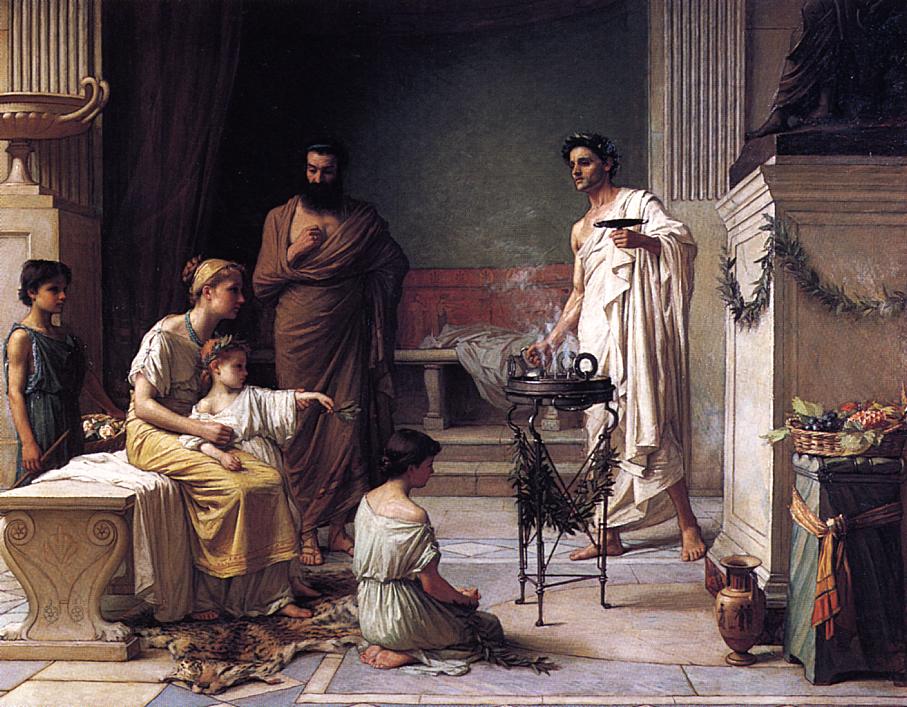
John William Waterhouse’s The Visit of a Sick Child to the Temple of Aesculapius (1877) stages a quiet crisis inside an antique sanctuary. Nothing here is theatrical in the loud sense. The drama is intimate, almost domestic, yet it is placed in a solemn public space where hope has to take the form of ritual. A pale child reclines against an adult’s protective arm, while an attendant in white prepares offerings at a small stand of sacred vessels. Around them, other figures hold themselves in attentive stillness, as if any sudden movement might disturb a fragile balance between illness and recovery.
The painting is built on a tension that Waterhouse sustains with care: the stillness of marble architecture and formal ceremony set against the vulnerability of a child’s body. The story is legible at a glance, but it keeps opening outward. Is the family arriving or already waiting? Is the priest about to begin a rite, or has it just ended? Waterhouse chooses the hinge of the narrative, the breath held between plea and answer. That choice lets the viewer feel the emotional weight of uncertainty without needing any overt gesture or melodramatic expression.
The setting as a sanctuary of medicine and mercy
Aesculapius, more commonly known by the Greek name Asclepius, belongs to the sphere of healing, not conquest. That matters for how the space reads. This is not a temple of triumph; it is a place where fear is admitted, where people come because they have run out of ordinary solutions. Waterhouse emphasizes the temple as a structured environment for vulnerability. The tall columns, the severe stone surfaces, the elevated bench, and the ordered floor pattern create a sense of law and measure. Illness, by contrast, feels messy and unpredictable. The sanctuary promises that suffering can be addressed through a shared system of meaning.
The architecture functions like a moral frame. It does not guarantee cure, but it offers containment. The family’s presence becomes a kind of petition, made credible by the very act of entering this space and bringing what they can: objects, attention, and belief. Even the coolness of stone seems purposeful, as if the building itself provides clarity and calm when the body does not. Waterhouse turns the temple into an image of disciplined compassion, a place where care is formalized so it can be endured.
Composition and the choreography of attention
Waterhouse organizes the scene so that every line returns to the child. The seated adult and the reclining child form a stable triangle on the left, while the standing attendant in white creates a counterweight on the right. Between these anchors is an open zone of floor, a quiet stage where the emotional distance between family and ritual is measured. The viewer’s eye crosses that space as the family must, from private worry toward public ceremony.
The figures are arranged in a gentle arc. The standing girl at the far left, the mother, the child, the kneeling girl in the foreground, the bearded man behind, and the officiant in white all angle their bodies and gazes toward the central action. Waterhouse avoids a crowd. The temple does not feel busy, it feels selective, as if this moment is protected from noise. That restraint intensifies the scene. When there are fewer distractions, every posture matters. A hand laid on a shoulder, a slight lean forward, a pause in the officiant’s step, these become the painting’s vocabulary of concern.
Light, shadow, and the ethics of quiet
The lighting is neither harsh nor sentimental. Waterhouse uses a soft, controlled illumination that lets the figures read clearly without turning them into spotlighted actors. The brightest whites are reserved for the child’s garment and the officiant’s drapery, linking the vulnerable body to the ritual specialist through a shared tonal language. That visual rhyme is important: it implies connection, as if the ceremony can reach across the open space between them.
Shadow gathers in the upper part of the temple and behind the figures, creating a protective dusk that keeps the focus low and human. The darkness is not threatening; it is a hush. It suggests that the world outside, with its ordinary movement, has been temporarily excluded. Within this hush, the smallest signs of care become visible. Waterhouse’s shadows also introduce the idea that healing is never fully transparent. The future outcome remains unseen, and the painting honors that uncertainty instead of pretending to resolve it.
Color and texture in a restrained classical palette
Waterhouse’s color choices favor natural, dignified tones: creamy whites, stone grays, muted greens, warm browns, and soft flesh. These hues feel appropriate to a classical setting, but they also serve an emotional purpose. The restraint avoids sensationalizing sickness. The child is not depicted with lurid emphasis; instead, the child’s pallor is conveyed through subtle contrast, made more tender by the surrounding warmth of skin and cloth.
Texture carries much of the painting’s realism and feeling. The marble surfaces look cool and smooth, the drapery looks heavy and folded, and the animal skin on the floor reads as both tactile and symbolic, introducing a note of primal life beneath civilized ceremony. On the right, baskets of offerings add organic color and irregular forms, fruits and flowers that interrupt the temple’s geometry. Waterhouse uses that contrast to suggest what the family brings into the sanctuary: not just objects, but the living world in miniature, offered up in hope of restored life.
Objects of ritual and the material language of prayer
The central stand of vessels is the painting’s ritual engine. It anchors the officiant’s action and signals that healing here involves material practice: bowls, containers, perhaps water, oil, or incense. Waterhouse paints these objects with enough specificity to make them credible but not so much that they become a still life detached from the narrative. They remain tools of transition, instruments that turn private grief into public petition.
Nearby objects extend the same language. A jug rests on the floor, ready for use, while offerings on the right appear carefully arranged, suggesting preparation, planning, and the family’s willingness to give. These items matter because they show hope expressed through labor. The family has gathered, carried, and presented what they can. In a world where illness can make people feel powerless, ritual restores agency. You cannot force a cure, but you can take steps, bring gifts, submit a plea, and participate in a process larger than yourself. Waterhouse gives that impulse a visible form.
The family group and the psychology of waiting
The seated adult figure, often read as the mother, is the emotional center of the left side. Her posture balances tenderness and vigilance. She supports the child while looking toward the officiant, as if holding two realities at once: the immediate condition of the body and the distant possibility of remedy. The child’s gesture, extending an arm outward, is especially affecting. It can be read as a reach toward help, toward ritual, or simply toward something steady to hold onto. Waterhouse keeps it ambiguous, which makes it feel true to sickness, where even simple movements can carry uncertainty.
The kneeling girl in the foreground embodies attentive stillness. She is close enough to the child to be part of the intimate circle, yet positioned so her body also faces the ritual space. She becomes a bridge between home-like care and temple ceremony. The standing girl at the far left introduces another emotional note: the observant sibling, old enough to understand fear, too young to control anything. Behind them, the bearded man’s presence adds gravity. He stands like a pillar of concern, contained but deeply invested, his stillness suggesting endurance rather than detachment.
The officiant as mediator between body and belief
The figure in white, crowned with a wreath, carries the authority of the sacred. Yet Waterhouse does not present him as severe. His stance is poised rather than domineering, and his bare feet on the stone floor emphasize humility and physical presence. He is not a distant magician; he is a practitioner within a tradition. The whiteness of his drapery echoes the child’s garment, creating a visual kinship that implies responsibility. If the child is the emblem of vulnerability, the officiant is the emblem of structured care.
Waterhouse’s real achievement is to make the officiant’s action feel imminent. He is caught mid-step, hand near the vessels, as if the rite is about to begin. That suspended moment heightens tension without requiring spectacle. The painting becomes a meditation on mediation itself: how communities build roles and rituals to face suffering. In that sense, the officiant represents not only ancient religion but also the broader human need to translate fear into a form that can be managed, shared, and possibly relieved.
Classical antiquity through a Victorian imagination
Painted in 1877, this scene reflects a Victorian fascination with antiquity that was never purely archaeological. Waterhouse uses the classical world as a moral and emotional stage, a place where contemporary feelings can be explored at a slight remove. The antique setting offers a language of marble, drapery, and ritual that feels elevated, but the theme is universal and immediate: a sick child, anxious family members, and the fragile hope invested in care.
This is also an early Waterhouse, before the later dominance of mythic heroines and romantic tragedies that many viewers associate with his name. Here, the emphasis is on civic and spiritual structure rather than personal enchantment. The temple is a public institution, and the family’s vulnerability is framed as something society must recognize. The painting quietly argues that compassion belongs not only in the home but also in communal spaces built for healing, whether those spaces are temples, hospitals, or any place where people gather to seek relief.
Meaning and symbolism: healing as a human contract
At its deepest level, the painting is about what people do when they cannot fix something alone. The child’s illness becomes a test of relationships: between parent and child, between family and community, between the material world of offerings and the intangible world of hope. Waterhouse does not mock belief, nor does he portray it as simple. He presents it as an adaptive human response, a way of turning helplessness into action and fear into ceremony.
The contrast between the cold permanence of stone and the fragile warmth of flesh suggests another theme: the body is temporary, but care is a tradition. Even if one child cannot be saved, the impulse to seek healing persists, carried forward by institutions and stories. The offerings, the wreath, the vessels, and the formal setting all imply continuity, a shared agreement across generations that suffering deserves attention. The painting’s calm is not indifference. It is the calm of a vow: we will do what we can, in the best way we know how, and we will do it together.
Why the painting still resonates
Modern viewers may approach the temple of Aesculapius with historical curiosity, but the emotional core needs no translation. The scene captures a familiar experience: waiting while someone else prepares help, watching procedures unfold, reading meaning into small gestures, and enduring the gap between fear and outcome. Waterhouse’s decision to hold the moment before resolution keeps the painting alive. It does not close the story; it invites the viewer to inhabit it.
The painting also resonates because it honors caregiving without romanticizing pain. The family is dignified, but not idealized into decorative figures. Their concern is palpable, their stillness earned. Waterhouse’s classicism, often associated with beauty and order, becomes a vehicle for empathy. The result is a work that feels both composed and compassionate, reminding us that the search for healing has always been part of human culture, whether expressed through ancient ritual or modern medicine.