Image source: wikiart.org
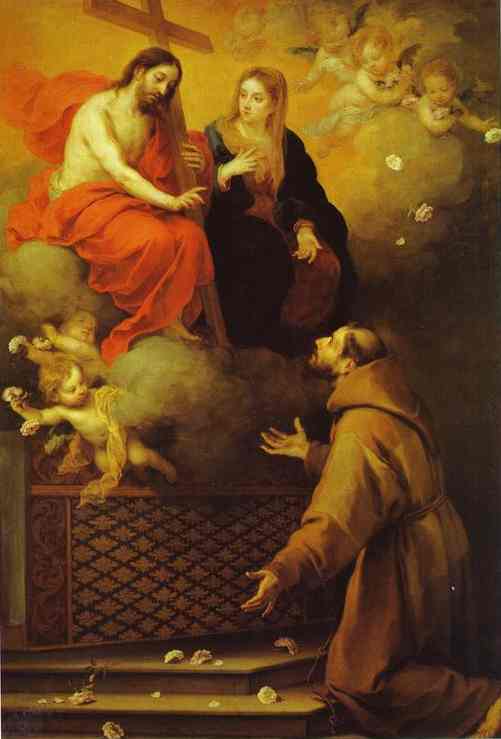
The Vision to St. Francis at Porziuncola by Bartolome Esteban Murillo
Bartolome Esteban Murillo’s painting “The Vision to St. Francis at Porziuncola,” created in 1667, is a luminous expression of Baroque spirituality rooted in tenderness rather than terror. In this work, Murillo shows St Francis of Assisi kneeling before an apparition of Christ and the Virgin Mary, surrounded by clouds and angels. The painting brings together the drama of a heavenly vision with the warmth and intimacy that define Murillo’s religious imagery.
Although it is a large and imposing altarpiece, everything about the composition is designed to draw the viewer into a personal encounter with the divine. The saint kneels at the lower right, his body angled toward the heavenly group above. Christ and Mary sit on a bank of golden clouds, like a celestial throne, while putti and cherubs dart around them, scattering white roses that cascade down toward the saint. The effect is theatrical, but also deeply human. Murillo turns a theological event into a scene of emotional recognition and mutual love.
The Story of the Vision at Porziuncola
The subject of this painting comes from a famous episode in the life of St Francis. While praying in the small chapel of the Porziuncola near Assisi, Francis is said to have received a vision of Christ and the Virgin. In that vision, he asked for a special grace: that all who visited the chapel in a spirit of repentance would receive a plenary indulgence. The request was granted, and the Feast of Our Lady of the Angels of the Porziuncola became a major celebration in Franciscan devotion.
Murillo’s painting captures the climactic moment of this legend. Francis is shown in the act of supplication, his hands open and his face lifted to the heavenly court. Christ, seated on a pedestal of clouds and draped in a vibrant red robe, leans gently toward the saint. The Virgin Mary, by his side, listens with serene attention. Above them floats the cross, a reminder that the indulgence requested by Francis is grounded in the sacrifice of Christ.
Rather than depicting the pope, documents, or crowds of pilgrims, Murillo focuses on the interior moment of spiritual encounter. The painting is not a literal historical illustration. It is a dramatic visualization of grace descending from heaven to earth, mediated through the humble figure of Francis.
Composition and Visual Structure
The composition follows a diagonal movement from the lower right corner, where St Francis kneels, up to the upper left where Christ is seated. This diagonal creates a powerful sense of connection between earth and heaven. Francis is close to the viewer, filmed in warm brown and ochre tones. Christ and the Virgin, by contrast, are enveloped in a haze of golden light that sets them apart from the dark chapel interior.
Murillo divides the space into two zones. At the bottom are solid architectural elements: a simple altar or step, and the figure of the saint in his coarse brown habit. At the top, clouds dissolve the boundaries of space, merging with the glowing atmosphere of the vision. Putti peek out of the clouds, some holding roses, others pushing aside the mist so that the central figures can be seen.
Although there is plenty of movement among the flying angels, the central triangle formed by Christ, Mary, and Francis gives the composition stability. Christ’s muscular torso and red drapery supply a strong vertical presence, answered by Mary’s darker robe and the diagonal line of the cross. Francis’s kneeling figure completes the triangular structure, his raised hands echoing the gestures of the celestial figures.
Murillo’s mastery of rhythm is evident in the way he staggers the cherubs and clouds. The eye travels in a gentle spiral, from Francis’s upturned face to the hand of Christ, across to Mary, then back down through the swirl of putti to the scattered roses at the base of the painting. This visual pathway mirrors the flow of grace as it descends from heaven to the kneeling saint.
The Human Presence of St Francis
Murillo’s St Francis is not a distant icon but a profoundly human figure. He is dressed in the simple brown habit of the Franciscans, tied with a rope. Bare feet, visible under the hem of his robe, press against the cold stone floor. The folds of the fabric are painted with thick, almost sculptural brushwork, emphasizing the solidity of his body and the weight of his life of poverty.
The saint’s expression is one of awe and trust rather than fear. His head is tilted slightly back, his eyes fixed on Christ. His mouth opens as if in mid prayer. One hand rests on his chest, the other reaches outward in a mixture of pleading and gratitude. Murillo does not show all the famous stigmata or the severity of Francis’s asceticism. Instead, he emphasizes the saint’s emotional openness.
This focus on gentleness is characteristic of Murillo. In many of his works, saints are portrayed almost as ordinary people visited by grace. Francis could be any humble believer who opens his heart in prayer. This approach makes the painting especially appealing to viewers seeking comfort and closeness rather than distant awe.
Christ and the Virgin as a Heavenly Court
Above Francis, Christ and the Virgin appear as the core of a heavenly court. Christ is partially draped in red, his upper body exposed in classical fashion. His gesture is both authoritative and tender. With one hand he points toward Francis or perhaps toward his own heart, indicating that the grace requested is granted through his passion. With the other hand he balances himself on the bank of clouds, anchoring the composition.
Mary, seated slightly behind Christ, wears a dark robe and a red dress that echo the colors of her son yet remain more subdued. She looks at Francis with a quiet, contemplative gaze. Her hands are folded, one resting on her chest, reinforcing her role as intercessor. The interplay of their expressions suggests a silent dialogue: Christ acts as judge and generous giver, Mary as advocate and compassionate mother.
Around them, a host of angels contributes to the celebratory mood. Two cherubs on the left hold a basket or bouquet of white roses, while others hover on the right, half hidden by the clouds. The roses tumble down toward Francis, visualizing the spiritual “flowers” of grace that fall from heaven upon the faithful.
Light, Color, and Baroque Drama
One of the most striking aspects of this painting is its use of light. The background of the chapel is dark, almost impenetrable, suggesting the ordinary world of stone, wood, and shadow. From the upper left, a golden radiance breaks through, spreading across the clouds and figures. This light has no visible source, yet it clearly emanates from the divine presence.
The glow around Christ and Mary forms a kind of halo, merging with the luminous aureoles of the cherubs. It spills down onto Francis, illuminating his face and hands while leaving much of his habit in shadow. The effect is a classic Baroque contrast between chiaroscuro and soft, diffused radiance. Murillo uses it to underline the transformative power of the vision.
Color plays a central role in reinforcing this drama. Red is the dominant hue in the upper portion of the painting. Christ’s cloak and Mary’s undergarment provide a rich, warm focal point. Red is traditionally associated with love, sacrifice, and the blood of Christ. In Murillo’s hands it also becomes a symbol of generous, overflowing life.
In contrast, Francis’s brown habit and the muted tones of the altar emphasize humility and earthly existence. White is used sparingly in the roses, in small accents on the garments, and in the glowing clouds, symbolizing purity and grace.
The overall palette is warm, even though there are areas of deep shadow. Murillo avoids cold bluish tones. Instead he favors golden browns, soft creams, and warm reds. This choice supports the painting’s emotional tone. The vision is not harsh or frightening. It is a radiant assurance of divine kindness.
Theological Symbolism in the Painting
“The Vision to St. Francis at Porziuncola” is rich in symbolic meaning. The cross behind Christ reminds viewers that all indulgences, all mercy, flow from the sacrifice of Calvary. The roses carried by the cherubs represent not only grace, but also the joy of heaven responding to Francis’s request. In some traditions, white roses stand for purity, while the shower of petals can be read as a sign of heavenly approval.
St Francis kneels at what looks like an altar or pedestal. This suggests that the vision occurs during prayer or worship, underscoring the importance of liturgical devotion in the granting of spiritual favors. The steps leading up to the altar hint at the spiritual ascent that Francis embodies, climbing from the lowliness of human poverty to the heights of heavenly communion.
The clouds that envelop Christ and Mary symbolize the mystery of divine presence. They veil and reveal at the same time. Baroque artists often used clouds to indicate that the heavenly realm cannot be fully grasped by human senses. Murillo’s clouds are soft and golden, more like a gentle mist than a storm. They express the nearness of God rather than his distance.
Even the arrangement of the figures carries symbolic weight. Christ is visually above Francis, signifying his authority, yet his body leans downward. Mary’s gaze, directed toward the saint, completes a cycle of attention that begins in heaven and returns to earth. The composition suggests that the prayers of the humble rise up, are received by Christ and Mary, and return as a shower of grace.
Murillo’s Style and the Franciscan Spirit
Murillo was working in Seville, a city where Franciscan spirituality had a strong presence. Many of his commissions came from Franciscan convents and churches. The order emphasized humility, charity, and a tender love for Christ and the Virgin. These values resonate deeply with Murillo’s natural inclination toward gentle, emotionally accessible images.
In this painting, his style is recognizable in the softness of the faces, the delicate modeling of hands and feet, and the slightly idealized beauty of the figures. Murillo does not aim for strict realism. Instead, he presents an elevated version of reality in which holiness and kindness are visibly inscribed in the features of the characters.
The angels, especially the playful cherubs, are painted with the same combination of sweetness and spontaneity that appears in Murillo’s many images of children. Their plump bodies and lively movements add a human warmth to the vision. They also signal that the joy of heaven is not remote, but intimately connected with the innocence and affection of everyday life.
Murillo’s handling of drapery deserves special attention. The swirling robes of Christ and Francis contribute to the painting’s dynamic energy. The folds are emphasized with strong highlights and deep shadows, giving them a sculptural quality. This drapery is not just decorative. It visually expresses the power of the vision, as if the very garments are moved by a spiritual wind.
Emotional Impact and Devotional Function
Originally, a painting like this would have been placed in a church setting, where viewers saw it while participating in liturgy or private prayer. Murillo’s composition is carefully designed to support that function. The kneeling figure of Francis offers a model for the believer. His attitude of openness, trust, and reverence invites viewers to adopt the same posture in their hearts.
Because Francis is shown so close to us, and because his features are rendered with empathy, it is easy to imagine oneself in his place. The viewer is encouraged to picture grace descending personally, as if Christ and Mary look down not only on Francis but on every person who stands before the painting.
The image also reinforces the connection between heavenly mercy and the sacramental life of the Church. The indulgence granted at Porziuncola was associated with confession, communion, and pilgrimage. By presenting this event in such a radiant and moving way, Murillo underscores the belief that God’s forgiveness is generous and accessible.
Even today, the painting maintains its emotional power. The contrast between the earthly struggle of Francis and the gentle compassion of the heavenly figures speaks across centuries. Viewers are confronted not with fear, but with a sense of being seen and loved from above.
Conclusion
“The Vision to St. Francis at Porziuncola” stands among Murillo’s most compelling religious works. It brings together the narrative richness of Franciscan legend, the theological depth of Baroque Catholicism, and the artist’s unique capacity for tenderness. Through carefully orchestrated light, expressive gestures, and symbolic detail, Murillo transforms a doctrinal story about indulgences into a meditation on grace, humility, and divine generosity.
The painting invites contemplation of a God who bends down toward the poor and the penitent, and of a saint whose greatest desire is not his own glory, but mercy for others. In doing so, it offers viewers both a lesson in devotion and a promise of consolation, wrapped in the golden light of Murillo’s incomparable art.