Image source: wikiart.org
Introduction to “The Vision of Fray Lauterio” by Bartolomé Esteban Murillo
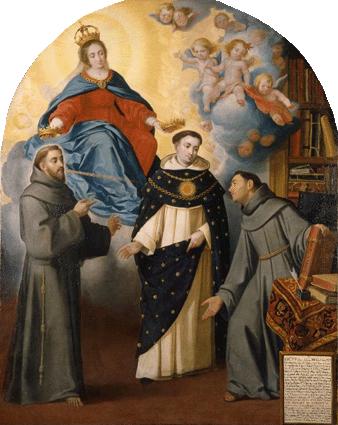
“The Vision of Fray Lauterio,” painted in 1640 by Bartolomé Esteban Murillo, is a rich and engaging example of Spanish Baroque devotion. In a single compact scene Murillo unites heaven and earth, scholarship and humility, and the quiet drama of a mystical vision. At the top of the painting the Virgin Mary appears enthroned on clouds, crowned and radiant, surrounded by playful putti. Below her stand three friars, absorbed in a spiritual exchange that centers on a humble Franciscan known as Fray Lauterio.
The work brings together an almost theatrical staging, warm color harmonies, and a clear narrative that would have been immediately understood by seventeenth century viewers. Murillo was still early in his career when he painted this canvas, yet it already shows his characteristic tenderness of expression and his ability to translate complex theology into accessible, human imagery.
The Legend Behind the Vision
The story that inspires the painting comes from Franciscan tradition. Fray Lauterio was a simple lay brother who, despite his devotion, found it difficult to understand the dense theological writings that shaped the intellectual life of the Church. He struggled in particular with the works of Saint Thomas Aquinas, the Dominican theologian whose Summa had become a central reference for Catholic doctrine.
Feeling discouraged, Lauterio turned to Saint Francis of Assisi in prayer. He asked the founder of his order to help him grasp the mysteries that seemed locked behind scholarly language. According to the legend, Francis interceded with the Virgin Mary, who in turn asked Saint Thomas himself to assist the humble friar. The result was a mystical illumination that allowed Lauterio to understand truths that had previously seemed inaccessible.
Murillo compresses this chain of intercession into a single image. The Virgin presides over the scene in the heavens, while Thomas in his Dominican habit appears below as a luminous intermediary between Mary and the kneeling Franciscan. The painting therefore dramatizes an invisible spiritual event, showing the moment when divine help reaches a struggling believer through the communion of saints.
Composition and Spatial Drama
Murillo organizes the painting with a clear vertical axis that links the earthly friars at the bottom to the Virgin and angels above. The upper half of the canvas is filled with a glowing cloud that supports Mary and the cherubs. The lower half is occupied by the three friars and a study corner with books and lectern.
This vertical structure creates a strong sense of upward movement. The gaze of the friars directs the viewer’s eyes toward Mary, while the soft golden light around her pours downward, visually connecting heaven and earth. The composition is slightly arched at the top, echoing the curve of the cloud and enhancing the sense that the viewer is looking into an opening in the sky.
Murillo also builds a subtle triangle among the three friars. Saint Thomas stands in the center, frontal and majestic, while the two Franciscans flank him on either side. Their bodies and gestures direct attention toward Thomas, who serves as the key to Lauterio’s understanding. The books and lectern at the right form another diagonal that leads back into the space, suggesting the world of study from which Lauterio had felt excluded and to which he is now being introduced through grace.
The Heavenly Vision of the Virgin
At the top of the painting, the Virgin Mary appears enthroned on clouds, crowned and robed in deep red and blue. Her arms open in a gesture of gentle authority. She serves as the ultimate source of the vision and the guarantor of its truth. Murillo depicts her with a serene, slightly distant expression, emphasizing her role as Queen of Heaven and loving intercessor rather than as sorrowful mother.
Around her cluster small angels and putti, their soft bodies and playful movements adding a note of joy to the scene. These cherubs seem to swirl in the golden atmosphere, their presence suggesting that heaven is alive with praise and delight. The cloud itself glows with a warm light that contrasts with the more subdued tones of the earthly realm below.
This upper register is painted with looser, more luminous brushwork, creating the impression of an immaterial, spiritual space. The bright halo-like glow around Mary functions almost like a sun within the canvas, radiating light that touches Saint Thomas and then, by extension, Fray Lauterio. In visual terms the Virgin is the source of illumination, both literal and intellectual.
Saint Thomas Aquinas as Theological Mediator
At the center of the earthly group stands Saint Thomas Aquinas, easily recognizable by his Dominican habit and the star or sunburst that adorns his chest. Murillo clothes him in a white tunic and black mantle sprinkled with golden stars, a detail that underscores his role as a shining light of doctrine. His head is encircled by a subtle halo, but more striking is the calm authority of his expression.
Thomas does not look upward like the Franciscans. Instead, he seems already aware of the heavenly communication, standing as one who belongs both to the world of scholarship and to the communion of saints. His right hand may gesture toward a book or toward Lauterio, indicating his willingness to share the fruits of his learning. In Murillo’s interpretation, Thomas is not a distant intellectual but a gracious teacher summoned by the Virgin to aid a struggling brother.
The placement of Thomas between Mary and Lauterio carries strong symbolic weight. It affirms the importance of scholastic theology within Catholicism while grounding it in humility and charity. Knowledge is not presented as an individual achievement but as a gift offered for the benefit of others.
Fray Lauterio and the Franciscan Companions
On the left and right sides of Thomas stand two Franciscans in brown habits. The figure on the left is often interpreted as Saint Francis of Assisi himself, founder of the order to which Lauterio belongs. He looks toward Thomas with a gesture that seems to introduce or commend Lauterio, as if saying, “Here is the brother who needs your help.” His posture is simple and direct, reflecting the Franciscan emphasis on poverty and humility.
On the right, near the lectern, kneels or bends Fray Lauterio. His body leans forward, hand extended in a gesture that combines pleading and openness. Unlike Thomas, he does not carry a halo, emphasizing that he is still a pilgrim on earth rather than canonized saint. His gaze is fixed on Thomas with a mixture of hope and reverence. Murillo captures in his face the intensity of someone who longs to learn and fears his own limitations.
The positioning of Lauterio next to the books is significant. A large lectern supports an imposing codex, symbol of the heavy intellectual tradition that he finds daunting. Another volume and a scroll lie nearby. They represent the learning he seeks to grasp. By placing Lauterio between these books and the sainted theologian, Murillo visually expresses the bridge that is being built for him. Grace and human teaching will together open for him the world of sacred doctrine.
Color, Light, and Symbolic Contrast
Murillo’s color choices reinforce the spiritual narrative. The heavenly region is dominated by clear blues, soft pinks, and glowing golds. Mary’s red gown and blue mantle echo traditional Marian colors that signify love and purity. The cherubs are bathed in rosy light, and the cloud beneath them seems to be lit from within.
In contrast, the lower portion of the painting uses more earthy tones. The brown and gray habits of the Franciscans ground the scene in humility and poverty. Saint Thomas’s dark blue mantle dotted with gold stars forms a bridge between earth tones and the luminous sky, visually linking doctrinal wisdom with heavenly truth. The bookshelf at the far right, filled with warm brown volumes, reinforces this connection by showing how truth is also stored and transmitted through books.
Light plays a unifying role. A warm radiance descends from the Virgin and spreads over Thomas’s face and clothing, then touches the Franciscans. This downward flow of light suggests the path of grace. Knowledge and insight are not generated purely from below through human effort. They are gifts that descend from above and then pass through human instruments like Thomas to reach receptive hearts like Lauterio’s.
Books, Lectern, and the World of Theology
The cluster of books and the lectern on the right side of the canvas form an important secondary focus. Murillo paints them with solid realism, reminding viewers that theology is not only a mystical experience but also a disciplined study of texts. The prominent open book suggests the works of Saint Thomas that Lauterio struggled to understand. Its large size and elevated position highlight the weight and importance of theological tradition.
There is also a parchment or inscription attached to the side of the lectern, perhaps summarizing the subject of the text or hinting at a specific passage. This detail underscores the written word as a vehicle for divine truth. At the same time, the presence of Thomas himself shows that books alone are not enough. The friar needs a living teacher and the inner light granted by God through the saints.
The arrangement of these objects speaks to the Baroque Catholic ideal of combining faith and reason. Study is honored, not dismissed, but it is framed within a larger spiritual context. The lectern becomes a kind of altar of learning, and Murillo’s painting implies that genuine theological understanding is itself a form of worship.
Murillo’s Baroque Style and Counter Reformation Spirit
Painted in 1640, “The Vision of Fray Lauterio” belongs to the early Baroque period in Spain, a time marked by strong Catholic renewal and intense emphasis on the power of images for instruction and devotion. Murillo’s style in this work blends clarity of narrative with gentle emotional appeal, qualities that would later become hallmarks of his mature religious paintings.
The figures are solid and individualized, yet there is no excessive drama. Murillo avoids exaggerated gestures or harsh contrasts, preferring a calm, balanced composition. This restraint suits the subject. The miracle depicted is intellectual and spiritual rather than physically spectacular. The painting aims to reassure and encourage rather than shock.
At the same time, Baroque elements are clearly present. The upward sweep of the composition, the luminous cloud, and the sense of a revealed heavenly space breaking into the everyday world all reflect Baroque interest in bridging visible and invisible realms. Murillo uses these devices not to impress for their own sake, but to make the theological message vivid and accessible for the faithful.
Emotional Tone and Devotional Purpose
The emotional tone of the painting is one of gentle encouragement. Fray Lauterio is not shown crushed by his difficulty, but open to help. Saint Francis appears kind and supportive. Saint Thomas is dignified yet approachable. The Virgin watches over them with serene benevolence. Even the cherubs, though playful, contribute to a mood of joy rather than distraction.
For a seventeenth century viewer, this image would have offered comfort in the face of spiritual or intellectual struggles. Many believers, whether monks, priests, or lay people, might have felt intimidated by complex theology. Murillo’s scene reassures them that God provides assistance through Mary and the saints, and that humility attracts divine light. The painting teaches that sincere desire to understand faith is already an opening to grace.
Placed in a convent or church, “The Vision of Fray Lauterio” would have functioned as a visual sermon. It invites viewers to imitate Lauterio’s trust, to seek the intercession of Mary and the saints, and to value theological study as a path toward deeper love of God. The tranquil yet uplifting atmosphere of the work supports quiet contemplation, allowing the story to unfold slowly in the viewer’s imagination.
Contemporary Relevance and Concluding Reflections
Today “The Vision of Fray Lauterio” continues to speak to concerns that transcend its original monastic setting. Many people wrestle with complex ideas, spiritual doubts, or the feeling that faith is reserved for the learned. Murillo’s painting offers an alternative vision in which intellectual light is accessible to the humble, and scholarship serves charity rather than pride.
The painting also illustrates the power of community in learning. Lauterio does not face his difficulty alone. He is surrounded by saints, past and present, who support him. In a broader sense, the work reminds viewers that understanding grows within a tradition and a living community, not in isolation.
Above all, Murillo’s canvas remains visually engaging. The warm colors, the carefully balanced composition, and the expressive faces draw viewers in. Whether one approaches it as a believer, a student of Baroque art, or simply a lover of narrative painting, “The Vision of Fray Lauterio” offers a rich experience. It embodies the Baroque ideal of art that instructs, moves the heart, and delights the eye, all at the same time.