Image source: wikiart.org
Introduction
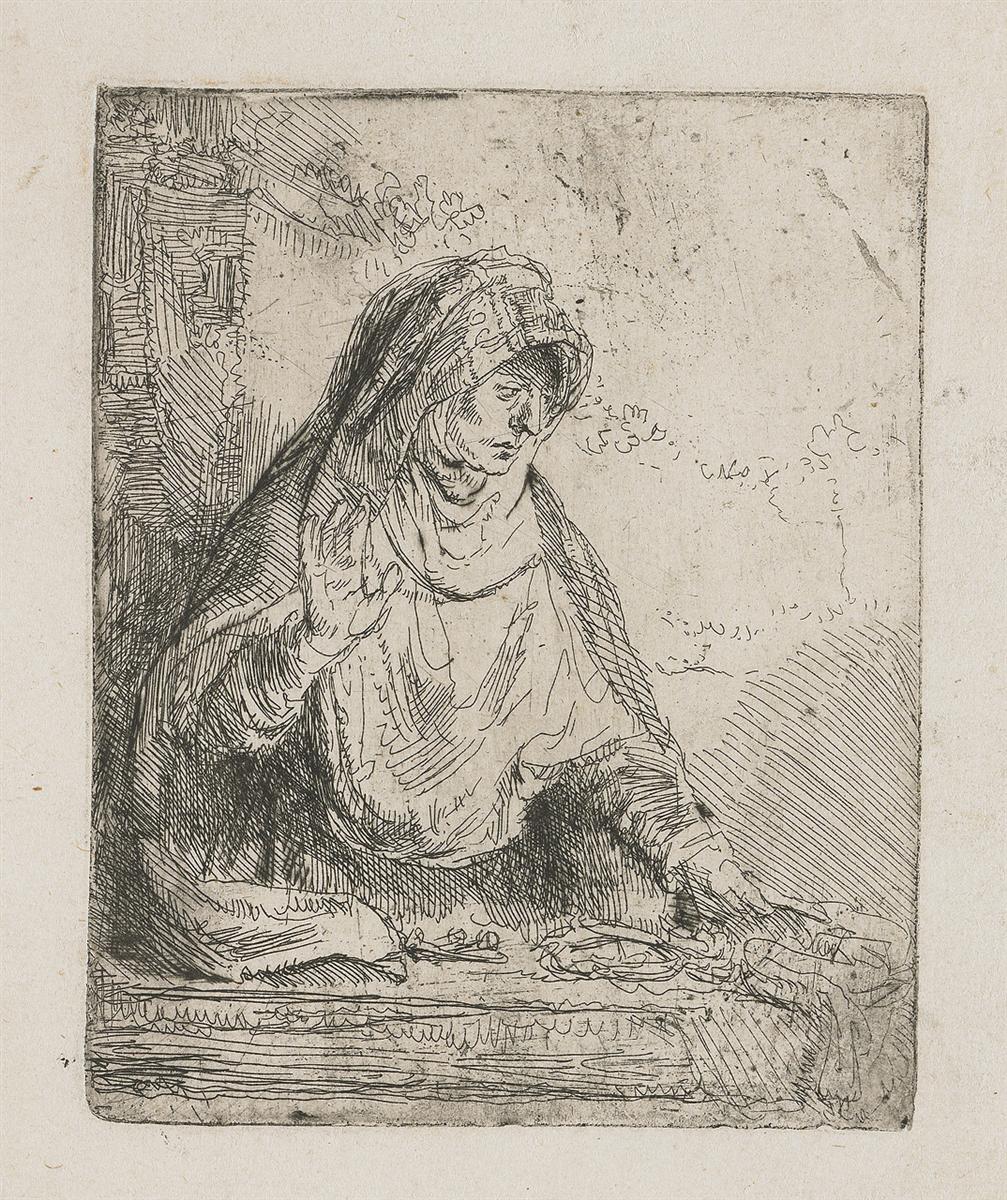
Rembrandt’s “The Virgin with the Instruments of the Passion” (1652) is a compact etching that turns a tabletop of small objects into the axis of salvation history. The Virgin Mary leans forward out of shadow, her mantle falling in sculptural folds, one hand lifted in a quiet, teaching gesture while the other rests near a scatter of tools—the nails, the scourge, the pincers, the crown of thorns—collectively known as the Arma Christi, the instruments of Christ’s Passion. The print is modest in scale, intimate in tone, and astonishingly clear in purpose: it shows a mother contemplating the implements that will wound her son and, in contemplating them, teaching the viewer how to face sorrow without spectacle.
An Unusual Marian Image in a Dutch Context
For a Dutch artist working in a largely Reformed culture, Rembrandt’s Marian imagery is rare and therefore striking. He avoids the doctrinal triumphalism that often surrounds images of Mary and chooses instead a human register: a woman absorbed, thoughtful, and given to gestures that belong to domestic life as much as to devotion. The subject here sits somewhere between a Mater Dolorosa (the Mother of Sorrows) and a devotional half-figure presenting the Arma Christi for meditation. It is not polemic; it is a practical aid to contemplation, a sheet that asks to be held close like a small book of hours.
Composition and the Architecture of Attention
The plate’s geometry is simple and effective. The Virgin’s figure forms a triangular mass anchored by the wide sleeve at left, the bent arm at right, and the mantle’s peak over her head. The triangle tilts gently toward the foreground, so the viewer feels addressed but not confronted. The upper left corner is dense with hatching that reads as masonry or timber framing—a domestic wall—while the upper right is left open, breathing space around the lifted hand. That asymmetry funnels attention down toward the parapet-like edge where the Passion instruments lie. The compositional message is unambiguous: a thinking person, a clear surface, and the objects that will carry the weight of meditation.
Hand, Gesture, and the Poetics of Teaching
Rembrandt makes gesture a language. The Virgin’s raised right hand is not theatrical; it is the kind of sign one makes when counting, blessing, or clarifying a thought. The fingers are separated just enough to articulate. This is a teaching hand, but the lesson is not spoken; it is pointed toward the things on the ledge. The left hand (partly under the cloak) anchors her body near the objects, affirming their reality. No angels frame her, no rays announce doctrine—only hands that organize attention. In Rembrandt’s theology of looking, instruction begins with how one points and how one touches.
The Instruments on the Ledge
The ledge holds an understated inventory: short cylinders for nails, a looped cord for the scourge, a small crown suggested with prickly arcs, and iron tools shaped by quick strokes for hammer and pincers. None is drawn with decorative insistence. Rembrandt wants recognizability, not spectacle. The scale is domestic, almost disarmingly so; the implements could be household tools casually arranged. That is the point. The Passion is not distant pageantry but a drama enacted with things like those one might find in a workshop drawer. By ordinary scale and honest depiction, he brings meditation into the realm of a viewer’s daily objects.
Face, Veil, and Interior Weather
Mary’s face is modeled with a handful of subtle hatchings that gather around eye, cheek, and mouth. She looks downward at an angle that compresses sadness and comprehension into a single expression. The veil draws a soft architecture around that expression: heavy, sheltering, its folds described by quick, parallel strokes that flex with the imagined weight of cloth. No halo rings the head; sanctity is communicated by attention, not by ornament. The interior weather is quiet—less a storm of grief than the pressure that precedes it, the sober mindfulness of what the objects imply.
Etching, Drypoint, and the Tactility of Thought
Technically the sheet is an object lesson in how Rembrandt combines etched line with drypoint warmth. The denser cross-hatching at left creates the cool shadow of a wall; the more widely spaced parallel lines at right turn into breathable light. In the folds of the mantle he varies the pressure of the needle, allowing some lines to dig deeply and others to skate lightly, so the cloth feels lived-in rather than diagrammed. Drypoint burr softens several contours—along the veil and near the hand—giving them a felt-like aura that reads as proximity, the way edges look when a viewer is close. This tactility, a kind of visual “hand-feel,” is crucial to the print’s psychological effect: the holy becomes touchable without becoming commonplace.
Light, Paper, and the Meaning of Space
Rembrandt leaves the top right quadrant largely unworked, letting the paper serve as atmosphere. That light is not empty; it is the pause in which thought happens. It also separates the Virgin from her background, placing her forward in the viewer’s space. The brightest passages are the high planes of her cheek and the brighter facets of the ledge. Light concentrates where attention concentrates: the face that contemplates and the things contemplated. The rest is deliberately subdued.
From Narrative to Contemplation
Many Passion images narrate: soldiers, Calvary, ladders, crosses. Rembrandt refuses narrative in favor of contemplation. He offers the means of the story rather than the story itself and situates them within reach of a single person’s thought. This change of register invites the viewer’s participation; instead of watching events unfold, we are asked to rehearse, with the Virgin, the moral weight of what these objects will do. The print therefore functions less as illustration and more as a tool for imaginative prayer.
The Edge as Threshold
The parapet-like edge at the bottom is more than a compositional device. It is a threshold—between us and the Virgin, between ordinary space and the space of meditation. Its wood grain is suggested with horizontal strokes; a nick here and there makes it tactile. The instruments lie on our side of that threshold. We do not merely observe them at a distance; we join Mary in considering them. The print gives the viewer a physical place to put the mind, the way a lectern gives the hands a place to rest.
The Virgin’s Humanity and the Refusal of Idealization
Rembrandt resists the marble smoothness of many Marian faces. Here the cheek is slightly furrowed; the mouth shifts with age and experience; the headscarf is practical. He chooses particularity over generalized beauty because particularity persuades. The viewer believes this person, and belief allows the print’s quiet theology to work. Sorrow looks like someone’s mother thinking across a table, not an abstraction in a gilded niche.
Echoes of Workshop Life
The etched setting hints at carpentry and domestic order—boards, a sill, a ledge cleared for the small arrangement. Those echoes are not accidental. They make the Passion instruments feel like they belong among the tools of a craftsman, in keeping with a Christ raised by a carpenter. Spiritual truth reaches into the workshop, and the workshop returns the favor by lending ordinary items to sacred meaning. This conversational exchange between craft and devotion is deeply Rembrandtian.
A Picture for the Hand, Not the Altar
The size and intimacy of the sheet suggest use in the hand, not display at a distance. Held close, the burr’s softness becomes legible; the light spaces open; the delicate shift of the Virgin’s mouth reads as an event. The print belongs to personal devotion—to the rhythm of morning or evening reflection when a viewer might count, with her, the instruments and allow each to place the day in truthful perspective. The portability of the object matches the portability of the practice it invites.
Comparison with Rembrandt’s Other Passion Prints
When set beside the large, complex “Hundred Guilder Print,” which surrounds Christ with crowds and multiple episodes, this 1652 etching feels almost austere. Both, however, organize light as attention: illumination falls where mercy and truth are at work. The difference is scale and scope. Here Rembrandt distills the entire Passion to a tabletop and a mother’s mind. It is the same theology refracted through an intimate lens.
The Viewer’s Role and the Ethics of Looking
By placing the instruments so near and by giving the Virgin a gesture that acknowledges our presence, the print assigns the viewer a role: attentive witness rather than passive spectator. The ethics of looking, in Rembrandt’s hands, involve proximity without intrusion, sympathy without sentimentality, and participation through thought rather than through possession. The sheet does not bully emotion; it cultivates it.
Close Looking at Key Passages
The crown of thorns is only a handful of pricked arcs, yet a slight thickening where strands overlap suggests hardness. The nails are tiny cylinders with darkened tips; two lean against each other like an accidental cross. The pincers are a pair of opposing curves that meet in a small diamond of shadow—the point where pressure bites. The Virgin’s mouth is made of three marks: a short hooked line for the upper lip, a subtle shadow under it, and a notch at the corner that turns her expression from blankness into consideration. On the veil, a change in hatch direction at the brow makes the cloth break softly, catching a little light the way linen does when it bends over bone. Such tiny decisions account for the print’s credibility.
Why the Image Still Speaks
Modern viewers, regardless of creed, recognize the act the print honors: a parent learning to live with the knowledge that the world will wound a beloved child. The instruments could stand for any set of inevitable difficulties; the Virgin’s gesture models how to hold them in mind without surrendering to despair. The sheet’s restraint—its refusal of melodrama, its dependence on attention—feels like a contemporary ethic of care. It teaches a way of seeing that dignifies sorrow and turns it into wisdom.
Conclusion
“The Virgin with the Instruments of the Passion” is a small masterpiece of concentrated feeling. Rembrandt clears a space, sets down a few ordinary objects, and places a thinking mother beside them. With etched line and drypoint burr he shapes cloth, flesh, and wood into instruments for the viewer’s own meditation. The composition’s triangle, the open light at right, the humble ledge, the precise yet understated depiction of the Arma Christi—all serve a single end: to convert doctrine into attention. The result is a print that asks little from the eye and everything from the heart, which is exactly why it continues to work. It does not argue the Passion; it invites you to look at what will hurt and to remain present.