Image source: wikiart.org
Introduction to The Virgin of the Caves
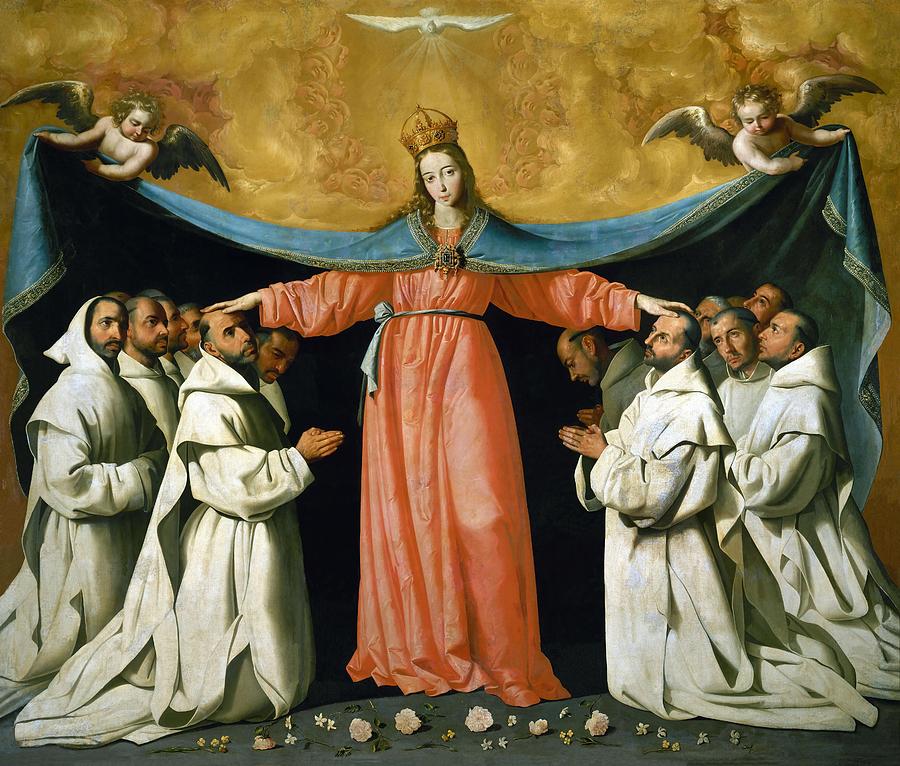
“The Virgin of the Caves” by Francisco de Zurbaran is a monumental devotional image that unites heavenly serenity with the grounded presence of kneeling monks. At the center stands the Virgin Mary, crowned and robed like a queen, stretching out her arms in a protective gesture. Her vast blue mantle is held aloft by two small angels and shelters a group of white robed monks who kneel at her sides. Above her hovers the dove of the Holy Spirit, while a golden sky filled with soft clouds provides a glowing backdrop.
This painting belongs to the long Christian tradition of the Virgin of Mercy, where Mary extends her cloak over a crowd of supplicants as a sign of intercession and protection. Zurbaran adapts that medieval theme to a Spanish Baroque context, combining intense realism, careful observation of fabric and a sober, contemplative mood. The result is a work that feels both theatrical and deeply intimate, inviting viewers to see themselves among those gathered beneath the mantle.
Historical and Religious Context
Francisco de Zurbaran worked in seventeenth century Spain, a period marked by strong Counter Reformation piety and a flourishing monastic culture. Many of his commissions came from religious orders that wanted clear, emotionally compelling images for their churches, refectories and cloisters. This painting focuses on a particular community, probably Carthusians or another contemplative order, who present themselves under the protection of the Virgin.
The title “The Virgin of the Caves” likely refers to a specific devotion connected to a hermitage or monastery associated with caves. In Spain and Portugal, Marian shrines were often linked to miraculous discoveries of statues or visions in grottoes and isolated landscapes. Zurbaran translates that idea into an indoor vision. Instead of painting an actual cave, he lets the deep golden atmosphere function as a kind of spiritual cavern, an enclosed yet luminous space where heaven bends down toward the monks.
At the same time, the subject relates closely to the iconography of the Virgin of Mercy, which was popular across Europe from the late Middle Ages onward. In those images Mary spreads a wide cloak that shelters clergy, nobles and laypeople. Zurbaran narrows the group to a single order, tailoring the motif to the identity of his patrons. By doing so, he turns a broad symbol of protection into a more intimate portrait of a particular community and its spiritual patroness.
Composition and Spatial Structure
Zurbaran constructs the scene with a strong central axis that runs from the dove of the Holy Spirit at the top of the composition down through the Virgin’s head, torso and feet to the line of scattered flowers at the bottom. This vertical alignment emphasizes her role as mediator between heaven and earth. The dove sends grace downward, Mary receives it, and the monks kneel at her feet to receive it in turn.
The Virgin’s arms stretch horizontally, creating a broad cross like shape. This cross is echoed by the line of monks on either side. They kneel in mirrored groups, their white habits forming two diagonal banks that converge toward her feet. The effect is architectural, almost like a living colonnade whose columns are human figures.
The large blue mantle that she holds open acts as a unifying canopy. Its interior forms a dark band that frames her coral robe and sets off the pale faces of the monks. On either side, small winged angels grasp the mantle at the top corners, completing the arc. The composition thus fuses vertical, horizontal and diagonal lines to create balance and stability while preserving a sense of expansiveness.
In the lower foreground, a line of flowers scattered across the ground acts as a gentle border between viewer and sacred space. These blossoms echo the floral ornaments on the Virgin’s gown and crown, tying together earthly nature and heavenly grace. The absence of a detailed architectural setting keeps the focus on the figures and on the protective gesture that defines the theme.
Light, Color and Atmosphere
The painting is suffused with warm golden light, particularly in the upper half where the clouds glow around the dove and the upper portion of the mantle. This radiant sky contrasts with the deeper shadows inside the mantle and within the folds of the monks’ habits. The result is a luminous, almost theatrical atmosphere that nonetheless feels calm rather than chaotic.
The Virgin’s standing figure is marked by a coral or soft red robe, a distinctive choice that makes her immediately visible among the white robed men. Around her shoulders drapes the large blue mantle, a color strongly associated with Marian imagery. The combination of coral and blue creates a vivid yet harmonious contrast, with the warm red suggesting love and charity and the cool blue evoking purity and heavenly protection.
The monks are dressed in white habits painted with Zurbaran’s typical mastery of drapery. Each robe catches the light differently, showing subtle variations of grey and cream. These tones act as a visual buffer between the intense colors of the Virgin and the deep shadows of the background. Their whiteness suggests simplicity, humility and contemplative purity, reinforcing the spiritual identity of the men who kneel in prayer.
The small angels at the top corners share the golden light of the clouds, with rosy skin tones and warm highlights on their wings. Their playful yet reverent poses add a touch of grace to the composition, reminding viewers that the realm of heaven is not only solemn but also filled with joy. Overall, the color palette moves from bright gold and blue at the top to softer whites and earth tones below, guiding the eye from divine radiance toward human devotion.
Characterization of the Virgin and the Monks
Zurbaran’s Virgin is regal but approachable. She wears a crown that signals her role as Queen of Heaven, yet her face remains gentle and youthful. Her expression is slightly serious, with a calm gaze that seems to look slightly beyond the viewer. The tilt of her head softens the strict symmetry of her pose, making her appear more human and empathetic.
Her hands rest on the heads of two kneeling monks, a gesture that conveys both blessing and protection. This touch humanizes her, showing a motherly intimacy rather than a distant majesty. At the same time, her outstretched arms, held at shoulder height, recall liturgical poses and emphasize her role as intercessor.
The monks themselves are carefully individualized. While they share similar habits, each face shows distinct features and expressions. Some look upward toward Mary, others close their eyes in prayer, and a few glance sideways at their companions. This variety suggests a community united in devotion but composed of unique persons with their own spiritual experiences.
The kneeling posture of the monks, with hands clasped or held in supplication, places them in a position of humility. They do not stand beside the Virgin as equals. Instead they gather at her feet, acknowledging their dependence on her mercy. The contrast between their bowed heads and her upright figure strengthens the vertical dynamic of intercession from heaven to earth.
Symbolism of Mantle, Dove and Flowers
The large mantle is the central symbol of the painting. In the Virgin of Mercy tradition, the mantle represents spiritual shelter. Those who step under it are protected from spiritual dangers and receive the benefits of Mary’s intercession. Zurbaran renders the inside of the mantle in a deep, almost nocturnal blue, suggesting a quiet sanctuary inside the broader luminous sky. This inner darkness is not threatening but restful, a space where prayer can unfold in safety.
Above Mary’s head the dove of the Holy Spirit appears within a burst of light. In Christian theology the Spirit is the source of guidance and comfort. Here the dove reinforces the idea that Mary’s protective power is not her own but comes from God. The vertical line from dove to crown to hands to kneeling monks visually maps the flow of divine grace.
At the bottom of the composition a row of small flowers stretches across the ground. These blossoms serve multiple symbolic functions. They recall the gardens of paradise and the beauty of creation. They may also allude to the virtues of the monks, each flower representing a quality cultivated under Mary’s guidance. Placed between the sacred group and the viewer, the flowers act as a gentle invitation to step forward in contemplation.
The crown on Mary’s head and the ornate clasp at her chest strengthen the theme of queenship. Yet the way her mantle opens like a tent also evokes the idea of the Church as a sheltering presence. In this sense, Mary embodies not only personal maternal care but the broader institutional protection of the Church. Zurbaran compresses complex theological ideas into a simple, legible set of symbols that can be read even by viewers without formal education.
Zurbaran’s Technique and Baroque Spirituality
Zurbaran was known in his time for his austere realism, especially in depictions of monks and still lifes. In “The Virgin of the Caves,” he applies that realism to a more elaborate composition without losing clarity. The folds of cloth, the faces and the small details such as the hem of the habits or the feathery wings of the angels are rendered with precise observation.
His use of chiaroscuro is prominent. Strong contrasts between illuminated areas and deep shadow create a sculptural sense of volume, making the figures appear tangible. Unlike Caravaggio, whose lighting often produces dramatic extremes and restless energy, Zurbaran’s light is steadier and more contemplative. It seems to originate from an unseen divine source rather than from a theatrical spotlight.
The painting also reflects the devotional aims of Spanish Baroque art. Images were to act as aids for meditation, helping believers imagine themselves in the presence of sacred figures. Zurbaran achieves this by placing the viewer at the same ground level as the kneeling monks. It is easy to imagine stepping up to join them under the protective mantle. The direct gaze of some of the monks and the open, front facing posture of Mary strengthen this sense of inclusion.
At the same time, the composition retains a hierarchical structure. Heaven is above, the Virgin stands in the middle, and the monks kneel below. This hierarchy would have felt familiar and reassuring in a culture that emphasized order and obedience within both church and society. The painting thus supports spiritual reflection while gently reinforcing the structures of the monastic world for which it was created.
Emotional Impact and Contemporary Relevance
The emotional tone of “The Virgin of the Caves” is one of serene security. Although the painting is large and visually rich, it does not feel overwhelming. The balanced composition, the stable verticals and the harmonious colors all work together to create a sense of calm. Viewers may feel drawn into an atmosphere of quiet prayer, much like the monks at Mary’s feet.
For modern audiences, the image can speak to the desire for refuge in times of uncertainty. The wide mantle opening like a sheltering wing suggests a space of acceptance and care. Whether or not viewers share the specific religious beliefs behind the image, the basic idea of a compassionate figure encompassing a vulnerable community remains powerful.
The painting is also an interesting example of how art can negotiate between individuality and collective identity. Each monk retains a distinct face and posture, yet together they form a unified group defined by common devotion. Mary stands at the center as a unifying presence. In this way, Zurbaran offers a visual meditation on community, protection and the role of compassion in holding people together.
Conclusion
Francisco de Zurbaran’s “The Virgin of the Caves” is a masterful synthesis of Baroque realism, theological symbolism and emotional depth. At its core is the simple but resonant gesture of the Virgin spreading her mantle and blessing the kneeling monks. Around that gesture Zurbaran builds a carefully structured composition marked by strong vertical and horizontal lines, glowing color contrasts and finely rendered details.
The painting celebrates Mary as Queen of Heaven and Mother of Mercy while honoring the specific monastic community that placed itself under her protection. Through individualized faces, the tactile presence of white habits and the delicate roses and flowers at the foreground, Zurbaran turns a traditional icon into a vivid, personal encounter.
Seen today, “The Virgin of the Caves” invites viewers to contemplate the meaning of shelter, intercession and communal faith. It stands as a testament to Zurbaran’s ability to give visual form to spiritual ideas with clarity, dignity and quiet intensity, ensuring that this image of protective grace continues to resonate far beyond the world of the seventeenth century monastery for which it was painted.