Image source: wikiart.org
Introduction: A Quiet Lament Etched in Light
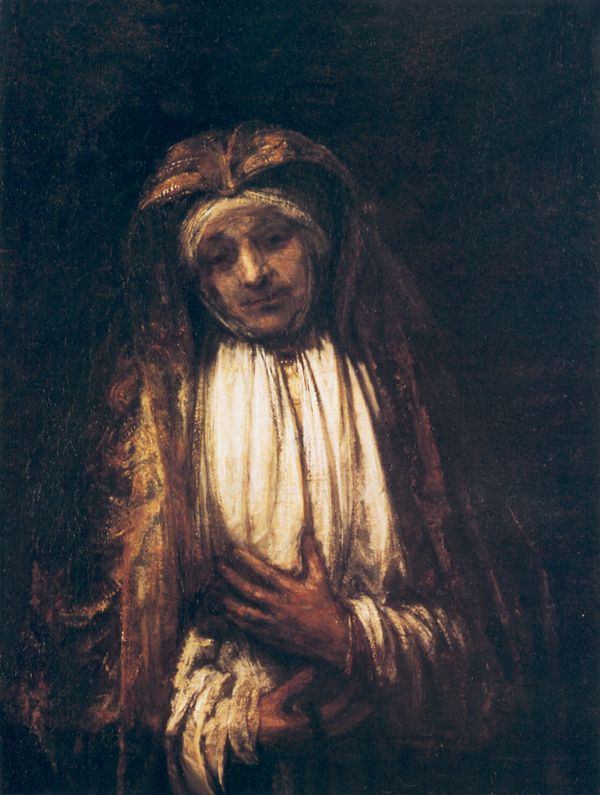
Rembrandt’s “The Virgin of Sorrow” (1661) is a late meditation on grief, distilled into a half-length figure who leans slightly forward as if the weight of feeling had a literal gravity. The Virgin’s head inclines; her eyes fall; one hand presses gently to the chest while the other gathers a fold of linen at her waist. The surrounding space is a hush of deep brown, more air than architecture, so that every small plane of light on veil, skin, and cloth reads like a syllable in a whispered prayer. Nothing here begs for pity. Everything invites contemplation. In this restrained image Rembrandt turns pathos into presence and pain into a quiet form of strength.
Late Style And Historical Moment
In 1661 Rembrandt stood firmly within the candor of his late period. Bankruptcy, losses in his family, and the shifting tastes of patrons had freed him from the glossy finish of earlier decades. The late works speak a different aesthetic and ethic: earthbound palettes, humane chiaroscuro, tactile surfaces that keep the record of touch, and a refusal to flatter or dramatize. “The Virgin of Sorrow” belongs to this final language. Instead of iconographic splendor or courtly Marian finery, we meet a woman whose sanctity reveals itself as endurance. The painting sits within a cluster of late half-length devotional figures—Mater Dolorosa, apostles, and saints—where Rembrandt relocates the sacred from theater to the intimate chamber of thought.
Composition As Consolation
The composition is simple and exact. The Virgin occupies the vertical rectangle with a tapering, almost triangular mass: a dark mantle creates the outer silhouette, a pillar of pale linen descends through the middle, and the face rests at the intersection of these fields. The head tilts toward the viewer’s left and slightly forward, softening the apex and converting geometry into tenderness. Hands organize the lower half: one palm pressed lightly to the breast, the other holding a gathered cloth near the waist. These gestures create a looping path for the eye—from face to hand to hand to face—so that looking becomes a kind of consolation, circling and returning without agitation. The background, kept intentionally anonymous, functions like a cushion of atmosphere, allowing the figure to breathe.
Chiaroscuro As Mercy
Rembrandt’s late chiaroscuro behaves like moral attention. The light is small, sufficient, and merciful. It falls from above left, opening the forehead, grazing the cheek and eyelid, catching the ridge of the nose, and then pouring itself onto the central waterfall of linen. Shadow is generous rather than oppressive. It gathers along the edges of the veil, under the brow, and in the hollow beneath the pressing hand, protecting privacy even as it defines form. The effect is not theatrical contrast but a gentle calibration that lets the viewer perceive feeling without the shock of exposure. In a subject that risks sentimentality, this calibrated light keeps the image truthful.
The Veil, Mantle, And Linen
Cloth carries much of the painting’s meaning. The brown-gold mantle forms a sheltering architecture—an implied archway that frames the face and concentrates the light. Rembrandt builds it with broad, dragged strokes that leave ridges to catch actual light, so the surface seems to breathe. The veil at the forehead is brushed thinly, its gray-white values modulated in small steps, giving it the fragile transparency of real fabric. At the center a vertical column of linen descends like a lit path. Its brightness is not a decorative flourish; it is the visual engine that draws the viewer inward and downward, mirroring the contemplative movement of grief from sudden shock to steady acceptance. The lower folds, gathered by the left hand, crumple with a haptic specificity that reads as care—the body tending to itself in sorrow.
The Face And The Psychology Of Lament
Rembrandt refuses the easy rhetoric of tears. The Virgin’s eyes are downcast rather than streaming; the mouth is relaxed, neither clenched nor parted in cry; the brows curve with a softness that admits pain without dramatizing it. The tilt of the head matters. It implies listening—to memory, to prophecy fulfilled, to the echo of a son’s future Passion that already lives in her awareness. Rembrandt’s handling of the face is all half-tones: transitions rather than lines; warmth and coolness negotiating at the cheeks and below the eyes; a faint olive shadow beneath the brow that deepens the gaze. The painter trusts these minute negotiations of value and temperature to communicate emotion more durably than any overt expression.
Gesture As Theology
Iconography calls this subject Mater Dolorosa, the Mother of Sorrows. Rembrandt translates doctrine into gesture. The right hand, laid across the chest, is not a dramatic strike but a gentle pressure, the learned habit of someone who gathers herself when pain rises. The left hand gathers cloth, a domestic action that anchors the sacred in the ordinary. Together they articulate acceptance without resignation. This is grief that has not lost itself. It is belief lived bodily. In this way the painting embodies a theology of Incarnation: meaning becomes flesh in the small, faithful movements of hands.
Palette: Earth, Honey, And Ash
The color harmony is a late Rembrandt orchestra of browns and whites. Umber and warm bitumen build the mantle and air; raw sienna and honeyed ochres warm the veil’s edges and the skin’s highlights; ashen whites and pearl grays shape the central linen. Because chroma is restrained, temperature and value do the expressive work. Cooler grays collect under the eyes and at the jawline; warmer notes bloom along the cheeks and on the fingers; a faint red lives at the knuckles and the lower lip. The whites are never hospital cold. They are breathed upon by the surrounding browns, so that the central pillar glows rather than glares. The overall effect is candlelit—an ambiance that suits the picture’s devotional intimacy.
Surface And Brushwork: The Record Of Touch
Across the canvas the paint keeps the history of its making. The mantle is scumbled and dragged, leaving ridges that catch light and suggest a rougher, well-worn cloth. The veil is brushed more thinly, with soft-edged transitions that let underlayers murmur. The column of linen is built with alternating passages of opaque highlights and translucent glazes, producing a sense of depth within the fabric itself. The hands are modeled with a tact Rembrandt reserves for living flesh: thicker, more assertive strokes at knuckles and tendons; thinner veils across the backs where skin stretches over bone. The face moves between these methods—small, decisive touches at the inner corners of the eyes and along the bridge of the nose; veils to soften the cheek and mouth. The surface thus mirrors the subject: firmness surrounded by tenderness.
Space And Silence
The background is not a wall but a climate. Soft oscillations of brown—some cool, some warm—pulse around the head like an inaudible halo of air. This atmospheric space is crucial. It keeps the picture from reading as a studio setup and places the Virgin in a universal chamber of sorrow where any viewer can join her. The silence of that space is not emptiness. It is a shelter. Rembrandt’s late pictures often create such rooms of brown air, inviting an encounter that feels private and unforced, the visual equivalent of a chapel without ornament.
Kinships In Rembrandt’s Oeuvre
“The Virgin of Sorrow” speaks with the same voice as Rembrandt’s late apostles and saints. Compare it to “Mater Dolorosa” or the portraits of anonymous old women from the same decade: in each, light scales itself to human dignity; surfaces are allowed to show their revisions; and spectacle gives way to steadiness. The mother’s bowed head echoes the slight inclinations in his late self-portraits, where the painter measures his own losses with a similar economy. This kinship binds biography and devotion: Rembrandt does not illustrate grief; he knows it.
Process And Pentimenti
Close looking suggests visible revisions that animate the painting. Along the outer edge of the mantle, softened restatements show where Rembrandt trimmed a heavier silhouette to let air slip between garment and ground. The transition from cheek to veil includes a cool glaze laid over an earlier, warmer patch, tempering the heat of the face and deepening the mood. The highlight at the bend of the right wrist appears to have been added late, anchoring the hand and guiding the eye back to the central linen. Such pentimenti are not blemishes. They are the painting’s conscience, the record of truth arrived at by correction.
Iconography Without Extravagance
Traditional Mater Dolorosa images often include swords of sorrow, elaborate halos, or teardrops like jewels. Rembrandt subtracts these emblems. He trusts hands, head, cloth, and light to carry the meaning. The result feels truer because it refuses shorthand. A viewer unfamiliar with the title would still understand: this is a mother who knows pain and gathers herself with dignity. The subtraction of ornament is itself a statement about sanctity. Holiness here is not performance but presence.
The Viewer’s Place
We stand near, at conversational distance, slightly below the level of her eyes. Because the Virgin looks downward and inward, we are free to look without embarrassment. The composition does not demand devotion; it invites company. Many viewers experience the painting not as an object to be admired but as a person to be with, which may be the highest ambition of sacred art. Rembrandt’s humane light makes that companionship possible.
Modern Resonance
In a world saturated with theatrical grief, the picture offers an alternative: feeling rendered as steadiness. It speaks to any experience of loss that resists spectacle—grief at a bedside, a quiet wake, the long after of mourning when gestures keep life moving. The palette of earth and ash, the small ration of illumination, and the primacy of hands have influenced generations of painters and photographers who learn from Rembrandt how to make emotion legible without noise. Curators often hang this work in low-lit rooms where it alters the temperature; viewers lower their voices without being told.
Lessons For Makers And Viewers
For painters, the image is a manual on saying much with little. A restricted palette can bloom if values are tuned; transitions can carry more feeling than outlines; fabric can become a light source without bleaching into abstraction; and leaving revisions visible preserves life. For viewers, the painting teaches a slow way of seeing. Follow the path of light from forehead to nose to the pillar of linen, and notice how the brightest whites never quite escape the embrace of brown. Let your eye rest on the small triangle of dark between fingers and wrist; feel the breath there. Return to the bowed head and observe how what seems simple is actually constructed from dozens of patient mixtures. The more one returns, the more the picture returns.
Why The Painting Endures
“The Virgin of Sorrow” endures because it presents grief as a form of wisdom. Nothing is theatrical; everything is exact. The bowed head refuses to manipulate; the hands tell the truth; the light is merciful. The painting models a way of being present to pain that honors it without surrendering to it. That is why the image continues to console across time and culture. Viewers do not leave with an argument; they leave with a steadier breath.
Conclusion: Sorrow Held, Light Kept
Rembrandt gathers earth pigments and a gentle beam to portray a mother who holds sorrow without letting it unmake her. The mantle shelters, the linen glows, the hand steadies, the face accepts. There is room here for the viewer’s own griefs to rest beside hers. That generous room—made of shadow, touch, and measured light—is the secret of the painting’s power. It is not only a portrait of the Virgin; it is a lesson in how to carry loss with dignity.