Image source: wikiart.org
Historical Context of “The Virgin And Infant Jesus”
“The Virgin And Infant Jesus” by Bartolome Esteban Murillo belongs to the rich tradition of Marian images that flourished in seventeenth century Spain. Murillo spent most of his career in Seville, a city whose religious life revolved around confraternities, processions, and an intense devotion to the Virgin Mary. In this environment patrons desired paintings that would bring the mysteries of faith into the intimacy of homes, chapels, and convents. Murillo answered that desire with a series of tender depictions of Mary and the Christ Child that quickly became some of his most beloved works.
The exact date of “The Virgin And Infant Jesus” is unknown, but stylistic characteristics point to Murillo’s mature period. By then he had moved away from the harsher tenebrist style of his early years and embraced a softer, more luminous approach. His colors grew warmer, his brushwork more delicate, and his figures more idealized. Yet he never abandoned the sense of humanity that makes his religious images feel approachable. This painting demonstrates that blend perfectly. It is not a grand altarpiece filled with clouds and angels, but an intimate half length portrayal that feels as if the viewer has quietly stepped into a private moment between mother and child.
First Impression and Overall Composition
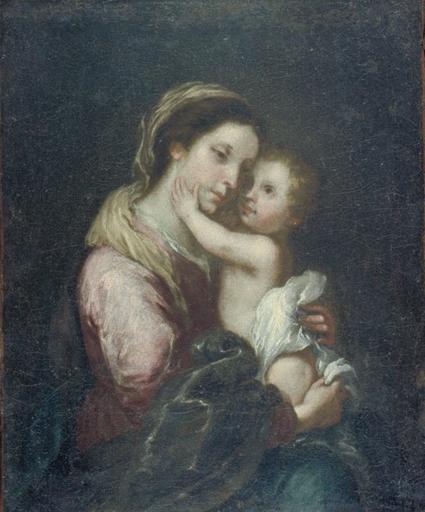
At first glance the eye is drawn immediately to the faces of Mary and the infant Jesus, which occupy the center of the composition and are set against a deep, neutral background. The figures are shown close to the picture plane, cropped at the waist so that their presence fills the small canvas. There is no distracting architecture or landscape. The entire focus is on the relationship between mother and child.
Mary sits slightly turned to the left, holding Jesus securely in her arms. The child stands on her lap, his small body leaning toward her, his left arm reaching up to touch her cheek. Their faces almost touch, forming a compact triangle that anchors the whole image. This triangular structure, echoed in the folds of Mary’s garments, creates a stable and harmonious composition that conveys both intimacy and balance.
The background is dark but not harsh. A soft haze blends into the contours of the figures, giving them a gentle halo. The absence of detailed setting encourages the viewer to focus on the emotional content rather than on narrative specifics. It is no particular moment in the Gospel; it is the timeless reality of the bond between Mary and Jesus.
The Tender Interaction Between Mother and Child
The emotional center of “The Virgin And Infant Jesus” lies in the simple but profound gesture of the child’s hand on Mary’s face. Jesus looks up at his mother with a gaze that is both trusting and curious. His little palm presses gently against her cheek, as children often do when they want to feel close to someone they love. The gesture is spontaneous and natural, and Murillo captures it with exquisite sensitivity.
Mary responds with a look of quiet affection mixed with contemplation. Her eyes are not quite closed and not fully open. She seems caught between the immediate tenderness she feels for her son and the deeper awareness of his destiny. Her lips are relaxed, suggesting a soft smile that never quite forms. Murillo resists sentimental exaggeration. Instead he gives us a nuanced expression that invites the viewer to imagine the thoughts passing through her mind.
The way Mary holds the child reinforces the sense of security. One arm wraps around his back, while the other supports him from below, holding a piece of white cloth that covers his lower body. The child’s weight is clearly felt. We see the muscles in Mary’s hand and forearm engaged in the simple physical task of holding him steady. This attention to bodily realism grounds the scene in the everyday experience of motherhood, making the sacred figures relatable.
Light, Color, and Atmosphere
Murillo’s treatment of light is central to the painting’s mood. A soft illumination falls from the left, bathing the faces and upper bodies of Mary and Jesus in gentle highlights while leaving the background and lower portions in shadow. There are no violent contrasts. Instead, light and dark blend gradually, creating a velvety atmosphere that envelops the figures.
The color palette is warm and muted. Mary wears a rose colored gown with soft golden reflections, partially covered by a dark blue or gray mantle that wraps around her and the child. Her scarf or veil is a pale yellow that catches the light and frames her face. Jesus’ skin is rendered with delicate flesh tones, slightly rosier at the cheeks and extremities, suggesting the softness of infant skin. The white cloth around his waist introduces a bright accent that emphasizes his small body.
These colors are not arbitrary. The rose and blue are traditional for Marian imagery and symbolize love and heavenly grace. Yet Murillo uses them in a subdued way, avoiding heavy saturation. The overall effect is one of warmth and quiet radiance rather than ostentatious brilliance. The dark background, leaning toward cool gray or brown, sets off the warmth of the figures, making them glow as if lit from within.
Murillo’s Characteristic Style in “The Virgin And Infant Jesus”
This painting showcases several hallmarks of Murillo’s mature style. One is his soft, almost sfumato handling of transitions. Edges are rarely sharply defined. Instead, contours dissolve into the surrounding air so that figures seem to emerge gently from the darkness. This technique enhances the sense of tenderness and spiritual calm.
Another characteristic is his approach to faces. Murillo favors oval shapes, smooth skin, and gentle expressions. His Mary is youthful but not overly idealized. She has the kind of beauty that feels more like goodness than glamour. The Christ Child, likewise, is plump and healthy, but his expression contains a hint of seriousness unusual in typical baby portraits. This seriousness reminds viewers that even in infancy he is the Savior of the world.
Murillo also excels at rendering fabric. The folds of Mary’s gown and mantle fall naturally, with subtle highlights that suggest the texture of wool or cotton rather than luxurious silk. This choice contributes to the sense that Mary and Jesus belong to a modest, humble context, aligning with the Gospel emphasis on their poverty and simplicity.
Iconography and Theological Meaning
While “The Virgin And Infant Jesus” appears at first as a domestic scene, it carries rich theological significance. The closeness between mother and child embodies the doctrine of the Incarnation: the eternal Son of God truly becomes human, sharing the intimate experiences of family life. By showing Jesus as a small child who seeks his mother’s touch, Murillo emphasizes his genuine humanity.
Mary’s contemplative expression invites reflection on her role as Mother of God. Traditionally, she is seen as pondering in her heart the words and events surrounding Jesus. In this painting, her half absorbed gaze suggests that she perceives more than the immediate pleasure of her child’s caress. She holds in mind both his present vulnerability and his future mission, which will involve suffering and sacrifice. There is a subtle note of foreknowledge behind her tenderness.
The white cloth around the child can be interpreted symbolically as well. On one level, it is simply a practical garment. On another, it echoes the swaddling clothes of the Nativity and foreshadows the shroud of the Passion. Murillo often includes such visual links to remind devout viewers that the joy of the Incarnation is inseparable from the mystery of redemption.
The absence of a crown, halo, or elaborate symbolic objects is significant. Murillo chooses to underline the natural relationship rather than emphasize royal or divine attributes. Yet the holiness of the figures is unmistakable through their serenity, the gentle glow of light, and the reverent composition. Sanctity is conveyed through atmosphere and emotion rather than through overt iconographic signals.
Devotional Function and the Viewer’s Experience
In its original context, “The Virgin And Infant Jesus” would have served as an aid to private devotion, perhaps hanging in a bedroom, small chapel, or convent cell. Its modest size and intimate focus make it ideal for close, contemplative viewing. The viewer is drawn into the quiet dialogue between Mary and Jesus and invited to share in their affection.
For believers, this kind of image fosters a sense of proximity to the sacred. The viewer is not placed at a distance watching a complex narrative but is positioned almost as a silent witness just a few feet away from the mother and child. Murillo’s soft light and close cropping heighten the feeling that we could reach out and touch the figures. This immediacy encourages prayerful identification. One can imagine being in Mary’s place, holding Christ close, or in the child’s place, resting in the embrace of divine love.
The painting also underlines Mary’s role as intercessor. Her quiet, reflective gaze suggests that she is receptive not only to her son but also to the needs of those who approach her in prayer. Many devotions encourage believers to entrust themselves to Mary so that she might present them to Jesus with the same loving gesture seen here. Murillo’s visual language supports that spiritual practice.
Comparison with Other Marian Works by Murillo
When compared with Murillo’s more elaborate compositions such as “The Immaculate Conception” or large altarpieces of the Holy Family, “The Virgin And Infant Jesus” reveals his versatility. In larger works he often surrounds Mary with clouds, cherubs, and dramatic light effects. Those paintings celebrate doctrinal themes and public devotion. Here, however, he strips away the grandeur and concentrates on the personal relationship.
Even among his many Madonnas, this painting stands out for the intimacy of the child’s touch. In some other works the infant blesses the viewer, holds a bird, or plays with a lamb. In this canvas all symbolic props are set aside. The focus is solely on maternal affection. This choice hints at Murillo’s interest in capturing the everyday humanity of Holy Family scenes, an interest shared with other Spanish painters of the period but expressed with particular sweetness in his art.
The painting also reveals his sensitivity to psychological nuance. In earlier works by other artists, Mary sometimes appears stiff or remote, as if her spiritual dignity precluded ordinary emotion. Murillo breaks that barrier. His Mary is clearly devout and pure, yet she is also emotionally present. That combination of holiness and warmth became one of his hallmarks and contributed greatly to his popularity.
Contemporary Relevance and Emotional Resonance
Even for modern viewers who may not share the theological background of seventeenth century Seville, “The Virgin And Infant Jesus” remains deeply moving. The theme of maternal love is universal. Anyone who has watched a child reach out to touch a parent’s face will recognize the authenticity of the gesture. The painting invites empathy, reminding us of our own experiences of being held and cared for or of caring for others.
In a world often marked by haste and distraction, the quiet stillness of the scene is particularly striking. Mary and Jesus are fully present to one another. There is no sense of hurry, no external task to perform. This concentrated attention can inspire contemporary viewers to value similar moments of focused presence in their own relationships.
The painting also offers a gentle counterimage to the harshness frequently surrounding depictions of the Passion. While Murillo certainly painted scenes of suffering, here he emphasizes the tenderness at the core of the Christian story. The God who will later suffer on the cross first comes as a child who longs for his mother’s touch. This perspective can enrich spiritual reflection, encouraging gratitude for the ways divine love stoops to meet human weakness.
Conclusion
“The Virgin And Infant Jesus” by Bartolome Esteban Murillo is a quietly radiant masterpiece that distills the essence of his Marian art. Set against a dark background, the close embrace of mother and child becomes the sole focus of attention. Through soft light, warm colors, and subtle expressions, Murillo creates an atmosphere of intimate tenderness that speaks both to deep theological truths and to universal human experience.
The painting reflects the devotional culture of seventeenth century Seville while transcending its context through timeless themes of love, protection, and contemplation. Mary’s gentle yet thoughtful gaze, the child’s trusting caress, and the enveloping shadows all work together to invite the viewer into a moment of prayerful closeness. Whether approached as a religious icon or as a sensitive portrayal of motherhood, “The Virgin And Infant Jesus” continues to move hearts with the same quiet power that made Murillo one of the most cherished painters of the Spanish Baroque.