Image source: wikiart.org
Introduction to The Virgin and Child with the Infant St John the Baptist
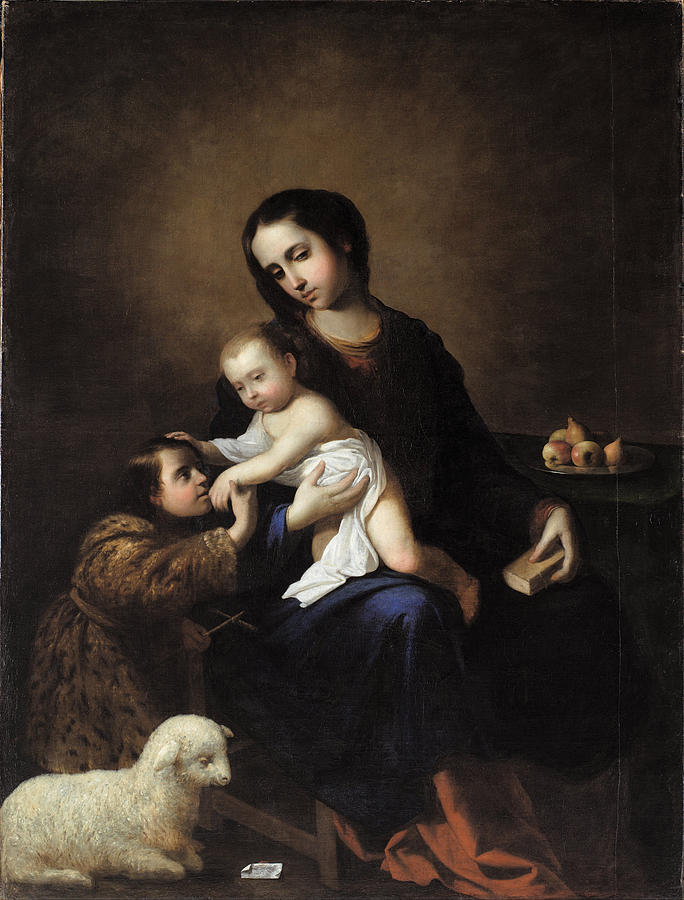
Francisco de Zurbaran’s painting “The Virgin and Child with the Infant St John the Baptist” presents an intimate domestic vision of the Holy Family that is at once tender, solemn and quietly monumental. Instead of a grand narrative scene, Zurbaran chooses a moment of calm interaction. The Virgin sits in a simple interior, the Christ Child on her lap, while the young John the Baptist kneels affectionately beside them. A lamb rests in the foreground and a small arrangement of fruit sits on a table in the back, transforming a seemingly ordinary family grouping into a rich meditation on sacrifice, redemption and divine love.
This canvas belongs to Zurbaran’s mature period, when he was one of the leading painters of Seville. His characteristic use of strong chiaroscuro, carefully rendered textures and serene devotional mood all appear here in a more intimate key. The work combines the realism of a genre scene with the theological depth of a devotional image, inviting viewers to contemplate the mysteries of the Incarnation through the everyday language of maternal affection and childhood innocence.
Historical and Devotional Context
Seventeenth century Spain was marked by intense Catholic piety and strong support for Counter Reformation ideals. The Church encouraged painters to create works that would move the faithful to deeper devotion while remaining theologically sound and easy to understand. Scenes of the Virgin with the Christ Child were especially popular, often enriched with additional figures such as Saint Joseph or John the Baptist to create small sacred families.
Zurbaran, active primarily in Seville, produced numerous altarpieces for monasteries and convents, but he also painted smaller devotional works intended for private chapels and domestic interiors. “The Virgin and Child with the Infant St John the Baptist” fits into this latter category. It has a quiet scale and intimacy that would have suited a noble household or a religious community seeking a painting for meditation rather than for a large public altar.
The inclusion of John the Baptist alongside the Christ Child was a common subject in Spanish and Italian painting. John, as the forerunner of Christ, represents prophetic recognition and spiritual friendship. Showing the two children together allows the artist to suggest the entire story of salvation in a single scene: the incarnation of the Son of God, the preaching of John, the sacrifice of Christ and the redemption of humankind. Zurbaran embraces this tradition but gives it his own voice, shaping a composition rooted in simplicity and emotional clarity.
Composition and Spatial Structure
The composition is organized around a triangular arrangement of figures, a classic structure that creates stability and balance. At the apex sits the Virgin Mary, centrally placed, her head gently tilted. Her dark mantle and blue gown create a vertical axis through the middle of the canvas. The Christ Child occupies the front plane of this triangle, sitting on his mother’s lap but leaning forward toward John the Baptist. John kneels at the lower left, completing the triangle and directing the viewer’s gaze back toward the Child.
The background is an undefined, softly lit space. There is no detailed architecture, no landscape opening to distant horizons. Instead, a warm brown field surrounds the figures, gradually darkening toward the edges. This simplicity focuses attention on the holy group while also evoking the quiet interior atmosphere characteristic of Spanish Baroque devotional painting.
A few secondary elements add depth without distracting from the central group. To the right, a small table holds a plate of pears and perhaps an apple, lit softly from the same source that illuminates the faces. In the foreground left, a lamb lies calmly on the ground, its white wool catching the light. A tiny scrap of paper rests near the lamb. These details anchor the figures in space and provide symbolic resonance, but they never compete with the main triangular grouping.
The Virgin Mary as a Contemplative Mother
Zurbaran’s Virgin Mary is youthful and modest, presented not as a distant queen but as a very human mother absorbed in quiet thought. She wears a dark cloak over a deep blue gown, with a reddish brown undergarment peeking out near her neckline and at the hem. This traditional color scheme associates her with humility, faithfulness and heavenly grace.
Her head bends gently toward the children, her eyes half lowered, producing an expression that combines tenderness with melancholy. She seems to contemplate not only the immediate scene of the two children but also the future suffering implied by the lamb and the cross shaped reed held by John. Unlike more dramatic Baroque interpretations that show the Virgin visibly distraught, Zurbaran gives her a mood of serene foreknowledge. The sadness is there, but it is interior and restrained, suited to quiet meditation.
In her right hand she holds a small book, perhaps a prayer book or the Scriptures. This detail connects her to the tradition of Mary as a woman of contemplation who meditates on the word of God. Her left arm supports the Christ Child securely, but her posture remains relaxed, conveying both physical care and spiritual composure.
The Christ Child Between Innocence and Sacrifice
The Christ Child is painted with a soft, luminous flesh tone that stands out against the darker garments of his mother. His body is realistically modeled, with chubby limbs typical of a toddler. He is naked except for a white cloth that wraps loosely around his waist and legs, leaving his torso bare. This combination of nudity and drapery both highlights his humanity and hints at the linens of his future burial shroud.
The Child’s pose is dynamic yet gentle. Seated on Mary’s lap, he leans forward toward John the Baptist while turning his head back toward the viewer. One hand rests on John’s head while the other reaches toward the young saint’s chin or hand. This gesture can be read as an affectionate blessing, an acknowledgement of the bond between them. At the same time, his direct gaze outward engages the observer, reminding us that we too are invited into this circle of love and recognition.
Zurbaran avoids any overtly regal attributes such as crowns or gilded halos. Instead, the holiness of the Christ Child is communicated through light, gesture and the surrounding symbols. His fair skin reflects the soft light, giving him a subtle inner glow against the darker setting, as if he is the source of illumination within the scene.
The Infant St John the Baptist as Devoted Companion
At the lower left, the young John the Baptist kneels on one knee, gazing upward at Jesus with a look of deep devotion and affection. Zurbaran dresses him in a rustic, fur like garment that anticipates the camel hair clothing he will wear as an adult preacher in the desert. This costume not only identifies him but also contrasts with the more refined garments of Mary, highlighting his role as an ascetic prophet.
John’s posture is humble and attentive. One hand rests gently on Christ’s arm while the other holds a slender reed cross, a miniature version of the cross associated with Jesus’ crucifixion. This reed cross is a key iconographic element. It signals John’s mission to announce the coming of the Messiah and points forward to Christ’s sacrificial death. The fact that John holds it while interacting with the Child suggests that the message of the cross is already present in their relationship, even in childhood.
There is a touching psychological dimension to the way John nestles close to Jesus, his face almost in profile yet clearly illuminated. He appears as both child and saint, embodying innocence and prophetic awareness in a single figure. The viewer can sense that this is more than play. It is a foreshadowing of John’s future proclamation, when he will point to Jesus and declare him the Lamb of God.
Symbolism of the Lamb, Fruit and Book
Zurbaran enriches the scene with a series of subtle symbolic objects. The most prominent is the white lamb lying on the floor near the children. The lamb is traditionally associated with Christ as sacrificial victim, drawing on biblical imagery from the Passover lamb to John’s proclamation of Jesus as the Lamb of God who takes away the sins of the world. Placing the lamb here links the innocence of the Child with the destiny of sacrifice that awaits him.
The lamb’s posture is calm and peaceful. It does not appear slaughtered or threatened. Instead, it rests quietly, reflecting the way Christ freely embraces his mission. Its bright white wool catches the light, reinforcing the theme of purity and divine innocence. The small scrap of paper lying near its front leg may once have borne an inscription or the name of the artist. Even if its exact meaning is uncertain, its presence near the lamb suggests the written testimony about Christ’s sacrificial role in Scripture and in the liturgy.
The small table at the right with pears and possibly an apple adds another layer of meaning. Fruit in Marian imagery often alludes to the Garden of Eden and the contrast between Eve and Mary. Pears can symbolize marital love and the sweetness of virtue, while the apple is commonly associated with the fall into sin. In this context the fruit may represent the reversal of original sin through Christ and the Virgin, who become the new Adam and new Eve bringing redemption rather than condemnation.
Finally, the book in Mary’s hand points to her role as a contemplative believer who ponders the mysteries of God. It may allude to prophecies about the Messiah that she has interiorly absorbed. It also connects the scene to the practice of lectio divina and prayer within monastic life, making the image especially resonant for religious viewers accustomed to meditating on Scripture.
Light, Color and Zurbaran’s Painterly Technique
Zurbaran’s mastery of light and color is evident throughout the painting. The primary light source comes from the left, softly illuminating the faces and upper bodies of Mary, Jesus and John. This focused area of brightness creates a natural emphasis on their interaction while leaving the broader surroundings in gentle shadow. The transition from light to dark is gradual rather than abrupt, producing an atmosphere that is contemplative instead of theatrical.
Color plays a key role in the emotional tone. Mary’s deep blue gown and dark mantle form the richest chromatic area, symbolically linked to faith and heavenly grace. The red brown accents at her neckline and at the bottom of her dress add warmth and connect visually with the warm tones of the wooden stool and the table. The Christ Child’s pale skin and white cloth create a luminous core in the center of the composition, flanked by John’s earthy brown garment and the soft cream tones of the lamb.
Zurbaran pays particular attention to textures. The fur of John’s garment, the wool of the lamb, the smooth skin of the Child, the draping of Mary’s robe and even the delicate sheen on the fruit are all rendered with a careful eye and controlled brushwork. This tactile realism invites viewers to imaginatively touch the surfaces, which in turn makes the sacred figures feel present and near.
Despite the detailed textures, the overall effect is one of simplicity rather than ostentation. There are no elaborate architectural settings or gilded ornaments. The painter relies instead on the natural beauty of light, fabric and flesh to convey the sanctity of the scene.
Emotional Atmosphere and Spiritual Message
The emotional tone of “The Virgin and Child with the Infant St John the Baptist” is gentle, affectionate and quietly meditative. There is no overt drama or visionary ecstasy. Instead, the painting captures an everyday moment within the Holy Family that is suffused with spiritual meaning.
Mary’s tender yet slightly sorrowful gaze, the Child’s direct look at the viewer and John’s loving adoration work together to create a sense of calm presence. The viewer is invited to approach this holy group with the same humility and affection that John displays. At the same time, the symbols of the lamb, the cross and the fruit remind us that behind this domestic intimacy lies the entire drama of salvation history.
The painting thus serves as a visual aid for prayer. By contemplating this gentle interaction, the viewer can meditate on the mysteries of Christ’s incarnation, his identification as the Lamb of God and the loving cooperation of Mary and John in the divine plan. Zurbaran’s subtle handling of light and gesture leads the mind inward, encouraging quiet reflection rather than emotional spectacle.
Place within Zurbaran’s Oeuvre and Legacy
This work reflects several of Zurbaran’s most distinctive strengths. Like his famous canvases of monks in contemplation, it combines strong realism with spiritual intensity. The figures are solid and tangible, yet their expressions and gestures evoke a sense of inward life that transcends the visible scene.
The painting also shows how Zurbaran could adapt his austere monastic style to a more tender, family oriented subject without losing depth. His control of composition and his ability to suggest narrative through a few key details make this an exemplary Baroque religious image.
In the wider history of art, “The Virgin and Child with the Infant St John the Baptist” contributes to the enduring tradition of Holy Family images that bridge the gap between everyday human experience and theological mystery. Zurbaran’s version stands out for its quiet dignity, its warm palette and its delicate balance between realism and symbolism.
Conclusion A Quiet Vision of Family and Redemption
“The Virgin and Child with the Infant St John the Baptist” by Francisco de Zurbaran offers a moving portrayal of sacred family life. Through a simple triangular composition, a restrained yet rich color scheme and a handful of meaningful symbols, the painting invites viewers into a contemplative encounter with Mary, Jesus and John.
The lamb at their feet, the fruit on the table and the prayer book in Mary’s hand all point beyond the scene to the larger story of sin, sacrifice and salvation. Yet the mood remains tender and accessible. This is a God who has entered ordinary human life, who is held in a mother’s arms and loved by a child who will later proclaim him to the world.
Zurbaran’s skill lies in allowing this theological depth to emerge naturally from the quiet gestures and gentle expressions of his figures. The painting continues to resonate because it speaks to universal experiences of family love, childhood innocence and the hope that such love is part of a larger divine plan.