Image source: wikiart.org
Introduction to The Virgin and Child with St Rosalina
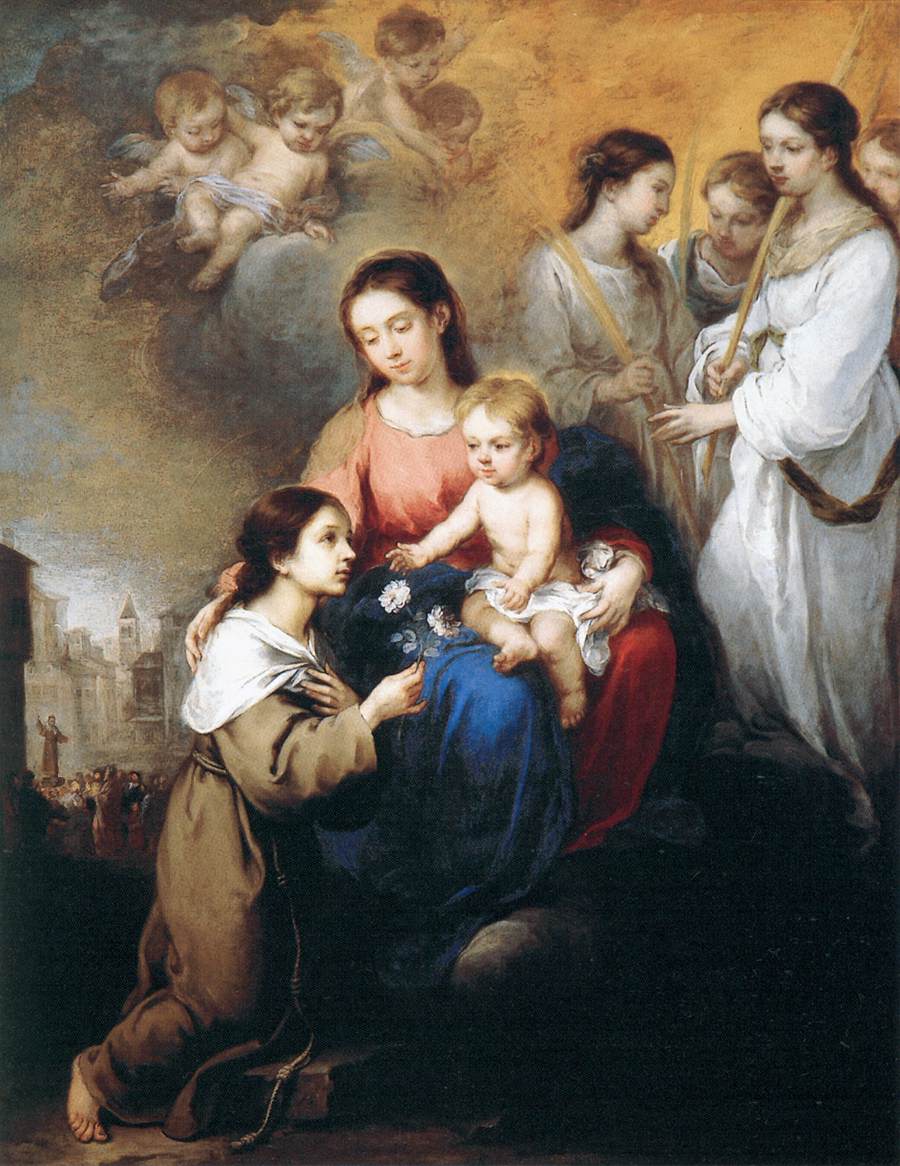
Bartolome Esteban Murillo’s painting The Virgin and Child with St Rosalina from around 1670 is a gentle but powerful example of Spanish Baroque devotion. In this work, Murillo blends celestial glory with the familiar warmth of family life, creating an image that feels both sacred and close to everyday experience. The Virgin Mary sits with the Christ Child on her lap, while the young St Rosalina kneels before them in reverent admiration. Around them float angels and soft clouds, wrapping the whole scene in a luminous, golden atmosphere.
This painting belongs to Murillo’s mature period, when his brushwork became more fluid and his colors more airy and glowing. It shows how he could translate complex theology into an image of tenderness, where divine grace appears in the language of human affection.
First Impressions and General Layout
At first glance, the viewer meets a vertical pyramid of figures that rises from the kneeling St Rosalina through the Virgin and Child and up toward the angels in the sky. The Virgin sits slightly to the left of center, dressed in a red gown with a deep blue mantle over her knees. She balances the standing Christ Child on her lap. To the right, St Rosalina kneels at their feet, gazing up and holding flowers which she offers to the Child.
Above, a group of angels and youthful saints gathers in a golden cloud. Some carry palm branches, others simply hover as attendants. The upper part of the painting is filled with warm light, while the lower area remains more grounded and earthy, with rocks and a hint of landscape.
The composition is crowded but not chaotic. Murillo arranges the figures in overlapping layers, so the eye moves naturally from the earthly foreground to the glowing heavens. The movement is gentle rather than dramatic, matching the calm mood of the scene.
The Emotional Center of the Painting
The heart of the painting is the exchange between St Rosalina, the Virgin, and the Christ Child. Rosalina kneels closest to the viewer. Her brown habit identifies her as a Franciscan, but her face looks young and very human, full of quiet expectation. She offers a small bouquet to the Child, who leans forward, accepting it with one hand while steadying Himself with the other.
Murillo captures an intimate moment. There is no theatrical gesture, no sudden miracle, only the simple act of giving and receiving. Mary looks on with a soft, protective expression, as if guiding this spiritual first meeting. Through this triangular relationship, Murillo shows what devotion means in practice: an offering of the heart and a gracious response from the divine.
The viewer is drawn into that triangle. Because St Rosalina kneels at the lower edge of the painting, we almost share her position. It is easy to imagine ourselves taking her place, presenting our own flowers, and receiving the Child’s gaze in return.
Light and Atmosphere
Murillo is famous for his luminous surfaces, and this painting is a clear example of that gift. Light enters from the upper right and spreads across the central figures, leaving the outer edges more subdued. The Virgin’s face, the Child’s body, and Rosalina’s uplifted features all catch this radiance. Their skin glows softly, standing out against the darker fabrics and background.
The sky and cloud mass surrounding the angels are painted in delicate variations of gold, cream, and pale gray. The light here is less focused and more diffused, suggesting a realm that is not entirely accessible to human sight. The angels partially dissolve into this haze, which makes them feel truly spiritual rather than solid and earthly.
Murillo does not use violent contrasts of light and dark. Instead he prefers subtle gradations that create a velvety atmosphere. This approach gives the painting its characteristic warmth and serenity. The divine presence is radiant, but it is also gentle, like the glow of evening rather than a blinding flash.
Color and Symbolic Harmony
The color scheme supports the spiritual message of the painting. Mary’s red gown and deep blue mantle are traditional Marian colors. Red hints at love and sacrifice, blue suggests heaven and spiritual wisdom. Murillo paints the fabrics with soft highlights and rounded folds, giving them both weight and softness.
St Rosalina’s habit is a modest brown. This humble color marks her as a person of poverty and simplicity, in contrast to the rich blue and red of Mary’s garments. Yet the brown also harmonizes with the golden light around the figures, so the saint does not feel separate from them. She belongs within the same warm world, though her role is different.
The flowers that Rosalina holds and the Child touches are pale and delicate, mostly whites and soft blues. They echo the cool highlights in the clouds and the gentle tones of the angels’ flesh. This visual rhyme subtly connects Rosalina’s offering with the purity of heaven.
Overall, Murillo organizes his colors in a rising scale: deeper reds and browns in the lower half, cooler blues and luminous yellows above. The palette mirrors the spiritual ascent from earth to heaven.
The Figures and Their Expressions
Murillo’s figures are never stiff or remote. In this painting, each person has a distinct expression that contributes to the overall mood.
Mary appears as a young Sevillian woman, her features rounded and calm. She does not look directly at the viewer but focuses on the Child and St Rosalina, which reinforces her role as mediator. Her half lowered eyes and slight smile express maternal tenderness and contemplative peace.
The Christ Child, standing on His mother’s lap, has the plump body and curious gaze of a real toddler. Murillo avoids idealizing Him into a miniature adult. Instead he balances natural childlike features with a sense of awareness beyond His years. The way He reaches toward Rosalina conveys acceptance and blessing, but also childlike interest in the flowers she holds.
St Rosalina’s face is one of the most compelling elements in the painting. Her eyes are wide and earnest, her mouth slightly parted as if she is whispering a prayer. The tilt of her head and the way she leans forward show eagerness and humility at once. Her youthful appearance makes the relationship between saint and Savior feel almost like a child meeting a beloved older sibling.
The angels above are typical Murillo cherubs, with rounded cheeks and playful poses. They are not stern guardians but joyful companions, celebrating the exchange happening below. Their presence widens the scene from a private vision to a cosmic event.
Iconography and Religious Meaning
The painting is rich with symbolic details that would have been clear to Murillo’s contemporaries.
The flowers that Rosalina offers are a classic symbol of purity, beauty, and the virtues of the soul. Placed in the hands of the Child, they suggest that Christ receives the virtues and acts of love of the faithful and transforms them into grace.
The palm branches held by some angels are traditional signs of martyrdom and victory over death. These remind the viewer that behind the sweetness of the scene lies the future Passion and Resurrection. What looks like an intimate family moment participates in the entire drama of salvation.
The city that appears in the distant background likely suggests Seville. Murillo often embedded hints of his own city into biblical scenes. For local viewers, this detail would have made the painting feel close to home. It implies that such heavenly encounters are not confined to faraway lands but can be imagined within the familiar streets of Andalusia.
The presence of St Rosalina, dressed in a Franciscan habit, ties the painting to Franciscan spirituality, which emphasized poverty, humility, and affective devotion to Christ and Mary. By pairing a relatively local or specialized saint with the universal figures of the Virgin and Child, Murillo affirms the role of personal devotion as a path to universal grace.
Murillo’s Mature Style in Context
Around 1670 Murillo had reached full artistic maturity. His earlier works sometimes show stronger chiaroscuro and more dramatic contrasts, but by this date he favored a softer, more atmospheric approach. The Virgin and Child with St Rosalina captures this later manner.
The brushwork, particularly in the sky and garments, is loose and supple. Up close, one would see distinct strokes and patches of color. From a normal viewing distance, these strokes blend into a convincing illusion of light and texture. This painterly freedom gives the scene a slightly shimmering quality, as if the air itself is glowing.
Within the Spanish Baroque tradition, Murillo occupies a unique position. While artists like Zurbaran often painted stark, contemplative scenes and Velazquez explored aristocratic portraiture and complex space, Murillo specialized in devotional works that combined realism with idealization. His religious paintings were meant to be loved, not just admired, and this painting is a prime example. It invites affection and trust more than fear or awe.
Devotional Use and Viewer Participation
For seventeenth century viewers, a painting like this would have functioned as much more than decoration. It would serve as a focus for prayer and meditation. Murillo’s choices clearly support that purpose.
St Rosalina’s position at the bottom edge of the scene makes her an ideal intermediary for the viewer. Her gaze and gesture guide our own response. We look where she looks, and we sense her emotions as she kneels. In meditation, a devotee could imagine joining her, offering the flowers of faith, hope, and charity, and receiving the Child’s blessing.
The gentle quality of the light and the affectionate relationship among the figures encourage an approach to God based on love rather than fear. The painting presents a path to holiness that begins with trust and closeness, not distance. Murillo’s art thus supports the Counter Reformation emphasis on personal, heartfelt devotion within the structure of Catholic doctrine.
Place of the Painting in Murillo’s Marian Works
Murillo painted many images of the Virgin and Child, as well as numerous scenes that pair Mary and Jesus with a particular saint. The Virgin and Child with St Rosalina belongs to this family of works and shares several common features.
Across his Marian images, Murillo tends to portray Mary as youthful and approachable, almost like an ideal Sevillian mother. He repeats the combination of red gown and blue mantle, the soft oval face, and the lowered, modest gaze. At the same time, each painting has its own emotional nuance. Here, the presence of the young Franciscan saint adds a tone of friendship and mentorship. Mary is both mother to Christ and spiritual mother to Rosalina and, by extension, to all believers.
Compared to some of his grander compositions, this painting feels fairly intimate. The space is not filled with elaborate architecture or large crowds. Instead, Murillo concentrates on a small group of figures and the atmosphere around them. The result is a devotional image that feels suited not only to a large church but also to private contemplation.
Lasting Appeal and Contemporary Relevance
Even for modern viewers who may not share the exact theological background of seventeenth century Seville, The Virgin and Child with St Rosalina retains a strong emotional appeal. The mother gently holding her child, the young woman kneeling in hopeful trust, the playful angels hovering above: these are images that speak to universal human experiences of family, care, and longing for something higher.
The painting also offers a model of spiritual relationship that is not harsh or judgmental. Instead, it presents a vision of a God who comes close in the form of a child, ready to receive even the smallest gift of love. In a world where religious images are sometimes associated with anxiety or guilt, Murillo’s work can feel surprisingly comforting.
As an example of Baroque art, the painting is important for its handling of light, color, and composition. As an image of devotion, it continues to invite quiet reflection. Murillo’s combination of technical skill and heartfelt feeling is what keeps this work alive for viewers today.