
Image source: wikiart.org
First Impressions and the Painting’s Quiet Tension
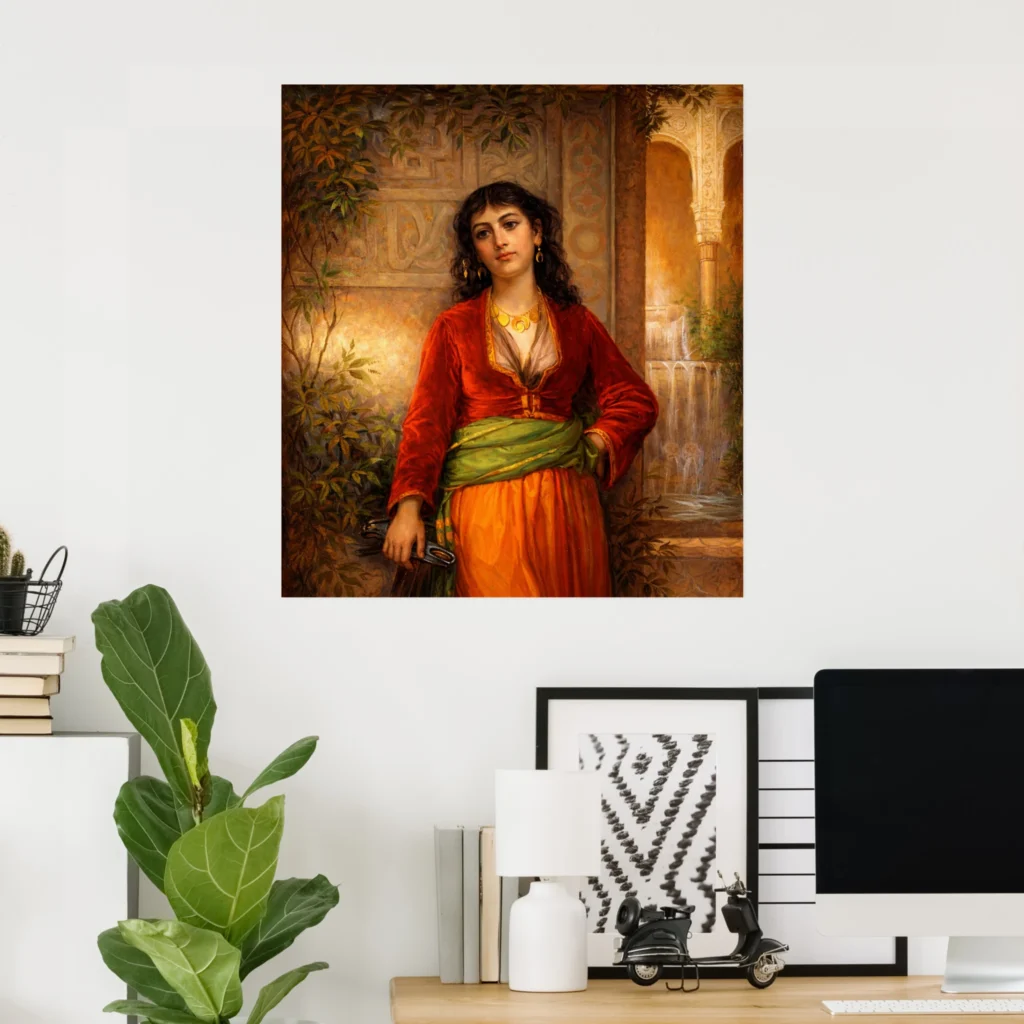
John William Waterhouse’s “The Unwelcome Companion” (1872) greets the viewer with an immediate sense of intimacy that is also slightly unsettled. At first glance, the scene feels calm: a young woman pauses in a shaded architectural setting, framed by warm stone, soft foliage, and a gentle fall of light. Yet the title primes us to look for friction, and once you accept that invitation, the painting becomes a study in subtle discomfort. Waterhouse does not stage drama with theatrical gestures or obvious conflict. Instead, he builds it through mood, posture, and the uneasy gap between the figure’s stillness and the implication that someone or something unwanted has entered her world.
The emotional temperature here is lukewarm but persistent. The woman’s gaze does not meet ours with invitation, nor does it project simple melancholy. It feels guarded, thoughtful, and slightly weighed down, as if she is managing a situation in which politeness must coexist with irritation. In that layered expression, Waterhouse shows an early talent that would later become one of his signatures: the ability to make narrative feel present without spelling it out. The painting functions like a paused sentence. You sense what came before and what may come after, but you are held in the charged uncertainty of the present moment.
Composition and the Art of Controlled Stillness
The composition is built around the woman as the stable axis of the image. Waterhouse places her slightly off-center, letting architectural elements and shadowed recesses balance her presence. The background does not compete for attention, but it is not empty either. It supplies a quiet stage set: stone surfaces with hints of carving, a column and arch that suggest an outdoor corridor or courtyard, and leafy branches that soften the geometry. This combination creates a space that feels both sheltered and exposed, a threshold between private and public.
Her body language is essential to the painting’s psychological effect. One arm rests with a casual authority, hand near her hip, while the other falls more loosely. That asymmetry suggests a person attempting to appear composed while internally unsettled. The pose reads as a practiced stillness, the kind someone adopts when they are waiting out an awkward encounter. Waterhouse uses this controlled posture as a narrative clue. The scene is not about movement, but about restraint.
The framing is also quietly strategic. The verticals of the architecture keep the figure contained, while the softer organic shapes of the foliage and drapery introduce a gentle counter-rhythm. This interplay makes the image feel stable, yet not static. Even without obvious action, the painting breathes. The viewer’s eye moves from her face down the line of her garment, across the green sash, and into the warm glow of the lower fabric, then back up toward the dark halo of hair and shadow. This slow circulation supports the painting’s central theme: tension that does not erupt, but lingers.
Color, Light, and the Emotional Weight of Warm Tones
Waterhouse’s palette here is one of the painting’s most persuasive tools. Warm reds and oranges dominate the figure’s clothing, contrasted by a muted green sash and the cool, subdued neutrals of the stone setting. The result is both harmonious and psychologically expressive. The reds suggest vitality, sensuality, and presence, but they also carry heat, and heat can imply irritation or intensity. The green sash, wrapped across her waist, reads like a calming counterbalance, a band of restraint holding the warmth in check.
Light is handled with a soft naturalism. It does not blaze across the scene; it settles. The brightest notes are in the lower garment and in highlights along the stone and skin. This distribution of light guides interpretation. The face is illuminated enough for us to read emotion, but it remains slightly veiled by shadow and surrounding darkness. That partial concealment makes her inner life feel protected. We are allowed to look, but not to fully know.
The background’s neutrals are not dead or flat. Waterhouse modulates them with gentle shifts of beige, gray, and warm brown, creating a shallow atmospheric depth. This restrained environment increases the figure’s chromatic impact. She becomes the emotional center because she is also the visual fire. Yet the fire is controlled, not flamboyant, which aligns with the painting’s narrative premise: the discomfort is present, but it is being managed.
The Figure as Character: Expression, Gaze, and Ambiguity
The woman’s face is the painting’s true plot. Waterhouse offers an expression that resists simple labeling. She appears tired, perhaps bored, perhaps resigned, but not defeated. Her eyes angle slightly away, as if she is refusing to give direct attention to the unwelcome presence implied by the title. This is not a startled glance or a fearful retreat. It reads more like social fatigue, the look of someone who has already decided they do not wish to engage, but must endure.
This nuance matters because it shapes the viewer’s role. We are not positioned as the hero arriving to rescue her, nor as a romantic confidant. We are witnesses. The painting invites us to speculate about the relationship dynamics at play without granting certainty. That ambiguity is part of its enduring fascination. “Unwelcome companion” could refer to a literal person nearby, outside the frame, or to a broader condition: unwanted attention, intrusive social expectations, or even a metaphorical companion like worry or regret.
Her jewelry and dress contribute to characterization. The earrings and necklace add a note of personal adornment that suggests pride and self-awareness. She is not portrayed as disheveled or powerless. The richness of the clothing implies dignity and perhaps a sense of identity that remains intact despite annoyance. This strengthens the psychological reading: she is not a victim of the scene, she is its central consciousness.
Setting and the Allure of the Exotic Interior World
Although the painting’s emotional narrative is intimate, the setting provides a wider cultural atmosphere. Waterhouse situates the figure in an architectural environment that suggests North African or Middle Eastern influences, a choice consistent with the nineteenth-century British fascination with Orientalist imagery. The stone surfaces, arches, and decorative hints create a sense of place that feels distant from the painter’s London audience, offering them the pleasure of imagined travel and difference.
At the same time, the setting is not rendered as a bustling street scene full of spectacle. It is quiet, almost private. That restraint makes the environment feel less like a postcard and more like a psychological chamber. The exoticized architecture functions as both backdrop and mood device: it separates the scene from ordinary life, which allows viewers to project narrative possibilities onto it more freely.
The foliage is particularly important. Leaves intrude into the space, softening hard stone and suggesting a courtyard where nature and architecture coexist. Symbolically, this creates a contrast between organic life and rigid structure, between emotion and social constraint. In a painting about an unwelcome presence, that contrast can be read as the push and pull between personal desire and external pressure.
Narrative Possibilities and the Power of the Unseen
The title is a deliberate act of storytelling. Without it, the painting might be interpreted as a serene portrait in a picturesque setting. With it, everything tilts. We begin searching for what is not shown. Where is the companion? Why are they unwelcome? Is the woman confronting persistent attention, a social obligation, or a personal memory that follows her like a shadow?
Waterhouse builds narrative through omission. The unseen companion could be just beyond the right edge, near the arch, or it could be behind the viewer. That uncertainty produces a mild tension in the viewing experience. The painting becomes interactive in a quiet way: we supply the missing element in our imagination.
The woman’s posture supports the idea of someone nearby. She is not posed for us with open invitation. The slight inwardness of her stance suggests she is listening or enduring. The setting’s stillness implies a pause in conversation. Perhaps she has stepped aside, or perhaps she is trapped in a moment of social patience. The fact that she does not look toward the implied companion intensifies the sense of rejection.
This narrative structure also mirrors real social experiences. Many people know what it feels like to be polite while inwardly wishing an interaction would end. Waterhouse elevates that ordinary discomfort into visual poetry. The drama is not external action but internal negotiation.
Waterhouse in 1872: Early Style and Emerging Strengths
As an early work, “The Unwelcome Companion” reveals Waterhouse developing the skills that would later define his best-known paintings. Even here, you can see his interest in the figure as a vessel of story and mood rather than mere likeness. The woman is not simply decorative. She is a psychological subject.
The painting also shows his attention to fabric and surface. The red garment has a soft richness, with folds that feel lived-in rather than stiff. The textures are convincing without being overly meticulous. This balance, where painterly suggestion meets believable form, is part of Waterhouse’s appeal. He creates a world that feels touchable, yet slightly idealized, as if memory has smoothed its edges.
Another emerging strength is his handling of mood through color harmonies rather than overt symbolism. The palette tells the story as much as the title does. Warmth becomes emotion, shadow becomes privacy, and the controlled light implies restraint. Even if you did not know anything about Waterhouse, you could sense that this painter is interested in feelings that do not shout.
Themes of Autonomy, Boundaries, and Social Pressure
One of the most compelling modern readings of this painting is its attention to boundaries. The woman’s expression and stance communicate a subtle assertion of autonomy. She may not be able to remove the companion from her space, but she can refuse emotional participation. In that sense, the painting becomes a quiet portrait of resistance.
The architectural setting reinforces this theme. Columns, walls, and carved surfaces suggest containment. The figure is framed, almost enclosed, which can be read as a metaphor for social structures that constrain behavior. Within that containment, the woman’s inner life becomes the last private territory she can control. Her distant gaze and composed posture are tools of self-protection.
The title also invites a reading about unwanted attention, particularly as it relates to gender and social power. Waterhouse does not depict the companion, which prevents the scene from becoming a simple moral tableau. Instead, it becomes an exploration of the feeling itself. The viewer is asked to empathize with discomfort rather than judge a villain. That choice gives the painting emotional complexity and keeps it from becoming a one-note anecdote.
Technique and Brushwork: Soft Focus, Firm Structure
Waterhouse’s technique here balances softness and structure. The face and hands are modeled carefully enough to convey personality, while edges elsewhere are allowed to blur into painterly suggestion. This creates a gentle hierarchy of attention. The viewer is drawn to the psychological centers first, then allowed to drift through the environment.
The brushwork in the background is especially effective because it remains understated. Stone surfaces are suggested through tonal shifts rather than sharp outlines, which creates atmosphere. The foliage is painted with enough variety to feel alive, but not so much detail that it distracts. This economy supports the painting’s main goal: to hold the viewer in the figure’s emotional space.
The clothing displays Waterhouse’s interest in drapery as a form of storytelling. The folds are not merely technical exercises. They emphasize the body’s stillness and the weight of the moment. The green sash, for example, is not just a color accent. It acts like a visual knot, a band that compresses the composition around her center, reinforcing the idea of contained emotion.
Why the Painting Still Works Today
“The Unwelcome Companion” remains engaging because it is built on a universal social sensation. The discomfort of unwanted company is timeless. Waterhouse captures the quiet, often invisible drama of endurance. He does it without exaggeration, trusting that viewers will recognize the feeling in the tilt of a head, the heaviness of an eyelid, the refusal of direct engagement.
The painting also rewards slow looking. The longer you stay with it, the more you notice how carefully everything is balanced: warmth against cool stone, openness of the arch against the enclosure of the wall, the softness of foliage against rigid architecture, the rich saturation of clothing against the neutral hush of background. These contrasts create an emotional chord that feels resolved and unresolved at the same time.
Finally, the painting is a reminder of how narrative can be created through absence. The unseen companion is more powerful than a visible figure might have been, because absence invites projection. Each viewer supplies their own version of the unwelcome presence, which is why the work can feel personal even when its setting feels distant.