Image source: wikiart.org
A Baroque vision of victory
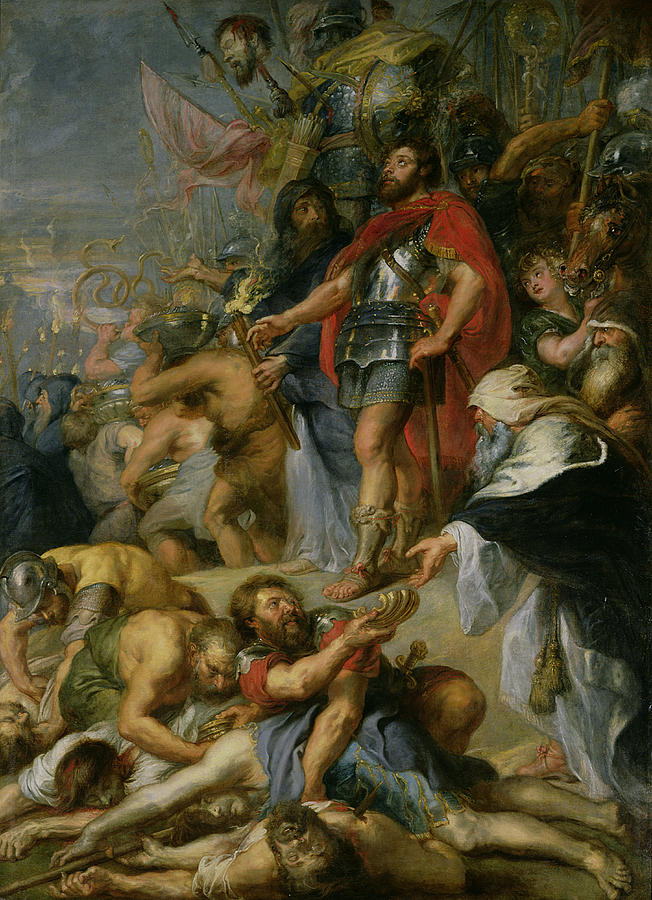
In “The Triumph of Judas Maccabeus,” Peter Paul Rubens transforms a biblical episode into a sweeping epic of movement, light, and moral tension. The painting shows Judas Maccabeus, the Jewish military leader who defended his people against foreign oppression, at the height of his glory. He stands elevated above a heap of defeated enemies, surrounded by soldiers, banners, and sacred objects. Around him the scene churns with activity as prisoners are dragged forward, bodies lie sprawled on the ground, and figures reach toward him with urgent gestures.
Rubens creates a dense, vertical composition that feels like a frozen moment in a crowded victory procession. Spears, standards, and armor crowd the upper half of the canvas, while muscular bodies and contorted limbs fill the lower foreground. In the center Judas stands out in shining armor and a red cloak, his steady posture set against the chaos beneath his feet. The painting captures not just the fact of victory but its emotional complexity, where triumph, exhaustion, fear, and awe coexist.
Historical and biblical background
The story of Judas Maccabeus comes from the books of Maccabees, which recount the revolt of the Jewish people against the Seleucid king Antiochus IV in the second century BCE. When the king attempted to force Greek religious practices on the Jews and desecrated the Temple, Judas and his brothers led an uprising to restore the worship of the true God. Judas became famous for bold tactics and unexpected victories against much larger enemy forces.
Catholic Europe in Rubens’s time saw Judas Maccabeus as a model of divinely guided resistance. He symbolized courage in defending faith against persecution and foreign domination. For Rubens, who worked for Catholic rulers and was himself engaged in diplomatic work during wars of religion, Judas represented the ideal of a commander whose military success served a higher spiritual cause.
This painting belongs to Rubens’s cycle on heroes of the faith. By choosing a triumphant moment rather than a battle scene itself, he emphasizes the aftermath of struggle and the public recognition of victory. The image becomes a meditation on what it means to win and on the responsibilities that accompany power.
The commanding presence of Judas Maccabeus
At the center of the painting Judas Maccabeus stands on a raised step, slightly above the tangle of figures below. He wears gleaming armor, a short skirt of metal plates, and sturdy greaves on his legs. Over his shoulders falls a red cloak, fastened at the chest and draped behind him. This garment catches the light and provides a strong color accent that immediately draws the eye.
Judas’s stance is stable and authoritative. One leg is planted firmly, the other slightly bent. His torso is upright, and his head is turned toward a figure in white and black at the right, often interpreted as a priest or elder who extends a hand toward him. Judas holds a scroll or scepter in his left hand, symbol of command or of the law he defends. His right arm stretches outward, connecting him visually with those around him.
Rubens gives Judas a thick beard and abundant hair, traits associated with masculine vigor and leadership. His expression is serious rather than jubilant. The eyes look outward with composure, as if already weighing the next task after victory. This restraint in his face contrasts with the contorted bodies of the defeated below, reinforcing his dignity and moral control. Judas is not gloating over bodies. He is accepting victory as a heavy responsibility.
The defeated enemies and the cost of victory
The lower foreground is crowded with defeated soldiers. Their bodies sprawl across the ground in a series of overlapping diagonals that lead the viewer’s gaze back up toward Judas. One lies face up, arms flung outward, another twisted on his side, and others bent over in pain or struggling to rise. Their armor and weapons are scattered, signaling complete collapse.
Rubens paints these bodies with great anatomical energy. Muscles strain, torsos twist, and limbs reach in different directions. The flesh tones range from warm pinks to pallid, almost grey hues, indicating varying degrees of life and death. Some faces show anguish, others blank unconsciousness. This vivid depiction of the fallen reminds viewers of the brutality underlying the hero’s triumph.
Among the heap of enemies, a central figure with reddish garments raises his head and extends a captured object toward Judas. His pose is almost supplicating, making him a bridge between the defeated at the bottom and the victorious leader above. Through him Rubens stages the moment when spoils and symbols of power change hands, signaling the transfer of domination from one side to the other.
Standards, trophies, and the visual language of triumph
The upper part of the painting is thick with banners, standards, and trophies. Soldiers cluster around Judas, carrying shields and ornate equipment. Some hold high the captured arms of the enemy. Others display symbolic items that refer to the spiritual meaning of the victory.
These elevated objects create a crown of sorts above Judas. Spears and standards form radiating lines around his head, almost like a heroic halo. The upward thrust of these elements contrasts with the downward sprawl of bodies at his feet, giving the whole composition a dynamic X-shaped structure. The eye moves from the lower left, across the heap of fallen soldiers, up through Judas’s figure, and then into the mass of banners and armor above.
Rubens delights in the decorative possibilities of this display. Metallic surfaces catch glints of light. Drapery on the banners ripples in the air. Complex patterns and gilded ornaments activate the background without distracting from the central figure. The variety of forms suggests the diversity of peoples and powers involved in the conflict. Their trophies now serve as testimony to Judas’s victory and to the vindication of his faith.
The presence of religious authority
On the right side of the painting, close to Judas, stands a figure dressed in white and black with a long beard. This person, often understood as a priest or elder, reaches out toward Judas as if presenting or receiving a sacred object. His gesture is solemn and deliberate, linking military success with religious sanction.
Around him are other figures, including a young woman with an expressive face who turns her gaze toward Judas. Her presence adds a note of admiration and perhaps gratitude, suggesting how victory affects not only soldiers but also civilians and the wider community.
By including religious officials in the scene, Rubens emphasizes that Judas’s triumph is not merely political. It is a victory in defense of the covenant and of proper worship. Military power is shown as subordinate to the law of God, represented by the scroll and the authoritative gesture of the priestly figure. This arrangement reflects Baroque Catholic ideals, where worldly success is ideally placed at the service of faith.
Light, color, and atmosphere
Rubens uses light to model his figures and to underscore the narrative hierarchy. Judas’s armor and red cloak are bathed in clear, strong light, making him stand out against the slightly darker background. The fallen bodies in the foreground also catch a sharp illumination, their pale flesh contrasting with the earth tones beneath them. This double focus on hero and victims reinforces the tension between glory and sacrifice.
The palette is rich and varied. Reds dominate Judas’s cloak and reappear in touches across the composition, such as the garments of some soldiers. Blues and greys define the armor and sky, creating a cool counterpoint to the warm flesh tones and earth colors. Gold highlights on helmets, standards, and decorative accents add a sense of opulence.
Rubens’s brushwork is lively and tactile. In the armor, swift strokes describe reflections and dents. In flesh, blended pigments create soft transitions from light to shadow, bringing the bodies to life. In banners and clouds, looser handling conveys movement and atmosphere. The whole surface vibrates with energy, mirroring the emotional intensity of the scene.
Diagonals, movement, and Baroque drama
One of the key strengths of this painting is its complex yet controlled sense of movement. Rubens organizes the composition around intersecting diagonals. The line of fallen bodies sweeps diagonally from the lower left to the center. Judas himself forms a vertical axis, while his extended arm and the reaching hands of others create diagonal exchanges across the middle. Standards and spears shoot upward, carrying the eye into the upper left and right corners.
These lines generate a swirling motion that unifies the many figures into a single, coherent narrative. The viewer feels drawn into the crowd, compelled to follow gestures and glances across the canvas. The Baroque preference for dynamism over static balance is evident here, yet Rubens maintains clarity by anchoring everything around the solid figure of Judas.
The sensation is that of a great surge of human bodies and emotions coalescing at the moment of triumph. The painting does not show calm after battle but rather the immediate aftermath, when adrenaline still pulses and the implications of victory are just beginning to unfold.
Symbolism of justice and divine favor
Beyond its narrative content, “The Triumph of Judas Maccabeus” carries symbolic meanings related to justice, martyrdom, and divine favor. The very fact that Judas stands above his enemies, receiving offerings and recognition, signals that his cause has been vindicated. The crowd of supporters around him suggests communal agreement.
The bodies of the defeated are not merely casualties. They represent the oppression and false worship that Judas has overcome. Their twisted forms and discarded weapons tell a story of power misused and then stripped away. Their proximity to the viewer underscores that such forces are real and dangerous, but also that they can be confronted when guided by faith.
The scroll or cylindrical object in Judas’s hand, and the gestures of the religious figure beside him, suggest that his triumph is aligned with the law and the covenant. This detail shapes the painting’s moral message. Victory is just when it protects the sacred and restores proper worship. In the political climate of Rubens’s Europe, such imagery would have resonated with Catholic rulers who saw themselves as defenders of orthodoxy against heresy or foreign domination.
Rubens’s interpretation of heroic virtue
Rubens often painted heroes from classical mythology, Roman history, and the Bible. His Judas Maccabeus shares qualities with those other figures yet remains distinctive. He is muscular and well armored, like many of Rubens’s warriors, but his expression and interactions set him apart. He is not drunk on victory or lost in rage. Instead he appears thoughtful, almost melancholy, as if fully aware of the cost of the struggle.
By giving Judas this inner gravity, Rubens presents a model of heroism that combines physical courage with moral seriousness. The true triumph lies not only in defeating enemies but in remaining faithful to higher principles. Judas is both commander and servant of the divine will, a figure of obedience as well as power.
Rubens’s own life as a diplomat and court painter likely informed this vision. He knew that glory and political success can be fleeting, and that leaders must constantly negotiate between worldly demands and ethical commitments. In Judas he portrays an ideal in which these demands are harmonized under the guidance of faith.
Contemporary relevance and lasting impact
For modern viewers, “The Triumph of Judas Maccabeus” offers more than a historical or religious tableau. It raises questions about how we represent victory, how we remember resistance, and how we judge the use of force. The painting does not sanitize the violence of war. The fallen bodies and expressions of pain are impossible to ignore. Yet it also suggests that resistance to tyranny and profanation can be necessary and even holy when directed toward the protection of a community and its beliefs.
Rubens’s mastery ensures that the painting captures these complexities in purely visual terms. We do not need to know every detail of the Maccabean revolt to feel the push and pull between triumph and tragedy in the composition. The contrast between Judas’s upright stance and the writhing figures below, between the shining standards and the broken weapons on the ground, all communicate the fragile line between justice and destruction.
As a work of art, the painting remains a prime example of Baroque storytelling at its most ambitious. It unites grand scale, intricate detail, and expressive gesture into a single, overwhelming image of historical drama. As a meditation on leadership and faith, it continues to invite reflection on what it means to fight for a cause that reaches beyond oneself.