Image source: wikiart.org
Introduction to “The Triptych of Saint Ildefonso Altar”
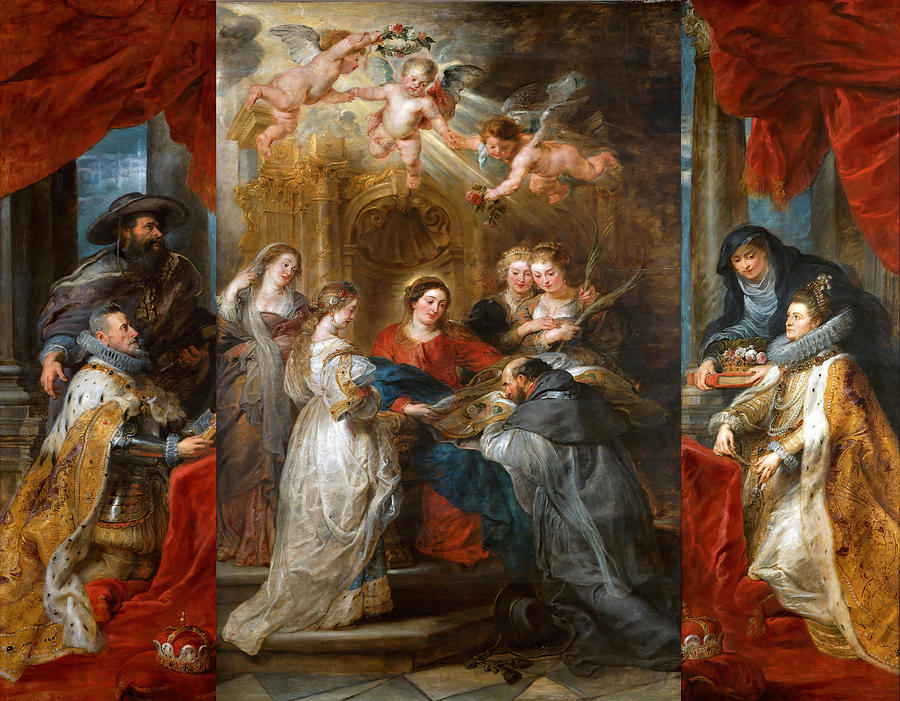
“The Triptych of Saint Ildefonso Altar” is one of Peter Paul Rubens’ most dazzling large-scale religious ensembles. Conceived as an altarpiece, the work unites heavenly vision, courtly magnificence, and intense personal devotion within a single sweeping composition. At the center the Virgin Mary, surrounded by a choir of female saints, appears in a richly decorated chapel. At her feet Saint Ildefonso, the learned bishop of Toledo, kneels in reverence while she bestows a liturgical vestment upon him. On the side panels, the sovereign patrons—Archduke Albert and Archduchess Isabella Clara Eugenia—kneel with their own retinues, linking their earthly rule to the celestial favors dispensed at the altar.
Rubens orchestrates these elements with quintessential Baroque energy. Curtains are drawn back like a stage, cherubs swirl overhead, fabrics shimmer, and the architecture glows with gold. Yet beneath the sumptuous surface lies a carefully structured program in which theology, politics, and personal piety intersect. The triptych presents Saint Ildefonso as champion of Marian doctrine, the Habsburg rulers as protectors of the Catholic faith, and the Virgin herself as source of grace for both Church and state.
Historical and Devotional Context
The Triptych of Saint Ildefonso was painted for the Brotherhood of Saint Ildefonso in Antwerp, a confraternity devoted to honoring the Virgin’s privileges. Saint Ildefonso, an early medieval bishop of Toledo, gained fame for defending the doctrine of Mary’s perpetual virginity. According to legend, the Virgin appeared to him in a vision and rewarded his zeal by presenting him with a miraculous chasuble. That episode, central to the confraternity’s identity, became the core subject of Rubens’ altarpiece.
At the time Rubens worked on this commission, the Spanish Netherlands were governed by the Habsburg couple Archduke Albert and Archduchess Isabella, devout Catholics who supported Counter-Reformation efforts to reinforce Catholic doctrine in their territories. By presenting them as kneeling donors alongside Saint Ildefonso, Rubens connects their rule to the saint’s defense of orthodoxy and to Mary’s protection. The altarpiece thus served not only as an object of worship but also as a visual affirmation of the religious and political order in seventeenth-century Flanders.
Overall Structure of the Triptych
Although conceived as three hinged panels, the triptych reads visually as a unified spectacle. A pair of massive red curtains frames the scene on both sides, like drapes drawn aside at the beginning of a play. Behind these curtains unfolds a grand architectural setting: stone columns, gilded altarpieces, and vaulted spaces that recede into depth. This stage-like arrangement underscores the idea that the altar is the place where heavenly mysteries become visible.
The central panel concentrates the main action. Saint Ildefonso kneels in the foreground, flanked by attendant clerics, with the Virgin seated slightly elevated on a dais. Around her, a semicircle of female saints and angels forms a radiant court. Above, hovering putti crown the Virgin with a garland of flowers and extend roses and palms, linking the earthly ceremony to the rejoicing of heaven.
The side panels mirror each other compositionally. On the left, Archduke Albert, clad in armor and enveloped in a golden cloak, kneels before the central vision. Behind him stand a bearded attendant and a richly dressed noblewoman. On the right, Isabella sits enthroned in elaborate robes, attended by a veiled nun-like figure presenting a crown of flowers and jewel-studded ornaments. Both donors are turned toward the central panel, visually and spiritually participating in the miraculous scene.
The Central Panel: The Virgin and Saint Ildefonso
At the heart of the composition Mary sits in a relaxed yet authoritative pose. Her red dress and blue mantle recall traditional Marian colors, emphasizing her role as Mother of Christ and Queen of Heaven. The cloth folds flow in soft, rounded rhythms, echoing the tenderness of her expression. Mary’s head tilts slightly downward as she looks at Saint Ildefonso with gentle approval, her right hand touching his new vestment in a gesture of offering.
Saint Ildefonso kneels on the steps below her, his body bent forward in an attitude of deep reverence. He wears ecclesiastical robes, but his posture suggests a man overwhelmed by grace rather than a proud prelate. With both hands he receives the chasuble, pressing it almost to his lips, as though kissing a sacred relic. The fabric of the vestment is opulent—gold, blue, and white embroidered with complex patterns—yet Rubens paints it with fluid brushstrokes that emphasize movement rather than static display. The folds cascade over Ildefonso’s arms and onto the steps, visually linking him to Mary.
To the left of the Virgin stands a group of elegantly dressed women, some carrying palm branches, others holding books or flowers. These figures are usually understood as virgin martyrs and holy women—saints who, like Ildefonso, have defended or exemplified Marian virtues. Their presence forms a courtly entourage around Mary, reinforcing her status as Queen of Saints. On the right side of the central panel another group of female saints, similarly adorned with crowns and palms, completes the semicircle. The central gathering thus presents the Church Triumphant, with Ildefonso as representative of the Church Militant on earth.
Angelic Realm and Heavenly Architecture
Above the central group the architecture opens upward into a more luminous zone where angels and putti hover. The gold of the altar canopy, the bright sky beyond, and the soft flesh tones of the angels all merge into a glowing haze that suggests a heavenly light invading the sanctuary. Two plump cherubs fly directly over Mary, holding a wreath of flowers that they lower toward her head. Their floating bodies and fluttering draperies introduce a playful energy that contrasts with the solemnity below.
Another angel approaches with roses and perhaps thorns, symbols associated with Mary’s joys and sorrows. Rubens delights in painting these airborne figures, giving them twisting poses and rosy cheeks that proclaim the exuberance of Baroque art. Yet they are not merely decorative; they function as intermediaries between heaven and earth, echoing the liturgical belief that angels are present at the Mass and join in human worship.
The architectural backdrop reinforces the sense of sacred space. Behind Mary rises a carved golden structure that resembles a richly ornamented altar or niche. Its curving lines, moldings, and sculpted figures frame her like an elaborate throne, implying that she is both statue and living presence. The interplay of stone, gold, and open sky suggests that the ceremony takes place at a point where earthly church architecture meets the luminous architecture of heaven.
The Left Panel: Archduke Albert as Devoted Ruler
On the left wing Rubens portrays Archduke Albert kneeling in profile, hands clasped in prayer, head slightly tilted upward toward the central miracle. He wears armor beneath a sumptuous robe of gold-embroidered fabric lined with ermine, visually uniting military authority and princely splendor. The heavy folds of his cloak pool around his knees and extend toward the viewer, emphasizing his tangible presence and status.
Behind Albert stands a tall figure believed to be Peter Paul Rubens himself, dressed as a courtier or officer in a broad-brimmed hat and dark cloak. He rests his hand on a stone balustrade and looks toward the central panel, as though witnessing and endorsing the devotion of his patron. If this identification is correct, the artist has inserted himself discreetly into the altarpiece, bridging the world of royal donors and the world of the images he created.
In front of Albert, near the bottom edge of the panel, a royal crown and other regalia rest on a red cushion. By setting aside his crown as he kneels, the archduke symbolically acknowledges that his earthly authority is subordinate to divine authority and to Mary’s queenship. His posture and expression convey humility rather than arrogance; he appears as a Christian ruler seeking the saint’s and the Virgin’s intercession rather than demanding favors.
The Right Panel: Isabella Clara Eugenia and Dynastic Piety
The right wing mirrors the left but focuses on Isabella Clara Eugenia. She sits enthroned, robed in an opulent gown of gold and white, with a high ruff framing her face and long strings of pearls cascading across her chest. Her crown, like Albert’s, rests below her on a cushion, signifying that she comes before the altar not as sovereign but as supplicant. Yet her upright posture and composed expression also communicate the dignity and responsibility of a Catholic princess.
Beside her stands a veiled woman in dark clothing, probably a nun of the Poor Clares, presenting a tray with a floral crown and jewels. This attendant symbolizes Isabella’s personal commitment to religious life—after Albert’s death she took the habit of the Poor Clares while continuing to govern. The offering of the floral crown suggests a spiritual exchange: worldly crown for crown of virtue, political power for sanctity. It also echoes the garlands held by the angels above Mary, linking Isabella’s devotion to the heavenly court.
The architectural setting on this side panel echoes that of the left: stone columns, red curtain, glimpses of sky. The repetition of forms visually balances the composition and reinforces the idea that both sovereigns approach the same central mystery from opposite sides, united in faith and purpose.
Color, Light, and Baroque Splendor
Rubens’ color palette in the triptych is extraordinarily rich. Reds, golds, deep blues, and creamy flesh tones dominate, punctuated by touches of white and black that provide contrast and rhythm. The massive red curtains at the sides create a framing device and inject warmth and theatricality. The gold embroidery of the donors’ robes, the gilded altar structure, and the halos and crowns of the saints shimmer with reflected light, giving the entire scene a sense of opulence befitting both heavenly glory and Habsburg magnificence.
Light flows primarily from above and slightly from the front, illuminating faces and key elements while leaving other areas in softer shadow. Mary’s face and red garment form a luminous focus at the center; the kneeling Ildefonso, the donors, and the angels all receive carefully modulated light that guides the viewer’s eye. Rubens uses subtle transitions of value rather than harsh contrasts, creating a glowing, enveloping atmosphere that feels almost like candlelight multiplied on a grand scale.
The painter’s brushwork varies according to material. Fabrics, especially the donors’ robes and the angels’ draperies, are rendered with broad, sweeping strokes that suggest movement and texture. Faces and hands, by contrast, are painted with more precise touches, capturing expressions and gestures with sensitivity. The overall effect is one of vitality and abundance, a feast of color and form designed to inspire awe in worshippers while demonstrating Rubens’ virtuosity.
Symbolism, Theology, and Political Message
Beyond its visual splendor, the Triptych of Saint Ildefonso Altar communicates a complex network of meanings. At its theological core lies the affirmation of Mary’s special status in Catholic belief. By depicting the moment when she rewards Ildefonso for his defense of her perpetual virginity, Rubens presents Mary as active participant in Church history and as dispenser of grace to those who champion her honor. The chasuble she grants symbolizes not only liturgical authority but also the protection she extends over the clergy and faithful.
The numerous female saints surrounding Mary underline key Marian virtues: purity, martyrdom, steadfastness in faith. Their palm branches, crowns, and books refer to their individual stories while collectively forming an ideal of holy womanhood. For the confraternity and viewers, these saints were powerful intercessors and role models, reinforcing Counter-Reformation emphasis on the communion of saints.
Politically, the presence of Albert and Isabella connects the saint’s heavenly reward to the earthly governance of the Spanish Netherlands. Their kneeling figures express the ideal of a Catholic monarchy humbled before God, committed to defending orthodoxy just as Ildefonso did. The crowns set aside on cushions testify that kingship itself is a trust granted by divine authority and subject to the higher kingship of Christ and the queenship of Mary.
At the same time, the donors’ splendid costumes and prominent placement communicate their status and beneficence. Viewers in Antwerp would recognize them and understand that the prosperity and security of their region were linked to this devout ruler couple. The triptych thus functions as both devotional image and dynastic monument.
Rubens’ Mature Baroque Style
This altarpiece shows Rubens at the height of his mature Baroque style. The composition is full of diagonals and swirling rhythms: the sweep of Ildefonso’s robes, the arcs of the curtains, the flight of the angels. Figures overlap and interact in complex groupings, creating a sense of crowded yet harmonious activity. Rubens avoids rigid symmetry by giving each side subtle variations while maintaining overall balance.
His interest in the human body is evident in the graceful movements of the saints and cherubs, whose limbs and torsos twist in contrapposto. Yet unlike the muscular figures of his earlier mythological works, these bodies appear softer and more lyrical, reflecting the devotional context. Rubens’ gift for portraiture appears in the individualized faces of the donors, whose likenesses are convincing and psychologically rich despite their idealized setting.
The triptych also illustrates Rubens’ skill in integrating different genres—portraiture, history painting, and allegory—into a single coherent work. He merges the grandeur of court ceremony with the intimacy of personal prayer, the opulence of state with the humility of the saint’s kneeling posture. This synthesis is a hallmark of his art and a reason the triptych continues to captivate viewers.
Legacy and Meaning for Modern Viewers
Today, “The Triptych of Saint Ildefonso Altar” can be appreciated on multiple levels. For art historians, it is a key example of Rubens’ collaboration with powerful patrons and his mastery of large-scale ecclesiastical commissions. For those interested in religious history, it visualizes core Counter-Reformation ideas about Mary, the saints, and the role of Catholic rulers. For general viewers, it offers an immersive experience of Baroque color, movement, and emotion.
Even outside its original liturgical context, the altarpiece speaks to enduring human themes: the longing for protection and favor, the relationship between spiritual authority and political power, the desire to see heaven and earth in harmony. Rubens invites us to imagine standing before this altar as members of the congregation, watching as curtains open on a vision where saints, rulers, and humble faithful gather in the presence of the Virgin. The painting becomes a shared stage on which every viewer is implicitly included.
In this way, the Triptych of Saint Ildefonso Altar stands not only as a masterpiece of Baroque art but also as a testament to Rubens’ ability to weave together beauty, belief, and human aspiration into one radiant image.