Image source: wikiart.org
Introduction
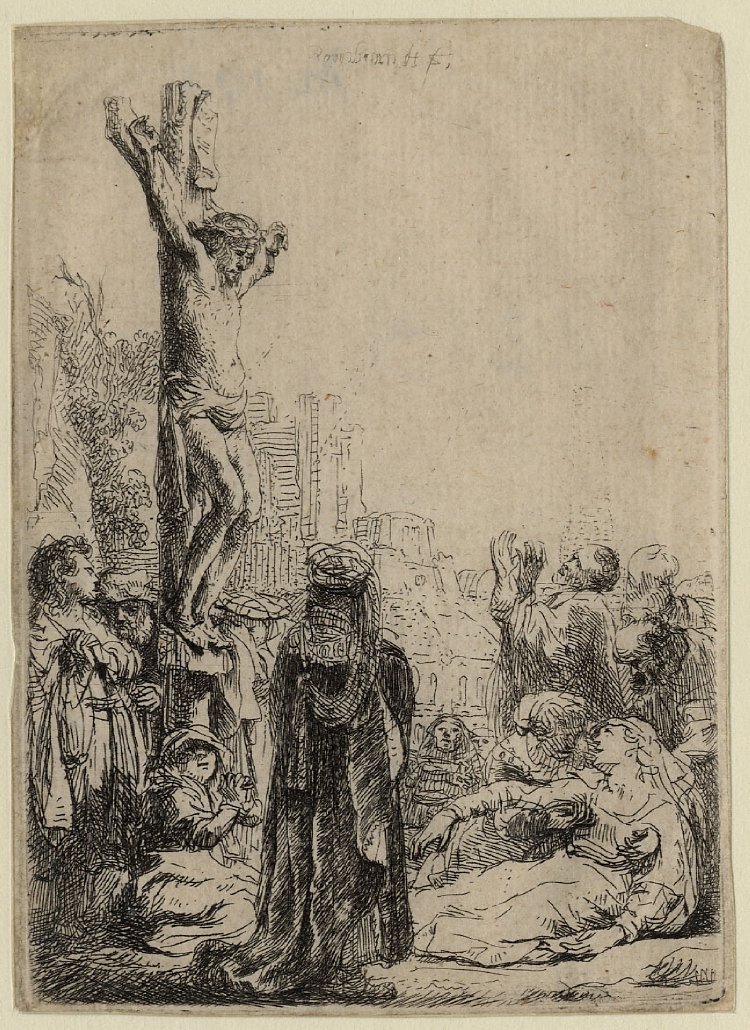
Rembrandt’s “The Tribute Money” (1635) is one of those small but inexhaustible etchings that reward every additional minute of looking. In a few inches of inked paper he stages an entire public debate: Christ confronted by a semicircle of legal minds, a coin held up for inspection, heads leaning in like question marks, a faint radiance breaking behind the teacher’s brow. The plate feels compact and intimate, yet the ideas inside it are civic in scale. What do we owe the state? What do we owe God? How does a wise answer re-order the emotions of a crowd? Rembrandt addresses those questions not with slogans or allegorical banners but with compositional logic, a choreography of hands, and light that behaves like understanding itself.
Historical Setting And Why The Subject Mattered In 1635
The “tribute” trap posed to Jesus appears in the synoptic Gospels and was already a favorite subject for Northern artists by the seventeenth century. But the theme had fresh bite in the Dutch Republic of Rembrandt’s day, where citizens navigated layered loyalties to city, province, States General, and Reformed confession. Taxes funded fleets and bulwarks, yet sermons emphasized the primacy of conscience before God. Rembrandt, new to Amsterdam and hungry for subjects that allowed him to test the theater of public persuasion, could hardly have found a better scene. He chooses the moment not of accusation or verdict but of instruction. The state is present in the coin and in the architecture of the temple precinct; divine claim is present in the human faces and in the restrained nimbus of lines around Christ’s head. The etching becomes a piece of civic pedagogy fit for the portfolio of any merchant or magistrate who owned it.
Composition As A Reasoned Argument
The plate is designed like a sentence with clauses and punctuation. Christ stands slightly left of center, feet grounded, torso turning toward the crowd, right hand lifted in a measured gesture. To his right a wedge of figures builds in density—cloth layered on cloth, shoulders mounting in a stair of diagonals—until the eye arrives at the open palm presenting a small coin. From there the gaze loops upward along noses and brows back to the radiant head, and then down again to quieter listeners at left. The loop is not decorative; it re-enacts the logic of the teaching. Begin with the teacher, observe the object, consider its inscription and image, and return to the person whose words clarify what belongs where. The composition thereby models ordered thought in a world that, like our own, often confuses volume for truth.
Chiaroscuro That Thinks Rather Than Decorates
Rembrandt’s light falls where comprehension grows. He avoids theatrical clouds or supernatural floodlamps; instead he scratches a corona of tight rays that feel as quick and efficient as a good answer. Around that center he graduates value carefully. Faces nearest Christ are readable and nuanced; the farther you travel into the knot of questioners, the more hat brims and beards sink into cross-hatched dusk. Darkness never condemns, but it asks the viewer to work harder—just as prejudice and anxiety make real hearing harder. The result is a moral weather system. The air is clearest where wisdom is offered; it thickens where motives cloud.
Gesture And The Silent Grammar Of Debate
Words are absent, yet the print is all speech. Christ’s raised hand articulates without accusing: the index finger slightly lifted, the others relaxed, the palm open as if weighing. The opposite hand gathers the robe, cinching the torso’s turn toward the questioner who shows the coin. That man’s palm is unmistakably presenting rather than clutching—a key distinction in a scene about possession. Another hand at the right margin curls inward, the visual equivalent of skepticism; a bearded elder presses fingers into chin and cheekbone, a universal signal for thought; a younger face tilts upward, eyes bright, ready to be convinced. If you read nothing but the hands, you would still follow the whole argument from snare to solution.
The Coin As The Plate’s Smallest Yet Heaviest Actor
The denarius is scarcely more than a bright nib of paper ringed by a few decisive lines, but everything pivots on it. Its stamped likeness is the hinge that lets Christ separate jurisdictions: Caesar’s coin with Caesar’s image circulates in Caesar’s order; people, bearing God’s image, belong to God. Rembrandt underscores the paradox: the thing that seems most solid and politically real—the coin—is visually insubstantial compared to the faces. It flashes for a moment; the human countenances, varied and particular, carry the lasting weight of likeness.
The Crowd As A Spectrum Of Motives
One of Rembrandt’s rare gifts is granting a group psychological complexity without chaos. Here we meet no faceless “Pharisees,” but individuals arrayed across a spectrum of motive. A sincere inquirer leans forward so far his nose nearly crosses the line of Christ’s sleeve; a legalist calculates the public effect of any answer; a status-conscious figure holds back, unwilling to concede a point in front of peers; a quiet listener at the far left seems content to be taught. Because the crowd is mixed, the image avoids the comfort of a simple hero-villain polarity and instead models what real civic conversations feel like: desire, pressure, care, and suspicion folded together in one space.
Architecture, Setting, And The City Beyond The Plate
Behind the knot of figures Rembrandt sketches a light-struck corridor of arches and stair. This is more than background. It signals that the conversation takes place within civic-religious architecture—precisely the realm where the question bites. It also gives the eye an exit, a way to imagine the teaching walking outward into courts, markets, and homes. The etching insists that correct distinctions made in the temple must travel into the ordinary arithmetic of paying and giving. The trace of sky that peeks through feels like breath after intense reasoning: the world opening beyond the argument.
Clothing And The Social Script Of Fabric
The subject sits in robes and turbans but speaks to the politics of attire. Rembrandt’s questioners wear layered garments that announce status: heavy sleeves with patterned hems, caps piled high, cloaks with lined interiors whose density he achieves by compact cross-hatching. Christ’s clothing is plenitude without pretension—shaped by light more than by ornament. The differential is not a sneer at elites; it is a visual map of where various kinds of authority lodge. Rank signals itself in fabric and silhouette; moral authority inhabits a human presence that remains readable even when the robe dissolves into shadow.
Etching Technique And The Pulse Of Thought
Rembrandt’s hand moves across copper with different speeds. In the halo the lines are quick, nearly calligraphic slashes; in the faces the line slows, curves, and thickens to carry eyelids, nostrils, and the soft planes of cheeks; under cloaks the strokes stack densely to make shade. Occasionally he leaves a veil of plate tone on the paper and wipes it thinner around Christ’s head and the palm with the coin. That subtle manipulation of ink turns atmosphere into argument—the air literally clearer where the lesson coalesces.
Authority Without Domination
Many artists render Christ’s authority by height, throne, or scepter. Rembrandt renders it by poise. He neither towers nor threatens. His feet press lightly but securely into the paving; his head inclines toward his questioners rather than away; his gesture invites attention rather than compels it. Such body language makes sense for a teacher who will refuse both political sedition and political idolatry. The print quietly claims that authority grounded in truth can stand in the middle of a crowd without theatrical protection.
Listening On The Margins And The Birth Of Text
At the plate’s left edge sits a scribe-like figure bent over a tablet. He functions like a hinge between oral moment and written memory. The Gospel story we know emerged from such acts: hearing converted to script, heat of presence translated into ink. Rembrandt keeps this recorder at the periphery as a tactful reminder that texts should preserve rather than replace the human warmth of debate. The etching itself participates in that preservation by carrying the moment into hundreds of homes.
Theology Without Trappings
The scene contains no oversized emblems, no angels, no thunderous cloud-rents. Theology enters by composition. Caesar’s realm is represented by the coin and by the architecture that organizes public life. God’s realm is represented by persons stamped with divine likeness and by the radiant clarity granted in the act of teaching. The lines “render to Caesar… to God” become visual: two centers, two circles, two rightful claims. Viewers receive an invitation to order their loyalties accordingly.
Close Reading Of Faces And What They Teach
Spend time with the heads and you learn a small course in rhetoric. The elder with deep-set eyes and a heavy beard, positioned near the coin, seems invested in precedent; the younger with mobile eyebrows hungers for a sentence that will allow integrity within complicated civic life; the man half in shadow, a little withdrawn, embodies the fear that any answer—however wise—will threaten status. Rembrandt refuses caricature. Doubt is rendered with sympathy, confidence without smugness. The faces make the etching a tool not only for devotion but for training in public charity.
The Denarius As Mirror For Modern Allegiance
The print’s endurance lies in the way the coin turns into a mirror. What do you hold that bears the stamp of temporal authority—salary, credential, passport, platform—and therefore rightly circulates in civic structures? What bears the imprint of divine image and therefore belongs to God—your neighbor’s dignity, your conscience, your capacity for love? The etching is not a policy paper. It is a device for rehearsal, a way to practice this distinction in the mind so that the hand can act with steadier peace.
Dialogue With Rembrandt’s Other Public Teachings
Placed next to the “Hundred Guilder Print” or “Christ Preaching,” this plate reads like a sonnet to their epic. The same humane curiosity governs: sick and healthy, rich and poor, curious and hostile gather around one voice. But here Rembrandt chooses intensity over extension. No broad crowd of children and elders spreads into landscape. Instead he compresses thought to a single exchange: coin, hand, face, hand, light. The compression gives the scene its force. You carry it in memory like a proverb.
Variations Across Impressions And The Plate’s Living Life
Collectors know that Rembrandt printed his plates with different inking strategies, leaving more or less plate tone and sometimes strengthening burrs with drypoint. “The Tribute Money” benefits from such play. In darker impressions the surrounding architecture broods, and the radiance pops; in cleaner ones the faces gain transparency and the coin glitters more crisply. The scene therefore possesses a living weather. As the plate wore and was reprinted, the debate gained different temperatures—appropriate for an image about truths applied in many circumstances.
The Civic Uses Of A Small Etching
Unlike an altar painting, an etching is a domestic object. It can sit in a study, be shown to a dinner guest, folded into a portfolio to travel in a coat. That portability made Rembrandt’s moral theater available to merchants, clerks, and pastors who could contemplate it at leisure. The print’s smallness is part of its ethic: serious thinking does not always require trumpets; it requires attention, which a small sheet elicits by asking viewers to come near.
Practical Seeing: How To Approach The Plate
Begin at the coin. Let it pull your eye to Christ’s hand. Follow the line up to the arc of light and out across the semicircle of faces. Pause at the bearded listener who rubs his cheek. Return to the coin and then, finally, look at the narrow corridor of architecture that opens behind the group. This path through the image recapitulates the teaching itself—object, wisdom, community, world—and it slows the mind enough to feel the subtle release that spreads across the crowd when a good answer lands.
Contemporary Resonance Without Anachronism
We are still citizens straddling jurisdictions—workplaces with policies, states with laws, communities with expectations, and consciences with stubborn claims. The brilliance of Rembrandt’s treatment is that it neither baptizes the state nor scorches it; it puts the coin in its place and the person in theirs. The etching therefore becomes a contemplative tool for readers of any era who want to honor both the necessities of civil life and the inviolable image stamped on every neighbor.
Conclusion
“The Tribute Money” is a small miracle of pictorial reasoning. With an ordered semicircle of bodies, a glint of metal, and a few rays of thoughtful light, Rembrandt transforms a political trap into a luminous lesson about ordered loves. Composition argues; chiaroscuro clarifies; gestures speak. The crowd arrives as a tangle of motives and leaves as a community that, if not fully convinced, has at least been reoriented by a wiser center. Few images accomplish so much with so little. Four centuries later, the coin still flashes, the faces still listen, and the viewer still feels both summoned and relieved by the calm authority at the plate’s heart.