Image source: wikiart.org
Context and Origin of “The Toilette”
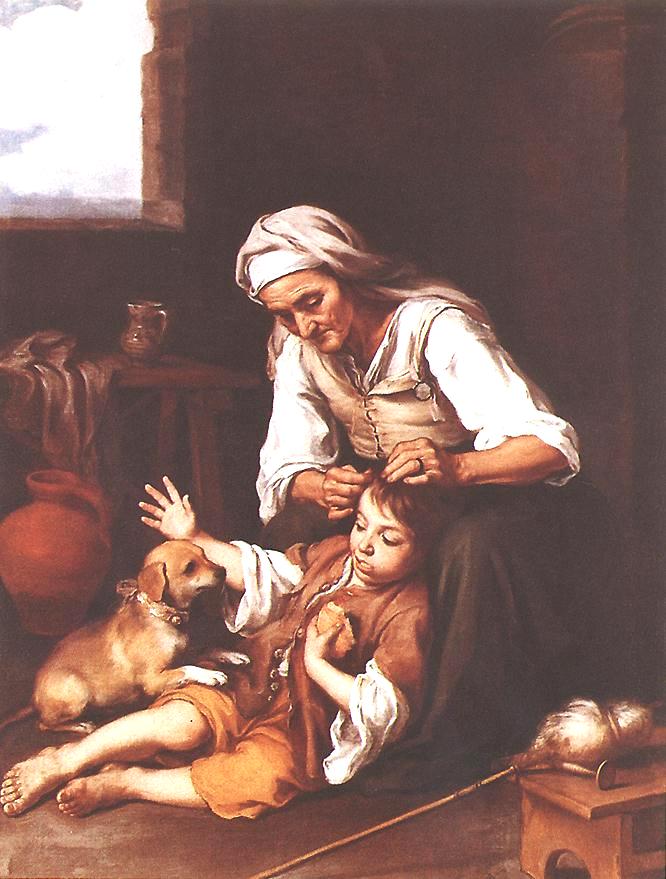
“The Toilette” by Bartolome Esteban Murillo, painted around 1675, belongs to the group of intimate genre scenes for which the Sevillian master is so admired. At a time when religious commissions still dominated Spanish art, Murillo turned his gaze toward the humbler corners of everyday life. In this painting he offers a quiet moment between an older woman and a young boy, set in a modest interior that speaks of poverty, tenderness, and routine care. Rather than glorifying aristocratic refinement, Murillo elevates the simple act of grooming a child into a subject worthy of sustained contemplation.
The work appears during the mature phase of Murillo’s career, when he had already mastered the soft, vaporous handling of light that characterizes his style. The artist lived and worked in Seville, a prosperous port city that had simultaneously known great wealth and deep misery. Orphaned children, beggars, and working women were part of the daily urban landscape. Murillo painted them with a sympathetic eye, suggesting that dignity and grace could be found in their lives as much as in the lives of saints and nobles. “The Toilette” fits perfectly into this humanistic vision, transforming a mundane domestic task into a scene of affectionate intimacy.
An Intimate Domestic Scene
At first glance, the composition is disarmingly simple. An elderly woman sits with a boy at her feet, carefully parting his hair with her fingers. The child reclines against her knees, clutching a piece of bread with one hand while raising the other in a gesture of mild protest or playful distraction. A small dog, alert and eager, noses toward the food in the boy’s hand. The setting is a plain, shadowed interior with a view of sky through a window at the left, rough pottery on a stool, and a broom leaning against the wall. Nothing here belongs to a luxurious household. The simplicity of the environment emphasizes the ordinary nature of the moment.
Yet the interaction between the figures adds emotional depth. The woman bends forward with focused attention, her expression both stern and caring, as if she has performed this task countless times before. The boy’s relaxed body and half closed eyes suggest trust and familiarity. He is not rigid with fear or discomfort; rather, he allows himself to be cared for even while half distracted by his bread and the dog at his side. Murillo captures a universal scene recognizable in any era: a caregiver patiently tending to a child who would rather be doing something else.
Composition and Focal Points
Murillo organizes the painting around a triangular structure that stabilizes the scene and directs the viewer’s gaze. The apex of the triangle is the bowed head of the woman, while its base stretches along the boy’s reclining body. This triangular arrangement unifies the two figures and establishes their bond as the central subject. The woman’s arms frame the boy’s head, creating a visual circle of protection and care around the child. Within this circle, the boy’s face becomes the primary focus, softly illuminated and gently modeled.
The dog and the objects around the figures are carefully placed to balance the composition. The animal occupies the lower left, its head angled toward the boy’s bread, echoing the diagonal of the child’s extended arm. On the right, the broom and the bundle of wool or cloth create vertical and horizontal accents that counterbalance the mass of the figures. The open window in the upper left introduces an area of bright sky, preventing the interior from feeling oppressively dark and offering a subtle suggestion of the world beyond the room. Murillo’s compositional choices keep the viewer’s eye moving in a circular rhythm, from the woman’s face to the boy, down to the dog, and back up again.
Light, Color, and Texture
Light plays a crucial role in shaping the emotional tone of “The Toilette.” A soft, warm illumination enters from the left, bathing the figures in a gentle glow. The older woman’s sleeves, the boy’s face and limbs, and the dog’s fur are all touched by this light, which seems to caress rather than pierce. Murillo avoids harsh contrasts and instead favors gradual transitions between light and shadow, creating an atmosphere of calm intimacy. The darker background throws the main group into relief while still allowing details of the setting to emerge.
Color contributes to this sense of warmth and familiarity. Earthy browns, muted oranges, and soft creams dominate the palette, evoking the tones of clay, wood, and worn cloth. The boy’s clothing, in shades of ocher and brown, harmonizes with the dog’s fur and the terracotta jar behind them, emphasizing their shared environment. The woman’s white sleeves and headscarf introduce cooler notes that catch the light, drawing attention to her role as caretaker. The limited range of colors strengthens the unity of the composition and suggests a world that is modest but not bleak.
Texture is rendered with Murillo’s characteristic sensitivity. The coarse fabric of the woman’s dress, the fraying edges of the boy’s garments, and the smooth glaze of the earthenware jar are all carefully distinguished. Even the dog’s fur is painted with quick, lively strokes that convey softness and movement. These tactile details invite the viewer to imagine the feel of the scene: the tug of fingers through hair, the roughness of bare feet on the floor, the warmth of the dog pressing against the child’s legs.
The Relationship Between Old Woman, Child, and Dog
One of the most compelling aspects of “The Toilette” is the interplay between the three living beings in the scene. The old woman’s attention is fixed on the boy’s head. Her hands are firm yet gentle, suggesting long practice in caring for him. Her age is evident in the wrinkles of her face and the veins on her hands, which contrast with the smoothness of the child’s skin. This contrast underlines the generational bond: experience and age caring for innocence and youth.
The boy, though slightly restless, seems secure. His body leans comfortably against the woman’s legs, his bare feet extended toward the viewer in an almost vulnerable way. The raised arm may indicate a momentary attempt to escape the discomfort of grooming, or it may simply be part of an animated conversation with the unseen world outside the frame. The piece of bread in his other hand hints at the continuity of daily routine: eating, grooming, playing, all woven together in one moment.
The dog serves as a bridge between child and viewer. With its keen gaze fixed on the bread, it provides a touch of humor and liveliness. The animal’s presence reinforces the domestic character of the scene. Dogs often symbolize loyalty and companionship, and here the small pet suggests that affection is not limited to human relationships. At the same time, the dog’s interest in the bread hints at scarcity, reminding us that food may be precious in this modest household.
Everyday Life and Social Commentary
Although “The Toilette” presents an intimate domestic moment, it also reflects the social realities of seventeenth century Spain. Murillo’s Seville was home to significant poverty, particularly among children. In several of his works he depicted ragged street boys eating fruit, playing dice, or sleeping outdoors. Compared to those images, the boy in “The Toilette” is somewhat better off: he has a caregiver, a roof over his head, and a loyal dog. Yet his bare feet, patched clothing, and simple diet of bread reveal the economic limitations of his world.
The older woman’s clothing and surroundings likewise indicate modest means. The unadorned walls, the basic pottery, and the broom speak of a household maintained through constant labor rather than wealth. By focusing on such a setting, Murillo draws attention to people who might otherwise be considered unworthy of pictorial representation. His sympathetic portrayal suggests that daily care within a poor home has as much value as the ceremonious rituals of the elite.
Viewers of the time, especially those from the upper classes, may have seen in this painting a reminder of their responsibility toward the poor. Murillo often collaborated with charitable institutions, and his images of children and humble families helped promote compassion. “The Toilette” can thus be read as both a celebration of simple domestic affection and a subtle moral appeal to empathy with the less fortunate.
Spiritual and Moral Resonances
While “The Toilette” is a secular genre scene, it carries spiritual undertones characteristic of Murillo’s work. The act of grooming a child can be interpreted as a metaphor for care of the soul. Just as the woman removes dirt or parasites from the boy’s hair, spiritual guidance seeks to cleanse the heart of vice and error. The patience and attention embodied in the woman’s posture echo the virtues of charity and humility praised in Christian teaching.
The light that falls so tenderly upon the figures may also evoke a quiet sense of grace. There is no overt religious iconography in the room, yet the serenity of the composition and the gentle interplay of gazes suggest a world suffused with a higher benevolence. Murillo frequently blurred the boundaries between sacred and everyday realms, showing that holiness could be found in ordinary acts of care. “The Toilette” exemplifies this approach, elevating maternal or grandmaternal duties into gestures that carry moral and even spiritual resonance.
For contemporary viewers, the painting can evoke reflection on the value of caregiving in all its forms. The older woman’s work is unglamorous and repetitive, yet it is essential to the boy’s wellbeing. Murillo invites us to recognize the dignity of such labor, which often remains invisible and undervalued.
Murillo’s Style and Technique in “The Toilette”
In technical terms, “The Toilette” reveals Murillo at a confident stage in his artistic development. His brushwork is soft yet assured, and he employs a subtle sfumato that gently blurs contours, especially in the faces and hands. This softness heightens the emotional warmth of the scene. The boy’s skin is modeled with delicate transitions, while the woman’s features are defined with greater firmness, reflecting her age and character.
Murillo’s command of chiaroscuro is evident in the way he balances illuminated areas with deep shadows. The dark background does not simply function as empty space; it suggests the enveloping quiet of the interior and helps to isolate the figures psychologically from the outside world. The small patch of blue sky glimpsed through the window introduces cool light that contrasts with the warm tones inside, giving the scene depth and a sense of air.
Perspective and scale are carefully handled so that the viewer feels close to the figures, almost sharing the floor with the boy and dog. The low viewpoint emphasizes the child’s world rather than that of the adult. This choice subtly centers the experience of the boy, reinforcing the painting’s compassionate outlook toward children as subjects worthy of attention in their own right.
Emotional Impact and Modern Relevance
Although painted in the seventeenth century, “The Toilette” continues to resonate with modern viewers because it addresses timeless themes: family care, childhood vulnerability, and the quiet heroism of everyday labor. The scene could take place in many cultures and eras, with minor changes in dress and furnishings. This universality explains why Murillo’s genre paintings remain popular, even among audiences who may know little about Spanish Baroque art.
In the context of contemporary discussions about social inequality and the value of unpaid domestic work, the painting feels particularly relevant. The older woman’s effort is not spectacular or publicly rewarded, yet it is vital. Many viewers may recognize in her the figure of a grandmother, mother, or caregiver who shaped their own lives through similar acts of routine care. Murillo gives visual form to that often invisible love.
The boy’s relaxed posture and the playful presence of the dog also contribute to the painting’s emotional appeal. There is a tender humor in the animal’s yearning for the bread and the boy’s distracted gesture. These small details lighten the seriousness of the scene and make the figures feel alive. The painting invites the viewer not only to admire Murillo’s skill but also to remember affectionate moments from their own childhood.
Place of “The Toilette” in Murillo’s Oeuvre
Within Murillo’s broader body of work, “The Toilette” stands as an important example of his ability to merge genre painting with moral and emotional depth. Alongside his images of street urchins and beggar children, this canvas forms part of a larger project that sought to humanize the poor and to represent children with tenderness rather than mockery. The presence of a caring adult distinguishes this painting from some of his more tragic scenes of abandoned youth, emphasizing the stability and protection that family can provide.
At the same time, the painting displays many of the stylistic qualities that made Murillo one of the most admired Spanish painters of his era: luminous flesh tones, gentle modeling, and a warm tonal range. It demonstrates how he could apply techniques usually reserved for religious altarpieces to the depiction of ordinary people, thereby narrowing the gap between sacred and secular art.
Today “The Toilette” is often studied as a key work for understanding Murillo’s contribution to the evolution of genre painting in Spain. It shows that everyday life, especially the lives of the poor, could be treated with the same seriousness and sensitivity as more conventional subjects. In doing so, it paved the way for later artists who would continue to explore humble domestic scenes as vehicles for emotional and social insight.
Conclusion
“The Toilette” by Bartolome Esteban Murillo is far more than a simple picture of a woman grooming a child. Through careful composition, delicate light, and nuanced characterization, Murillo transforms an ordinary moment into a meditation on care, poverty, and human dignity. The triangular arrangement of figures, the warm earth tones, and the interplay of gazes and gestures all work together to create a scene that feels both specific to seventeenth century Seville and timeless in its emotional truth.
The painting reminds viewers that genuine beauty can be found in the most modest environments. A humble interior, a worn garment, or a simple piece of bread can become vehicles for expressing tenderness and moral reflection. Murillo’s sympathetic attention to the lives of the poor encourages empathy and invites us to recognize the quiet value of caregiving in our own world. “The Toilette” thus endures not only as a masterpiece of Baroque painting but also as a moving tribute to the everyday acts of love that sustain human life.