Image source: wikiart.org
Introduction to “The Three Graces”
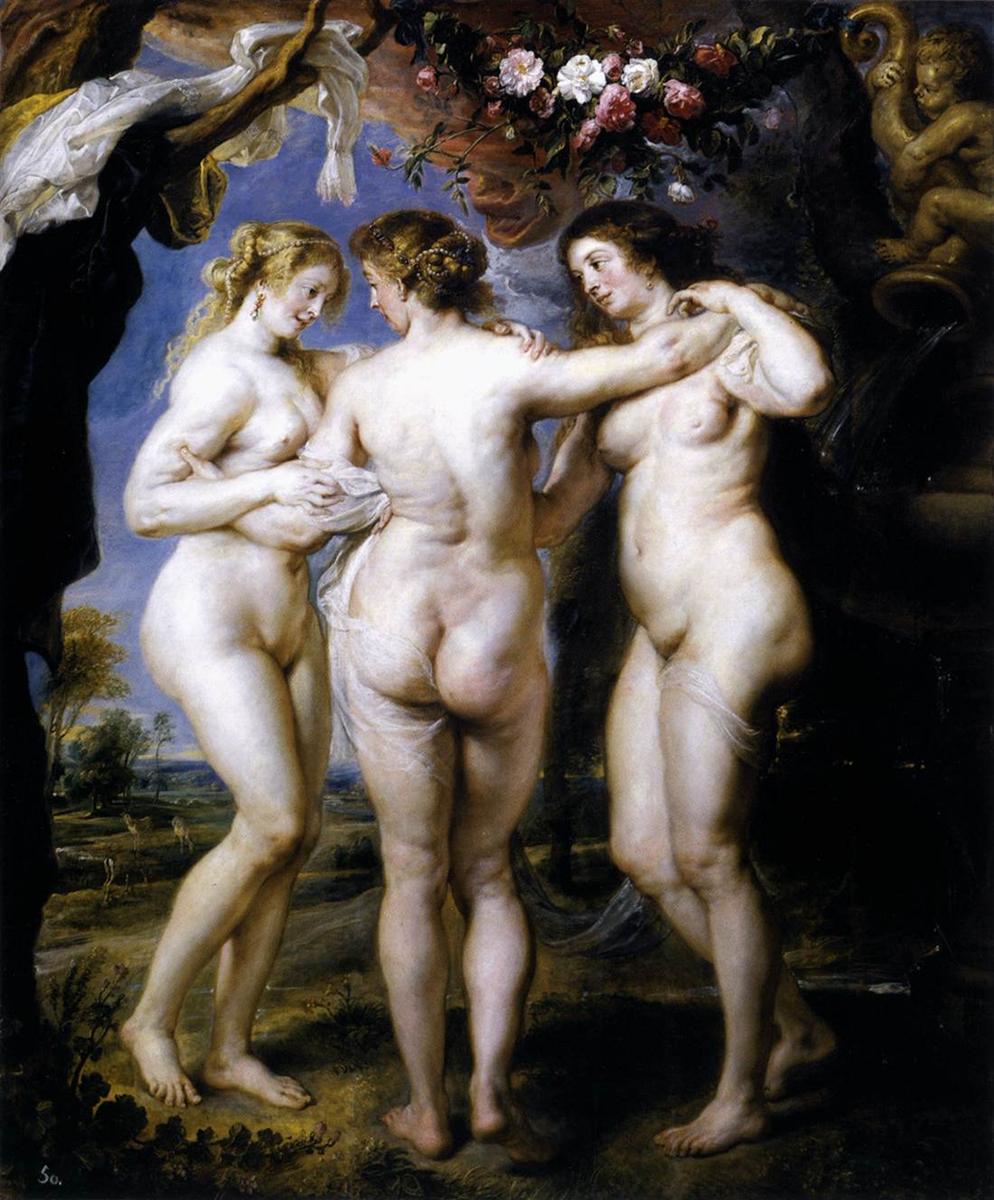
“The Three Graces,” painted by Peter Paul Rubens around 1639, is one of the most celebrated images of feminine beauty in European art. The canvas presents three nude women standing closely intertwined in a shallow landscape, their bodies forming a flowing circle of flesh, gesture, and gaze. Garlanded roses above their heads and a sculpted fountain with a child-like figure to the right frame the group, while a quiet countryside stretches into the distance behind them.
In classical mythology the Three Graces—Aglaia, Euphrosyne, and Thalia—are attendants of Venus and embodiments of charm, splendor, and joy. Rubens transforms this ancient theme into a deeply personal celebration of sensuality, abundance, and the pleasures of earthly life. Painted near the end of his career, when he was married to Helena Fourment and enjoying the comfort of his estates, the work reflects both his mature artistic style and his own ideal of beauty.
Mythological Background and Humanist Culture
The subject of the Graces has a long history in art, from ancient sculpture to Renaissance painting. Traditionally the three figures are shown nude, standing close together, sometimes with the central figure turned away from the viewer while the other two face forward—a composition Rubens adopts and intensifies. For humanists and collectors in Rubens’s time, mythological themes were not mere stories but vehicles for exploring philosophical ideas about harmony, love, and the generative forces of nature.
As companions of Venus, the Graces preside over all that is pleasing and attractive in the world: beauty, music, festive gatherings, and generous giving. Their linked hands often symbolize the circulation of gifts and affection, as each Grace gives to the next in an endless chain. In Rubens’s version, their embrace is more physical than symbolic; shoulders and arms drape over one another, and the soft pressure of hands on flesh makes the idea of mutual generosity tangible.
By choosing this subject late in life, Rubens aligns himself with a classical tradition while also asserting his own interpretation. His Graces are not remote goddesses but women full of warmth and presence, inviting contemplation rather than worship.
Composition and Circular Harmony
Rubens organizes the three figures into a tight, almost circular composition. The central Grace stands with her back to the viewer, head turned to the left, while her arms extend outward to touch her companions. The figure on the left faces inward, tilting her head in a gentle, almost shy gesture, while the one on the right looks outward, meeting our gaze. Together they form a rhythmic sequence of turning bodies and mirrored poses.
This circular arrangement expresses the theme of unity and reciprocity. The eye moves from one figure to the next in an endless loop, never finding a clear beginning or end. The poses are carefully balanced: where one leg is bent, another is straight; where one shoulder rises, another falls. This interplay of opposites creates a sense of living balance, as if the group were slowly rotating on an invisible axis.
The background landscape is low and unobtrusive, allowing the figures to dominate the foreground. Trees and distant fields open a quiet horizon that frames the women without distracting from them. The garland of flowers overhead echoes the arc of their bodies, while the sculpted fountain on the right creates a vertical counterpart to the central figure’s spine.
Light, Color, and the Glow of Flesh
One of the most striking features of “The Three Graces” is the radiant treatment of skin. Rubens uses layers of warm pinks, creams, and golden tones to create flesh that seems to shimmer from within. Subtle transitions of light and shadow model the curves of shoulders, hips, and limbs, giving the figures a palpable weight and softness.
The lighting is gentle rather than theatrical. A broad, diffused light falls from the left, illuminating the left and central figures more brightly while leaving portions of the right figure and the background in richer shadow. This gradient of light helps shape the group and introduces depth into the shallow space.
Color accents are concentrated in details: the golden hair of the women, the red and pink roses above them, the warm brown and ochre tones of the tree trunk, and the muted blues and greens of the sky and landscape. These hues complement the flesh tones, enhancing their warmth. The white drapery that snakes around the figures and hangs from the tree adds a cool contrast, emphasizing the nudity by framing rather than covering it.
Rubens’s brushwork is fluid but controlled. Up close, one can see the lively strokes that create the texture of hair, the sheen on skin, and the soft blur of distant foliage. From a distance, these strokes blend into a harmonious whole, giving the painting its luminous, almost breathing quality.
Rubens’s Ideal of Beauty and Personal References
Rubens’s women have long been famous for their full, rounded forms—an ideal that differs from the slender, elongated figures favored by some earlier artists. In “The Three Graces,” this preference reaches its fullest expression. The bodies are robust, with soft curves, gently swelling bellies, and ample thighs. This sense of abundance aligns with Baroque ideas of vitality and with the painting’s theme of grace as generosity.
Many scholars have noted a resemblance between the leftmost Grace and Helena Fourment, Rubens’s second wife, who appears in numerous portraits and allegorical roles in his late works. The fair hair, delicate facial features, and youthful plumpness suggest that Helena served as a model or at least an inspiration. If so, the painting becomes not only an exploration of classical mythology but also a loving tribute to the woman who brought joy to the artist’s later years.
This personal dimension does not reduce the work to a private statement. Instead, it enriches the mythological theme by rooting it in lived experience. The Graces become embodiments of the happiness Rubens found in marriage, family, and rural life—a happiness he often expressed through imagery of feasts, gardens, and playful scenes.
Movement, Gesture, and Intimacy
Although the three women stand still, there is a subtle sense of movement in their shifting weight and flowing drapery. To the left, a breeze seems to lift the white cloth hanging from the tree, echoing the gentle twist of the figures. The central Grace’s weight rests on her left leg, her right heel slightly raised, suggesting a slow step or turn. The others lean towards her, as if drawn into a quiet dance.
Gestures convey intimacy more than narrative. The left Grace places her hand over her breast while her companion’s arm circles around her shoulders, a gesture of both support and affection. The right Grace extends her arm to rest on the central figure’s shoulder, completing the chain of touch. The small strip of transparent drapery that loosely wraps around hips or hands hints at modesty while also drawing attention to the very areas it partially veils.
Their faces express different moods. The left one smiles softly, eyes half-lowered; the central one appears thoughtful, her head turned as if listening; the right one looks outward with a more direct, slightly serious gaze. These varied expressions prevent the group from seeming repetitive and suggest a spectrum of emotional states within harmony.
Setting, Symbolism, and the Fountain of Life
The setting of “The Three Graces” is a mixture of real landscape and mythic garden. In the distance we see fields, trees, and tiny figures of deer or other animals, reminiscent of the Flemish countryside Rubens knew well. Closer to the figures, however, the environment becomes more symbolic. The roses above them, lush and open, evoke love and beauty. The tree trunk to the left, partly draped with cloth, functions like a stage prop, framing the scene.
To the right, a sculpted fountain featuring a child-like figure pouring water from a vessel adds another layer of meaning. Flowing water has long been associated with fertility, renewal, and the pleasures of the senses. Its presence near the Graces underlines their role as sources of delight and life-giving energy. The combination of stone sculpture and living bodies also recalls classical gardens where myths were embodied in statues, now animated in paint.
The sky is a clear blue with soft clouds, suggesting pleasant weather and an atmosphere of calm. There is no hint of conflict or drama; the entire setting supports the theme of tranquil, joyous existence.
Classical Tradition and Rubens’s Innovation
Rubens was deeply versed in classical and Renaissance art, having studied ancient statues in Italy and works by artists such as Raphael, Titian, and Correggio. The motif of three nude women, one seen from the back, derives from this tradition. Yet Rubens brings a new fullness and immediacy to the theme.
In earlier representations, the Graces can appear somewhat idealized and remote, with smooth, almost marble-like bodies arranged in carefully controlled poses. Rubens’s version feels more immediate and physical. The skin has texture and warmth; the slight imperfections and asymmetries of real bodies are embraced rather than suppressed. For example, the central figure’s back shows subtle folds of flesh and the natural dimples of the lower spine and hips. These touches humanize the myth and give the viewer a sense of real presence.
Rubens also positions the Graces within a recognizably northern landscape rather than an abstract classical setting. This relocation suggests that the ideals of grace and beauty are not confined to ancient Greece or Rome but can be found in the artist’s own world.
Sensuality, Morality, and the Counter-Reformation Context
For a modern viewer, the unabashed nudity of “The Three Graces” might seem purely sensual, even provocative. Yet in Rubens’s Catholic milieu, such images were often understood through a complex interplay of pleasure, moral reflection, and learned symbolism.
Mythological nudes could be appreciated as celebrations of divine creation, embodiments of the beauty of the human body as fashioned by God. Humanist viewers interpreted them through classical texts that linked physical beauty to inner virtue and harmony. At the same time, the Counter-Reformation Church encouraged art that avoided overt lasciviousness and that framed sensual subjects within uplifting themes.
Rubens navigates this terrain by infusing sensuality with a sense of wholesome joy rather than erotic tension. The Graces’ interactions are affectionate but not aggressive; their expressions convey ease and contentment. The soft daylight, flowers, and flowing water situate them in a world of natural abundance rather than secretive desire. For many of his contemporaries, this would have read as a celebration of God-given beauty, aligned with moral and spiritual ideals, even as it delighted the senses.
Psychological and Emotional Resonance
Beyond myth and symbolism, “The Three Graces” has a quiet psychological power. The closeness of the figures suggests solidarity and companionship among women. They support one another physically and emotionally, forming a self-sufficient circle that viewers can observe but not enter. This creates a dynamic tension: we are invited to admire, yet also kept at a respectful distance.
The varied expressions and poses hint at different aspects of grace: playful charm in the left figure, thoughtful reserve in the central, and confident calm in the right. Together they embody a full range of emotional possibilities within harmony. The painting thus offers not a single, rigid ideal but a spectrum of attitudes united by mutual affection.
For Rubens, who at this stage of life had experienced both professional triumph and personal loss, such a vision of harmonious companionship may have had special appeal. It suggests a world where discord is absent, replaced by gentle interaction and shared presence.
Legacy and Influence
“The Three Graces” quickly became one of Rubens’s most admired works and has remained an icon of Baroque art. Later artists, from the Rococo to the nineteenth century, responded to its combination of classical subject and exuberant flesh. Some adapted its composition directly; others engaged with its ideal of voluptuous beauty, sometimes embracing, sometimes reacting against it.
In modern times, the painting has sparked debates about body ideals and the representation of women in art. Its full-figured Graces stand in contrast to contemporary standards of thinness, prompting viewers to reconsider historical notions of beauty and health. Others have examined how the work reflects male perspectives and the dynamics of looking. Whatever the angle, the painting continues to inspire strong responses, a testament to its lasting vitality.
For many viewers, however, the enduring appeal lies in its sheer visual pleasure. The luminous skin, graceful poses, and lush setting create a sense of happiness that transcends historical context. Standing before the painting, one feels the warmth of the imagined sun and the soft closeness of the figures, as if the canvas were a window onto a world of perpetual spring.
Conclusion
“The Three Graces” is more than a mythological scene; it is a summation of Peter Paul Rubens’s artistic vision at the end of his life. Classical learning, personal affection, sensual delight, and spiritual optimism all converge in the intertwined bodies of the three women. Through circular composition, radiant color, and sensitive modeling, Rubens creates an image of harmony—between the figures, between humanity and nature, and between earthly pleasure and divine blessing.
By transforming an ancient subject into something deeply rooted in his own experience and environment, he offers a timeless meditation on beauty and joy. The painting invites us to see grace not as an abstract concept but as a living, embodied presence that can be found in companionship, in the natural world, and in the generous fullness of life.