Image source: wikiart.org
Introduction
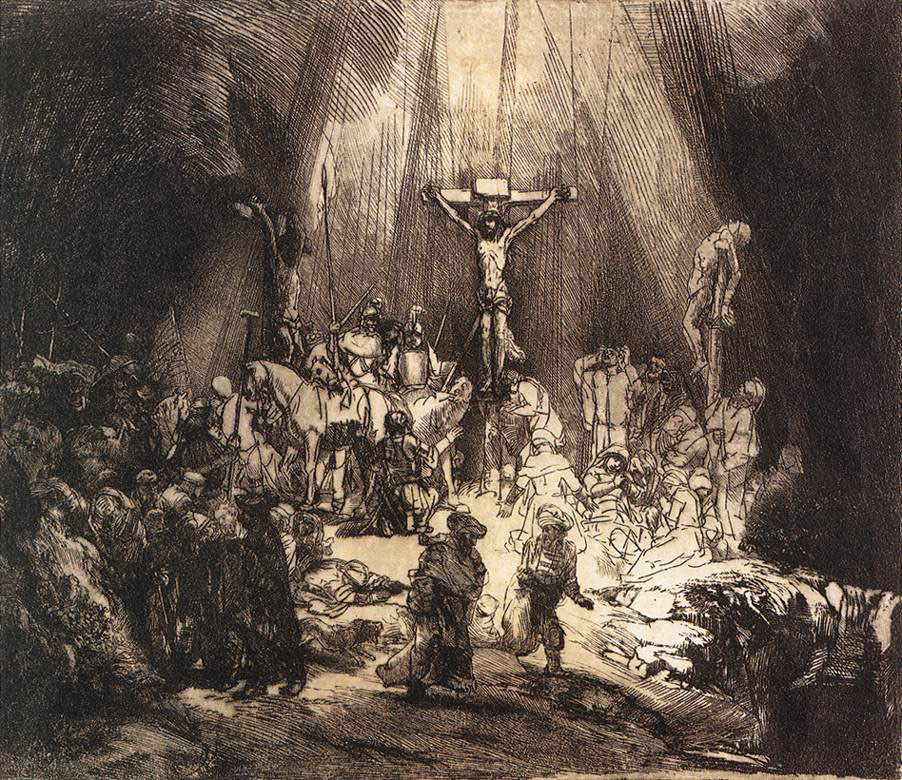
“The Three Crosses” of 1653 is Rembrandt’s most ambitious meditation on the Crucifixion in print, a sweeping performance in etched line and drypoint burr that turns the copper plate into a darkened amphitheater. The subject is familiar, yet the orchestration is astonishingly contemporary in its pacing, lighting, and emotional reach. Instead of a tidy tableau, Rembrandt gives us a crisis unfolding in waves, the crowd surging and breaking around three vertical beams while sheets of light descend diagonally like divine searchlights. The result fuses drama and devotion: a scene one can read historically, theologically, and psychologically in a single viewing.
Subject and Moment
The image records the central episode of Christian narrative: Christ crucified between two thieves on Golgotha. Rembrandt chooses the moment when the spectacle of execution has become revelation. Soldiers mill around the foreground; religious officials argue; women cluster in grief; a mounted officer surveys the scene; common onlookers gape or withdraw. Everything circles the figure on the central cross, whose body, drawn with unflinching economy, anchors the storm. The thieves—one repentant, one hardened—flank him. This distribution of figures makes the page not just a picture but an argument: humanity deciding who Christ is, some in adoration, others in confusion, still others too busy to notice.
Composition as Stagecraft
Rembrandt builds the image like a stage director mapping sightlines. Three towers form a vertical chord across the center, and from their upper reaches the eye cascades down into a basin of light. The crowd funnels toward that basin from all sides. Dark masses occupy the corners and edges, compressing the bright center into an arena of meaning. The left and right thieves sit at diagonals that tilt slightly away, making Christ the only perfectly frontal vertical—an axis mundi in human form. Horses, spears, and ladders generate secondary uprights that echo the crosses, multiplying the sense of a forest of justice turned against a single innocent.
Light, Darkness, and the Theatrical Beam
No feature is more striking than the light. Rembrandt lets it fall from above in slanting wedges, transformed by his technique into tangible planes. The beams do not merely illuminate; they render verdict. Christ’s body is the brightest register, his torso cleaving the light as if it emanates from him. Around this radiance, Rembrandt suspends a dome of shadow created by tight, curved hatching. That dome behaves like a tent lowered over the crowd, forcing them into the same moral climate. The gradual darkening toward the edges is not just atmospheric; it is ethical space, a way of saying that the further one stands from the event, the more opaque the world becomes.
Drypoint Burr and the Sound of Suffering
“The Three Crosses” is celebrated not only for its composition but for its tactile surfaces. Rembrandt drove a needle directly into the copper to create drypoint lines that throw up a burr—tiny ridges of metal that hold ink and print velvety, almost furry blacks. Those burr-rich passages are especially thick around the outer vault of shadow, along soldiers’ cloaks, and in the huddled groups at lower left. The technique adds a gritty timbre to the darkness, like the hoarse sound of a crowd. In contrast, the cleaner etched lines articulate armor, spears, and skeletal contours, lending an iron chill to implements of execution. Viewed closely, the plate hums with two voices at once: the rasp of suffering and the cold of authority.
Multiple States and the Evolution of Meaning
Rembrandt reworked this plate through several states, changing not only details but the mood. Early impressions are clearer, with more open air around the central group and more individuated figures. As he revised, he thickened the shadows, altered gestures, and transformed the composition into a vortex. In later states he partially erased a swooning Virgin and a cluster of bystanders, pressing the drama inward and upward toward the cross. This ongoing revision is not mere correction; it is exegesis in copper. The deepening dark can be read as the encroaching hour—“from the sixth hour there was darkness over all the land”—but it is also Rembrandt’s instinct to strip away anecdote until the event hits with elemental force.
Characters and Gestures
Within the crowd, Rembrandt writes in a language of silhouettes and stances. At lower center, cloaked figures cross the light like pedestrians overtaken by history, one gesturing toward the cross as if narrating what even he cannot yet comprehend. On the left, a mounted officer rises above the press, a diagonal spear creating a vector that points back to Christ. Soldiers at the foot of the cross haggle and toss dice for garments, their triviality set against the immense gravity above. Women cluster to the right in an angle of grief, a collective body bent by sorrow. The unrepentant thief twists away, his figure already sliding into the darkness he has chosen; the repentant one leans toward the center, a physical confession. These micro-dramas intensify the macro-drama, like short melodies interwoven beneath a sustained organ note.
Crowd Psychology and Moral Topography
The Crucifixion is often imagined as a closed, holy scene. Rembrandt insists it is public. The crowd is not background but subject matter. He renders the ecology of bystanders with unsparing accuracy: the curious, the cruel, the indifferent, the tender. Groups coagulate and dissolve; the flow of bodies obeys the currents established by fear, authority, and spectacle. The ground itself encourages such reading. A shallow trench cuts across the foreground, and ridges of earth break at the right, echoing the way the crowd fractures around the cross. Even the shadows seem to understand the social map; they pool at the edges, where apathy and malice flourish, and recede where compassion or revelation appears.
The Central Body as Theology
At the middle of this human tide, Christ’s body is quiet. Rembrandt avoids theatrical contortions. The arms extend horizontally across the beam; the torso forms a tapering column; the head bows in a rhythm of surrender rather than collapse. The anatomy is precise but spare, using taut lines rather than modeled shading to preserve a sense of exposing truth rather than displaying flesh. The theological thrust is clear: power is perfected in weakness. That message is not delivered as slogan but as sight. The miracle is that a body so small on the plate can command so completely. One understands why viewers across centuries have spoken of the image with hushed voices; it does not shout, yet it fills the room.
Time, Sequence, and the Cinema of Printing
Because the work exists in multiple states and because the composition itself is built around diagonal “cuts” of light, “The Three Crosses” encourages the viewer to think cinematically. One can imagine the beams shifting, the crowd surging, the centurion pivoting in realization, the gamblers breaking into laughter that dies when the earth shakes. The print therefore holds two times at once: the eternal present of devotion and the ticking sequence of narrative. Rembrandt amplifies this duality with his techniques. The drypoint burr prints lushly in early impressions but wears down with repeated printings, so later impressions are cleaner, lighter, and in some areas ghostly. The image literally ages as it is produced, mirroring the theological claim that an event repeats without ceasing yet is never the same for any two witnesses.
Old Testament Echoes and New Testament Fulfillment
Rembrandt weaves into the page a field of echoes. The three crosses recall not only the immediate story but the Moses-Aaron-Hur trio supporting a saving act on a hill, the gallows of Haman raised for another and turned on himself, the tree in Eden that became a site of chosen knowledge now answered by a tree of given grace. He does not illustrate these texts explicitly, yet his choice of three verticals, the shadowed hill, and the crowd hissing like a wilderness suggests a typological imagination at work. Under such a reading, the light shafts are not merely atmospheric. They function as a parted veil, opening the world to a new covenant even as the old world groans.
Comparison with Earlier Crucifixions
Rembrandt had engraved and etched Passion scenes throughout his career, often with strong contrasts of night and day. Earlier treatments can be more descriptive, filled with crisp costumes and tidy anatomy. In 1653 he abandons polish for pressure. Armor glints less; sorrow weighs more. Comparing this plate with stately Renaissance versions clarifies his break with decorum. Where earlier masters pose the scene for courtly contemplation, Rembrandt compresses it into a whirlpool of bodies and light, making a viewer stand in dust and hear the clatter of dice. He dignifies faith by showing it surrounded by contingency.
The Role of the Horse and the Scribe of Power
At left a horse stands in profile, a pale shape within the dark. This animal is more than scenery. Its curve and height counterbalance the cross and gather attention around the Roman presence. Mounted officers served as the mobile pens of imperial authority; where they moved, law moved. Rembrandt’s officer looks toward Christ as if to take testimony. The horse’s pale body, almost illuminated, suggests authority under inspection. In some states, the centurion’s gesture is ambiguous enough to invite the reading that he is the one declaring, “Truly this man was the Son of God.” If so, the horse becomes the pedestal of reluctant revelation.
The Architecture of Line
Rembrandt’s line is a building material. In the vault above the crosses, he lays curved hatches that function like ribs, forming a ceiling that drives sight downward. He uses vertical strokes around the central beam that seem to vibrate, a visual crackle that implies the rent veil in the temple or the shudder of the earth. Where the ground breaks at the right, he drags the needle in quick, jagged lines, creating a cascade of white that could be rocky glare or spiritual rupture. The contrasts among these “architectural” systems of line structure the viewer’s movement and mood. The page is not only filled but engineered.
Devotion without Sentimentality
One reason the print has remained persuasive across eras is its refusal to flatter. Rembrandt does not idealize the righteous nor demonize the guilty. He shows both together, stamped with the same ink, subject to the same light. Saints in the making stand inches from mockers; kindness and cruelty drink from the same air. The work thus invites examination of conscience rather than easy identification. There is room, in the shadows at the edges, for any of us who have drifted away from the center; there is also room, in the band of light, for those who are willing to step forward. The call is gentle and stern, like the light itself.
Material History and the Collector’s Object
As the plate wore and Rembrandt reworked it, “The Three Crosses” became not a single object but a family of related images. Some impressions retain vigorous burr and print with dense blacks that almost swallow figures at the margins; others are cleaner, the lines thinner, the silhouettes more legible at a distance. This variability makes the print a living thing in the world of collectors and museums. Each impression tells a slightly different story about how the image was handled, wiped, inked, and cherished. That material plurality suits the theological plurality of witnesses around the cross. No two people saw the same crucifixion; no two sheets tell the same tale.
Influence and Afterlife
The plate’s fusion of light, crowd, and vertical structure influenced generations of printmakers and painters. Its beams prefigure cinematographic spotlights; its massing of bodies reads like the prototype for nineteenth-century history painting turned inside out. Artists who sought to depict public grief, state violence, or revelation in ordinary settings found in Rembrandt a grammar to adapt. Yet influence tells only part of the story. Viewers continue to return to the work not because it started traditions but because it still interrogates them. In a century crowded with images of suffering, “The Three Crosses” remains singularly lucid about why suffering is hard to look at and why we must look.
A Contemporary Reading
Seen today, the print feels uncomfortably current. It shows an execution staged as public order and entertainment, a crowd divided between empathy and distraction, officials sure of their authority, and a condemned man whose truth is recognized too late by those tasked with keeping the peace. The light that falls is neither sentimental nor accusatory; it asks whether recognition can occur in the midst of noise. That question reaches beyond doctrine. It touches any situation where a person’s dignity is obscured by systems and spectatorship. Rembrandt, through copper and ink, teaches attention in a noisy field.
Conclusion
“The Three Crosses” stands at the peak of Rembrandt’s printmaking because it marries mastery with urgency. The composition is monumental, the drawing restless, the light inexorable. The scene is public yet intimate, crowded yet concentrated, ancient yet immediate. Across its several states, the print functions like a meditation practiced over time. One returns to it and learns to see more: new faces in the dark, a fresh direction of a spear, the precise tilt of a repentant head. In that way the work does what religious art at its best can do—it trains vision, not merely illustrating belief but forming it. The copper plate has long ceased to bite, the burr has worn from most impressions, but the image continues to carve channels in the minds of its viewers, opening a space where judgment, mercy, and recognition meet.
