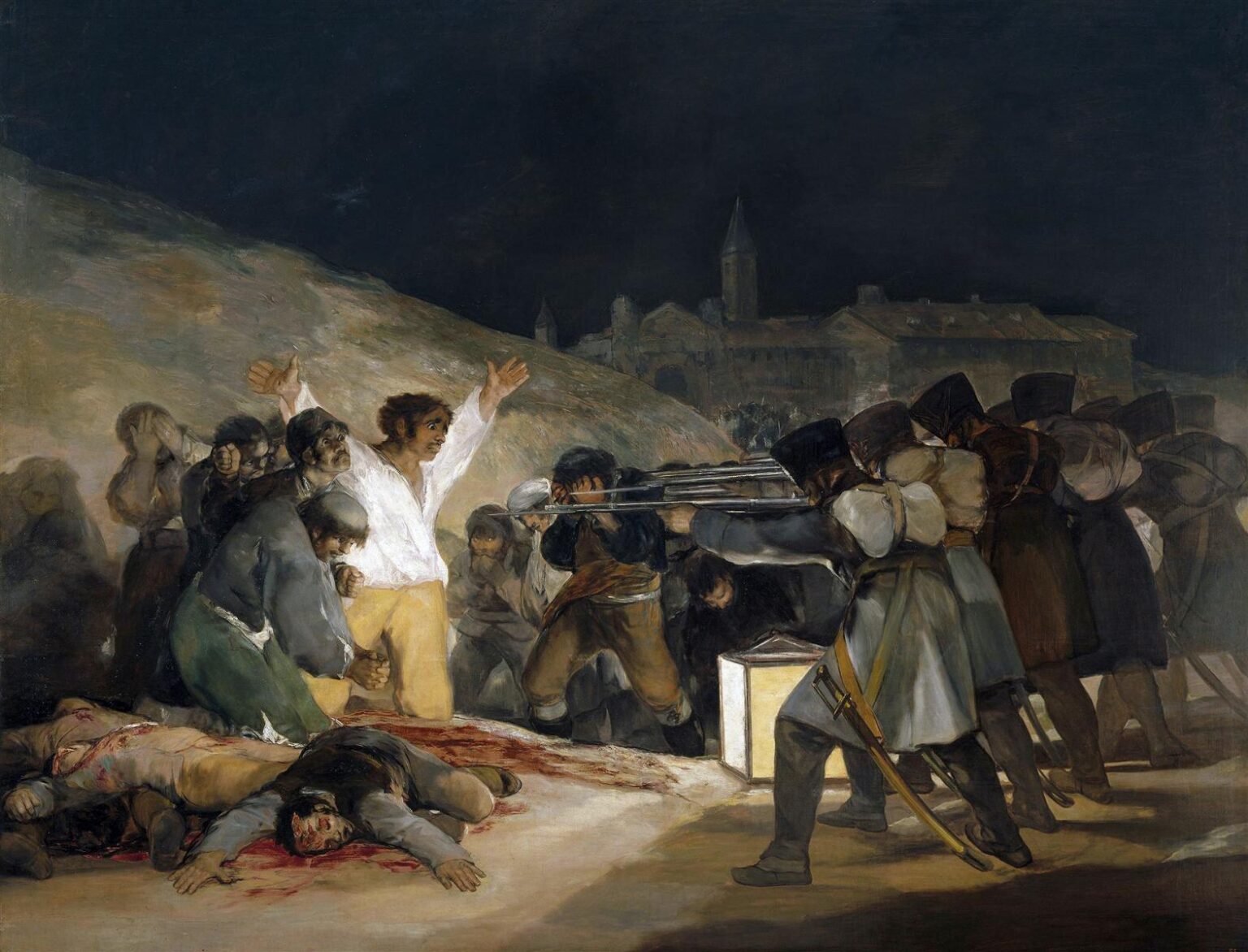
Image source: wikiart.org
Introduction
Francisco Goya’s The Third of May 1808 is one of the most powerful anti war paintings in European art. Completed in 1814, the work transforms a specific historical event into a universal image of fear, sacrifice, brutality, and human dignity under extreme pressure. At first glance, the composition seems simple. A line of French soldiers at the right aims their rifles at a group of Spanish civilians and rebels. At the center, one man in a white shirt raises his arms in surrender, shock, or martyr like acceptance. Around him lie the dead, the terrified, and those who know they are next. Behind them, the dark hill and distant architecture make the scene feel isolated, cold, and final.
Yet the painting is much more than a historical illustration. Goya does not present war as heroic spectacle. He strips away the traditional language of military glory and replaces it with panic, anonymity, and moral horror. The result is a painting that still feels disturbingly modern. It does not ask the viewer to admire victory. It asks the viewer to confront violence itself.
This is one of the reasons The Third of May 1808 remains so important in art history. It stands at the crossroads of Old Master painting and modern political art. It reflects both the specific trauma of Napoleonic occupation in Spain and a broader truth about how power treats vulnerable bodies. Goya shows that art can bear witness. He also shows that painting can become an accusation.
Historical Background and the Meaning of the Event
To understand the emotional force of The Third of May 1808, it helps to understand the historical crisis behind it. In the early nineteenth century, Spain was deeply destabilized by Napoleon’s ambitions. French troops entered the country under the pretext of military cooperation, but the relationship soon became occupation. Tensions erupted in Madrid on May 2, 1808, when ordinary Spaniards rose up against French control. The uprising was fierce but disorganized. The following day, French forces retaliated with mass executions.
Goya’s painting refers to these reprisals. Rather than showing the uprising itself, he focuses on the aftermath, when captured Spaniards were shot outside the city. This choice matters. A battle scene might have emphasized movement, strategy, or patriotic action. By contrast, an execution scene centers helplessness. Goya is not primarily interested in military conflict between equal opponents. He is interested in the terrible imbalance between armed authority and defenseless people.
The timing of the painting is also significant. Goya painted it in 1814, after the French occupation had ended. This means the work is both remembrance and reckoning. It looks back at trauma, but it also participates in the construction of national memory. Even so, it does not become simple propaganda. There is patriotism in the work, but it is not triumphant. Instead, the painting insists that the suffering of ordinary people is the true subject of history.
First Visual Impression and Overall Composition
The composition of The Third of May 1808 is immediate and theatrical, but not in a decorative sense. Everything is arranged to create psychological impact. The soldiers form a rigid block at the right side of the canvas. Their bodies overlap so tightly that they appear almost mechanical, like a single killing instrument rather than a group of individuals. Their backs face the viewer, which denies us access to their expressions and removes any sense of shared humanity.
Opposite them stands the group of victims. This side of the composition is much less orderly. Bodies kneel, collapse, recoil, pray, and hide their faces. The central figure in white dominates the scene, but he is surrounded by a range of human reactions. Some men are already dead. Some brace themselves. Some cannot bear to look. This contrast between the soldiers’ uniform order and the civilians’ emotional variety is one of the painting’s strongest formal ideas.
The ground between the two groups becomes a stage of irreversible action. The lantern placed near the center bottom lights the victims and turns the execution into a scene of exposure. There is no escape into darkness for those about to die. The hill behind them rises like a barrier, blocking any sense of spatial freedom. The distant buildings and church tower remind us that this is happening near a city, near ordinary life, near the world that should have protected these people but did not.
The painting’s structure leads the eye directly to the confrontation. From the rifles, to the white shirt, to the bloodied bodies in the foreground, the viewer experiences the event not as a narrative unfolding over time but as a single unbearable moment.
The Central Figure in White
The man in the white shirt is the emotional and symbolic center of the painting. He kneels with his arms raised, palms open, facing the firing squad. His pose immediately sets him apart from everyone else. Visually, the white shirt catches the lantern light and makes him glow against the darkness around him. Emotionally, his gesture combines surrender, protest, terror, and revelation.
This ambiguity is part of the figure’s power. He may be pleading for mercy, but the painting suggests none will come. He may be expressing disbelief, but the rifles are already aimed. He may also be presented as a martyr like figure. Many viewers have noted the resemblance between his pose and traditional depictions of Christ crucified. The spread arms, the illuminated white clothing, and the sense of innocent sacrifice all support this reading. Even the marks on his hands have often been interpreted as evoking the wounds of Christ.
But Goya avoids making the figure purely religious or idealized. This is not a serene saint floating above pain. He is a frightened human being facing death in real time. His face is tense, his eyes wide, his body vulnerable. By combining sacred associations with unmistakable mortal fear, Goya creates a figure who is both individual and universal. He is a man from Madrid in 1808, but he also stands for all civilians crushed by military violence.
The genius of this figure lies in the balance between symbolism and immediacy. He is memorable because he feels like a real person, yet he also carries the visual weight of a moral statement. He is the painting’s conscience made visible.
Light, Darkness, and the Power of the Lantern
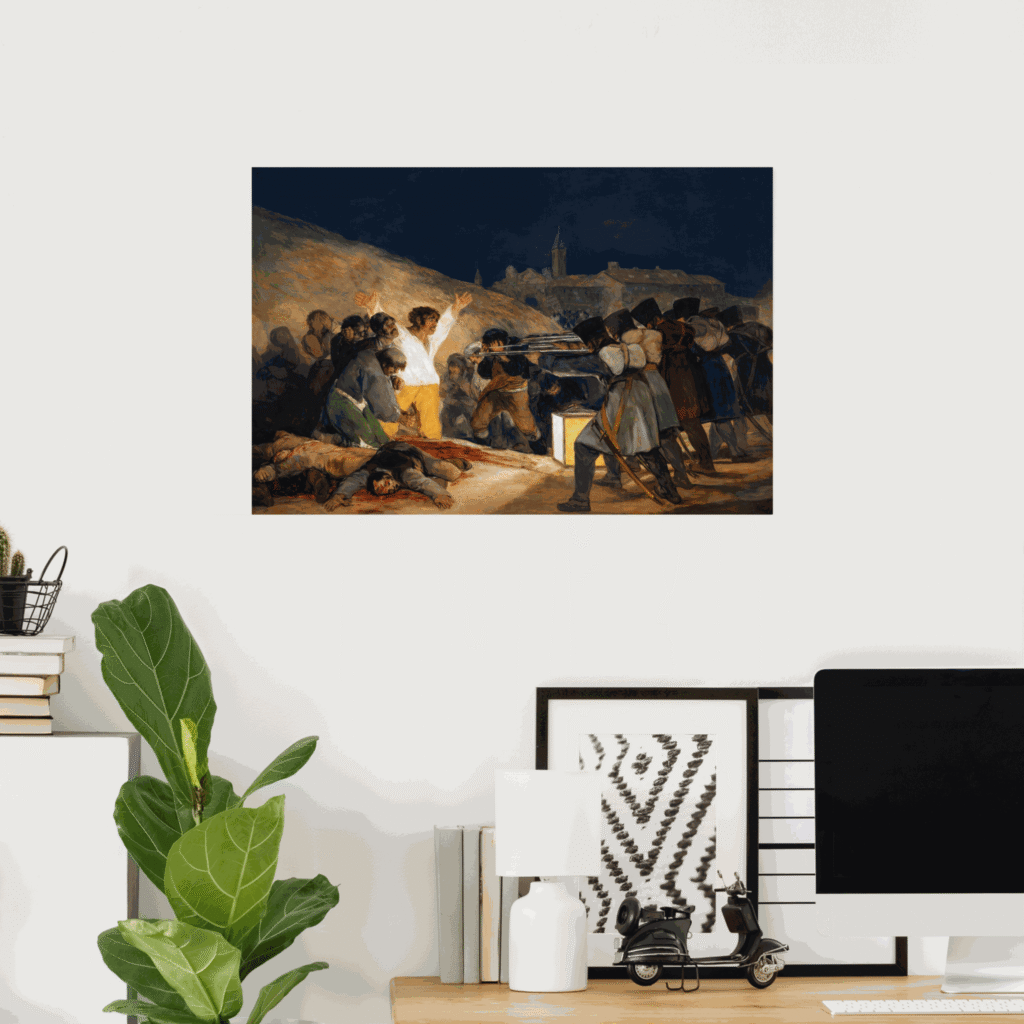
Light is one of the most important elements in The Third of May 1808. The lantern placed on the ground does more than illuminate the scene. It becomes a key part of the painting’s meaning. In traditional art, light often symbolizes truth, divinity, or reason. Here, however, light does not save anyone. It exposes the victims to death. It reveals horror rather than overcoming it.
The strongest illumination falls on the central man in white and on the cluster of figures around him. The soldiers are much darker, especially because their backs face us and their uniforms absorb the surrounding gloom. This division is morally charged. The victims are lit as fully human beings with expressions, emotions, and individuality. The soldiers remain partly obscured and depersonalized.
The contrast between light and darkness also heightens the painting’s emotional pressure. The black night sky presses down over the scene, while the lantern creates a harsh local brightness that feels almost cruel. This is not the warm, dignified light of a history painting celebrating noble sacrifice. It is closer to the light of interrogation or public punishment. The victims cannot hide. Their fear becomes visible.
At the same time, the lantern gives the composition a stark clarity. It isolates the event from the world around it, as if all reality has narrowed into this one circle of violence. In that sense, Goya uses light to force attention. The viewer becomes a witness because the painting offers no comfortable distance.
Color and Emotional Temperature
The palette of The Third of May 1808 is dominated by earth tones, blacks, grays, muted greens, and the strong accent of white and yellow in the central figure’s clothing. This restraint is essential to the painting’s effect. A brighter or more decorative palette would have weakened the moral seriousness of the scene. Instead, the colors create a heavy, nocturnal atmosphere.
The white shirt is the clearest chromatic focal point. It catches the eye instantly and establishes the central victim as the painting’s emotional anchor. The yellow trousers also help define him spatially and visually. These lighter tones separate him from both the darkness behind and the darker clothing of the men around him. He becomes a kind of living flare in the middle of night and fear.
The blood on the ground is present, but Goya does not make it the dominant feature. He includes enough red to register the reality of violence, yet he keeps the image from becoming purely sensational. The emotional impact comes more from tension, posture, and light than from graphic detail. This makes the work more disturbing, not less. The horror is psychological before it is physical.
The soldiers’ dark uniforms contribute to their visual anonymity. Their mass reads as a block of shadow and force. By contrast, the victims’ clothing contains subtle variations that make them feel individual and vulnerable. The painting’s emotional temperature is cold overall, but the lantern introduces a sickly warmth that seems less comforting than merciless. The color system therefore supports the larger themes of humanity versus machinery, exposure versus concealment, and suffering versus impersonal power.
Brushwork and Goya’s Modernity
One of the reasons Goya feels so modern is his handling of paint. The Third of May 1808 is not polished in the manner of strict academic history painting. Instead, many passages are loose, energetic, and expressive. Goya is less concerned with smooth idealization than with immediacy. He wants the scene to feel felt.
This is especially visible in the faces, clothing, and landscape. Some areas are precisely defined, especially where emotional clarity matters most, but others dissolve into broad, suggestive strokes. The hill, the night sky, and parts of the background architecture are not carefully finished for their own sake. They exist to support mood and concentration. Goya directs effort where meaning is most intense.
The brushwork also reinforces the instability of the moment. The painting does not feel frozen in a classical sense. It feels alive with trembling, breath, and dread. The kneeling men seem to shift under pressure. The dead bodies in the foreground feel heavy and immediate. The faces are not ideal masks but quick, charged records of emotion.
This painterly freedom places Goya ahead of many artists of his time. Later movements such as Romanticism, Realism, and even aspects of Expressionism would value the ability of paint to convey feeling directly. In The Third of May 1808, Goya uses painterly looseness not as a technical shortcut but as a moral and emotional method. He paints trauma in a way that resists elegance.
The Rejection of Heroic War Painting
Traditional war painting often celebrates military order, noble sacrifice, and national victory. Even when it depicts suffering, it tends to shape that suffering into a grand narrative of honor. Goya breaks sharply with that tradition. In The Third of May 1808, there is no glorious commander, no triumphant cavalry charge, no balanced contest between armies. There is only execution.
This shift is radical. Goya refuses to aestheticize war in the usual heroic mode. The soldiers are faceless. Their formation is efficient but morally empty. The victims are not idealized warriors dying for fame. They are frightened civilians and rebels facing annihilation. The focus is not on strategy or conquest, but on what violence does to human beings at the moment it becomes unavoidable.
This rejection of heroic convention is one reason the painting has had such a long afterlife. It anticipates later anti war imagery by artists who understood that modern conflict cannot be represented honestly through old formulas of glory. Goya’s painting is often discussed alongside later works that expose atrocity rather than celebrate battle. Its power lies in its refusal to console.
There is still courage in the image, but it is not martial courage in the traditional sense. It is the courage of remaining human in the face of terror. The central figure in white does not win. He does not even resist physically. Yet his open posture, lit face, and exposed body give him a moral presence that overwhelms the anonymous soldiers opposite him. Goya suggests that dignity can survive even where justice fails.
Religion, Martyrdom, and Moral Drama
Religious associations deepen the meaning of The Third of May 1808, even though the painting is grounded in a secular historical event. The central victim’s pose recalls Christ, and the white garment intensifies the idea of innocence. The surrounding figures also echo scenes of lamentation, prayer, and martyrdom familiar from Christian art. This visual language would have been recognizable to Goya’s audience.
Yet the painting does not become a conventional religious image. Instead, Goya borrows the emotional and symbolic weight of sacred art to elevate ordinary people. The victims are not saints canonized by doctrine. They are civilians made sacred by suffering. In this sense, Goya democratizes martyrdom. Holiness enters history not through miracle but through the exposure of injustice.
The churchlike structure in the distance is also significant. Its presence raises questions rather than offering answers. Does it represent faith watching from afar? Institutional silence? A reminder that these men belong to a society with spiritual traditions that failed to protect them? Goya leaves such questions unresolved, which makes the painting richer.
The moral drama of the work lies in this fusion of the earthly and the spiritual. The event is historically specific, but the composition gives it the gravity of an icon. At the same time, fear is never smoothed away into piety. The men tremble, cover their faces, and huddle together. This insistence on fear keeps the painting honest. Goya does not use religion to beautify death. He uses religious echoes to show the depth of human violation.
Psychological Intensity and Human Reactions
One of the painting’s greatest achievements is the variety of emotional responses it captures within a single scene. The central man raises his arms. Another man clasps his hands. Others hide their faces or bow their heads. The dead in the foreground register what is about to happen to those still living. This range of reactions makes the painting feel psychologically true.
Goya understands that terror is not uniform. Some people plead. Some collapse inward. Some stare. Some seem numb. By showing these differences, he restores individuality to the condemned. The soldiers, by contrast, are stripped of individuality. This reversal is crucial. In many traditional battle scenes, soldiers are glorified as distinct actors while victims blur into the background. Here, Goya gives emotional specificity to the powerless and reduces the armed force to a machine.
The viewer is drawn into this emotional field almost against their will. We do not merely observe an event from outside. We feel the dread of anticipation. The rifles are raised, but the shots have not yet been fired. That suspended instant is unbearable because the outcome is certain. Goya paints not only violence, but the knowledge of violence just before it happens.
This is where the painting’s humanity is strongest. It does not ask us to think abstractly about politics alone. It asks us to see faces, bodies, fear, and helplessness. The result is not sentimental because the emotional force is earned through structure, light, and observation rather than theatrical excess.
Legacy and Lasting Importance
The Third of May 1808 has become one of the defining images of modern art because it changed what a history painting could be. It showed that large scale painting did not have to glorify rulers, generals, or victories. It could instead bear witness to suffering and expose moral catastrophe. In doing so, Goya opened the way for later artists to treat political violence with honesty and urgency.
Its influence can be felt in later depictions of war, occupation, execution, and civilian trauma. The painting remains relevant because the structure it reveals has not disappeared from history. Armed power still confronts unarmed people. States still justify violence in the language of order. Images still struggle to make viewers care. Goya’s answer was to create an artwork so emotionally direct and morally clear that it could not easily be neutralized.
The painting also endures because it avoids simplification. It is sympathetic without being sentimental. It is political without becoming empty rhetoric. It is symbolic without losing contact with lived fear. It belongs to Spanish history, but it also speaks far beyond Spain. That combination of specificity and universality is rare.
In the end, The Third of May 1808 is unforgettable because it gives visual form to a fundamental truth. Violence often depends on turning people into targets, categories, or obstacles. Goya refuses that reduction. He gives the condemned back their faces, gestures, terror, and dignity. He makes the viewer stand where conscience has no easy escape.
Conclusion
Francisco Goya’s The Third of May 1808 is one of the most compelling paintings ever made about political violence. Through its dramatic composition, harsh lighting, restrained color, expressive brushwork, and unforgettable central figure, it transforms a historical execution into a timeless statement about human suffering and moral resistance. Goya does not celebrate war, and he does not soften its consequences. Instead, he shows the crushing weight of military power against ordinary bodies and asks the viewer to witness what history often tries to absorb into statistics or patriotic language.
What makes the painting so enduring is that it combines immediacy with depth. It works instantly, through shock and contrast, but it also rewards long looking. The more one studies it, the clearer its formal intelligence becomes. Every part of the composition supports the central conflict between anonymous force and exposed humanity. The painting is tragic, but it is not hopeless. In the illuminated figure at its center, Goya locates a dignity that violence cannot fully erase.
That is why The Third of May 1808 still matters. It is not simply a masterpiece of Spanish art or a landmark of the early nineteenth century. It is one of the clearest demonstrations that painting can serve as memory, protest, and moral testimony all at once.