Image source: wikiart.org
Introduction to “The Temptation of St Jerome”
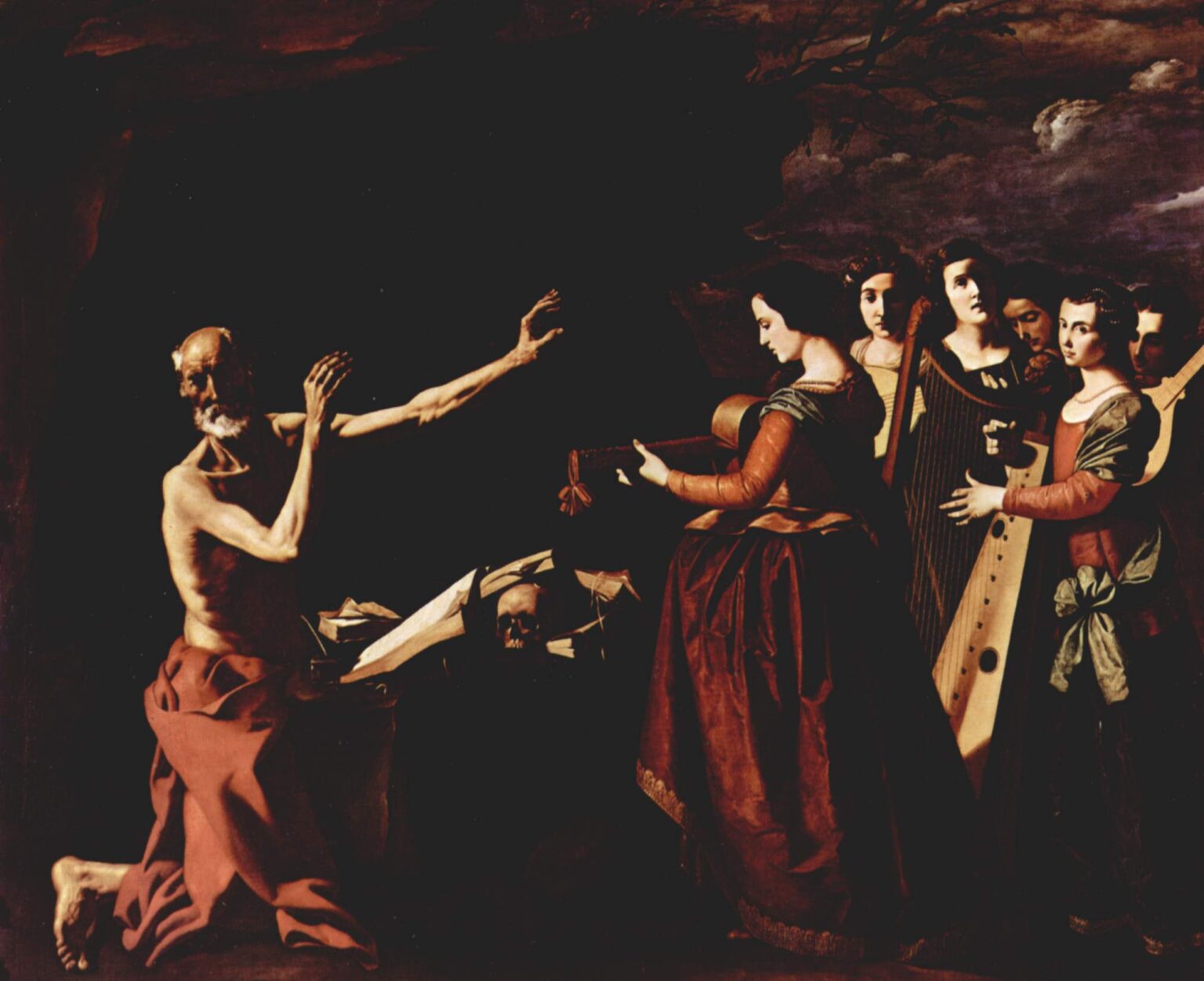
Francisco de Zurbaran’s painting “The Temptation of St Jerome,” created in 1639, is an arresting vision of spiritual struggle. On the left, in stark isolation, kneels an aged, ascetic figure with a bare torso and a red cloth wrapped around his waist. His arms rise in a defensive gesture, as if he is pushing something away. On the right advances a group of richly dressed women carrying musical instruments, illuminated against the darkness like an elegant procession. Between them, on a stone ledge, lie scattered books and a skull, the traditional attributes of St Jerome as scholar and penitent.
The scene captures the moment when the hermit scholar is besieged by sensual and worldly temptations. There is no physical violence, only the tension between ascetic withdrawal and seductive beauty, between the silence of prayer and the allure of music. Zurbaran transforms this psychological conflict into a powerful theatrical tableau, using dramatic light, strong contrasts and carefully choreographed gestures to make the invisible drama of conscience visible on canvas.
St Jerome and the Theme of Temptation
St Jerome, the great translator of the Bible into Latin, spent part of his life as a hermit in the desert, practicing intense penance. Medieval legends tell of the saint being tormented by memories of the pleasures he had renounced. In particular, he was said to have been haunted by images of dancers and musicians from Rome while he tried to devote himself to Scripture and prayer.
In Counter Reformation Catholicism, Jerome became a model of learned piety, but also an example of the ongoing battle against sin that even the most devout believers face. Paintings of his temptations served as vivid reminders that holiness requires constant vigilance. Instead of depicting overtly immoral scenes, artists often symbolized temptation through elegant women, sumptuous fabrics, and music that appeals to the senses.
Zurbaran, working in seventeenth century Spain, draws on this tradition. His Jerome is a gaunt, elderly man who has clearly left behind worldly pleasures. Yet temptations still approach him in the form of young women whose graceful instruments and luxurious clothing contrast starkly with his naked, emaciated body. The painting thus speaks to the enduring human struggle to keep the mind and heart focused on higher things even when attractive distractions remain.
Composition and the Division of Space
The composition is dominated by a strong contrast between left and right. On the left, Jerome occupies a deep pocket of shadow that suggests the interior of a cave. The background behind him is nearly black, with only the faintest glimpses of rock and a small opening that reveals part of a landscape. On the right, the group of women stands against a slightly lighter backdrop where dark clouds and a twisted tree branch hint at gathering storm.
This division of space creates a clear visual and symbolic separation. Jerome inhabits the realm of solitude, asceticism and interior life. The women emerge from the outside world of social interaction, beauty and art. The narrow band of ground on which they all stand acts as a threshold between these two realms, emphasizing that temptation crosses into the hermit’s space uninvited.
Zurbaran carefully controls the movement within the painting. Jerome’s body forms a diagonal that rises from the bottom left toward the center, his extended arms pointing back toward the women. Their column of figures moves from right to left, pressing inward with instruments held forward. The opposing diagonals create the sense of a collision between two forces – the saint’s resistance and the temptations’ advance.
The Figure of St Jerome
St Jerome is presented in a way that emphasizes both his humanity and his heroic effort. He kneels on the bare ground, one knee forward, the other leg bent back. His torso is lean, almost skeletal, with protruding ribs and prominent muscles that speak of long fasting and physical hardship. The skin tone is pale and taut, lit by a strong beam that falls from the upper left, carving his body out of darkness.
His head turns sharply toward the women, and his facial expression combines alarm, concentration and prayer. The white beard and receding hairline mark his age, while the furrowed brow and partially open mouth suggest intense inner dialogue. Jerome’s raised arms are particularly expressive. One hand lifts as though to shield his eyes, the other stretches out toward the instruments and colorful dresses, perhaps in a gesture of refusal or supplication.
The red cloth wrapped around his waist evokes both the cardinal’s robe that Jerome would later be associated with and the blood of Christ that inspires his penance. It is the only vivid color on his side of the canvas, symbolically linking the cost of renunciation with sacrificial love. The rest of his environment is stripped down: bare rock, a simple bench or chest, scattered papers and a skull.
The Musicians as Embodied Temptations
Opposite Jerome stands a group of young women, elegantly dressed and carrying various instruments. Their presence introduces a very different world – the world of music, refinement and social pleasure. They do not appear grotesque or overtly sinful. On the contrary, they are graceful and composed, which makes their tempting power all the stronger.
The central figure plays a lute or guitar, her fingers poised on the strings. She wears a deep red gown with a rich sheen, edged with gold trim. A dark cloak drapes over her shoulders, and her hair is carefully styled. Her posture is dignified, not flirtatious. She seems absorbed in the act of music itself.
Behind and beside her stand other women holding instruments such as a harp, a portable organ or a psaltery. Each face is distinct, some looking toward Jerome, others focused on their music. Their formation creates a compact cluster of sound and color that presses against the surrounding darkness.
In a spiritual reading, these women might represent not only sensual temptation but the entire spectrum of worldly delights – art enjoyed for its own sake, social prestige, the admiration of others. None of these things is intrinsically evil, but for a hermit dedicated to radical withdrawal they can become powerful distractions from the single-minded pursuit of God. Zurbaran communicates this complexity by making the women both beautiful and slightly unsettling. They are attractive yet out of place in the cave of penance.
Light, Shadow and Dramatic Tension
The painting’s emotional force depends heavily on Zurbaran’s tenebrist lighting. A strong, focused light source illuminates the figures from the left, leaving large areas of the canvas in deep shadow. Jerome’s body, the front of the musicians and some of the instruments catch this light, while the background simply disappears into darkness.
The empty blackness behind Jerome is especially striking. It suggests both the solitude he seeks and the inner void he confronts when stripped of all external supports. The light that falls on his body may be read as the light of grace, revealing both his fragility and his openness to divine help.
On the right, the light glances off the polished surfaces of the instruments, the silk dresses and the hair of the women. These highlights make the temptations seem almost tangible. One can imagine the sound of strings and the rustle of fabric. Yet beyond them, the sky is darkening, clouds heavy, a barren tree branch stretching across the upper right. This ominous background hints that following such temptations may lead into storm and spiritual desolation.
The interplay of darkness and light thus mirrors the moral drama. Jerome is surrounded by shadow yet lit in a way that suggests inner integrity. The musicians are bright and appealing, but the gloom behind them reveals the danger hidden inside their charm.
Symbols of Books and Skull
At Jerome’s side on a stone surface lie scattered pages, bound volumes and a skull. These objects are traditional attributes of the saint and they deepen the painting’s symbolic content.
The books represent his scholarly vocation and his translation of the Bible. They also stand for the wisdom found in Scripture and the writings of the Church Fathers, wisdom that guides him in resisting temptation. The disorderly arrangement of the pages, however, suggests that his normal routine of study has been disrupted by the intrusion of the musicians. The pages flutter as though caught in a gust of wind from their arrival.
The skull, partly hidden among the papers, is a reminder of mortality and judgment. It echoes the skull in countless images of hermits and scholars who meditate on death in order to live wisely. Positioned between Jerome and the women, it acts as a silent warning. No matter how delightful the music or beautiful the clothes, all human life ends in death. The skull invites Jerome and the viewer to view the temptations in light of eternity.
Psychological Depth and Inner Conflict
One of the most compelling aspects of “The Temptation of St Jerome” is its psychological depth. Jerome’s gestures and expression are ambiguous enough that viewers can project their own interpretations. He appears disturbed, but not entirely horrified. There is a hint of pain in his face, as if the music stirs memories of youth and lost pleasures. At the same time, his raised arms and tense muscles show determination to resist.
The women are likewise complex. They do not leer or taunt. Their faces show concentration, even a certain seriousness. This suggests that temptation often comes not through obvious evil, but through things that are good and beautiful in themselves, yet misplaced in a life dedicated to radical holiness. Jerome’s struggle is not against clear-cut vice but against the misuse of gifts that belong in another context.
Zurbaran thus portrays temptation as something subtle and interior. The real battle happens in Jerome’s mind and heart. The music may be external, yet the response that matters takes place inside. The intense focus on his face, contrasted with the somewhat generalized features of the musicians, reinforces this idea. The saint’s inner experience is the true subject of the painting.
Counter Reformation Values and Zurbaran’s Style
In the context of Counter Reformation Spain, this painting aligns perfectly with the Church’s emphasis on penance, self discipline and the dangers of vanity. Monastic communities, confessors and spiritual directors encouraged believers to examine their hearts and reject whatever distracted them from God. Paintings like Zurbaran’s served as visual sermons, warning that even good things can become snares if they lead the soul away from its primary calling.
Zurbaran’s style contributes to this message. His tenebrist lighting, strong naturalism and sparse settings are well suited to ascetic subjects. He avoids decorative excess and concentrates on a few carefully chosen elements. In “The Temptation of St Jerome,” this economy of means heightens the spiritual impact. There are no extraneous details to distract from the central conflict.
At the same time, his skill in rendering fabrics, instruments and human anatomy adds credibility to the scene. The saint’s bony shoulders, the shimmering red dress of the central musician, and the polished wood of the harp are all described with convincing realism. This grounded naturalism ensures that the spiritual drama does not feel abstract but viscerally real.
Contemporary Relevance of the Painting
For modern viewers, “The Temptation of St Jerome” resonates beyond its historical context. The conflict it depicts is familiar in new forms. Many people experience tension between focused work or spiritual commitments and the constant stream of entertainment, social media and pleasurable distractions that technology makes so available.
In this light, Jerome’s cave becomes a metaphor for any space where we try to concentrate on what matters most, while the musicians stand for the many voices that call us away from that focus. The painting invites self reflection. What are our own “instruments,” the things that attract us and yet can disturb our interior peace if we give them too much power?
The presence of the skull and books also raises questions about how we relate to mortality and truth. Do we, like Jerome, keep reminders of our limits nearby so that we live with wisdom, or do we drown them out with constant noise and distraction?
Zurbaran’s painting does not condemn beauty or art. The women are not portrayed as grotesque demons. Instead, the work suggests that beauty must be ordered toward the good. In Jerome’s vocation as a hermit scholar, the appropriate response to these particular delights is to renounce them. For others, the call may be different, but the principle is the same – to discern what leads us closer to or farther from the deep purpose of our lives.
Conclusion
“The Temptation of St Jerome” stands as one of Francisco de Zurbaran’s most powerful explorations of spiritual conflict. Through the stark contrast between an emaciated, praying hermit and a group of elegant musicians, through dramatic light and shadow, and through carefully chosen symbols of books and skull, the painter transforms a medieval legend into a timeless reflection on the nature of temptation.
The painting does not simply illustrate a single episode in the life of a saint. It exposes a perennial human experience – the pull between contemplative focus and the seduction of sensory pleasure, between the desire to belong wholly to God and the lingering charm of the world that has been left behind. In Jerome’s tense posture, in his raised arms and searching eyes, viewers can recognize something of their own struggles to remain faithful to what they know is right.
More than three centuries after its creation, Zurbaran’s canvas continues to invite viewers into quiet examination of conscience. It urges us to ask what music plays at the threshold of our own hearts, and whether we, like Jerome, will call on grace to help us resist whatever draws us away from the call we have received.