Image source: wikiart.org
Introduction
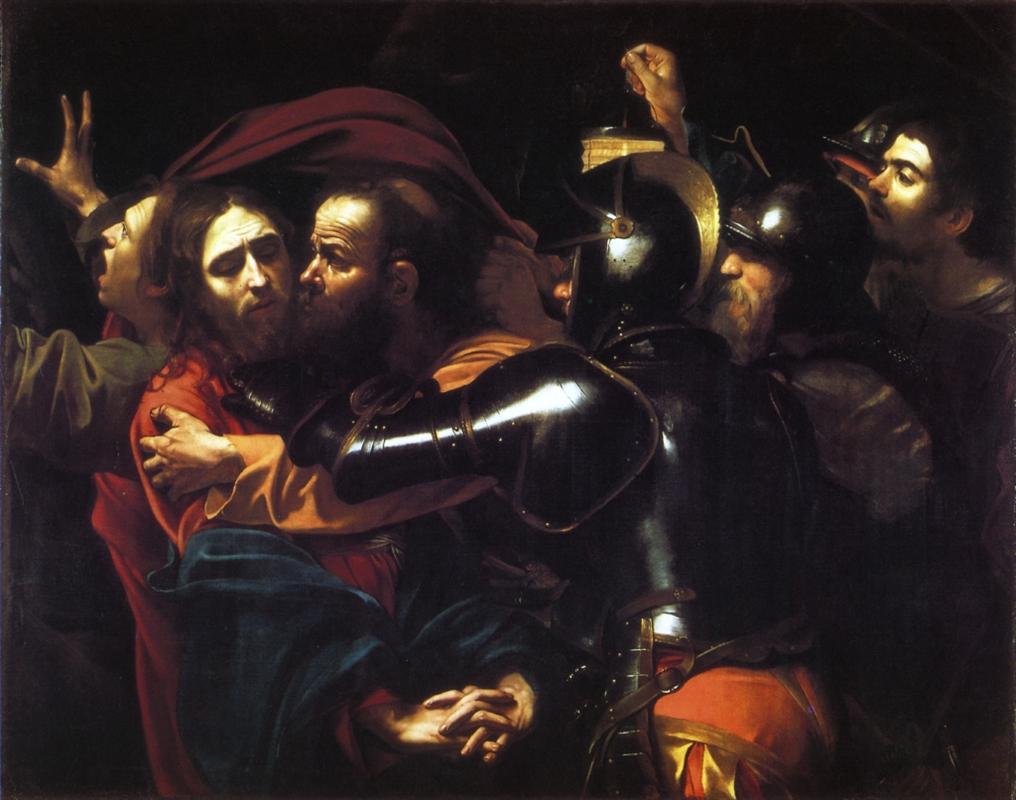
Caravaggio’s “Taking of Christ” (1602) compresses betrayal, recognition, and arrest into an instant so crowded with bodies that the air seems to buckle. In a shallow pocket of darkness, Judas presses his kiss against Christ’s cheek while soldiers in polished armor surge forward with gauntlets and lanterns. The apostles recoil and scatter, their gestures cut by the picture’s edges as if the frame itself has closed on them like a trap. Raking light strikes faces and steel, then dies into blackness before it can resolve the chaos. The result is a picture that feels less like an illustration of Scripture than a collision you have stumbled into, with moral shock traveling along every reflective surface.
Historical Setting and Commission
Painted in Rome at the height of Caravaggio’s fame, the canvas speaks to the Counter-Reformation demand for images that were immediate, intelligible, and emotionally persuasive. Patrons wanted sacred history to feel present; Caravaggio answered with tenebrism, naturalistic models, and stages so shallow that the events seem to unfold in the viewer’s space. “Taking of Christ” likely formed part of a private devotional context, which suits the work’s intense intimacy. The artist’s choice to show not the procession to trial but the first seizure—when love and violence meet at a kiss—aligns with his habit of locating theology in the instant where decisions become flesh.
The Narrative Instant
The painting arrests the moment after Judas has identified Jesus and just as the guards clamp down. Christ’s face registers both resignation and inward focus; his hands knit in a restrained gesture of prayer and self-possession. Judas strains forward, gripping the Lord’s shoulder, his features dense with purpose rather than villainy. To the right, a captain in black armor locks his gauntleted hand on Christ’s cloak, while another soldier presses in behind, a lantern lifted to force light into the fray. At the far edge a helmeted face peers with predatory interest. To the left, the apostle John flings his arms back and cries out, his mouth open in grief, while another figure—sheared by the frame—flees. The story moves like a wave: shock, identification, seizure, illumination.
Composition and the Architecture of Force
The composition is built as a tight wedge driving from left to right. Christ and Judas form the wedge’s point, their heads nearly touching, their profiles locked in a cruel echo. Steel and leather mass behind them in a triangular engine of arrest. The robed disciples, cut off by the picture’s edge, create a counter-force that cannot hold. Caravaggio positions Christ near the center but not exactly at it; the slight displacement unsettles balance in the same way the event unsettles justice. Every diagonal converges on the knot of hands at Christ’s chest—Judas’s grasp, the captain’s gauntlet, Christ’s folded fingers—so that touch becomes the grammar of betrayal and surrender.
Chiaroscuro and Light as Witness
Light in this painting behaves like testimony. It arrives from the right, carried by the guard’s lantern and strengthened by an invisible source outside the frame. It falls first on Christ’s face, rendering it serene and legible, then leaps to the oily gleam of armor, the red of Judas’s sleeve, the crushed blue of Christ’s mantle, and the anguished profile of John. Darkness swallows everything else so that the visible feels judicial, as if truth were naming what must be seen and denying distraction. The lantern itself becomes an emblem of false clarity—an attempt by the powers to master the night even as the painting’s true illumination settles where meaning resides, on Christ’s features and hands.
The Faces: Psychology without Caricature
Caravaggio refuses easy types. Judas is neither grotesque nor theatrical; his brow is knitted with intent, his lips pursed in a determined press. He looks like a man enacting a decision already made in terrible privacy. Christ’s face is calm to the point of otherworldly focus, eyes downcast, mouth relaxed, cheek muscle soft beneath the kiss. The nearby captain’s features are locked under the brim of a helmet, eyes narrowed by habit and duty; the soldier behind him shows a blunt, workman’s profile. John, by contrast, is all open grief—mouth ajar, eyebrows arched, body arcing backward. Together, these faces form a spectrum of human states around an act: calculation, surrender, function, curiosity, and shock.
Gesture as Moral Syntax
Everything essential is said by hands and arms. Judas’s left hand claws Christ’s shoulder, binding intimacy to coercion. The captain’s gauntlet anchors the seizure, its polished knuckles catching a bright seam of light that reads as both beautiful and brutal. Christ’s hands weave together low and tight, fingers interlaced in a gesture that is at once prayerful and self-containing; the posture declares consent without collaboration. John’s hands fly upward, palms turned, the classic sign of lament and astonishment, while a fleeing hand on the extreme left remains as a fragmentary punctuation—an ellipse indicating the disciples’ dispersion. Caravaggio’s grammar is tactile: the viewer reads the scene through pressure and release.
Armor, Fabric, and the Tactility of Reality
Surfaces in this painting do moral work. The soldiers’ cuirasses gleam like dark water, their curves reflecting skewed patches of light that never resolve into purity. Leather straps, buckles, and rivets fit the bodies with practical menace. Christ’s mantle, a deep marine blue with crushed highlights, absorbs illumination rather than flinging it back, a visual metaphor for a figure who takes violence into himself without returning it. Judas’s garment burns with orange tonalities that echo the soldiers’ metal in a lower register, binding treachery to machinery. The fabrics and metals are not decorative inventory; they are actors that persuade the eye of the event’s fact.
The Lantern and Caravaggio’s Self-Presence
Near the upper right a man holds the lantern aloft. Many have read this figure as a self-portrait—a bearded face leaning forward, eyes intent, features half shadowed. Whether or not the identification is literal, the gesture introduces a meta-painterly moment: light is an instrument of capture. The lantern announces that seeing has become part of the arrest; illumination is now a tool in the hands of those who will bind the truth. Caravaggio thereby folds his own art—light making things present—into the moral complexity of the scene. The painter knows that revealing can be an act of violence as well as grace.
Space, Proximity, and the Viewer’s Role
The stage is shockingly shallow. There is no garden vista, no moonlit landscape, no distance to cushion the blow. Bodies fill the frame and press forward so that the event occurs inside our breathing space. The immediacy converts spectators into witnesses. We are too near to judge from afar; we must feel the heat of armor and the scrape of fabric. The composition thereby implicates the viewer in the episode’s ethics: the question is not what they do, but what we recognize in ourselves—complicity, fear, function, or fidelity under pressure.
The Silence Inside the Noise
Though the scene hums with implied sound—metal clanking, cloth tearing, urgent commands—the painting itself is silent. The partial figures and the black ground work together to muffle narrative chatter. What remains is the quiet between kiss and seizure, a breath where fate is sealed and yet nothing visibly final has happened. Caravaggio excels at this suspended second. He lets viewers occupy it long enough to feel the paradox: the stillness of Christ’s acceptance amid the noise of force gathering around him.
Color and the Emotional Weather
The palette is restrained and purposeful. Black dominates in armor and background, giving the canvas its cavernous depth. Christ’s blue mantle and the red beneath provide the picture’s cool-warm axis, their crushed, almost mineral colors speaking of weight and gravity. Judas’s tawny ochre robe and the orange-brown leather straps of the soldiers supply a heat that borders on fever. Skin tones are rendered in a narrow, believable range from John’s pale grief to the weathered cheeks of the guards. No decorative hues soften the scene. The color climate remains nocturnal, concentrated, and moral.
Iconography and Subtle Symbolism
Caravaggio avoids overt emblems—no torches shaped like crosses, no inscriptions, no halos except the faintest whisper around Christ. Yet symbolism percolates through action and material. The kiss as sign of betrayal receives its devastating clarity; the lantern offers a false day that cannot reach hearts; polished armor reflects the world without ever absorbing it; Christ’s folded hands embody the paradox of power in restraint. Even the truncated figures at the edges function iconographically, reminding viewers that the gospel’s story of abandonment is also a story of the world closing in.
Theological Stakes
If the painting has a thesis, it is that truth enters the world through consent, not force. Christ’s calm face and folded hands are the axis around which the soldiers’ energy spins. The kiss attempts to counterfeit love as identification; Caravaggio shows how the counterfeit reveals itself when set against genuine self-offering. The lantern is bright, but the deeper light falls where humility lives. The artist does not preach with symbols; he arranges bodies so that their relations incarnate doctrine.
Technique and Paint Handling
The paint surface reveals a mastery of economy. Large masses—armor, mantles, faces—are blocked with broad, confident tones; edges are sharpened only where light breaks decisively, as along a knuckle or helmet rim. Glazes give depth to blacks and blues, while small, bright impastos flicker on metal and fabric to suggest wet highlights. Brushwork remains subordinate to legibility. The scene reads instantly from a distance yet repays close inspection with textures that speak of hand and pressure. Caravaggio’s virtuosity is moral as well as technical: he refuses flourish that would distract from the event’s gravity.
Dialogue with Caravaggio’s Oeuvre
“The Taking of Christ” shares DNA with the artist’s other nocturnes. Like “The Calling of Saint Matthew,” it uses a selective beam to distinguish grace from ordinary light. Like “Judith Beheading Holofernes,” it compresses violence into a claustrophobic stage where gesture carries narrative. Like the Contarelli canvases, it honors hands as instruments of decision. Yet this painting holds a distinct place in his corpus for the density of bodies and the metallic sheen that acts almost like a second protagonist. Steel here is more than costume; it is a character—unyielding, beautiful, and morally blank—against which the softness of a cheek becomes heroic.
The Apostolic Disarray
The apostles’ fragmentation along the left edge carries compositional and emotional purpose. John’s backward arc reads as both recoil and heartbreak, his youthful face open to pain in a way that foreshadows the Gospel’s intimacy. The barely seen hand and sleeve of another figure suggest the start of a flight cut off by the frame. The audience of this drama thus learns what fidelity looks like by its absence and by the lone figure who refuses to struggle. Caravaggio’s cropping, radical for its time, intensifies the sense of a world breaking apart outside the viewer’s sightline.
The Kiss as Ethical Knot
At the center of the image lies a paradox: a sign of affection used as a weapon. Caravaggio does not exaggerate the kiss; he makes it small and awful, its intimacy ruined by intent. The viewer feels the betrayal in the way Judas’s hand claws rather than embraces, in the way Christ’s eyes refuse the exchange by looking inward, and in the way armor immediately substitutes for arms. The painter finds in this knot an eternal theme: gestures detached from meaning become tools of harm. The painting thus speaks beyond its scriptural moment to any age wrestling with the corruption of signs.
How to Look
Begin with Christ’s face and allow the eye to register its calm. Slide to Judas’s mouth and hand, then drop to Christ’s folded fingers to feel the counter-gesture. Move right into the glossy plates of armor, riding their reflections up to the lantern and the face that holds it, then back across the helmet brims to the anguished John. Let your gaze fall again to the blue mantle’s heavy folds and trace them into the darkness where the rest of the apostles vanish. Repeat the circuit until the choreography of pressures—kiss, grip, prayer, glare, cry—organizes itself into a rhythm you can feel in your own breathing.
Reception and Afterlife
The painting’s visceral clarity and theatrical compression have made it a touchstone for later artists and filmmakers exploring betrayal under artificial light. Its rediscovery in modern times renewed appreciation for Caravaggio’s ability to stage complex ethical situations without rhetorical props. Viewers today continue to find in it a mirror for public and private moments when appearances are weaponized and truth must be carried in the body rather than brandished. The canvas endures because it gives betrayal a face and gives acceptance a posture.
Conclusion
“Taking of Christ” distills a turning point of the Passion into a single, concentrated image where metal, fabric, and flesh argue about power. Caravaggio removes scenery and keeps only what matters: a kiss that reveals, a hand that seizes, hands that fold, a lantern that insists on seeing, and a cry that opens into darkness. The painting’s authority lies in its trust that composition can think, that light can testify, and that a human face can carry doctrine more convincingly than an emblem. Standing before it, one feels the press of bodies and the hush inside the noise, and understands that the story of salvation unfolds at the precise intersection of consent and force.