Image source: artvee.com
Introduction
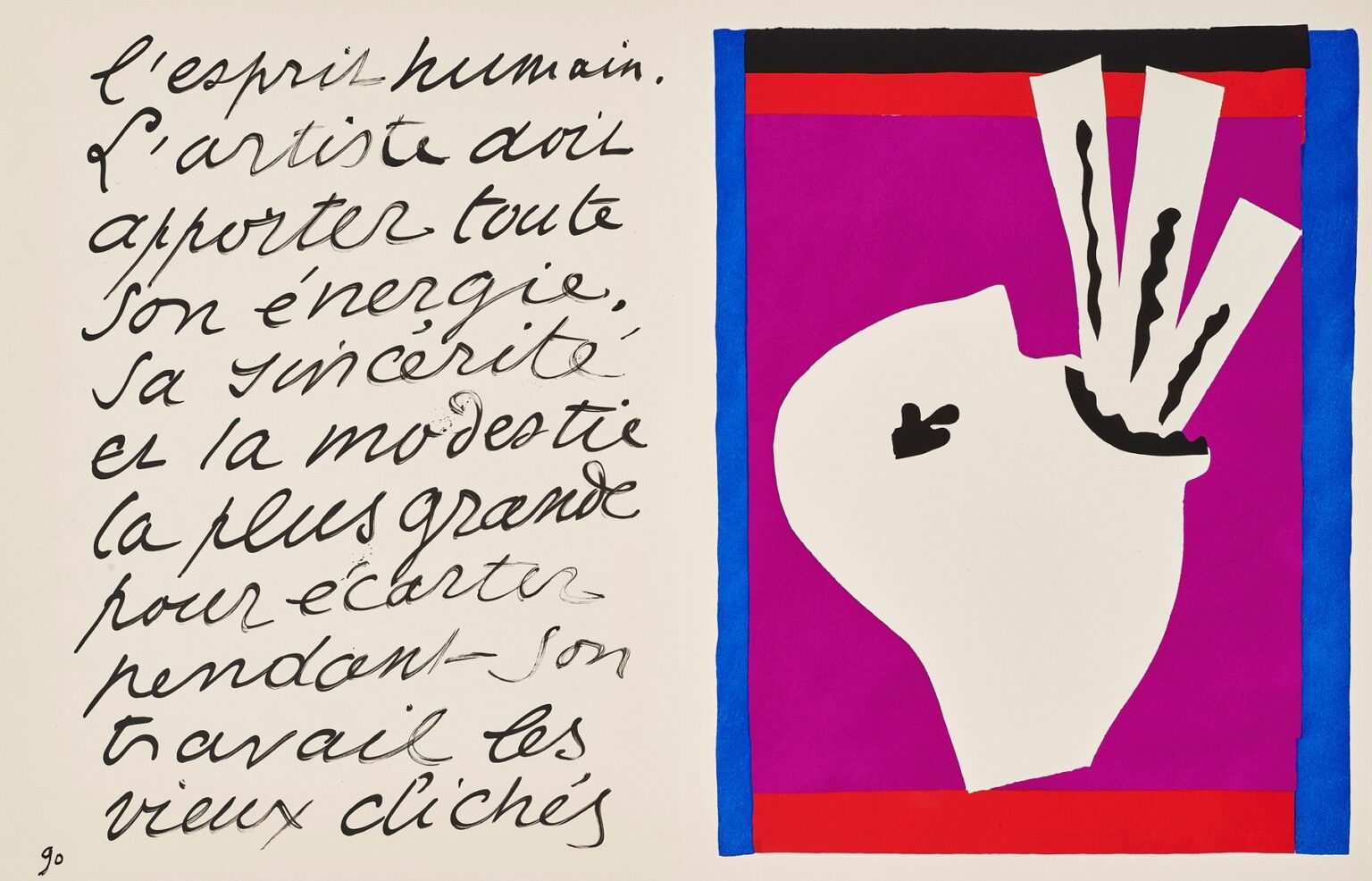
Henri Matisse’s “The Sword Swallower” (1947) distills spectacle into a few boldly cut patches of color and the breath of a handwritten sentence. Presented as a two-page spread from the artist’s landmark Jazz portfolio, the work pairs a right-hand image built from gouache-painted paper with a left-hand page of his fluid, black-ink script. The subject is pure theater: a performer whose head tilts back to receive three blades, the improbable feat staged inside a glowing proscenium of magenta, red, blue, and black. With almost nothing—paper, scissors, gouache, ink—Matisse engineers tension, danger, and delight, making the ancient fairground act feel freshly modern.
Jazz and the Invention of Drawing With Scissors
Matisse devised the cut-out method in the 1940s after illness curtailed long sessions at the easel. He painted large sheets of paper with matte gouache and cut directly into the color, composing by pinning the fragments to his studio walls and moving them until a composition clicked. He described the process as “drawing with scissors,” an apt phrase because contour and color arrive in the same instant as the blades travel. Jazz gathered these inventions into a book format using pochoir, a luxurious stencil process that preserves the dense, even surfaces of gouache and the razor clarity of cut edges. “The Sword Swallower” exemplifies the portfolio’s aim: to transform the energies of circus, carnival, and dance into a new visual music.
A Two-Page Composition That Thinks and Performs
Unlike a single canvas, this work is designed to be read across a gutter. The left page is voice—Matisse’s cursive reflections about the artist’s responsibility to approach work with energy, sincerity, and humility. The right page is performance—the cut-paper image of the act itself. Between the two lies a conversation: language sketches an ethic while image enacts risk. The spread’s structure matters because it converts a picture into a doubled experience. We do not merely look; we also hear a tempo set by handwriting that feels both intimate and public, like an emcee’s introduction delivered in the artist’s own voice.
The Performer Composed as Emblem
At the center of the right page a white, profile-like shape reads instantly as a head and throat tipped back. Matisse refuses every descriptive luxury—no facial modeling, no flesh tones, no anatomical detail—yet the silhouette persuades because the cut edge describes the essential action. A black, crescent-shaped passage marks the dark of the mouth and esophagus. Into that opening three pale rectangular “blades” descend, each bearing a black, wavy stripe that carries the idea of steel’s shine or the quiver of danger. One small black mark at mid-head functions as an eye, an accent so spare and comic that it retrieves the plate from melodrama and deposits it in the realm of emblem and mask.
Color Architecture and Theatrical Framing
Matisse frames the act with a stack of color fields that behave like proscenium, curtain, and footlights. A broad band of vivid magenta saturates the performance area. Inside that zone, a red lintel runs along the top, capped by a shallow strip of black, the two together reading as valance and shadow. Around the outer right and lower edge, a thick bar of ultramarine serves as both border and cool counterweight. The performer’s body is rendered in white, which reads not as emptiness but as the brightest available light, as if the act were singled out by a spotlight. The palette’s extremes—magenta heat, red flare, blue chill, black depth, white blaze—conspire to make the image throb like a stage in use.
The Poised Violence of the Blades
The “swords” are not literal; they are narrow, off-white strips whose edges taper slightly, each decorated with a single wavy black line. Their minimalism is strategic. Because the head and mouth are so simple, any increase in blade realism would unbalance the scene. Instead Matisse delivers a graphic equivalent of sharpness: straightness opposed to the performer’s soft curves, verticality opposed to the body’s rounded tilt, and those wavy lines acting like vibrations in air. The top ends of the blades extend beyond the magenta field, pushing against the black lintel, a compositional decision that heightens pressure and makes us feel the stage’s ceiling closing in.
Rhythm, Breath, and The Moment Between
The image captures a breath. The blades hover a beat above full insertion; the head’s curve lifts like an intake of air. That suspended timing is crucial. It turns the page from depiction to drama, allowing viewers to complete the sequence in imagination. Matisse often staged thresholds—before the leap, after the gesture, at the instant when movement is decided but not yet spent. Here that threshold is a swallow’s edge, where disbelief and trust fight for dominance and the audience holds breath with the performer.
The Black Ground and the Power of Contrast
The performer’s white silhouette sits inside a magenta field that is itself capped by red and black. The black—thin at the top and thick along the inner edge of the head and mouth—does triple duty. It signals the darkness of the throat, it defines the figure with a crisp contour so that white doesn’t bleed into color, and it establishes gravity within the glowing palette. Matisse rarely used black as mere absence; he treated it as a substance, an active color that gives structure and sets the pitch of surrounding hues. “The Sword Swallower” demonstrates this mastery: without the black lintel and mouth, the plate would lose its theatrical tension.
Handwriting as Ethic and Countermelody
The left page’s writing is not decoration; it is a manifesto delivered in a calligrapher’s swing. Words about energy, sincerity, and modesty march diagonally down the page like musical notation. The script’s loops and descenders rhyme with the swoops of the cut edges, so that ink and paper are allied rather than opposed. The sentence insists that an artist must clear away “old clichés” while working. The image beside it fulfills that charge, remaking a fairground cliché into a modern emblem so distilled it feels newly minted. The two pages thus braid content and method, theory and practice.
The Cut Edge as Handwriting
Even more than the ink, the scissor trail is the work’s true signature. The performer’s silhouette thickens and thins with tiny changes of pressure; the blue and red bars reveal micro-wobbles that keep the geometry human; the black mouth shows a jagged bite where the scissors pivoted. These are not flaws. They are reminders that this is not an industrial poster but a handmade score. The edge is line, and line is character. In the absence of modeling, the edge carries everything: humor, danger, speed, and calm.
Figure–Ground Games and the Intelligence of Simplicity
Matisse’s cut-outs thrive on figure–ground play. Is the white head a form or a gap carved out of magenta? Is the black mouth a void or a shape? Because the plate oscillates between these readings, it remains lively longer than a literal illustration would. The mind does small work to keep the image coherent, and that work becomes pleasure. Simplicity—far from being simplistic—liberates attention to savor proportion, spacing, and color temperature.
Performance, Body, and Modern Myth
The sword swallower is an ancient performer, part of a lineage of bodies used to resolve public tension—between fear and trust, the rational and the marvelous. Matisse modernizes the myth. The body here is almost abstract, a bold single piece that accepts a shock with serenity. There is no gore, no grimace. The feat becomes a meditation on openness and measure, qualities Matisse prized. The act is dangerous, but the picture’s calm proportion refuses panic, as if to say that discipline and design can turn extremity into art.
The Role of Small Signs
Two tiny details do surprising work. The little black almond marking the eye places the performer within comedy as much as within danger, a wink that rebuttals morbidity. And the three blades—why three?—establish pattern rather than singularity. Repetition converts stunt into music. The irregular spacing between the swords keeps the rhythm off-beat, closer to jazz than to march. These details remind us that even in emblematic mode Matisse composes as carefully as any classical painter, distributing small weights to control the viewer’s path.
A Palette Tuned for Impact and Balance
Magenta, blue, red, black, and white seem inevitable after one has seen them together, but their balance is delicate. The red strip is very narrow; any wider and it would shout. The blue border is thick enough to cool the field but stops before it becomes a frame that closes the image down. Black is rationed: a top bar and the mouth contour, nothing more. White owns the silhouette but nowhere else. This economy ensures that the viewer’s eye bounces between accent and rest, heat and chill, figure and stage.
The Page as Stage and the Viewer as Audience
Everything in the right page behaves like theater. The blue outer rectangle is hallway or tent; the magenta is curtain; the red is the glow at the edge of a footlight; the black is backstage. The performer is spotlit. The three blades are props. We, positioned outside the blue frame, complete the scene as audience. The left page’s handwriting amplifies that sense by reading like a pre-show address. In this setup the spread becomes not just an illustration of a show but a show itself, with the reader cast as witness.
The Ethics of Clarity After War
Composed just after World War II, the Jazz portfolio carries a desire for brightness and order without denial of risk. “The Sword Swallower” epitomizes that attitude. It acknowledges danger—steel at a throat—but holds it in a structure of proportion and calm color. The performer’s trust in his craft parallels the artist’s trust in essentials. In a time fatigued by spectacle’s darker forms, Matisse proposes a different spectacle: a clear, humane image that offers exhilaration without violence.
Influence and Continuing Usefulness
Designers, illustrators, stage directors, and educators return to this plate for lessons. It demonstrates how to make a scene read at once and deepen on inspection, how to assign jobs to colors, how to let a border act, how to animate a page with handwriting, and how to compress narrative into emblem. Its grammar is transferable—to posters, book covers, motion graphics, and stage signage—because it rests on fundamentals of rhythm and contrast rather than on fashionable tricks.
Seeing at Two Distances
From across a room the spread is unmistakable: a white head offers its throat to three dark-striped blades inside a magenta and blue theater. Up close, the scissor’s micro-hesitations and the brush’s slight textures in the gouache fields come forward, along with the ink’s little splashes and hesitations in the script. The work is built for this double reading, functioning like a piece of music that oversweeps a hall and still rewards attention to the reeds’ vibration and the drummer’s wrist.
Conclusion
“The Sword Swallower” is a compact manifesto disguised as a circus act. On the left the artist writes about the energy and sincerity required to clear away clichés. On the right he proves it, replacing anecdote with emblem, rendering danger with a few cuts of paper and a handful of colors, and staging it within a frame that glows like a tent at night. The page is fearless but not reckless, playful but not trivial. It embodies the promise of late Matisse: that with clarity, rhythm, and the living edge of a cut, art can turn even risk into a lucid, generous experience.