Image source: wikiart.org
Introduction
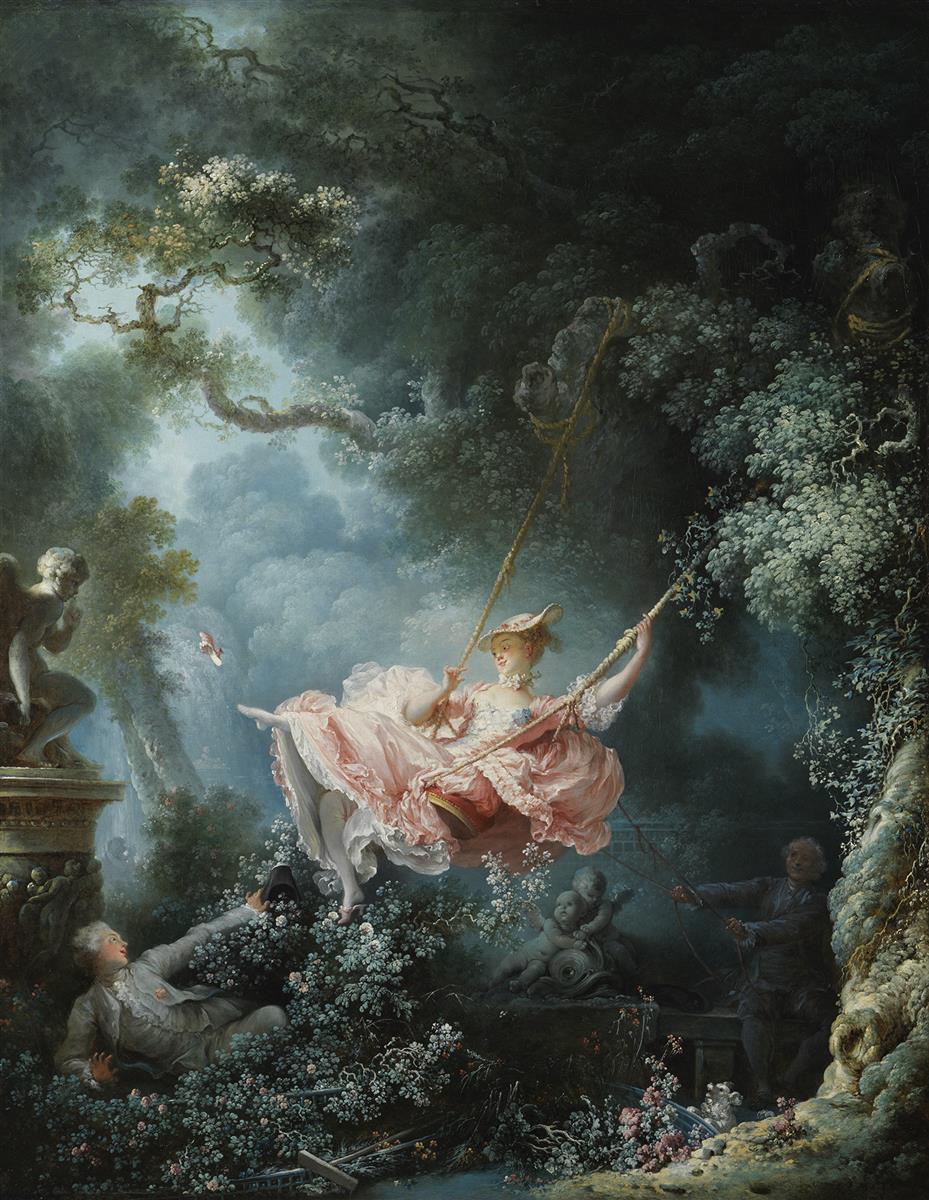
Jean-Honore Fragonard’s The Swing, painted in 1767, is one of the most memorable images of the Rococo era. At first glance, it appears playful, delicate, and dreamy. A young woman dressed in a cloud of pink silk glides through a lush garden while light filters through dense foliage and flowers bloom around her. The scene seems charming and airy, almost like a theatrical fantasy suspended between moonlight and sunlight. Yet the painting’s appeal goes far beyond its beauty. Beneath its graceful surface lies a witty and carefully staged work full of flirtation, secrecy, movement, and social performance.
What makes The Swing so enduring is the way Fragonard transforms a simple moment into something layered and unforgettable. The painting is immediately attractive because of its softness, color, and elegance, but the longer one looks, the more complicated it becomes. The figures are not merely arranged in a garden. They are acting out a drama of desire, concealment, and spectacle. The painting invites the viewer to enjoy the scene while also recognizing its playful deception. This double effect is central to its charm. It is a work that delights the eye while rewarding close attention.
Fragonard created the painting at a moment when French aristocratic taste favored refinement, pleasure, and fantasy. Rococo art often celebrated intimacy, ornament, gardens, romance, and leisure, and The Swing gathers all of those themes into one brilliantly orchestrated composition. Yet it is not simply decorative. It is also intelligent. The more one studies its lighting, composition, symbolism, and emotional atmosphere, the more it becomes clear that Fragonard was not only a gifted painter of luxury and movement but also a subtle storyteller.
The Rococo World of Pleasure and Fantasy
To understand The Swing, it helps to see it within the larger world of Rococo painting. Rococo art developed in eighteenth century France and became associated with elegance, lightness, sensuality, and aristocratic amusement. In contrast to the grand seriousness of Baroque painting, Rococo often favored private pleasures over public heroism. Instead of historical battles or religious revelations, artists painted gardens, flirtations, music, theater, and scenes of refined leisure.
Fragonard was one of the movement’s most gifted painters because he could combine surface beauty with emotional vitality. In The Swing, the Rococo spirit reaches a kind of perfection. The painting is lush, decorative, and full of movement, yet it never feels static or overdesigned. Everything seems to tremble with life. The leaves shimmer, the flowers glow, the fabric billows, and the swing cuts through the air in a graceful arc. Even the garden itself feels theatrical, as though nature has been transformed into a stage set for aristocratic fantasy.
This emphasis on pleasure is central to the painting’s meaning. The garden is not a place of labor or ordinary life. It is an enclosed realm of leisure and secrecy, removed from social duty. Within this space, rules soften and appearances become playful. The world of The Swing is carefully artificial, but that artificiality is part of its message. Rococo art often celebrates the pleasures of artifice, costume, and performance. Fragonard does not hide that this is a fantasy. He makes fantasy itself the subject.
A Scene Built on Motion
One of the painting’s greatest achievements is its sense of motion. The title directs attention to the act of swinging, but Fragonard does much more than simply show a figure on a swing. He builds the entire composition around movement, turning the scene into a visual rhythm of rising, falling, lifting, and drifting.
The young woman is suspended at the center, but she does not feel still. Her dress opens in soft waves, her body leans backward, and one leg extends outward with a kind of carefree confidence. The swing ropes create strong diagonal lines that cut through the composition and guide the eye upward into the trees. These diagonals are balanced by the curve of her body and the flowing folds of her gown, making the motion feel fluid rather than abrupt.
Around her, Fragonard multiplies this sensation of movement. Branches twist overhead. Leaves and blossoms seem to vibrate in the air. The flying shoe, one of the painting’s most famous details, intensifies the impression that the moment is both fleeting and mischievous. The entire image feels caught at the peak of a single instant, yet it also suggests a continuous cycle. One can almost imagine the swing moving backward and forward beyond the frame.
This ability to freeze motion without killing its energy is one of Fragonard’s greatest strengths. The painting captures a specific instant, but it never feels fixed. Instead, it preserves the thrill of motion itself. That quality gives the work much of its freshness even today.
The Garden as a Secret Theater
The setting of The Swing is not merely background. The garden is essential to the painting’s emotional and symbolic effect. It is dense, overgrown, and almost dreamlike, filled with shadows, flowers, stone sculpture, and mysterious recesses. This is not a natural landscape in any ordinary sense. It is a cultivated fantasy of nature, shaped into a world where secrecy and seduction can unfold.
The dark foliage surrounding the brighter central area creates a feeling of enclosure. The woman on the swing appears illuminated within a private clearing, as though nature itself has opened to frame her. This use of light and shadow gives the painting a stage-like quality. The bright figure emerges from a dim world of leaves and stone, drawing all attention to the central drama.
At the same time, the garden suggests concealment. One figure reclines low among the flowers, partly hidden and gazing upward. Another remains deeper in the shadows, pulling the swing from behind. The viewer’s eye moves through layers of cover, discovery, and partial visibility. Fragonard uses the garden to create a visual game of hiding and revealing. It becomes the perfect environment for flirtation because it shields while also exposing.
The sculptures in the scene deepen this theatrical atmosphere. Stone figures watch silently from the garden, transforming the setting into a place where desire is both observed and stylized. The famous cupid figure, often read as a sign of love or complicity, reinforces the sense that the entire scene belongs to a realm governed by play, secrecy, and erotic suggestion. These sculptural presences make the garden feel inhabited by the language of mythology and allegory, not just by living people.
The Woman at the Center
At the heart of the painting is the young woman in pink, and Fragonard presents her with extraordinary brilliance. She is the brightest figure in the composition and the emotional focus of the entire scene. Her dress, painted in shimmering pinks and creamy whites, seems to gather the available light and reflect it outward. She is not simply placed at the center. She is made to dominate the visual field through color, luminosity, and motion.
What is especially striking is the balance Fragonard creates between elegance and spontaneity. The woman is richly dressed and unmistakably aristocratic, yet her pose suggests an unguarded moment of delight. She seems to enjoy the movement of the swing with complete abandon. That sense of freedom is one reason the painting feels so alive. The figure does not appear stiff or posed in a formal way. She is animated, playful, and aware of the pleasure of being seen.
At the same time, she is not innocent in a simple sense. Fragonard gives her a knowing presence. The scene depends on her participation in its games of concealment and revelation. She is not just the object of the composition but one of its active performers. Her gesture, posture, and expression all suggest complicity in the flirtatious atmosphere around her.
This complexity is part of what gives the painting its lasting fascination. The woman is at once graceful, theatrical, playful, and socially controlled. She embodies the Rococo ideal of refined pleasure, but she also represents the instability of appearances. She is both on display and in motion, both framed and untouchable, both idealized and vividly human.
The Hidden Figures and the Drama of Looking
Much of the painting’s tension comes from the relationships between the figures. Although the young woman commands attention, the surrounding male figures are crucial to the painting’s drama. One reclines near the lower left, partly concealed by foliage and looking up toward her. Another, more shadowed figure appears at the right, operating the swing from behind. These figures create a triangular structure of desire, observation, and control.
The reclining man is especially important because he embodies the act of looking. His upward gaze directs our own, and his hidden position turns the scene into a private spectacle. He is not simply present in the garden. He is a secret viewer within the painting, and in that sense he mirrors the role of the audience standing before the work. Fragonard cleverly turns viewing itself into part of the subject. The painting is about pleasure, but it is also about the pleasures and complications of spectatorship.
The darker figure behind the swing adds another layer. Less visible and less emotionally vivid, he seems almost absorbed into the foliage. His relative obscurity contrasts with the brightness of the woman and the alert pose of the hidden admirer. This contrast strengthens the sense of secrecy and imbalance within the scene. Not everyone sees equally, and not everyone is seen equally.
This network of glances is central to the painting’s wit. Fragonard does not present a simple romantic scene. He presents a visual arrangement built on asymmetry. One person swings, one gazes, one pushes, and the viewer watches all of them. The result is a painting that constantly raises questions about power, attention, and desire without ever abandoning its playful tone.
Color, Light, and the Seduction of the Surface
Fragonard’s handling of color is one of the painting’s great triumphs. The palette is dominated by cool greens, blue-grays, soft whites, and delicate pinks. These colors create a world that feels at once rich and airy. The surrounding garden is dark but never dead. Its shadows are full of subtle color, and the lighter passages bloom gently from within. Against this setting, the pink dress becomes the visual heart of the work.
The pink itself is especially important. It gives the woman warmth, softness, and visibility, allowing her to stand out from the cooler environment. Fragonard paints the fabric with feathery brushwork that suggests texture without weighing it down. The dress seems to float as much as the figure does. This is a painter deeply interested in how color and touch can produce sensual delight.
Light functions just as carefully. Rather than flooding the whole scene evenly, Fragonard allows light to gather around selected forms. The woman’s face, dress, and extended leg receive strong emphasis, while much of the garden remains in shadow. This selective illumination heightens drama and directs the eye. It also contributes to the sense that the scene exists in a suspended, enchanted atmosphere.
The surface beauty of the painting is not accidental decoration. It is part of the meaning. Fragonard uses color and light to create a world of temptation and elegance, where pleasure is experienced through vision itself. The viewer does not only understand the painting intellectually. The viewer is drawn into it sensually through paint, color, and luminous texture.
Symbolism and Playful Suggestion
Although The Swing is famous for its visual charm, it also contains a carefully arranged language of symbols and suggestions. These details do not turn the painting into a heavy allegory, but they enrich its playful meaning.
The flying shoe is one of the most discussed elements in the work. Because it is tossed into the air, it intensifies the sense of motion and spontaneity, but it also suggests a release from restraint. The image of something cast off in the midst of flirtation adds a note of daring and theatrical surprise. It is a tiny detail, yet it draws the eye because it feels so improbable and lively.
The cupid sculpture reinforces the mood of secret love. Often interpreted as a sign of complicity or a warning to remain silent, it gives the garden a symbolic witness. Cupid belongs to the world of erotic play and mythological love, so his presence links the scene to a wider visual tradition in which gardens become sites of seduction and fantasy.
The dense flowers and foliage also matter symbolically. They do not function only as decorative abundance. Their richness suggests fertility, sensuality, and the overflowing vitality of pleasure. Nature in this painting is not austere or moralizing. It is lush, excessive, and intimately tied to human emotion.
Yet Fragonard handles all of this with wit rather than solemnity. The symbolism never hardens into a rigid code. Instead, it remains light, suggestive, and playful. This is one reason the painting continues to feel alive. It hints rather than declares. It invites interpretation without closing itself into a single fixed meaning.
Technique and Painterly Brilliance
Fragonard’s technical skill is one reason The Swing has remained so admired. His brushwork is agile, fluid, and expressive. He can render lace, silk, leaves, stone, and skin with remarkable sensitivity, yet he rarely does so in a dry or overfinished manner. The painting retains a freshness that makes the entire scene feel animated.
In the foliage, the brushwork becomes loose and suggestive, allowing clusters of leaves and blossoms to shimmer rather than harden into strict detail. In the dress, the handling is more controlled but still light, creating volume and softness without stiffness. The fabric appears to rustle in the air, and the highlights seem to flicker across its surface.
Fragonard also excels at orchestrating visual contrast. Hard stone is placed beside soft flowers. Deep shadow surrounds bright fabric. Smooth skin appears against textured vegetation. These contrasts give the picture richness and keep the eye moving across the surface. Every area seems alive with variation.
What is especially impressive is how effortless the painting appears. The composition is highly artificial and carefully designed, but Fragonard makes it feel spontaneous. That illusion of ease is a mark of true mastery. The painting never announces its labor. It simply delights, even though its effects are the result of extraordinary control.
The Painting as a Portrait of an Age
Beyond its immediate charm, The Swing can also be read as a portrait of aristocratic culture in late eighteenth century France. It reflects a world deeply invested in elegance, leisure, and performance. The painting’s refined costumes, secluded garden, and playful intrigue all belong to a social environment where pleasure could become a form of art.
At the same time, modern viewers often see in the painting a kind of fragility. The world it depicts is beautiful, but it also feels insulated from ordinary reality. Everything has been transformed into spectacle and amusement. That quality gives the painting some of its historical poignancy. It captures the grace of aristocratic culture at a moment when such refinement was highly developed, even as that world would later come under intense pressure.
Still, the painting should not be reduced to a simple moral lesson about excess. Its greatness lies in its complexity. Fragonard does not merely celebrate pleasure, nor does he obviously condemn it. Instead, he reveals its charm, artifice, and instability all at once. The painting is enchanting because it understands the seductions of appearance so completely.
Why The Swing Still Captivates
More than two and a half centuries after it was painted, The Swing remains one of the most beloved images in European art. Part of its appeal lies in its immediate accessibility. Even viewers with little knowledge of eighteenth century painting can respond to its light, color, movement, and theatrical charm. It is beautiful in a direct and undeniable way.
But the painting lasts because it is more than beautiful. It is also smart, subtle, and emotionally layered. It turns a fleeting moment into a complex reflection on pleasure, looking, secrecy, and performance. It captures the spirit of Rococo culture while also transcending it through extraordinary painterly invention.
Fragonard gives the viewer everything at once: graceful motion, luminous color, decorative richness, narrative tension, and symbolic wit. The result is a painting that rewards both first impressions and close study. One can admire it for the swirl of pink silk and flowering trees, or for the more complicated drama hidden beneath that elegance.
In the end, The Swing remains unforgettable because it embodies a rare union of delight and intelligence. It is playful without being shallow, refined without being cold, and theatrical without losing emotional immediacy. Fragonard created not just a charming garden scene but one of the defining images of eighteenth century art, a painting that still feels alive each time it is seen.