Image source: artvee.com
Introduction
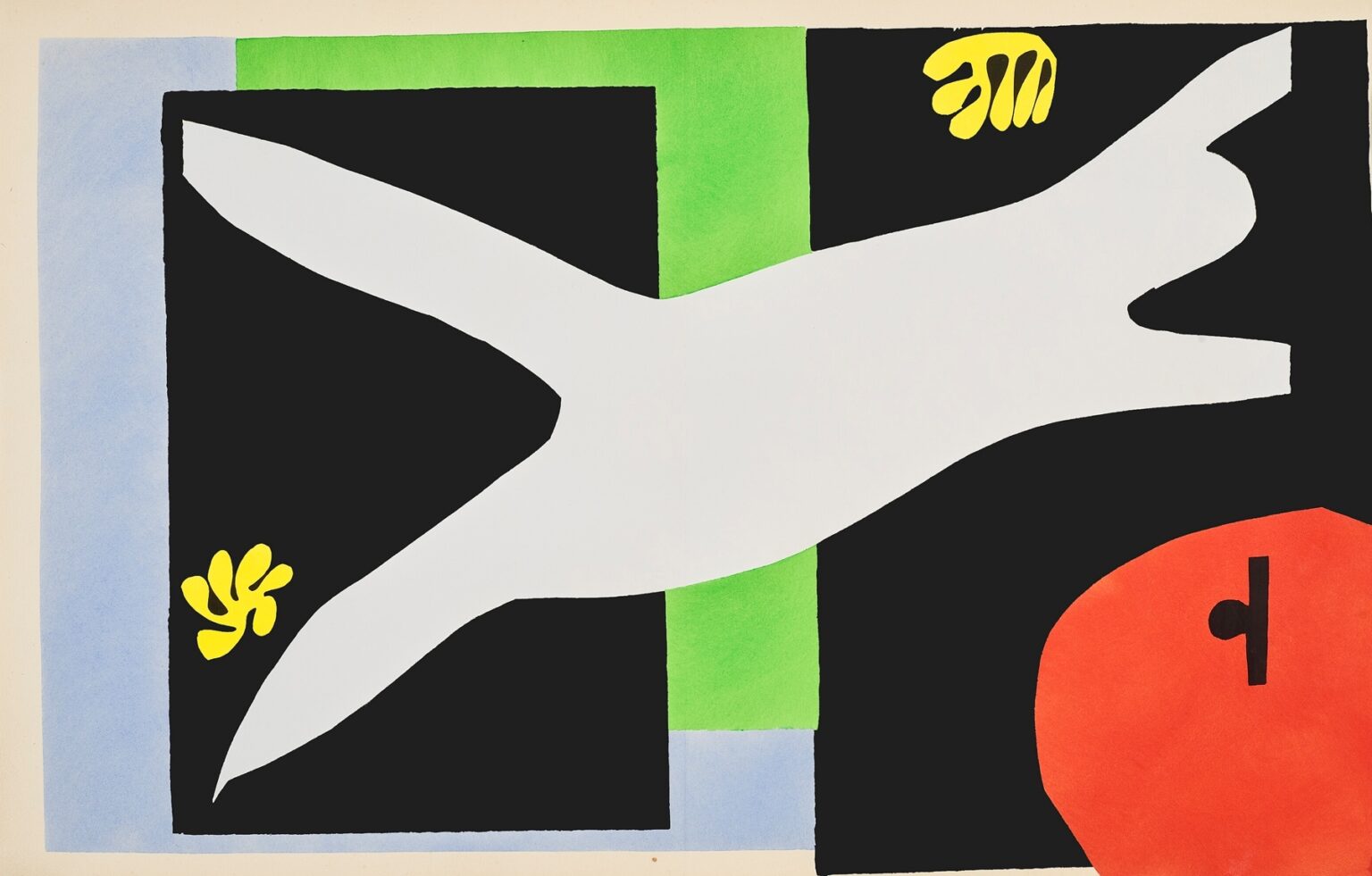
Henri Matisse’s “The Swimmer in the Tank” (1947) transforms a circus act into a crisp drama of color and edge. A pale swimmer stretches diagonally across a set of interlocked rectangles, passing through panes of black water and green glass while yellow “splash” motifs flicker at the corners. A glowing orange form anchors the lower right like a buoy, drum, or spotlight, its small black mark striking a percussive note. The composition belongs to the Jazz portfolio, the book in which Matisse reinvented performance—acrobats, clowns, masks, fables—through a newly invented medium: cut and arranged papers painted with matte gouache. “The Swimmer in the Tank” is among the suite’s most distilled pages. It condenses breath, risk, and motion into an emblem that reads in a heartbeat and deepens with study.
The Cut-Out Method and the Spirit of Jazz
By the mid-1940s Matisse had turned to what he called “drawing with scissors.” He brushed sheets of paper with saturated gouache, cut directly into the color, and pinned the shapes to his studio walls, shifting and tuning them until the composition clicked. The method fused line and color in a single gesture. Edges were no longer lines enclosing paint; they were the very shape of color itself. Jazz presented these maquettes as pochoir prints that preserved the cut contours and the matte density of the gouache. Like the music invoked by the title, the pages rely on rhythm, syncopation, riff, and reprise. “The Swimmer in the Tank” speaks this language with exceptional clarity: a few flats of color, a decisive diagonal, and a handful of perfectly placed signs.
The Circus Act Translated into Emblem
The title refers to a popular spectacle in traveling shows: a swimmer performing feats underwater inside a glass tank. Matisse strips away anecdote—faces, costumes, spectators—and redesigns the event as a set of relations. The tank becomes architecture made of rectangles; water becomes a black field; illuminated glass glows green; the swimmer is a single pale shape with pointed hands and feet that cut through darkness like knives. Two sprigs of lemon yellow read instantly as splashes or bubbles—small, bright confirmations that the body passes through liquid. A red-orange disk-like form at the lower right adds theatrical pressure. It can be read as a buoy, a drum, a spotlight, or simply a counterweight that keeps the sheet from sliding into cool abstraction. The act’s breath-holding suspense is everywhere, but no one is posed or individualized. The picture performs rather than illustrates.
Composition and the Authority of the Diagonal
Matisse orchestrates movement with a single, commanding diagonal. The swimmer traverses the page from lower left to upper right, a trajectory that reads as ascent even though the “water” is unmodulated black. That climb is reinforced by the narrowing of the limbs and by the way the figure’s tapered feet almost pierce the corner of the frame. Diagonals in the Jazz plates often serve as vectors of energy; here the diagonal is the subject itself. The swimmer is a line drawn across the tank, and the tank’s segmented planes—two black panels separated by vertical bars of green—measure that line like ticks on a metronome. The result is a picture that feels musical even before one identifies its parts.
Tank as Architecture: Rectangles, Panes, and Sightlines
The stage is built from rectangles. A pale blue outer zone suggests ambient air. Inside it, an emphatic black rectangle sets the water’s depth. Interrupting that darkness, bright panels of green slice vertically, like glass panes catching light. At the bottom edge another strip of pale blue hints at reflection or a sill. These framed zones give the page its architectural force. We do not see water rendered with ripples and highlights; we feel it because the swimmer is confined by panels that read as glass. The tank is an idea, not a picture of plumbing, and it functions the way all good stage design functions: it states the rules of the world in one glance.
Figure–Ground Reversal and the Pleasure of Perception
The cut-outs thrive on flips between figure and ground, and “The Swimmer in the Tank” is a master class in that game. The body is a bright void inside darkness, yet because the hands and feet taper to spears the “void” behaves like a solid cutting through resistance. The black field is water, but it is also simply the largest shape on the page, a presence in its own right. Even the green panels oscillate: at one instant they read as glass in front of the swimmer, at the next as glass behind. This ambiguity is not a flaw. It charges the image with the cognitive pleasure of switching readings while never losing coherence. The swimmer’s path remains legible as the mind plays.
Color as Temperature and Physics
Matisse’s palette is deliberately limited. Black carries weight and depth. The pale swimmer is not quite white; it is light chalk or diluted blue, cool enough to sit comfortably on the page yet bright enough to slice the darkness. Green is a saturated mid-tone that supplies the world’s “material” (glass) without overclaiming attention. Yellow is a high note used sparingly—two quick bursts that indicate light striking droplets, a reminder that water can sparkle. The orange form commands with warmth, tilting the composition toward theater rather than pure diagram. These choices are not symbolic in a programmatic way; they are practical. Each color has a job and performs it decisively.
The Orange Anchor and the Beat of Risk
The reddish orange form in the lower right corner is the composition’s wildcard. It interrupts the cool triad of black, green, and blue and spikes the page’s temperature. Its small black mark—resembling a hinged latch, an aperture, or even a musical rest—delivers a percussive beat. Functionally, the shape keeps the sheet from sliding visually leftward with the swimmer’s motion. Psychologically, it supplies a hint of risk or apparatus: the idea of equipment, a drumroll, the red glow of a lamp, the edge of a tank. Because the form is cropped by the frame, it also implies offstage continuation, the world beyond what is shown.
Scissor-Cut Edges as the Artist’s Handwriting
Though “The Swimmer in the Tank” reads with poster clarity at a distance, up close its edges reveal the living hand that made it. The swimmer’s contour thickens and thins with minute changes of pressure; the green panels show tiny hesitations where the scissors pivoted; the yellow splashes flare with irregular lobes that prevent them from stiffening into icons. Because line and color are one in the cut-outs, these edges carry everything: speed, breath, calm. The diagonal body looks effortless, but its ease is the result of hundreds of practiced decisions about curvature and proportion.
Rhythm, Breath, and the Held Moment
Matisse selects the instant when the swimmer is fully extended, as if lungs are at capacity and the next beat will be the turn. The black panels of water above and below the body reinforce the feeling of suspension; there is no surface, no bubbles stringing away, no narrative of before or after. The two yellow flashes at opposite corners feel like sparks thrown off in passing. Together these cues make the viewer breathe with the figure. It is the same strategy Matisse used for acrobats and dancers elsewhere in Jazz: capture the moment of maximum reach and let the body’s line hold the room.
Spatial Ambiguity and the Experience of Glass
Nothing in the picture is modeled, yet space is palpable. Overlap does the work. The swimmer passes in front of a black panel, then behind a green bar, then over another patch of black. The mind reads these sequences like pages in a flip book, assembling a shallow stage with just enough depth to stage the act. The pale blue strips at left and bottom are crucial. They suggest the tank’s exterior air and the way glass cools and pales light, so the scene gains atmosphere without a single brushy effect. The tank is solid because its edges are clear.
Dialogue With Other Pages in Jazz
Within the portfolio, “The Swimmer in the Tank” talks to other plates through recurring devices: a decisive diagonal like the flight in “Icarus,” bright punctuation like the red heart in “The Heart,” a framed stage like the magenta proscenium in “Pierrot’s Funeral,” and a choreography of panes and nets like “The Codomas.” Yet it is unique in its near-silence. Many Jazz pages teem with motifs. Here, economy rules. A body, a box, two splashes, a single warm anchor—that is all. The restraint is part of the pleasure; each element can sing at full voice.
The Ethics of Clarity and the Afterglow of War
Composed just after World War II, the Jazz suite radiates a desire for lucidity and joy without denying risk. The swimmer is alone, contained, and exposed, yet the page does not read as anxious. The arc of the body is confident, the colors harmonious, the world intelligible. Matisse’s late work sought balance and serenity, not as decorative escape but as a gift of order to viewers newly aware of fragility. “The Swimmer in the Tank” embodies that ethic. Danger is acknowledged—the body is enclosed and breath is limited—but design turns the moment into a clear, generous experience.
Lessons in Design and Readability
Artists, stage designers, and graphic thinkers have long mined the Jazz plates for principles. “The Swimmer in the Tank” offers several that remain evergreen. Use a commanding diagonal to generate motion across a static field. Build environment from a few assertive planes rather than fussy descriptions. Assign jobs to colors and let them perform without interference. Trust edges to carry character. Stage ambiguity intentionally so that viewers complete the scene in their minds. Most of all, compress a narrative into emblematic relationships instead of illustrating every fact. The result, as here, is an image that reads at poster scale and rewards the close glance.
Seeing at Two Distances
From across a room the page is unmistakable: a pale swimmer streaks through a black and green tank; two lemon splashes and an orange anchor keep the beat. Up close, the craft reveals itself. The black fields are not empty; they are dense flats that make nearby hues glow. The swimmer’s ankle ends in a sharp, specific point; the hand, though a blunt triangle, feels convincingly extended by virtue of placement alone. The faint seam of the pochoir printing at the center fold speaks to the portfolio’s book format and to the way Matisse envisioned these images being handled—turned, read, lived with.
Conclusion
“The Swimmer in the Tank” is a masterclass in how little is needed to conjure an experience. With a body shaped like a single stroke, a tank built from three or four rectangles, and a handful of sparks and anchors, Matisse compresses breath, water, and risk into a clear, luminous design. The page honors the circus tradition of making danger legible—an audience should understand the feat instantly—and transposes that clarity into the language of modern art. It is not a picture of a swimmer; it is the idea of swimming under glass, a thought written in color and edge. Decades later, its diagonal still cuts the air.