Image source: wikiart.org
Introduction to Peter Paul Rubens’s “The Supper at Emmaus”
“The Supper at Emmaus,” painted by Peter Paul Rubens in 1638, presents a deeply human and emotionally charged vision of one of the most intimate encounters with the risen Christ described in the New Testament. Instead of a grand public miracle, Rubens depicts a quiet meal in an inn, where two weary disciples suddenly realize that the stranger who has joined them on the road is in fact Jesus himself. In the instant of recognition the ordinary becomes miraculous, and Rubens captures that turning point with all the theatrical intensity and warm humanity that define his late Baroque style.
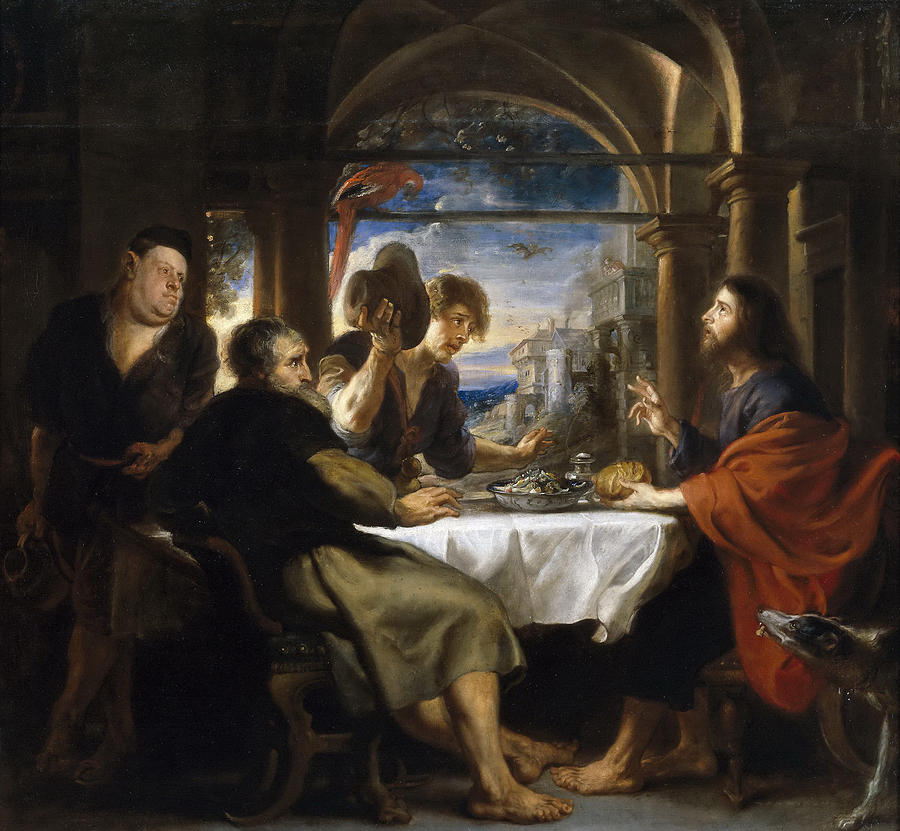
At a small table draped with a white cloth, Christ sits on the right, blessing bread with a familiar gesture. Across from him, the disciples react with shock and dawning faith, their bodies leaning forward or twisting around as understanding spreads from one to another. A servant pauses with a dish in his hand; an innkeeper looks on; a dog in the lower right sniffs the air, sensing the tension. Behind them, a window opens onto a luminous seacoast landscape, framed by an arch that echoes the sacred space of a church.
Rubens thus transforms a simple meal into a visual meditation on revelation, hospitality, and the presence of Christ in everyday life.
Biblical Background and Narrative Moment
The story of the supper at Emmaus appears in the Gospel of Luke, chapter 24. After the crucifixion, two disciples leave Jerusalem for the village of Emmaus, discussing the tragic events they have witnessed. A stranger joins them and explains the scriptures, but they do not recognize him. Only when they persuade him to stay for a meal and he breaks bread do their eyes open and they realize that he is the risen Christ. At that moment, he vanishes from their sight.
Painters have long been fascinated with this scene because it condenses sorrow, companionship, teaching, and sudden revelation into one narrative arc. Rubens chooses to depict the climactic instant in which Christ blesses and breaks the bread, just as the disciples’ recognition begins to ignite. Everyone in the room reacts differently, giving him ample opportunity to explore the psychology of faith and doubt.
Composition and Spatial Structure
Rubens structures the composition around the small table at the center, covered with a luminous white cloth whose folds cascade toward the viewer. The table acts as both physical and symbolic axis. It is where the bread and simple dishes rest, where human hunger is met, and where divine presence is disclosed.
Three primary seated figures ring the table: Christ at the right, one disciple with his back to us at the front, and a younger disciple at the left leaning inward. A standing servant behind the table creates a vertical accent, while another attendant or innkeeper lingers at the far left, partly in shadow. The dog at the lower right and a dish placed near the table’s front edge subtly break the circle, drawing the viewer into the scene.
Architecturally, the space is defined by strong vertical columns and rounded arches. The dark interior frames the brilliant opening at the back, where the landscape and sky glow in blue and gold tones. This inner window creates depth and offers a symbolic path from the dimness of confusion inside the inn to the clarity of revelation and open air beyond.
The composition is also organized through contrasting diagonals. Christ’s calm, almost vertical posture anchors the right side, while the disciples’ twisting bodies create diagonals that converge toward him. The servant’s arm, holding the dish, cuts across the center, visually marking the moment when ordinary service intersects with the extraordinary presence of the resurrected Lord.
Light, Color, and Atmosphere
Light is central to the painting’s meaning. Rubens bathes Christ in a gentle, focused illumination that touches his face, hands, and red-and-blue garments. This light is warmer and more stable than the more varied reflections on the other figures. It acts as a visual sign of Christ’s divinity, yet remains soft enough to feel consistent with the candlelit interior of an inn.
The disciples, especially the one closest to the viewer, are partly in shadow yet touched by glancing highlights on forehead, hands, and clothing. This shifting light suggests their transition from ignorance to recognition. The leftmost figure’s face is almost entirely shadowed, as if still struggling at the threshold of understanding.
Rubens’s color palette is rich but restrained. Earthy browns and grays dominate the background architecture and the clothing of servants and innkeeper. Against this subdued ground, Christ’s deep blue robe and vibrant red cloak stand out dramatically, visually identifying him much as they do in many other paintings. The white tablecloth acts as a reflector, bouncing light upward and unifying the figures around its glow.
Through the window, the landscape shines with cool blues and soft golds, indicating either dawn or evening—times of transition that echo the spiritual turning point unfolding indoors. The sky’s clarity contrasts with the dim room, hinting that the disciples’ hearts and minds are about to be opened to a new clarity of faith.
The Figure of Christ: Calm Center of Revelation
Christ sits calmly at the right side of the table, his gaze directed toward the disciple opposite him. Rubens paints him with long dark hair and a short beard, his features gentle yet intent. His right hand, raised in blessing, echoes the familiar gesture from the Last Supper, linking this meal to the institution of the Eucharist. In his left hand he holds bread, caught between breaking and offering.
Unlike the agitated movements of the other figures, Christ’s pose is composed. His bare feet rest firmly on the ground, suggesting both humility and rootedness in the physical world. The folds of his garments fall in broad, monumental curves, giving him a quiet authority. This stillness amid surrounding motion underscores his role as the source of order and meaning in the scene.
Rubens does not overemphasize Christ’s divinity with a halo or supernatural glow. Instead, holiness is communicated through his demeanor, his central placement, and the subtle play of light. This approach aligns with the story itself: the disciples initially fail to recognize Jesus because he appears as an ordinary traveler. Only the familiar act of breaking bread reveals his true identity.
The Disciples: Doubt, Surprise, and Awakening
The disciple seated with his back to the viewer occupies the central foreground. He twists in his seat, turning toward Christ with a mixture of shock and dawning comprehension. Rubens paints his profile in strong light, emphasizing the furrowed brow, open mouth, and raised eyebrows that convey his emotional upheaval. His shoulders are hunched, and his hands rest tensely on the table edge, pushing against it as if about to rise.
To his left, a younger disciple has just lifted his cap or hat as an instinctive gesture of reverence. His body leans forward, and his eyes widen as he gazes at Christ. This act of removing his head covering is both polite and symbolic. It suggests humility before the divine and the stripping away of ignorance.
Their reactions are not identical; each embodies a different stage of recognition. One is caught in the first jolt of realization, the other in an almost worshipful acknowledgment. Together they show how faith often unfolds in individual, varied ways even when triggered by the same revelation.
Servants, Innkeeper, and Dog: Everyday Witnesses
Rubens enriches the scene by including figures who are not mentioned in the biblical text but who ground the story in ordinary life. At the far left stands a heavyset man with a blunt, slightly skeptical expression. His hands rest on his hips, and his gaze is directed toward the disciples rather than Christ. He may be the innkeeper, concerned with the practicalities of hosting guests, only dimly aware of the spiritual drama unfolding at his own table.
Behind the younger disciple, another servant holds a dish or platter, paused mid-step. His body leans forward, eyes peering over the hat he has just raised. He appears caught between his duties and the strange tension in the room. The dish he carries, with its simple food, reminds us that revelation occurs in the context of everyday hospitality.
In the lower right corner, a dog stretches its neck toward the table, mouth slightly open as if sniffing or begging. This animal adds a note of naturalism and quiet humor, characteristic of Rubens. At the same time, the dog’s alertness hints that even creatures sense unusual energy in the room. It also invites the viewer into the domestic intimacy of the scene, where animals wander freely and meals are shared without ceremony.
Architectural Setting and Landscape Beyond
The room is framed by sturdy columns and barrel vaults, reminiscent of Romanesque or early Renaissance architecture. This choice gives the scene a timeless, almost churchlike quality. The deep shadows between columns emphasize the interior’s heaviness, which contrasts with the open vista outside.
Through the central opening we see a seaside town perched on cliffs, with towers, walls, and houses bathed in gentle light. The water glimmers in the distance; birds fly across the sky. This landscape situates the story in a broader world: life continues outside, oblivious to the extraordinary event inside the inn.
Symbolically, the window functions as a threshold between old and new understanding. The disciples have traveled a road through that landscape in confusion and grief. Now, as they cross the threshold of recognition, the view behind them becomes a reminder of the journey of doubt that is giving way to faith. The sea may even recall baptism and renewal, reinforcing the theme of spiritual rebirth after the trauma of the crucifixion.
Symbolism of Bread, Gesture, and Hospitality
The bread in Christ’s hand is the central symbolic object in the painting. In the Gospel account, the act of breaking bread is the moment of recognition. It connects this meal to the Last Supper, when Jesus declared bread to be his body, given for his followers. For viewers familiar with Christian liturgy, the scene clearly alludes to the Eucharist, where Christ is believed to be present under the form of bread and wine.
Rubens underscores this symbolism by placing the bread where it is clearly visible, held in Christ’s hand and illuminated by soft light. His gesture of blessing recalls both priestly consecration and the way he fed the crowds in the miracle of the loaves. The white tablecloth can be read as an echo of an altar cloth, turning the inn’s table into a humble altar where sacramental presence is revealed.
Hospitality is another key theme. The disciples have insisted that Jesus stay with them because evening was approaching. Their willingness to offer food and shelter becomes the occasion for grace. Rubens emphasizes the ordinary nature of their hospitality with simple tableware, a modest meal, and the bustling servants. The message is that Christ is recognized not in spectacular displays but in shared bread and attentive welcome.
Rubens’s Late Style and Comparison with Other Emmaus Paintings
Rubens painted this scene late in his life, after decades of creating grand altarpieces and diplomatic allegories. His late works often show a more introspective tone, with landscapes and domestic scenes gaining prominence. “The Supper at Emmaus” combines that quieter mood with the emotional intensity typical of his earlier religious paintings.
Compared with earlier depictions of the Emmaus story by artists like Caravaggio, Titian, or Rembrandt, Rubens’s version is warmer and more crowded with human presence. Caravaggio emphasizes stark chiaroscuro and dramatic gestures; Rembrandt often highlights interior psychological reflection. Rubens blends these elements with his own love of rich color, robust bodies, and layered details. His Christ is less austere than Caravaggio’s, more approachable and suffused with gentle light rather than harsh contrast.
The inclusion of servants, dog, and elaborate architecture is also characteristic of Rubens’s ability to integrate sacred narrative into a bustling, lived-in world. His painting invites viewers not simply to revere a distant miracle but to imagine such a revelation occurring in their own sphere of meals, inns, and everyday gatherings.
Emotional and Spiritual Impact on the Viewer
For viewers, the painting offers multiple entry points. One may identify with the startled disciple at the front, suddenly realizing that the familiar stranger is Christ. Another might connect with the more reverent younger disciple, already reaching toward worship. Others may feel closer to the innkeeper, busy and half-aware, or to the servants, who sense something unusual but do not fully grasp it.
The painting encourages reflection on the ways recognition comes slowly, through shared experiences rather than sudden spectacles. It suggests that divine presence often hides in plain sight—in travelers, in simple meals, in conversations on the road—until a symbolic act like breaking bread reveals its depth.
Artistically, the warm color, dynamic composition, and interplay of light and shadow draw viewers into the scene until they almost feel seated at the table. Spiritually, the work invites contemplation of hospitality, gratitude, and the possibility of encountering the sacred in ordinary life.
Conclusion
“The Supper at Emmaus” by Peter Paul Rubens is a profound synthesis of narrative, theology, and everyday realism. Painted in 1638, it captures the precise instant when the risen Christ is recognized by his disciples in the breaking of bread. Through carefully orchestrated composition, subtle light, and richly characterized figures, Rubens turns a small inn into a stage for revelation.
The painting speaks across centuries because it addresses universal experiences: grief turned to hope, confusion transformed into understanding, and the surprise of finding the extraordinary in the midst of ordinary routines. It stands as one of Rubens’s most intimate religious works, demonstrating that his genius for grand spectacle could also serve the quiet mystery of a shared meal and a sudden, life-changing recognition.