Image source: wikiart.org
First Sight Of A Miracle In Motion
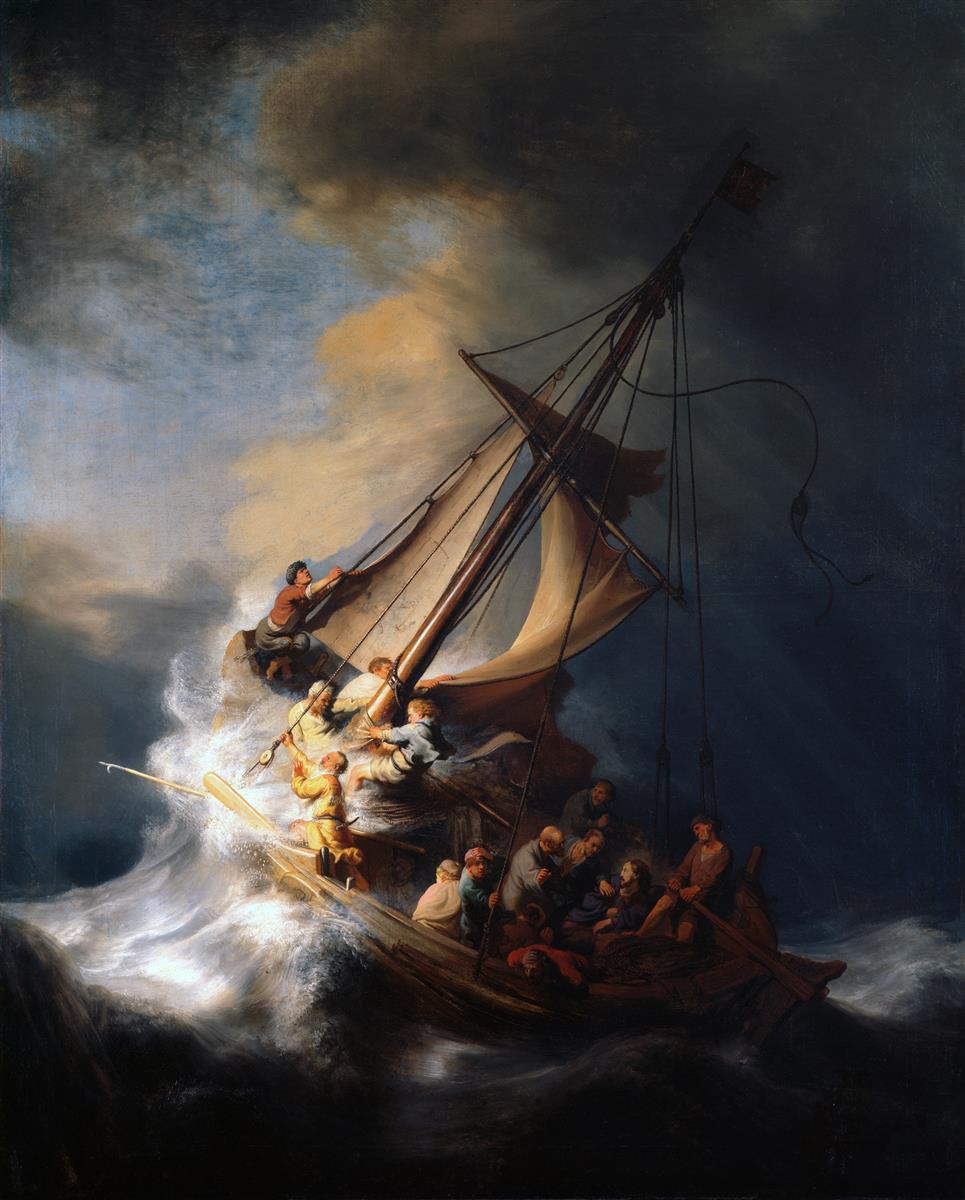
Rembrandt’s “The Storm on the Sea of Galilee” captures a single heartbeat on a heaving boat when terror, doubt, and faith collide. The vessel rockets up the face of a wave that explodes into light, its rigging straining and its sail cleaved by the wind. Crewmen claw at ropes and spars while, in the shadowed stern, Christ rises amid the disciples’ confusion. The painting is not a calm devotional scene but a living emergency in which natural force and human emotion are painted with the same muscular energy. From the first glance, the eye is pitched into the swell, and the drama feels immediate, bodily, and inescapable.
The Biblical Moment And Its Human Temperature
The narrative is drawn from the Gospel story in which Christ, asleep during a storm on the Sea of Galilee, is awakened by his terrified disciples; he rebukes the wind and sea, and there is a great calm. Rembrandt focuses not on the calm but on the shuddering instant before it, when fear is at its zenith and faith is being tested. The miracle is imminent but not yet visible. That decision to stage the tense brink rather than the aftermath gives the image its psychological temperature. We are invited to feel what it costs to trust when the world appears to be breaking.
A Composition Built On Diagonals And Tilt
The boat is placed on a radical diagonal that launches the prow toward the upper left, where a wall of water detonates into white. This diagonal thrust is countered by the mast that spears toward the upper right, snapping the composition into an X-shaped armature. The two diagonals create torque, and the entire canvas seems to rotate around a pivot near Christ’s seated form. The mast’s lines and the boom’s arc carve the picture into zones of action, while the sail, whipped open like a torn banner, acts as a wind map that lets us read the invisible force animating everything else.
Chiaroscuro As Weather And Theology
Light breaks through cloud in a wedge, striking the exploding wave and washing over the front half of the boat. The stern retreats into concentrated dusk where Christ and several disciples huddle. This chiaroscuro performs two tasks at once. As weather, it describes a squall with brutal accuracy: sudden shafts, curtains of shadow, veils of spray. As theology, it pictures the paradox of the scene: fear is brightest and most visible where nature is loudest; the source of peace is quiet, shadowed, and near. Rembrandt withholds the glowing halo of convention and uses directional light instead to draw the viewer’s intuition toward the figure whose word will calm the storm.
The Boat As A Small World
The little vessel is a whole society in miniature, each person performing a different response to danger. Some wrestle with tools and lines, bodies bent into the gale. Others stare outward, stunned or praying, while two or three crowd close to Christ with gestures that plead or accuse. The boat is also a wooden theater: the curved gunwale frames the figures like a proscenium, the raised stern provides a dais for Christ, and the veering mast is a stage machine that threatens to tear the set apart. Rembrandt engineers this stage so that each action reads clearly without becoming theatrical artifice.
Faces And Gestures As A Map Of The Soul
Emotions range across the boat like weather systems. Near the prow, a sailor hauls on a rope with the grim resolve of someone who believes salvation lies in labor. Another clings to the mast in a panic that travels down his legs. At midship, a man braces himself, looking out as if measuring a route through the water. At the stern, disciples question and implore, one gripping Christ’s shoulder, another shielding his eyes, another collapsing to his knees. Christ himself is calm and compact, one hand lifting in a gesture that both steadies and signals authority. The variety of gestures is not decorative; it is Rembrandt’s way of painting states of belief, from exhausted self-reliance to surrendered trust.
The Self-Portrait And The Viewer’s Place On Board
Among the figures is a man in a cap, turned toward us, his face vividly illuminated as he clutches a line. He has often been read as Rembrandt inserting himself into the episode. Whether or not it is a self-portrait, the figure plays a structural role: he acknowledges the viewer and enlists us as fellow passengers. The look is not heroic; it is a look of someone caught in the same peril we are. That glance collapses the historical distance and makes the story a present-tense test for anyone who sees it.
The Sea Painted As Muscle And Voice
The water is not a backdrop; it is a protagonist. Rembrandt paints waves as muscular forms that swell, twist, and break with anatomy-like articulation. White water snaps into splinters around the prow; darker troughs yawn toward the right where the boat’s stern may plunge in the next instant. The sea has a voice in the paint: thick, broken impastos hiss into foam; long, horizontally dragged strokes create slick surfaces that reflect sky; tiny flecks of spray sting the viewer’s eye. The painter translates water into touch and sound so persuasively that the viewer feels drenched.
Sky, Opening, And The Promise Of Calm
Overhead, clouds shear apart to reveal a pale aperture of sky. The opening is not centered; it is a slanted, uncertain promise. Rays of cooler light angle down behind the mast, brushing the sail and catching edges along the faces. The sky reads as a conditional sentence: there will be calm, but not yet. By refusing to flood the scene with reassurance, Rembrandt honors the narrative’s crucible. Faith, in this register, is not a glow that erases struggle but a piercing clarity that arrives through it.
The Engineering Of The Sail And The Physics Of Force
The sail, billowing and torn, is a study in pressure dynamics. Its belly bulges where the wind’s push is strongest; edges snap back where gusts reverse direction; ropes bite into canvas, creating tension points that transmit force to wooden spars. Rembrandt’s specificity is not pedantry; it is empathy for material truth. By making the physics convincing, he earns the right to speak about metaphysical reality. The viewer submits to the power of the storm because the painter has earned our trust with observed particulars.
Color As Weather And Breath
The palette is composed of cool greys, sea-blues near black, leaden violets, and sudden sunlit yellows and warm creams where foam catches light and garments flare. These color zones function like temperature gradients. The prow basks in a chilly blaze, the stern huddles in muted warmth, and the sky alternates between bruised blue-black and thawing amber. The color does not flatter the world; it measures it. Rembrandt’s restrained chroma leaves room for air, as if the gale has scoured the painting of excessive pigment.
Brushwork That Alternates Between Surge And Stillness
The painting’s surface carries two speeds. In the water and sail, strokes surge and whip, laid wet into wet with a speed that mimics the storm’s tempo. In the faces and Christ’s hand, the brush slows, articulating planes and expression with small, decisive touches. This alternation between surge and stillness is the structural rhythm of the painting, the very rhythm of the story itself: panic convulses, then a word stills it.
Sound, Smell, And The Sensory Imagination
The image awakens sensory imagination to a degree unusual even for Rembrandt. One can almost hear the slam of timber, the slap of loosened ropes, the guttural roar of water under the hull, the cry of men coordinating effort, and the gusts booming in the canvas. The smell of salt, pitch, and wet wool seems to leak from the edges. This sensory fullness matters because it makes the miracle subsequent to the picture feel like a real intervention into a real world, not a fable imposed on a painted stage.
The Number Of Figures And The Pattern Of Roles
Counting Christ and the disciples, the boat holds a company that approximates the narrative’s group. Their placement follows a pattern of counterweights: a cluster of laborers strains forward to keep the prow up; a cluster of petitioners gathers aft; a few transitional figures bridge the zones by pulling lines across the middle. The arrangement is not a frozen tableau; it is a machine for translating energy, with Christ at the system’s quiet center.
The Ethics Of Representation In A Scene Of Peril
Rembrandt never glamorizes danger. There is drama, but no cheap heroism. No one is posed as a classical savior; no stagey lightning splits the sky to flatter the painter’s skill. What he offers instead is moral clarity about human limitation. The disciples are competent men overwhelmed by a force they cannot master. The painting honors their labor without pretending it is sufficient, which is precisely why the miracle matters.
Christ As Compact Authority
Christ is rendered with an almost inconspicuous economy. He is small relative to the sail and sea, seated rather than towering, and lit modestly rather than theatrically. Yet everything bends toward him: glances, gestures, and the slight tilt of surrounding bodies. His raised hand is the compositional fulcrum and the theological hinge. The hand’s shape is not melodramatic; it is the measured signal of someone about to speak with effective authority. By underplaying spectacle here, Rembrandt intensifies the authority that will soon command the storm to cease.
The Viewer’s Emotional Path Through The Painting
The eye typically enters on the bright wave at the bow, climbs along the thrust of the hull to the tangle of ropes and struggling men, arcs up the mast to the ragging sail, and then descends in a diagonal toward the stern where the shadowed consultation with Christ takes place. That path is the emotional itinerary of the story: overwhelm, effort, appeal. It is also the path many viewers know from experience. The painting becomes a map of human response to crisis, directing the eye toward the source of resolution.
The Work Within Rembrandt’s Early Amsterdam Period
Painted in 1633, the picture belongs to Rembrandt’s early Amsterdam years, when he tackled large-scale narrative subjects with polished technique, dramatic lighting, and a relish for material facts. Even in this youthful bravura, however, he resists superficial flash. The technique serves the drama of belief. The world is painted so persuasively that the claim of the divine event can land inside a credible physical universe. That balance—virtuoso naturalism paired with psychological and spiritual depth—is a signature of the period.
Symbolic Threads That Deepen Without Distracting
Several details carry symbolic weight without hijacking the scene. The broken or slackened sail lines hint at the failure of purely human control. The banner at the mast’s top flickers like a tiny, precarious standard in a world that will soon be reordered by a different sovereignty. The sharply foreshortened bowsprit, aimed like a spear into the glowing wave, reads as risk taken in good faith, a thrust into danger that will become a passage once peace is spoken. These threads enrich the narrative without turning it into allegorical puzzle.
Why The Painting Still Works On Modern Eyes
Contemporary viewers, regardless of belief, recognize the anatomy of crisis here. The boat can be read as a workplace, a family, a mind, or a community pitched by forces larger than itself. The painting refuses denial and refuses despair. It depicts effort to the point of exhaustion and then makes room for a word beyond effort. That structure continues to feel truthful in times of cultural, personal, or environmental turbulence.
A Closing Reflection On Motion Toward Calm
“The Storm on the Sea of Galilee” is a picture propelled toward quiet. Every diagonal, every blast of spray, every contorted rope prepares us for a stillness that the painting withholds but guarantees. By stopping time at the brink, Rembrandt asks us to inhabit the charged second when the heart must choose what to trust. In doing so, he renders a marine catastrophe as a spiritual portrait and turns a boatload of frightened men into a mirror for anyone who has ever faced a wave that seemed larger than the world. The sea rages, the sky fissures, the men cry out, and a hand rises. The next breath will change everything.
