Image source: wikiart.org
A Young Master’s First Public Statement
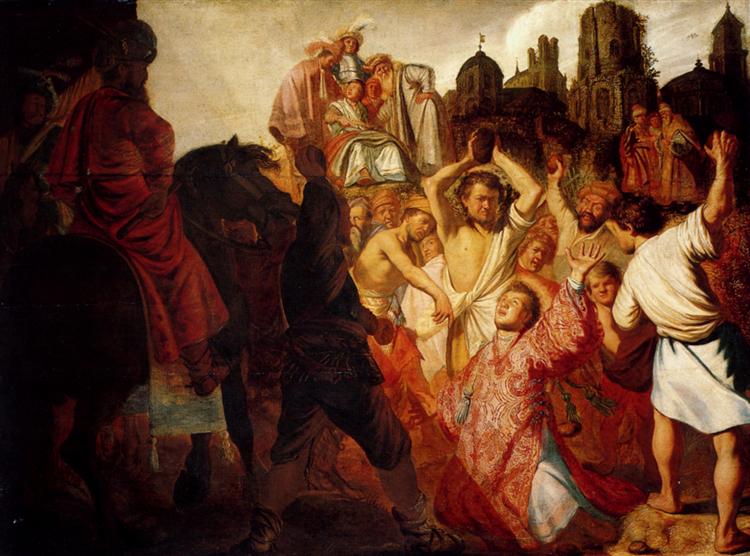
Rembrandt’s “The Stoning of St. Stephen” is one of the most ambitious declarations of talent from his formative Leiden period. Painted in 1625, when the artist was about nineteen, the canvas plunges the viewer into the first Christian martyrdom as told in Acts 6–7. What might have been a didactic scene becomes a stage crowded with conflicting energies: righteous ecstasy, mob fury, bureaucratic indifference, and dawning conscience. The painting is large, busy, and deliberately theatrical, yet it already carries the traits that will define Rembrandt’s later genius—psychological complexity, storytelling through light, and an unsentimental sympathy for human weakness. The work reads like a manifesto: the teenager from Leiden is not merely illustrating scripture; he is testing how far a single canvas can hold the contradictions of the human condition.
Historical And Biographical Setting
In 1625 Rembrandt had recently returned to Leiden after a brief apprenticeship with Pieter Lastman in Amsterdam. Lastman specialized in grand historical subjects packed with figures in exotic dress, precise gestures, and archaeological detail. Rembrandt absorbed this taste for history painting—the most prestigious genre in the Dutch hierarchy—and immediately sought a subject that would demonstrate command of multiple skills at once: anatomy, drapery, horse and rider, architecture, crowd choreography, and a moving central drama. “The Stoning of St. Stephen” answered that ambition. The choice of Stephen, a deacon eloquent in debate and radiant in faith, also allowed the young painter to stage a conversion subplot: Saul of Tarsus, later Paul the Apostle, appears as an observer consenting to the execution. This double narrative gives the painting an inner hinge between violence and future mercy.
The Scene And Its Narrative Pivot
Stephen kneels in the foreground at right, richly robed in a diaconal vestment that glows scarlet and gold. His face turns heavenward, his hands raised in a gesture of prayer and surrender. Around him the crowd tightens. One executioner at center hoists a rock over his head, teeth clenched, another already bends to scoop more. At the left, a mounted figure—often read as a Roman authority or civic official—oversees the scene without intervening. High on a ridge beyond the scrum, a cluster of dignitaries watch from seats like a tribunal, their robes and headdresses catching the light. Whether or not we pick out Saul among them, we feel the moral geometry: below, the earthbound frenzy; above, the cool sanction of power; in between, a chorus of onlookers whose varied reactions mirror our own potential responses.
Composition As Orchestration Of Forces
The composition is built from three interlocking arcs. The first is the diagonal from the horse’s croup at left down to Stephen’s kneeling body at right; it functions like a descending blade that cuts the space into action and victim. The second is the semicircle of raised arms at center, a rhythm of elbows and fists that wraps Stephen in a crown of violence. The third is an upper register of seated authorities and silhouetted architecture that frames the sky. Together these arcs keep the viewer’s gaze in motion while always returning to the martyr’s radiant head. The ground plane is steep, as if we stand on a slope stepping into the riot; this tilt accelerates the urgency and compresses distance so the figures jostle against one another. Rembrandt learned such stagecraft from Lastman, but he pushes it toward density and immediacy, shortening the spaces and inviting us into the press of bodies.
Light As Theology
Light is the most articulate speaker on the canvas. A high, cool illumination pours from the upper right, catching the ridges of Stephen’s robe and bathing his upturned face. The rest of the scene is a weather of alternations—half-shaded faces, gleams on lifted stones, a rim of brightness along the horse’s flank. The brightest patch belongs to the martyr; no gold aureole is needed. In a single move the painter proposes that grace is not an abstract radiance but a property that adheres to flesh in a moment of witness. Even at nineteen Rembrandt understands light as moral rhetoric: the equitable illumination that shows us every participant, and the privileged clarity that sanctifies one figure not by erasing his suffering but by making it legible.
Costume, Drapery, And The Appeal Of The Exotic
Seventeenth-century Dutch artists had access to a flood of fabrics and fashions through Amsterdam’s trade networks. Painters gathered costumes for their workshops, using turbans, embroidered mantles, and metallic trims to situate biblical episodes in a timeless “Orient.” Rembrandt seizes the opportunity to animate fabric as a vehicle for meaning. Stephen’s red-and-gold garment is not merely pretty; its heavy folds slow his kneeling body, giving the moment the weight of ritual. The crowd’s varied garments—bare torsos, rough tunics, sashes—grade the composition from luxury to labor, creating a social spectrum that underlines the episode’s tension between official authority and street execution. The way the fabrics catch the light becomes a second axis of narrative: the more saturated the cloth, the more it participates in the drama.
Gesture And Expression As Language
This period’s history painting relied on a codified vocabulary of gesture to communicate each figure’s role. Rembrandt handles the code with a mingled deference and freedom. The man at center lifting a stone follows textbook ferocity: knees flexed, arms raised, mouth open. Yet his expression is not caricatured rage; it is messy exertion, a human face caught between duty and adrenaline. The figure beside him leans forward, his torso a long curve of intent, lips taut. A man to the right throws both hands up in what could be alarm, encouragement, or visceral recoil—Rembrandt refuses to fix it. The tribunal above maintain decorous poses, their composed hands and straight backs proclaiming distance. Stephen’s own hands offer the most complex sign: raised in prayer, yes, but also as if to receive the very stones, a nuance that compresses acceptance and petition into one eloquent attitude.
The Horse And The Economy Of Power
The mounted figure on the left is a masterstroke. Only part of the rider is visible; his bearded profile echoes imperial medals, and the horse’s flank—huge, dark, indifferent—occupies a mass equal to several human bodies. This tonnage of animal and authority presses into the scene like a mute witness. The animal’s turned rump and the rider’s averted gaze both deflect moral responsibility while asserting control. The visual effect is to balance the bright drama at right with a shadowed bloc at left, a counterweight that represents institutional power’s cold steadiness against individual ardor. The viewer senses that without the tacit approval embodied by horse and rider the stoning would stall; with it, violence proceeds.
Architecture, Setting, And The Sense Of Time
Behind the upper figures rise domed and towered structures, a hybrid cityscape that folds antiquity and the artist’s northern contemporaneity into a single horizon. These buildings are not archaeological reconstructions; they are mood. Their silhouettes, ragged and luminous against a burst of sky, create a distant register of permanence from which the transient chaos below can be measured. The sky itself shows a bright breach in cloud cover, a visual proxy for the heaven Stephen beholds. The high vantage of the tribunal and the far skyline lend the scene a stratification of time: the immediate moment of stones in the air, the civic time of courts and councils, and the long time of cities and faith that survive any one act.
Color, Paint Handling, And Surface
The palette alternates warm earths—reds, ochres, raw umbers—with cool grays and a few acidic highlights. Stephen’s robe functions as the chromatic heart, its red deepened by glazes and patterned with golden embroidery that catches tiny sparks of light. Flesh is modeled with a youthful firmness; the paint is lean in the background and more loaded in places where texture matters, such as the quilted sleeve of a figure bending to lift a stone or the pelt-like mane along the horse’s neck. In passages of crowd and architecture the brush becomes summary, massing figures into teams of light and shade rather than completed portraits. This modulation of finish is deliberate: the eye recognizes hierarchy through the precision lavished on the protagonist and the studied economy elsewhere.
Theological And Emotional Stakes
Stephen’s speech before the Sanhedrin reviews Israel’s history and charges the council with resisting the Spirit. As he is dragged out and stoned, he prays for his killers. Rembrandt renders this paradox—truth spoken and mercy offered in the same breath—by allowing two atmospheres to coexist on the canvas. Around the martyr, the light is coolest and most constant, anchoring calm. Around the executioners, light is broken, flickering, and intermittent, like a conscience not yet steady. Everywhere else the tonality is mixed, registering the undecided. Rather than settle the argument with a didactic emblem, the painting asks the viewer to occupy this threshold where judgment and compassion struggle.
Echoes Of The Artist’s Own Face
One of the most intriguing details is a self-referential head near the center, just behind the main executioner’s raised arms. The young painter grants himself a cameo, looking out with a puzzled, almost stricken curiosity. This is not a vainglorious signature; it is an ethical position. By placing his own face inside the crowd, Rembrandt exposes the painter as a witness implicated in the spectacle, neither innocent nor judge. The cameo also folds time: the artist of 1625 stands in the first century and in the studio at once, a bridge between scripture and the painting’s present tense.
The Role Of Lastman And The Step Beyond
The work is steeped in the methods of Pieter Lastman: the crowding of figures, the predilection for costume, the rhetorical clarity of gesture, the carefully placed official on horseback. Yet Rembrandt already bends these tools toward a deeper interiority. Lastman often orchestrates scenes like tableaux; Rembrandt agitates the space so that we feel bodies collide and glances cross. He avoids the crystal clarity of allegory in favor of layered motives: anger mixed with doubt, authority tinged with hesitation, piety joined to fear. This thickening of motive foreshadows the path he will take away from the shiny surface of decorative history toward the rougher, more searching vision of his mature years.
The Viewer’s Position And The Ethics Of Looking
The composition situates us almost within the ring of executioners, closer than comfort allows. We see Stephen’s face nearly at our feet, as if he has turned toward us for witness. The stone-raiser’s legs frame our sightline; we are not a safe distance away but inside the reach of the next thrown rock. The painting therefore makes a demand: what do we do with this proximity? Do we align with the authorities and call it lawful? Do we join the fervor? Do we recoil? That ethical provocation is part of the canvas’s originality. Rather than provide a moral from on high, the picture makes our response the final component of the narrative.
A Study In Contrasts That Coheres
Nearly every opposition available to painting is activated here. Horizontal bench versus diagonal bodies, red versus earth tones, bare skin versus armor and brocade, vertical towers versus bent postures, the mass of a horse versus the vulnerability of a kneeling man. Yet the painting does not fly apart. The continuity is provided by the flow of light and by a hidden armature of curves that unite sky shapes, shoulder lines, and the semicircle of raised arms. Even the thrown stones, caught at different points in their arc, become a rhythmic bracelet around the central event. Coherence emerges from motion rather than stasis.
Martyrdom Without Sentimentality
Many earlier depictions of Stephen emphasize the sweetness of his vision at the expense of the body’s ordeal. Rembrandt keeps the pain present. Stephen’s mouth is parted not in rapture alone but in an inhalation before impact; the weight of his garment drags at his kneeling posture; the stones are real, rough ovals poised to bruise and break. And yet the painting refuses cruelty for its own sake. It asks us to hold the bodily fact and the spiritual reality in one glance, which is the challenge of martyrdom itself. In this balance the nineteen-year-old already shows a steadiness rare even among older masters.
The Work’s Place In Rembrandt’s Development
After this canvas, Rembrandt continues to paint and etch historical and biblical scenes, but the crowd decreases and the psychological pressure rises. By the 1630s, the drama will often be carried by a few figures in a close space with light doing the heavy narrative lifting. “The Stoning of St. Stephen” therefore reads as a threshold piece. It proves that the young artist could compete in the arena of grand manner history, then quietly points toward a more intimate theater of the soul. The self-insertion in the crowd is a harbinger of the self-portraits to come, where the artist will interrogate his own face as thoroughly as he interrogates scripture’s protagonists.
How The Painting Works On Us Today
For a contemporary viewer, the painting is less about a distant martyrdom than about how collective violence gathers around certainty. We recognize the roles: the inciters who perform zeal, the officials who look away, the curious who drift with the nearest shout, the few who hesitate. Stephen’s gesture of forgiveness converts the scene into a test of imagination. Can we grant mercy while still naming the wrong? The painting offers no easy path, only the serene light of the martyr’s face to guide the eye. Its power lies in this refusal to simplify. It is a difficult picture because moral life is difficult.
Practical Lessons For Looking
The work rewards slow scanning. Begin at the flare of red around Stephen’s shoulder and trace the line of his forearm up to the pale palm. Follow that arc to the raised stones and their shadows, then down the strong diagonal of the black-clad executioner’s legs to the dark bulk of the horse. From there, let the eye climb to the tribunal, then leap across to the bright notch of sky that answers Stephen’s gaze. Each circuit tightens comprehension. You start to notice micro-dramas—a man restraining another, a bystander hiding his eyes, a child craning for a view. The canvas becomes not a single event but an ecosystem of responses to the event.
Enduring Significance
Beyond its value as an early masterpiece, the painting remains a touchstone for how art can hold argument without collapsing into chaos. It demonstrates that clarity is not the same as simplicity. It boasts craft without vanity, a packed stage without confusion, zeal without propaganda. By a disciplined distribution of light, gesture, and texture, Rembrandt creates a believable world where every actor has a reason to be there. The young painter announces that history painting need not be a sermon delivered from a pulpit of style; it can be a gathering where all the voices of a moment, including ours, contend under the same sky.