Image source: wikiart.org
Introduction
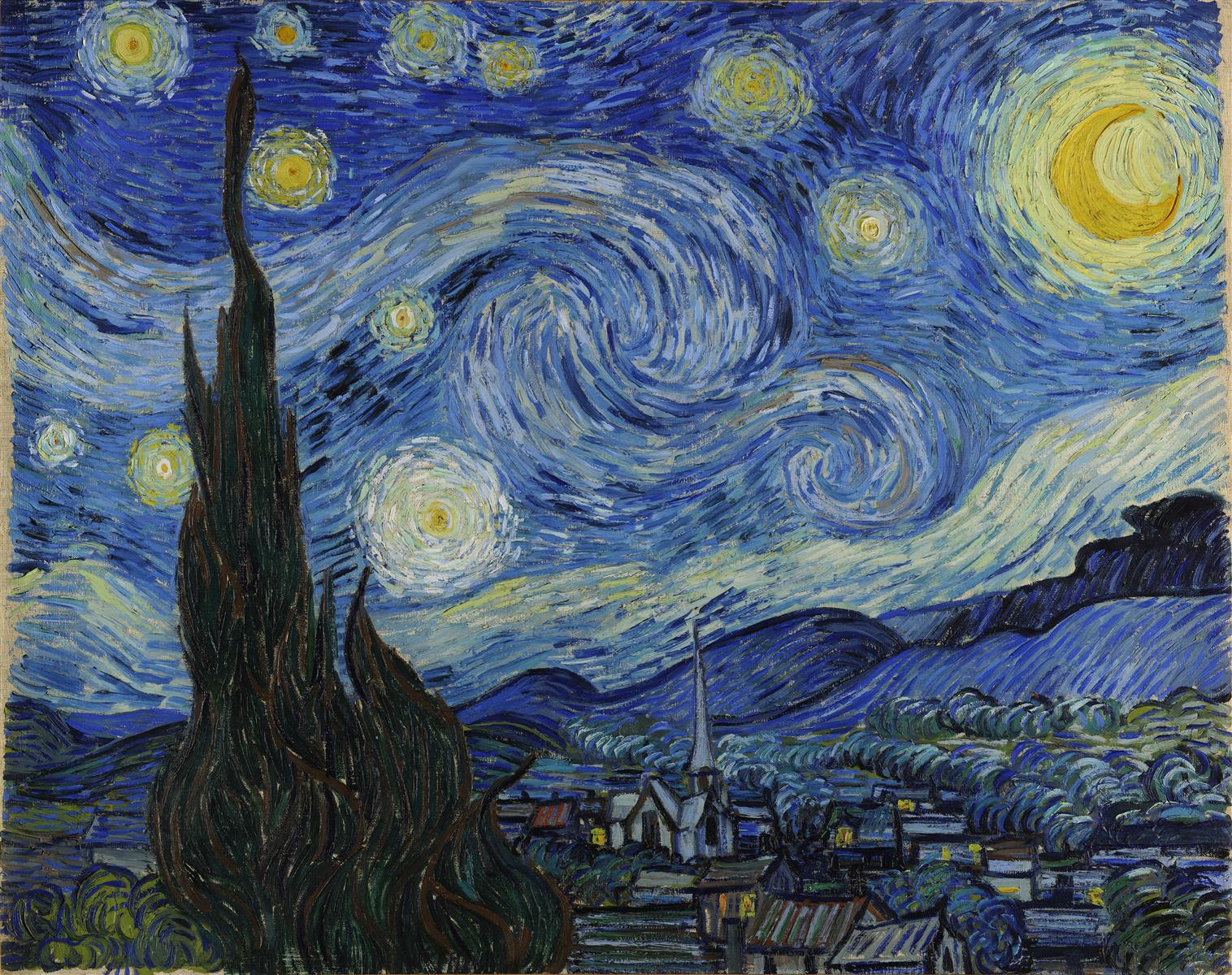
Vincent van Gogh’s The Starry Night, painted in 1889, is one of the most instantly recognizable images in the history of art. Few paintings have entered popular culture so completely while still rewarding close, serious viewing. At a glance, the work seems simple enough: a sleeping village beneath a dramatic sky filled with stars, a bright moon, and enormous spiraling forms of light. Yet the longer one looks, the more complex it becomes. The painting is not just a view of the night. It is a transformation of nature into feeling, memory, rhythm, and vision.
What makes The Starry Night so powerful is the way it stands between observation and imagination. Van Gogh did not paint the scene as a literal transcription of what lay before him. Instead, he reshaped it into something inward and emotional. The hills roll like waves, the stars pulse with energy, and the sky seems alive with motion. Even the dark cypress in the foreground rises like a flame. The painting takes the familiar elements of a landscape and turns them into a deeply expressive image of the world as it might be felt rather than merely seen.
This balance between reality and invention is central to the painting’s enduring appeal. It offers viewers both a place and a state of mind. The church steeple, clustered houses, hills, moon, and stars suggest a quiet rural world, but the sweeping sky carries another force entirely, one that feels cosmic, restless, and almost overwhelming. Van Gogh unites these two scales, the intimate and the vast, the earthly and the celestial, and in doing so creates a work that feels both personal and universal.
Historical Context and the Moment of Creation
The Starry Night was painted during a crucial period in Van Gogh’s life. In 1889 he was living at the asylum of Saint Paul de Mausole in Saint Rémy de Provence in southern France. He had admitted himself there after the crisis that followed his breakdown in Arles. This period is often discussed mainly through the lens of his mental struggles, but it was also a time of remarkable artistic productivity. Even while dealing with instability and suffering, Van Gogh continued to work with determination, producing some of the most memorable paintings of his career.
The setting of Saint Rémy mattered greatly. Surrounded by gardens, olive groves, hills, and a landscape marked by strong light and dramatic forms, Van Gogh found subjects that matched his growing desire for expressive intensity. He painted cypresses, wheat fields, mountains, and skies with a heightened emotional charge. In these works, nature becomes more than scenery. It becomes a living force capable of carrying spiritual and psychological weight.
The Starry Night belongs to this period of transformation. It reflects Van Gogh’s growing confidence in moving beyond straightforward naturalism toward a more imaginative mode of painting. He had already absorbed important influences from Impressionism, Japanese prints, and Post Impressionist experimentation, but in this canvas he pushed further. The result is not a passive record of what he saw from his window. It is a constructed vision, shaped by memory, invention, and artistic intention.
The painting also reflects Van Gogh’s long standing fascination with the night. He was drawn to evening scenes and often wrote about the expressive possibilities of darkness illuminated by stars or lamps. For him, night was not simply the absence of day. It carried mystery, poetry, and emotional depth. In The Starry Night, that fascination reaches one of its fullest expressions.
Composition and the Structure of the Scene
The composition of The Starry Night is carefully organized despite its apparent turbulence. Van Gogh arranged the painting so that the viewer moves between the stable forms of the land and the animated energy of the sky. This tension is one of the work’s greatest strengths. The lower half of the canvas contains the village and hills, creating a sense of groundedness. Above them, the sky dominates, swirling with arcs, circles, and streaming lines of light.
The tall cypress at the left foreground is one of the most important compositional elements. It acts almost like a visual bridge between earth and heaven. Rising from the bottom edge of the painting and extending upward into the sky, it links the human scale of the village with the cosmic scale above. Without the cypress, the painting would feel split between lower and upper zones. With it, the whole scene becomes connected. The tree is both an anchor and a dramatic accent, dark and vertical against the luminous motion of the heavens.
The village below provides contrast. Its houses are small, angular, and relatively calm. Their rooftops create horizontal and diagonal patterns that hold the bottom of the composition together. At the center, the church steeple stands out as a second vertical form, though much smaller than the cypress. This steeple reinforces the upward pull of the composition and subtly echoes the larger movement from the earthly realm toward the celestial one.
The hills in the background form a barrier between village and sky, but they also participate in the overall rhythm. Their rolling contours prepare the viewer for the larger curving motions above. In this way, Van Gogh ensures that every part of the painting contributes to a unified visual language. The scene is not divided into separate pieces. Everything is connected through shape, direction, and rhythm.
Color, Light, and the Drama of Contrast
Color plays a decisive role in the emotional impact of The Starry Night. Van Gogh uses deep blues and blue greens as the dominant tones of the night sky and surrounding landscape. Against these cool, dark hues, he places brilliant yellows, whites, and touches of orange in the moon and stars. This contrast creates a sense of vibration. The lights do not merely sit in the sky. They seem to radiate, pulse, and expand.
The blue of the sky is not uniform. It shifts in intensity, moving through darker and lighter passages that suggest depth and movement. This layered handling of color keeps the sky active even before the swirling lines are fully noticed. The darkness of the night is therefore not empty or flat. It is rich, varied, and alive.
The stars and moon are painted as halos of energy. Van Gogh enlarges them far beyond natural appearance, surrounding them with concentric rings that make them appear luminous and dynamic. These halos are among the painting’s most memorable features. They suggest not scientific precision but emotional intensity. The stars become presences rather than distant points. They seem close, active, and expressive.
The village, by contrast, is painted in more subdued tones. Soft grays, blues, and muted browns keep it quieter than the sky above. A few warm lights in the windows suggest human life, but these small glows remain modest. They do not compete with the celestial drama overhead. Instead, they create a secondary level of warmth, intimate and domestic, beneath the larger lights of the cosmos.
The cypress is almost black, though in fact it contains subtle greens and blues. Its darkness gives it tremendous visual weight. Against the sky’s brilliance, it appears mysterious and solemn. This contrast between dark vertical mass and radiant swirling sky intensifies the painting’s emotional range. Van Gogh uses color not merely to describe objects but to orchestrate feeling.
Brushwork and the Sense of Living Movement
One of the most remarkable qualities of The Starry Night is its brushwork. Van Gogh’s paint application is visible, energetic, and directional. He does not smooth the surface into illusionistic calm. Instead, every stroke remains active, reminding us that the painting is a made object, shaped by gesture and touch. The result is a sense of immediacy that few artists have matched.
In the sky, the brushstrokes curve, twist, and loop. These marks create the painting’s famous sensation of swirling motion. The sky feels like a sea of currents. Lines of paint gather into spirals, streams, and circular halos that give the heavens a dynamic, almost musical structure. The viewer does not simply see the sky. One feels its movement across the surface.
The hills and cypress are also built through active strokes, though their rhythms differ from those of the sky. The hills are more compressed and rolling, while the cypress is marked by upward, flame like strokes that make it seem to flicker. The village is calmer in its handling, with more compact and controlled marks that reflect its stillness. Through these differences, Van Gogh assigns each part of the painting its own visual tempo.
This brushwork is central to the painting’s expressive force. The surface becomes a record of perception transformed by emotion. Rather than pretending that the painting is a transparent window onto the world, Van Gogh allows the viewer to feel the artist’s presence in every mark. The act of painting becomes part of the subject itself. The world is not only depicted. It is reanimated through touch.
The thickness of the paint also matters. In many areas, Van Gogh laid it on heavily enough to give the surface physical texture. This material richness makes the stars and swirls feel even more substantial. Light catches the raised paint, enhancing the sense that the sky itself is built from moving energy. The painting is therefore expressive not only in image but in matter.
The Sky as Vision and Symbol
The sky in The Starry Night is one of the most discussed passages in Western painting because it resists simple explanation. It can be seen as a response to the actual appearance of the night sky, but it is clearly much more than that. Van Gogh transforms astronomical forms into symbols of intensity, wonder, and emotional power. The heavens are not calm and distant. They are near, animated, and almost overwhelming.
This transformation gives the painting much of its spiritual character. The stars and moon do not function merely as natural features. They suggest a universe charged with meaning. Van Gogh had long been interested in religion, morality, and the possibility of transcendence, even though his relationship with formal religion became complex. In The Starry Night, the sky can be understood as a place where longing, faith, fear, and hope all converge.
The swirling central form, often read as a great current of light or atmosphere, intensifies this effect. It turns the sky into a living field of motion, as though invisible forces have become visible. Viewers often respond to this as a kind of cosmic energy. Whether interpreted spiritually, psychologically, or poetically, the effect is undeniable. The sky seems alive with more than weather or astronomy. It becomes a stage for the unseen.
At the same time, the sky does not entirely eclipse the rest of the painting. Its grandeur is set against the stillness below, and that contrast deepens its meaning. The night is both magnificent and unsettling. It inspires awe, but it also suggests vulnerability. Human life appears small under such an immense and active universe. That feeling of smallness is not necessarily negative. It can also be humbling, moving, and profound.
The Village, the Church, and the Human Presence
Although the sky attracts most of the attention, the village is essential to the painting’s emotional balance. Without it, The Starry Night would become a purely cosmic image. The small houses, rooftops, and church give the painting a human center. They introduce themes of community, shelter, and daily life. The village sleeps while the heavens blaze above it.
Interestingly, the village is not an exact depiction of Saint Rémy. It includes elements that seem more northern or imagined, especially the prominent church steeple, which resembles structures from Van Gogh’s Dutch background more than those of southern France. This suggests that memory played a role in shaping the scene. The village may therefore represent not only a place but an idea of home, familiarity, or spiritual longing.
The church steeple is especially meaningful. It rises upward like a narrow counterpart to the cypress, pointing toward the sky. In a painting filled with forces larger than humanity, the steeple stands as a sign of human aspiration. It may also hint at Van Gogh’s continued interest in spiritual questions. Even in a world dominated by nature and cosmos, the human impulse to reach beyond the material remains present.
The windows lit from within add another layer. They suggest private lives unfolding quietly behind walls. These small signs of habitation humanize the painting and create a contrast with the monumental sky. The stars may blaze with cosmic intensity, but people still sleep, dream, and live in ordinary dwellings below. This relationship between the vast and the intimate helps explain why the painting feels so complete. It includes both the universe and the village, the infinite and the local.
The Cypress and Its Emotional Power
The cypress is one of the painting’s most mysterious and powerful elements. Dark, towering, and flame like, it immediately commands attention. In practical terms, it anchors the left side of the composition and connects foreground to sky. Emotionally and symbolically, however, it carries even greater weight.
Cypress trees were often associated with cemeteries and mourning in European visual culture, which has led many viewers to see the tree here as a reminder of death. That interpretation has some force, especially given Van Gogh’s emotional struggles and his known interest in themes of mortality and eternity. Yet the tree does not feel only mournful. It also feels vital, energetic, and intensely alive. Its upward movement is dynamic rather than passive.
This duality is part of the painting’s richness. The cypress can be read as a symbol of death, aspiration, nature, or the burning intensity of feeling itself. It is dark, but it is not inert. It surges upward, almost as if answering the motion of the sky. In that sense, it participates in the cosmic drama rather than standing apart from it.
Visually, the cypress also makes the painting more immersive. Because it is placed in the foreground and cut by the edge of the canvas, it feels close to the viewer. It draws us into the scene. At the same time, its dark mass frames the brighter sky and intensifies the contrast that makes the stars and moon appear so radiant.
Emotion, Psychology, and the Painting’s Inner World
It is impossible to discuss The Starry Night without acknowledging its emotional depth. The painting is often approached as a window into Van Gogh’s state of mind, and while that can sometimes lead to oversimplified biographical readings, the emotional dimension of the work is undeniably strong. The painting does not feel detached or neutral. It feels charged, searching, and intensely personal.
What makes it so compelling is that its emotion is not narrowly defined. The painting can evoke wonder, loneliness, restlessness, hope, fear, exaltation, and calm all at once. This complexity is one reason it continues to resonate with such a wide audience. It does not trap feeling into a single message. Instead, it creates a space where multiple emotions coexist.
The sky’s turbulence may suggest anxiety or inner agitation, but the sleeping village introduces stillness and reassurance. The stars burn with energy, yet the overall scene remains contemplative. The painting therefore holds opposites together. It is restless and serene, intimate and vast, dark and radiant. That union of opposites gives the work unusual psychological depth.
Rather than illustrating a specific narrative, The Starry Night externalizes an inner experience through landscape. Van Gogh uses the visible world to express what cannot be easily said. In this sense, the painting anticipates later developments in modern art, where subjective feeling becomes central. It shows that landscape can be more than description. It can become a language of consciousness.
The Painting’s Place in Art History
The Starry Night occupies a crucial place in the history of modern art because it demonstrates how far painting could move beyond naturalistic representation while still remaining rooted in the visible world. Van Gogh does not abandon landscape. He reinvents it. He shows that a painting can remain recognizably about a place while also becoming a vehicle for emotion, symbolism, and formal invention.
This was a major step in the development of modern art. Earlier traditions often valued accurate description, balanced composition, and controlled finish. Van Gogh, by contrast, embraced distortion, visible brushwork, heightened color, and subjective intensity. These choices opened possibilities that later artists would pursue in different ways. Expressionism, Fauvism, and various strands of modern painting all owe something to the freedom and emotional courage found in works like The Starry Night.
The painting also matters because it embodies Van Gogh’s unique synthesis of influences. He absorbed the broken color of Impressionism, the decorative clarity of Japanese prints, and the structural experimentation of Post Impressionism, but he transformed them into something unmistakably his own. The result is not derivative. It is singular.
Its fame today can sometimes make it difficult to see freshly, but its reputation is deserved. This is not simply a beloved image because it is familiar. It is familiar because it achieves something extraordinary. It transforms the night sky into one of the most moving and original visions in all of painting.
Why The Starry Night Still Moves Viewers
Part of the lasting power of The Starry Night lies in its accessibility. Even viewers with little knowledge of art history can feel its impact immediately. The colors, movement, and emotional atmosphere communicate directly. At the same time, the painting is sophisticated enough to sustain endless interpretation. It can be loved for its beauty, studied for its technique, and discussed for its symbolism.
The painting also speaks to a fundamental human experience: looking up at the night sky and feeling both small and connected. Van Gogh captures that sensation with unusual intensity. He turns the distant heavens into something immediate and alive. In doing so, he gives visual form to emotions that many people know but cannot easily express.
Another reason for its endurance is the sincerity of its vision. Nothing in the painting feels cynical or calculated. It is full of conviction. Van Gogh believed that painting could communicate profound feeling, and The Starry Night proves that belief was justified. The work still meets viewers with freshness because its emotion feels genuine and its form remains alive.
Ultimately, The Starry Night endures because it offers more than a beautiful image. It offers an encounter with a world transformed by imagination and feeling. It reminds us that art can take ordinary elements, a tree, a village, a sky, and reveal them anew. In Van Gogh’s hands, the night becomes not silent emptiness but a living field of light, motion, and meaning.