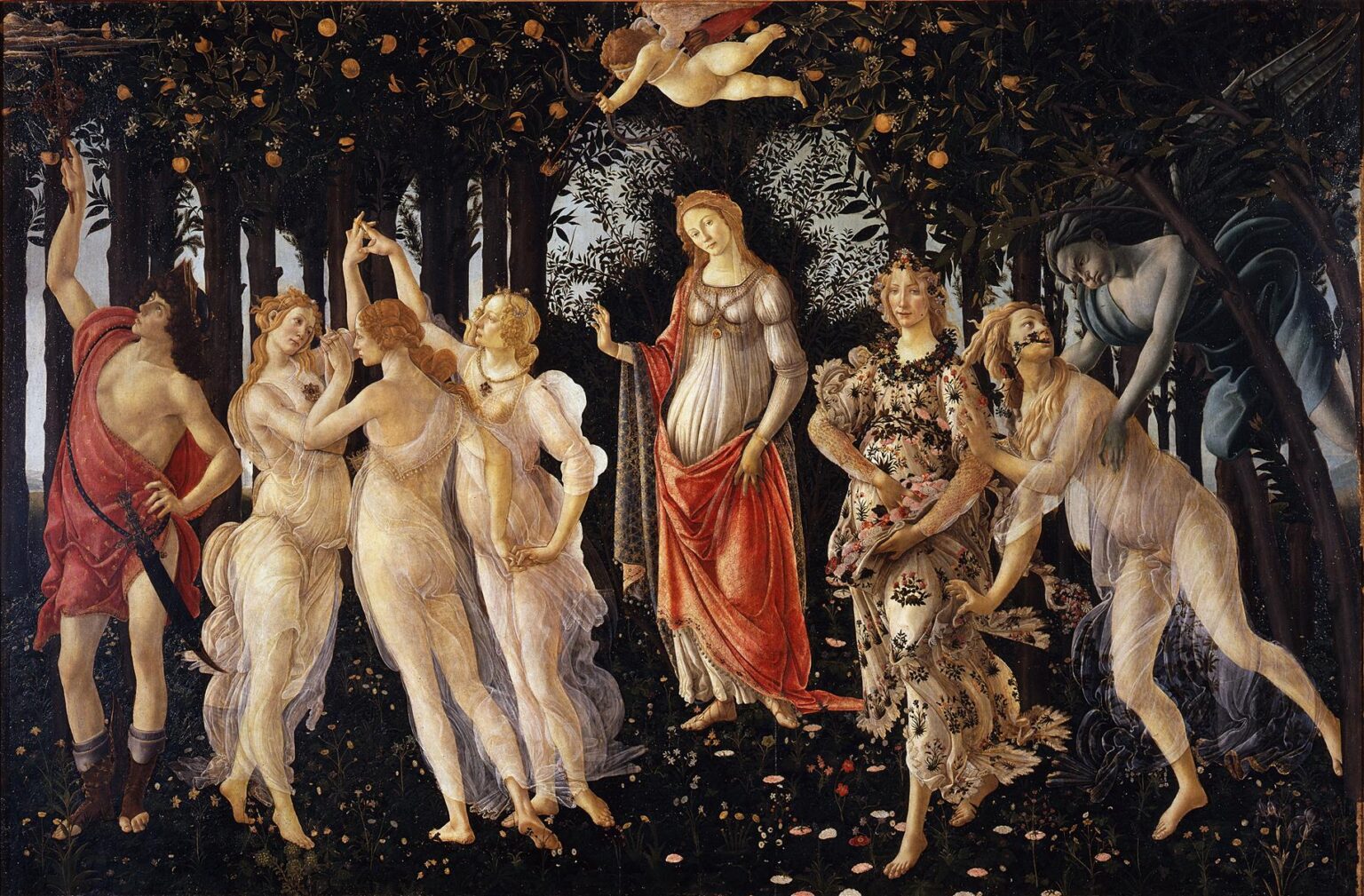
Image source: wikiart.org
Sandro Botticelli’s The Spring (Primavera)
Sandro Botticelli’s The Spring (Primavera), painted around 1480, stands as one of the most celebrated images of the Italian Renaissance. It is a painting that seems to exist between dream and ritual, between mythology and poetry, and between earthly beauty and something more elevated and ideal. At first glance, the picture appears to be a graceful gathering of mythological figures in a flowering grove. Yet the longer one looks, the more complex it becomes. Every gesture, every glance, every fold of drapery, and every orange leaf seems charged with meaning. This is not simply a decorative mythological scene. It is a deeply thoughtful meditation on love, fertility, beauty, transformation, and the arrival of spring.
The painting has fascinated viewers for centuries because it resists a single simple explanation. It is elegant and mysterious at the same time. Unlike many religious or historical works that tell a clearly defined story, Primavera offers a poetic sequence of figures that invite interpretation rather than impose it. Botticelli does not present mythology as a literal drama. Instead, he turns classical myth into an atmosphere, a visual song of renewal and desire. The result is a work that captures the intellectual ambitions of Renaissance Florence while also preserving a sense of enchantment that feels timeless.
The First Visual Impression
One of the most striking aspects of Primavera is its immediate visual rhythm. The figures are arranged across the width of the panel like actors on a stage, yet the scene does not feel static. There is movement everywhere, though it is a stylized and graceful movement rather than a dramatic one. The bodies sway, hands rise delicately, garments ripple, and hair drifts in curving lines. The dark grove behind them creates a rich backdrop that makes the pale skin and luminous fabrics stand out with extraordinary clarity.
The setting feels at once natural and artificial. It is a garden, but not a wild one. Flowers spread across the ground in careful abundance, and the orange trees above form an enclosed, almost sacred space. This controlled natural world reflects the Renaissance taste for idealized beauty. Nature here is not observed in a bluntly realistic way. It has been refined, ordered, and transformed into a poetic environment worthy of gods and allegories.
The eye is drawn first toward the central female figure, who stands slightly back from the others. She has a composed, almost solemn presence that anchors the entire scene. To one side, three young women dance in transparent garments. To the other, a blue-gray male figure pursues a nymph, from whose mouth flowers seem to emerge as she transforms into a richly dressed goddess. Above, Cupid prepares to release his arrow. On the far left, a young man dressed in red lifts his staff toward the trees. The composition is balanced, but it is never rigid. It unfolds like a visual poem, inviting the viewer to read from right to left and from movement into harmony.
The Mythological Figures and Their Meanings
The identities of the figures in Primavera have been discussed for generations, but the most widely accepted reading sees them as characters drawn from classical mythology and linked by themes of spring and love. On the far right is Zephyrus, the wind god, who rushes toward the nymph Chloris. According to myth, Zephyrus pursues and possesses Chloris, who is then transformed into Flora, goddess of flowers and spring. Botticelli represents this metamorphosis with remarkable ingenuity. Chloris appears as the pale, retreating figure, while Flora emerges beside her in a floral dress, scattering blossoms.
This transformation is one of the key dramatic moments in the painting. It suggests that spring is born from change, desire, and the generative force of nature. Flora becomes a figure of abundance, calm, and fertility. She is richly clothed and grounded, a contrast to the anxious movement of Chloris and the forceful rush of Zephyrus. In this pairing, Botticelli moves from disturbance to harmony, from pursuit to flowering.
At the center stands Venus, the goddess of love, though she is presented in a restrained and dignified manner. She is not merely sensual. Her gesture and placement give her the quality of a moral or spiritual guide. She presides over the garden like a queen or a refined allegorical presence. Above her, Cupid is blindfolded, preparing to shoot his arrow toward the dancing Graces. This detail reminds the viewer that love operates unpredictably, often without reason.
To the left of Venus dance the Three Graces, figures associated with beauty, charm, and generosity. Their linked movement suggests social harmony, refinement, and the reciprocal nature of love and grace. They are among the most admired figures in the painting because of the exquisite way Botticelli handles their transparent drapery and interwoven gestures. On the far left stands Mercury, identifiable by his staff and winged sandals. He appears to be dispelling clouds or guarding the garden. His presence may suggest reason, eloquence, or the intellectual dimension of love.
Together, these figures do not form a straightforward narrative. Instead, they create a progression of ideas. From right to left, the scene moves from desire and physical force to blossoming fertility, from there to civilized grace, and finally to Mercury’s more elevated sphere of intellect and order. The painting thus becomes an allegory of love in its many forms, from instinctive passion to refined and even spiritual beauty.
Venus at the Center of the Painting
Venus is essential to the logic and emotional tone of Primavera. Without her, the scene might feel like a loose collection of classical characters. With her, it becomes a unified vision of love’s domain. She occupies the central axis of the composition, framed by the dark arching foliage behind her. This natural framing gives her a quasi sacred presence, almost like the central figure in a religious altarpiece. Botticelli quietly borrows the visual language of devotional art and applies it to mythology, giving Venus an unusual dignity.
Her expression is calm and inward. She does not dominate through physical action. Instead, she stabilizes the surrounding energies. Zephyrus is forceful, Chloris is startled, Flora is active, the Graces are in flowing motion, and Mercury gestures upward. Venus alone remains still. This stillness is not emptiness. It is authority. She embodies the principle that holds the scene together.
The way Botticelli paints her also reflects the Renaissance tendency to merge pagan beauty with moral idealism. Venus is lovely, but she is not erotic in an obvious or theatrical sense. Her modesty and self possession suggest a higher form of love, something closer to harmony and civil refinement than to raw passion. In Florentine intellectual culture, classical mythology was often interpreted through philosophical ideas that linked physical beauty to spiritual truth. Venus in Primavera seems to stand at that meeting point. She belongs to the world of myth, but she also suggests a more elevated ideal of human love and order.
The Transformation of Chloris into Flora
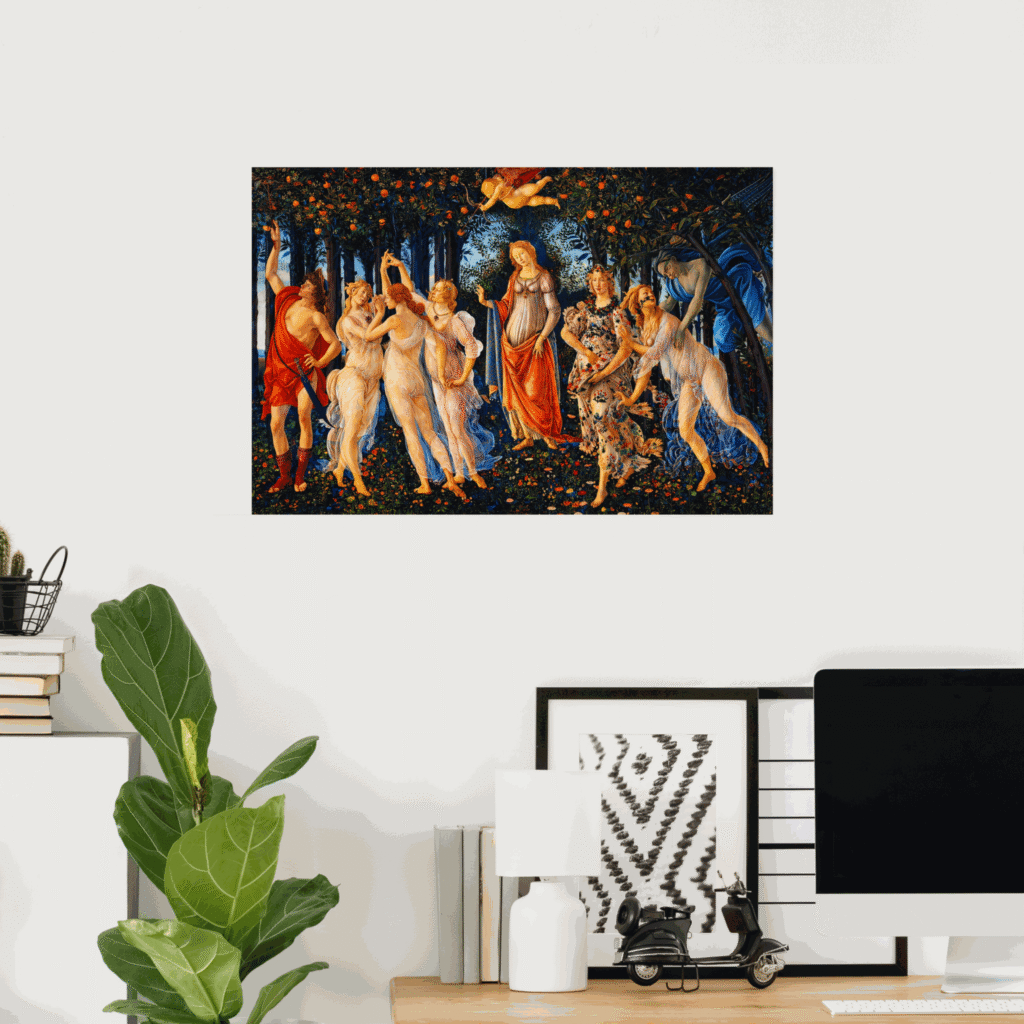
The right side of the painting contains its most vivid sense of change. Zephyrus enters with speed and force, his bluish body contrasting with the warm tones of the others. He represents wind, impulse, and desire. Chloris recoils from him, and Botticelli marks the transformation from nymph to goddess with flowers flowing from her mouth. This is one of the most memorable details in the entire painting because it turns metamorphosis into something visible and lyrical.
Flora, standing beside Venus, is one of Botticelli’s richest creations. Her dress is covered with flowers, and she scatters blossoms over the earth as if she were literally making spring happen. She is full, serene, and self contained. In visual terms, she is the completed version of the fragile Chloris. The scene suggests that nature’s fertility arises through processes that are both beautiful and unsettling. Spring is not only gentle bloom. It is also a season of stirring forces, change, and renewal after dormancy.
This passage from Zephyrus to Chloris to Flora has often been understood as a movement from sensual appetite to fruitful abundance. Botticelli does not hide the tension within that sequence. The pursuit on the right is not as peaceful as the grace and calm found in the rest of the painting. Yet the transformation resolves that tension into a richer state of being. In this sense, Primavera offers a vision of how desire can become beauty, and how the violence of natural impulse can be transmuted into order, fertility, and culture.
The Three Graces and the Idea of Harmony
The Three Graces are among the most admired parts of Primavera, and it is easy to understand why. Their dance is one of the great achievements of Renaissance line. Their bodies are arranged in a flowing circular movement, linked by delicate hands and transparent veils. Botticelli does not paint them as heavy, fully solid bodies occupying space in a strictly realistic way. Instead, he treats them almost like music made visible. Their forms are light, rhythmic, and idealized.
Each Grace appears distinct, yet together they form a unified pattern. Their gestures suggest giving, receiving, and returning, which fits the classical idea that grace is something exchanged among people. In the context of the painting, they represent a more civilized and social form of beauty than the urgent desire seen on the far right. They belong to the world of courtly behavior, refinement, and balanced interaction.
Cupid’s arrow above them adds tension to the scene. Though the Graces seem poised in harmony, love may suddenly disrupt that harmony. The blindfolded Cupid implies that desire does not always follow reason or fairness. This small but important detail keeps the painting from becoming overly serene. Love remains active, unpredictable, and transformative even in the realm of elegance.
The Graces also reveal Botticelli’s gift for making line carry emotional weight. Their transparent drapery clings and flows at once, outlining the body while also dissolving it into a shimmering effect. This gives them an almost immaterial beauty, perfectly suited to a painting concerned with ideal forms rather than ordinary reality.
Mercury and the Left Edge of the Garden
Mercury is often overlooked by viewers who are more drawn to Venus, Flora, or the dancing Graces, yet he plays an important role in the symbolic structure of the painting. Positioned at the far left, he stands somewhat apart from the women and turns his attention upward. With his caduceus, he seems to part or disperse the clouds. This gesture has been interpreted in several ways, but in general it suggests protection, clarity, and the exclusion of disorder from the sacred garden.
His red cloak gives him a strong visual presence, and his upward movement balances the rushing energy of Zephyrus on the opposite side. If Zephyrus represents impulsive natural force, Mercury may represent intellect, eloquence, or rational control. He marks the edge of the scene not as a barrier, but as a guardian of its refined atmosphere.
Mercury’s inclusion strengthens the idea that Primavera is not simply about spring as a season. It is also about levels of love and beauty. The painting begins with physical desire and ends with a figure associated with the mind and the heavens. This progression mirrors Renaissance philosophical interests in the ascent from bodily attraction to higher contemplation. Even if viewers do not know those intellectual traditions in detail, they can still feel the movement from right to left as a journey from agitation toward poise and elevation.
Botticelli’s Style and the Power of Line
Botticelli’s style is central to the painting’s effect. Unlike artists who focus on deep perspective, massive volume, or close anatomical naturalism, Botticelli builds beauty through line, contour, and rhythm. His figures are elongated, graceful, and slightly unreal. They seem to float rather than stand heavily on the earth. This quality is one reason why Primavera feels so dreamlike.
The outlines of bodies, garments, hair, and branches are handled with extraordinary sensitivity. Botticelli’s line is never merely descriptive. It is expressive. It creates movement, elegance, and emotional tone. The flowing hair of the figures, the thin transparent veils of the Graces, the rippling drapery of Venus, and the scattering flowers all contribute to a sense of living pattern.
Color also plays a major role, though it is more restrained than in some later Renaissance works. The dark background of the grove intensifies the pale flesh and light fabrics. The reds of Venus and Mercury, the flowered cream dress of Flora, and the bluish tone of Zephyrus create a subtle but effective orchestration. Botticelli uses contrast not to produce dramatic spotlighting, but to set off each figure within the larger harmony.
The surface of the painting feels precious and deliberate. It rewards slow viewing. The details of leaves, blossoms, and textile patterns suggest a labor of care that matches the intellectual richness of the subject. This union of delicacy and complexity is one of the reasons the painting has never lost its power.
Nature, Fertility, and the Garden Setting
The garden in Primavera is not just a backdrop. It is part of the meaning of the work. The orange trees, flowering ground, and dense foliage create a setting of abundance and enclosure. The scene feels sheltered, almost private, as if it were taking place in an idealized orchard beyond ordinary time. This enclosed garden carries associations of fertility, renewal, and cultivated beauty.
Spring in the Renaissance imagination was not simply a weather pattern. It symbolized rebirth, growth, youth, marriage, and the awakening of life. Botticelli fills the painting with visual signs of this seasonal richness. Flora scatters blossoms, the earth blooms beneath the figures’ feet, and the orchard suggests fruitfulness and continuity. The entire atmosphere of the work is one of generative energy.
Yet this is not wild nature. It is ordered and refined, shaped into a harmonious setting appropriate to Venus and the Graces. This reflects the humanist ideal that nature reaches its highest beauty when joined with culture, intelligence, and form. The grove is fertile, but it is also composed. It becomes a symbol of civilization’s ability to elevate natural impulse into art, ritual, and meaning.
Renaissance Florence and the Intellectual World Behind the Painting
Primavera belongs to a remarkable moment in Florentine culture when classical antiquity was being rediscovered and reimagined. Artists, poets, and thinkers were deeply interested in ancient mythology, but they did not treat it as a dead past. They turned it into a living language for exploring beauty, morality, love, and human potential. Botticelli’s painting reflects this world perfectly. It is learned without feeling dry, graceful without feeling shallow, and symbolic without losing visual delight.
The painting likely resonated with viewers who were familiar with classical poetry and contemporary philosophical ideas. In that environment, Venus could be understood not only as a pagan goddess but also as an allegory of harmony, refined love, or even the uplifting power of beauty itself. The painting’s meaning would have unfolded through association, discussion, and reflection.
At the same time, Primavera does not require specialized learning to be moving. Its beauty works on a visual and emotional level even for viewers who do not know every mythological reference. That double quality is one of its greatest strengths. It is both sophisticated and immediately appealing, both intellectual and sensuous.
Why Primavera Still Feels Alive
One reason Primavera continues to captivate modern viewers is that it never becomes exhausted by explanation. It has been interpreted as a marriage painting, a philosophical allegory, a celebration of spring, a mythological tableau, and a poetic meditation on love. Each of these readings reveals something true, yet none fully contains the painting. That openness is part of its genius.
The work also remains alive because it captures a universal human experience through symbolic form. Spring is a season of change, awakening, vulnerability, and promise. Love can be disturbing, beautiful, irrational, civilizing, and transformative all at once. Botticelli turns those truths into a visual procession of figures that still feels immediate centuries later.
Its emotional tone also helps explain its lasting appeal. The painting is neither tragic nor merely cheerful. It is filled with a soft seriousness. Beauty here is not superficial decoration. It is something profound, delicate, and slightly melancholy. Even in the abundance of flowers and graceful motion, there is a sense that beauty is fleeting and precious. That emotional complexity gives the painting depth beyond its famous surface charm.
Conclusion
Sandro Botticelli’s The Spring (Primavera) is far more than a beautiful mythological painting. It is a carefully orchestrated vision of love, fertility, harmony, and renewal. Through the transformation of Chloris into Flora, the poised authority of Venus, the dance of the Graces, and the guarding presence of Mercury, Botticelli creates a poetic world in which desire becomes beauty and nature becomes culture.
Its enduring power lies in the union of visual elegance and interpretive richness. The painting offers movement without chaos, symbolism without heaviness, and beauty without emptiness. Every detail contributes to a larger vision of spring not only as a season, but as a state of being in which life, love, and form come newly into bloom.
That is why Primavera remains one of the defining masterpieces of the Renaissance. It captures the era’s fascination with classical mythology, ideal beauty, and philosophical meaning, yet it also speaks across time in a language of flowers, gestures, and human longing. To stand before it is to enter a garden where myth still breathes, where beauty still moves, and where spring seems forever on the verge of arrival.