Image source: wikiart.org
First impressions and the quiet drama of “The Spinner”
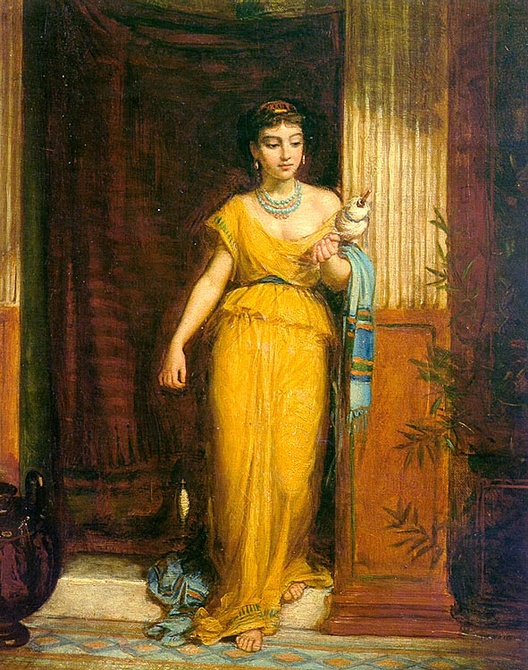
In “The Spinner” (1874), John William Waterhouse builds a scene that feels like a paused breath. A young woman stands at the threshold of an interior space, poised between shadow and light, with the tools of spinning gathered in her hands. Nothing about her stance suggests frantic work. Instead, the painting presents labor as ritual and as contemplation. The figure’s calm face, the careful arrangement of drapery, and the warm, enclosed room turn an everyday act into something symbolic, even fateful.
That sense of suspended time is one of the painting’s most powerful qualities. The spinner does not seem captured mid action so much as held in a reflective interval. Her gaze is lowered, directed toward the spindle and the thread she manages, as if the smallest movement could alter the course of what comes next. Waterhouse frames this moment like a private theater. The heavy backdrop of dark fabric behind her reads as a curtain, and the bright curtain at the right reads as the stage lighting. We are invited to look, but also to recognize that what we are seeing is intimate, quiet, and controlled.
Composition, staging, and the doorway as a threshold
The composition is strongly vertical, with the figure placed almost centrally, yet slightly offset by the architectural element at the right. Waterhouse uses the doorway and the hanging dark drape behind the woman to create a deep recess, a pocket of shadow that makes her yellow dress flare forward into the viewer’s space. This is a classic strategy for dramatic emphasis: a luminous figure pressed against a darker field, so that contour and color become instantly legible.
The threshold matters as more than a compositional device. A doorway is an in between space, and the spinner seems to inhabit an in between state. She is not seated at a wheel in the usual image of domestic industry, nor is she outdoors in a pastoral fantasy. Instead, she stands ready, as if she has just stepped out from privacy and could step back in at any second. The bright curtain to the right suggests an adjacent source of daylight, but it is filtered and softened, not an open blast. Even the light feels like a boundary.
Waterhouse supports this threshold idea with small spatial cues: the step beneath her feet, the rug or textile underfoot, and the drape pooling near the hem of her gown. These elements define a zone of transition. The figure’s body becomes the hinge between areas, between darkness and brightness, between stillness and possible motion.
Color and light: the glow of yellow against a dark interior
The painting’s color story is anchored by the golden yellow dress. This hue is not merely decorative. It acts as the painting’s lamp, catching and amplifying the warm light that filters in from the right. Waterhouse layers this yellow with subtle shifts, from brighter highlights across the torso and skirt to deeper, more amber shadows along folds and seams. The dress is both a surface and a structure, describing the figure’s weight and movement while also functioning as a field of radiant pigment.
Around that central yellow, Waterhouse orchestrates a restrained palette of browns, russets, and muted greens. The dark drapery behind the woman is heavy and earthy, giving the scene a hushed atmosphere. The right side introduces a contrasting brightness through the pale curtain, but the brightness is tempered by warmth, keeping the painting cohesive. The blue cloth draped at the right, and again pooling near the hem, becomes the key accent. Blue and yellow, opposites on the color wheel, create a visual spark. The blue’s coolness prevents the yellows and browns from turning overly uniform, and it pulls the viewer’s eye toward the spinner’s hand and the object she holds.
Light is carefully controlled. It does not carve sharp edges; instead, it wraps softly. This softness gives the figure a sense of presence rather than harsh spotlighting. It also reinforces the theme of interior life. We are not in a bright public world. We are in a space where illumination is partial, selective, and intimate.
The figure: posture, expression, and the psychology of concentration
The spinner’s posture is relaxed but deliberate. One arm drops gently, the other bends to support the spindle and thread. Her head tilts slightly downward, and her expression remains composed. There is no overt smile, no theatrical grief. The feeling is concentration, perhaps thoughtfulness, perhaps a mild fatigue. Waterhouse often excels at portraying women not as simple symbols but as psychologically present figures, and here he does it with restraint.
Her bare feet add to the sense of immediacy. The absence of shoes makes the scene feel domestic and grounded, as if this is a private room where comfort and routine matter. At the same time, the jewelry and draped costume elevate the image beyond ordinary Victorian realism. The necklace, the hair adornment, and the classical cut of the garment suggest a historical or imagined setting, a timeless past. This blend is central to the painting’s mood: it is both specific and archetypal, both a woman at work and a figure who stands for something larger.
The spinner’s attention is focused on the object she holds. That focus creates narrative tension. If she is spinning, then she is producing thread, and thread implies continuity, connection, and time. Her downward gaze turns the act into introspection. The viewer follows her gaze, and the painting becomes an invitation to think about what is being formed, what is being measured, and what might be decided.
Spinning as symbol: time, fate, and the thread of life
Spinning is one of the oldest visual metaphors in Western art and literature. The act transforms loose fiber into a continuous line, and that transformation naturally lends itself to ideas about making, shaping, and sustaining life. Thread can mean livelihood, domestic order, patience, and endurance. It can also mean destiny, where a life is imagined as a strand that can be spun, measured, and cut.
Even without explicit mythological figures, “The Spinner” carries echoes of the Fates, the ancient powers who govern life’s duration through thread. Waterhouse does not need to paint a trio of divine spinners to summon that association. The single woman, alone, holding the spindle with calm authority, is enough to suggest that the labor of spinning can stand in for the labor of living. The thread becomes a quiet emblem of continuity, and the stillness becomes a moment of awareness. If thread is time, then the spinner is someone who touches time with her hands.
At the same time, spinning is also an emblem of domestic virtue in many storytelling traditions. It signals discipline and steadiness, the ability to take raw material and make something usable. Waterhouse holds these meanings in balance. The spinner is neither romanticized as pure ornament nor reduced to a moral lesson. She is shown in a dignified pause, suggesting that work has an inner life, and that routine can contain mystery.
Setting and objects: textiles, plants, and the language of interiors
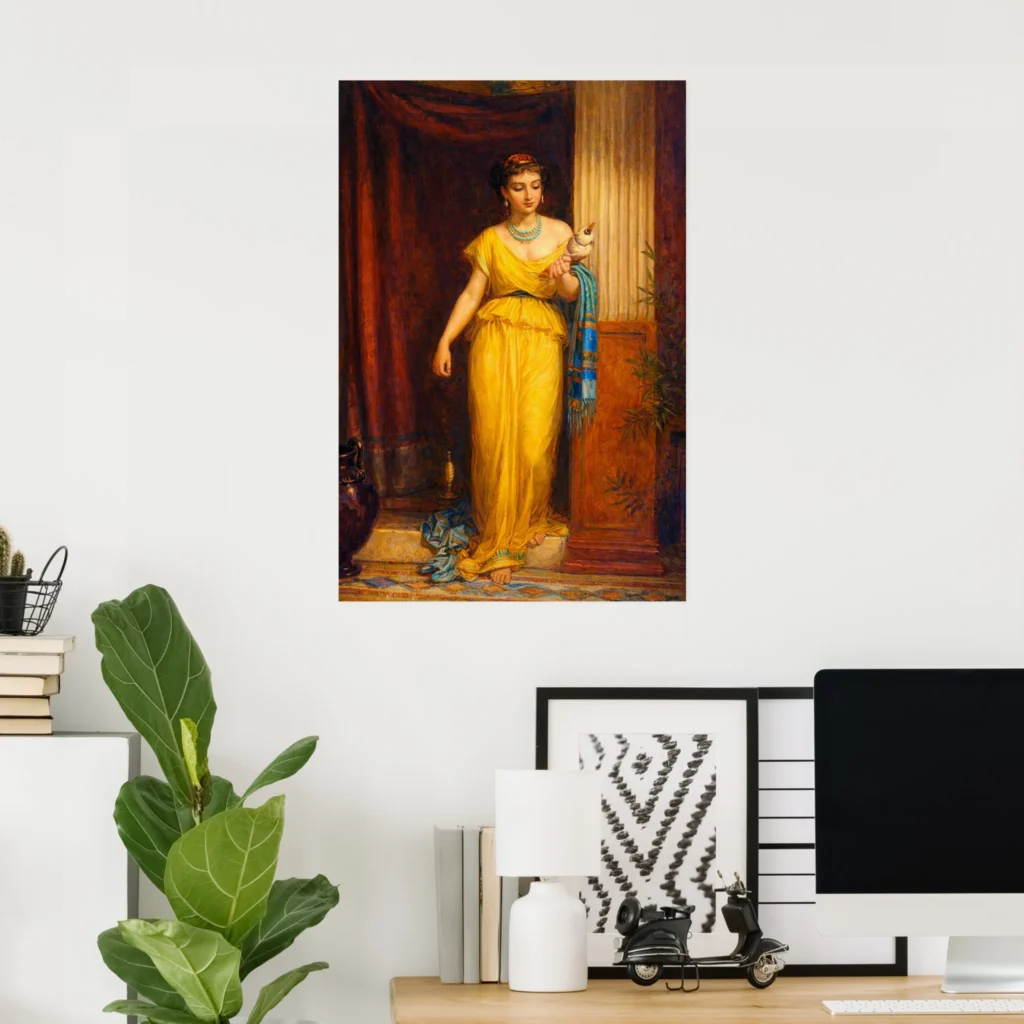
The room is described through a small number of carefully chosen elements: drapery, curtain, vessel forms, a patterned textile underfoot, and a tall plant at the right. Each object adds texture and meaning. The dark hanging cloth behind the spinner feels theatrical, but it is also a textile, which links back to her craft. The pale curtain at the right is another textile, one that converts outside light into softness. These fabrics become visual rhymes. The spinner’s work is mirrored by the environment, as if the whole room is made of the same language.
The blue cloth draped over the architectural element at the right is especially important. It appears like a shawl or wrap, with bands of patterning that give it a richer identity than a simple color patch. This cloth bridges the figure and the architecture, connecting human softness to structural firmness. It also carries the viewer’s eye downward, where the blue fabric pools near the hem of the yellow dress, tying the composition together from top to bottom.
The plant introduces a living, organic counterpoint to the crafted textiles. Its slender leaves add a delicate rhythm and bring a hint of the outside world indoors. Whether read as decorative greenery or a subtle symbol of growth, it reinforces the painting’s meditation on making and sustaining. Fiber becomes thread; thread becomes cloth; life becomes environment. The interior is not just a backdrop, it is a system of forms that echo the spinner’s action.
Waterhouse in 1874: early style, classical mood, and Victorian taste
Dated 1874, this painting belongs to Waterhouse’s earlier period, when his art often leaned toward classical or historical atmosphere shaped by Victorian academic training. The controlled composition, the sculptural clarity of the figure, and the polished handling of fabric all suggest an artist attentive to established standards of finish and elegance.
Yet even within that academic poise, the painting hints at the interests that would later define Waterhouse’s most famous works. There is the focus on a solitary woman with a rich interior life, the preference for narrative charged quiet, and the attraction to themes that blend romance, myth, and psychology. The spinner is not presented as a generic model. She feels like a character who has a story that extends beyond the frame.
Victorian audiences were drawn to images that offered an escape into imagined pasts, especially scenes that suggested classical antiquity or a generalized historical world. The costume and jewelry here deliver that appeal. At the same time, the subject of spinning would have felt legible and morally acceptable, rooted in craft, patience, and tradition. Waterhouse uses that acceptability to smuggle in something more haunting: the suggestion that the simplest tasks can carry the weight of destiny.
Technique and brushwork: softness, fabric realism, and controlled atmosphere
The painting’s handling is designed to maintain atmosphere rather than flaunt bravura. The transitions between light and shadow are smooth, and the forms are modeled gently. This is particularly evident in the face and arms, where the skin tones are kept warm and natural, avoiding sharp contrasts. Waterhouse treats the figure with a sculptural sensibility, shaping volume through gradual tonal shifts.
Fabric is a central technical showcase. The yellow dress has enough variation to feel tactile, with folds that imply weight and a slight sheen. The blue cloth introduces a different texture, richer and cooler, with patterned bands that suggest weaving or embroidery. These textile differences matter because the painting is about making textiles. Waterhouse does not simply depict the spinner; he demonstrates the material world she inhabits.
The background drapery is painted more broadly, with darker, less descriptive passages that prevent distraction. This control keeps the viewer’s attention on the figure and the symbolic action. The overall effect is an enclosed, harmonious atmosphere where nothing shouts, and every element supports the mood of quiet intensity.
A narrative without a plot: what the painting invites you to imagine
One of the painting’s strengths is that it tells a story without specifying a plot. We are not shown a clear beginning or end. Instead, we are given a moment that implies before and after. Has she been spinning for hours? Did someone call her attention? Is she listening for footsteps beyond the curtain? Is she thinking about someone absent? Waterhouse leaves these questions open, and that openness is part of the appeal.
The spinner’s stillness can be read as waiting, as decision, or as reflection. The doorway setting encourages the idea of interruption. A threshold is where arrivals and departures happen. Even if nothing happens in the scene, the space itself carries the potential of change. The filtered light, the quiet room, and the focused gaze create a sense that something internal is occurring, a thought turning over, a memory returning, a future being measured.
This narrative ambiguity helps the painting feel timeless. It does not depend on a specific myth or literary reference to function. It relies on universal experiences: work, patience, solitude, and the feeling that time moves through our hands even when we stand still.
Why “The Spinner” endures: beauty, meaning, and the dignity of quiet work
“The Spinner” endures because it treats a humble action with seriousness and grace. Waterhouse transforms spinning into a subject worthy of luminous color, careful design, and emotional depth. The figure is beautiful, but her beauty is not the only point. The painting respects her concentration and presents her labor as a form of knowledge, something practiced and embodied.
The visual contrasts deepen the meaning. Yellow against darkness becomes a metaphor for consciousness within the unknown. The thread, implied by the spindle, becomes a metaphor for time, continuity, and fate. The interior becomes a metaphor for private life, where decisions and emotions are formed away from spectacle.
For viewers drawn to Waterhouse, this painting offers an early glimpse of his gift for combining elegance with psychological resonance. It is a quiet image that feels full of implication. The spinner stands, holds her tool, and looks down, and in that modest posture Waterhouse places an entire meditation on making, waiting, and becoming.