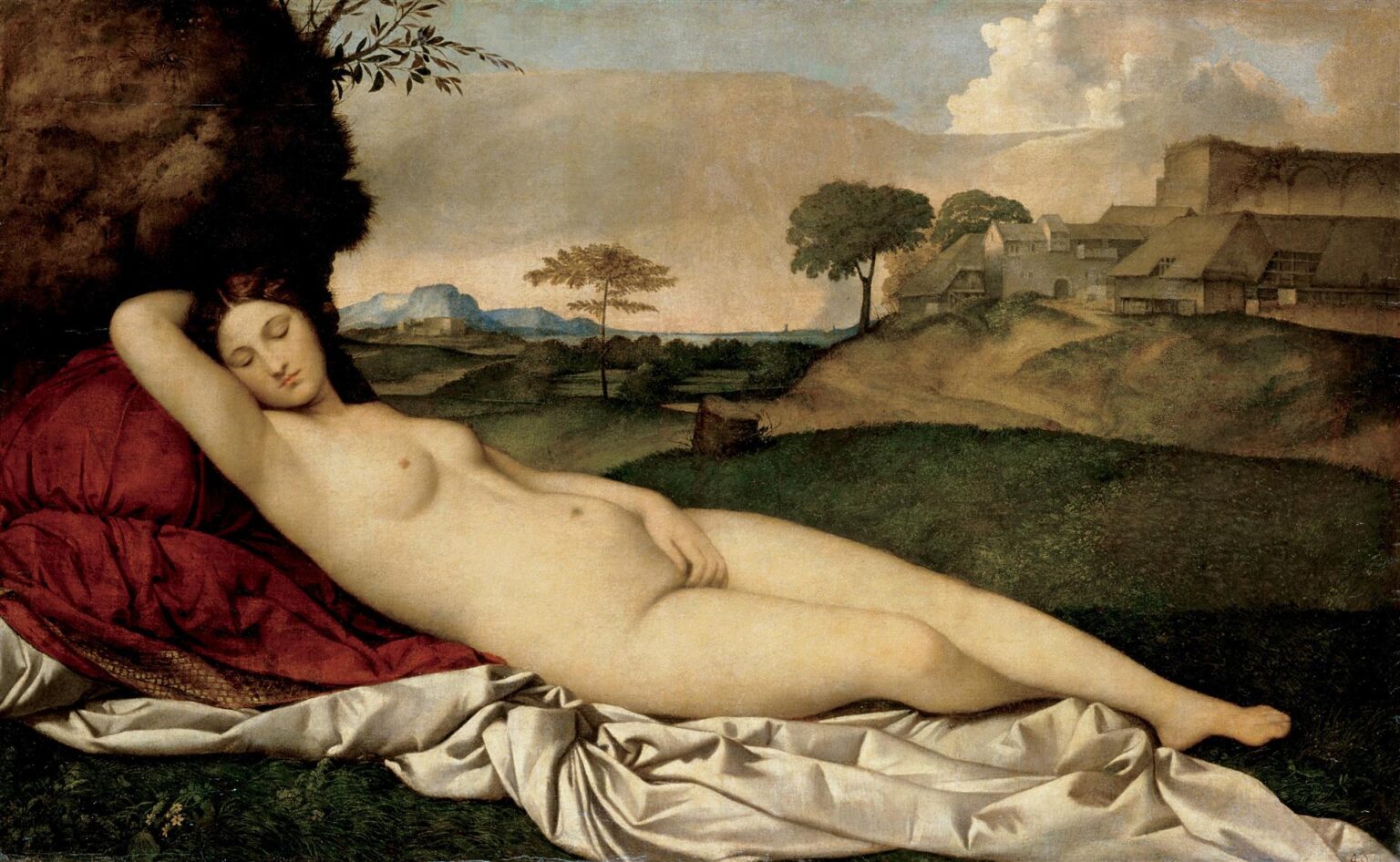
Image source: wikiart.org
Introduction
Giorgione’s The Sleeping Venus, painted around 1510, is one of the defining images of the Venetian Renaissance and one of the most influential reclining nudes in the history of Western art. At first glance, the picture appears disarmingly simple. A nude female figure lies asleep in an open landscape, cushioned by rich red drapery and pale white fabric. Her body stretches across the foreground with remarkable calm, while behind her the countryside unfolds in gentle hills, trees, buildings, and a sky filled with soft light. Nothing violent or dramatic happens. There is no complicated narrative action, no crowded stage of mythological characters, and no overt display of symbolism forcing itself on the viewer. Yet the painting has extraordinary power.
That power comes from Giorgione’s ability to unite figure, landscape, and mood into a seamless poetic whole. The body of Venus is not presented as a cold academic study, nor as an aggressively idealized emblem. Instead, she seems to belong to the earth and atmosphere around her. The curves of her torso and legs echo the rolling forms of the hills. The hush of sleep spreads across the entire scene. The viewer does not simply look at a goddess reclining outdoors. The viewer enters a world of perfect stillness where nature, beauty, and dream seem suspended together.
This painting matters not only because it is beautiful, but because it helped establish a new artistic language. It gave later Venetian artists, especially Titian, a model for how the female nude could become the center of a poetic and sensuous image. It also showed how mythological subject matter could be transformed into something atmospheric and contemplative rather than theatrical. The Sleeping Venus is therefore both an exquisite individual work and a turning point in art history.
Historical Context and the Venetian Renaissance
To understand why The Sleeping Venus feels so distinctive, it helps to place it within Venice in the early sixteenth century. Venetian painting had already developed a character different from the art of Florence and central Italy. Florentine artists often emphasized drawing, sculptural structure, and precise anatomical clarity. Venetian painters, by contrast, became especially celebrated for their command of color, light, and tonal atmosphere. They were deeply attentive to how forms emerge through transitions of shade, how surfaces glow, and how a scene can evoke feeling through visual harmony rather than strict linear design.
Giorgione was one of the great early masters of this Venetian sensibility. Though his career was short, his influence was immense. He brought to painting a lyrical and elusive quality that later generations found hard to define but impossible to ignore. Many of his works seem to resist straightforward interpretation. They are filled with mood, ambiguity, and poetic stillness. Instead of presenting a story in a clear didactic way, Giorgione often invites viewers into an atmosphere of suggestion.
The Sleeping Venus belongs perfectly to that world. Although the subject is mythological, the painting does not labor to explain itself through attributes or narrative clues. Venus, the goddess of love, is not shown in the company of Cupid or surrounded by divine spectacle. She is simply asleep, detached from action and immersed in silence. This restraint is crucial. It shows how Venetian art could transform classical mythology into something intimate and meditative.
The date of 1510 places the painting at the end of Giorgione’s life, and it stands at a moment when Venetian painting was about to move into a new era. The next generation, especially Titian, would build on this foundation and expand it into a richer, more assertive visual language. In that sense, The Sleeping Venus looks both backward and forward. It gathers the dreamy refinement associated with Giorgione and opens the door to the grand tradition of Venetian mythological painting that would flourish later.
The Subject of Venus Reimagined
Venus had long been a compelling figure for artists because she offered a bridge between classical mythology and the idealized nude body. Yet Giorgione’s handling of Venus is strikingly original. This is not a goddess defined by motion, seduction, or dramatic encounter. She is not surprised, judged, pursued, or displayed in a crowded mythological setting. She sleeps.
That decision changes everything. Sleep removes deliberate performance. Venus is unaware of the viewer. Her face is serene, her eyes closed, and her raised arm behind her head contributes to the sense of complete relaxation. Because she is not active within a story, the viewer’s attention shifts from narrative to contemplation. The painting becomes less about an event and more about a state of being.
There is also something important in the balance between divinity and humanity. Venus is idealized, yet she is not remote. Her body is smooth, harmonious, and perfected, but her sleep makes her seem vulnerable and inward. The goddess becomes accessible through stillness rather than spectacle. Giorgione creates a figure who is elevated by beauty but softened by repose.
The title The Sleeping Venus captures the painting’s essence with great precision. Sleep is not a secondary detail here. It is the key to the entire image. Because Venus sleeps, the scene is suspended outside ordinary time. The normal energies associated with love and desire are quieted. Instead of excitement, we encounter calm. Instead of drama, we encounter silence. In this sense the painting becomes a meditation on ideal beauty at rest.
Composition and the Harmony of Form
One of the greatest achievements of the painting is its composition. Venus occupies the foreground almost completely, stretching horizontally across the width of the canvas. Her body becomes the visual anchor of the image, but it never feels awkwardly imposed on the setting. Giorgione arranges her in such a way that the figure seems to grow naturally out of the landscape.
The reclining pose is crucial. Rather than presenting the body frontally or in a contorted position, Giorgione allows it to extend with measured ease. The head rests near the left side of the composition, supported by red cushions and drapery. The torso gently rises and falls, while the legs stretch toward the right edge. This movement directs the eye across the entire picture. The figure is long, calm, and rhythmically ordered.
What makes the composition especially memorable is the dialogue between body and background. The curves of Venus’s form echo the undulating hills behind her. Her abdomen and thighs mirror the soft rises of the land. The result is not accidental resemblance but structural harmony. Figure and nature appear governed by the same principle of beauty. The body is not merely placed in the landscape. It is visualized as part of the landscape’s order.
The hand positions also matter. One hand rests above her head, opening the pose and giving the upper body a graceful arc. The other rests over her pelvis in a gesture that is both modest and compositional. It stabilizes the center of the figure and prevents the pose from becoming exposed in a crude or confrontational way. Giorgione’s treatment is controlled, balanced, and deeply attentive to the ideal of grace.
Landscape as Emotional Space
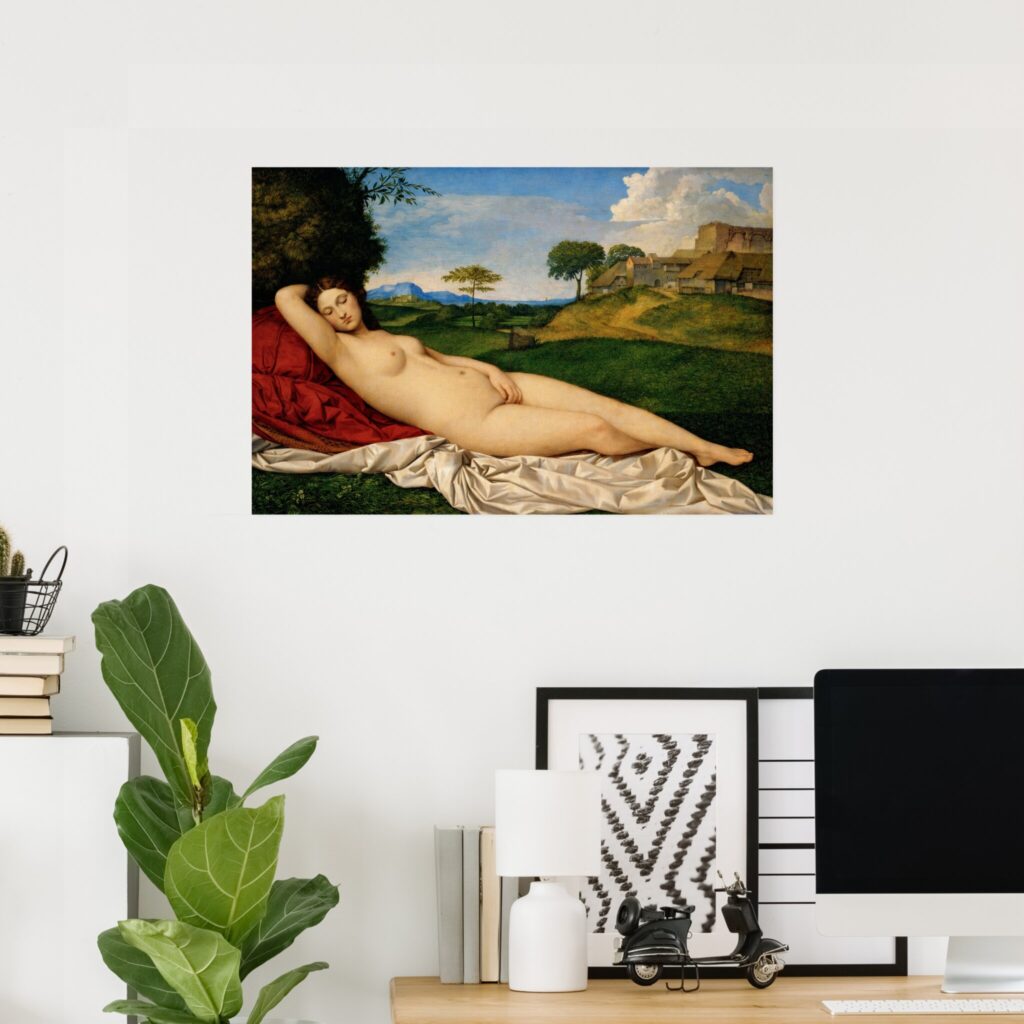
The landscape in The Sleeping Venus is far more than a backdrop. It is an emotional extension of the figure and a vital part of the painting’s meaning. Giorgione was among the artists who helped elevate landscape from a secondary decorative setting into an active carrier of mood. In this picture, the land breathes with the same quiet rhythm as Venus herself.
The background is not wild or threatening. It is calm and pastoral. Gentle slopes, a few trees, distant mountains, and modest architecture give the setting a human scale without distracting from the central figure. The scene feels inhabited, but not busy. Civilization is present in the far buildings, yet it remains subdued and distant. The countryside is serene, touched by soft light and spacious air.
This calm environment reinforces the theme of sleep. Nothing in the setting disrupts Venus’s repose. The trees do not bend violently in wind. The sky is luminous but not stormy. The forms are softened rather than sharply dramatic. Even the darker masses on the left side of the painting serve to cradle the figure rather than oppress her. Giorgione uses the landscape to sustain an atmosphere of stillness from edge to edge.
The visual rhyme between the body and the terrain has often been noted because it is so central to the painting’s beauty. The sleeping goddess and the sleeping earth seem joined. Nature itself appears to rest. This unity is one reason the painting feels so poetic. It suggests that ideal beauty is not separate from the world but woven into its very structure.
Color, Light, and Surface
As a Venetian painter, Giorgione understood that color could do more than decorate forms. It could create atmosphere, organize emotion, and bind the whole composition together. In The Sleeping Venus, the color scheme is restrained but richly effective. The creamy tones of Venus’s skin stand out against the darker greens and browns of the earth, while the red drapery beneath her provides a deep, warm counterpoint.
That red fabric is especially important. It intensifies the whiteness of the body and gives the foreground a luxurious richness without overwhelming the overall calm. The contrast between red cloth, pale flesh, and white sheet creates a subtle yet powerful visual drama. It draws attention to Venus, but in a harmonious rather than harsh way.
The light in the painting is equally remarkable. Giorgione avoids the sharp brightness that would make the body look sculptural and hard. Instead, the light is diffused and gentle. It glides across the skin, emphasizing smoothness and softness. The transitions between light and shadow are gradual, giving the figure a living presence without rigidity. This tonal delicacy is one of the hallmarks of Venetian painting at its best.
The sky also contributes to the painting’s tonal unity. Its muted luminosity helps connect the distant landscape to the foreground figure. Nothing is isolated. Light passes through the entire image, joining body, cloth, grass, trees, hills, and clouds into a single atmospheric field. The result is a picture that feels less constructed than breathed into being.
The Ideal Nude and Renaissance Beauty
The female nude had classical roots, but in the Renaissance it became a central site for artistic ambition, intellectual reflection, and idealization. Giorgione’s Venus belongs to that tradition, yet she also transforms it. This is not a body rendered with obsessive anatomical display. Nor is it a portrait of an individualized woman. It is an ideal form shaped by harmony, proportion, and serenity.
The body is smooth and continuous, with few abrupt muscular accents or descriptive details. Giorgione avoids a harsh emphasis on bone, tension, or strain. The softness of the form is essential to the image. Venus appears complete, self-contained, and untouched by effort. Her beauty lies in balance rather than in dramatic realism.
At the same time, the painting does not feel abstract. The body has weight and presence. It reclines with convincing mass on the fabrics beneath it. This balance between idealization and physical plausibility is part of Giorgione’s genius. Venus is elevated into an ideal, yet she remains persuasively embodied.
Her pose also helped define a visual formula that would become enormously influential. The reclining female nude, arranged across a horizontal format and set within a poetic or domestic environment, would reappear in later Venetian painting with major consequences. But in Giorgione’s version, the formula retains an extraordinary purity. The image is not yet charged with the active engagement and worldly confidence that later works would bring. It remains a vision of beauty in repose, protected by sleep and atmosphere.
Sleep, Silence, and Poetic Meaning
The true subject of the painting may be beauty, but the emotional language through which beauty is expressed is silence. This is why the image remains so haunting. Giorgione does not rely on overt symbolism to create meaning. Instead, meaning emerges through mood.
Sleep is central to that mood because sleep suspends ordinary consciousness. Venus is inaccessible in a practical sense. She cannot return the viewer’s gaze, enter conversation, or participate in action. This makes the painting contemplative rather than dramatic. The viewer becomes a witness to a private state of rest that feels timeless and complete.
There is also a profound stillness in the relation between the human figure and the natural world. The painting suggests not just a sleeping goddess but a sleeping universe, or at least a world momentarily freed from agitation. The air is calm, the land is settled, and the body lies in perfect accord with its surroundings. This kind of poetic unity was one of Giorgione’s greatest gifts. He made pictures that feel as though they are governed by music rather than by narrative explanation.
Because of this, The Sleeping Venus has often been understood as more than a mythological picture. It can also be read as an allegory of harmony, a celebration of ideal beauty, or a meditation on the bond between the human form and the natural world. Giorgione leaves enough openness in the image to support all of these responses. That openness is not vagueness. It is artistic richness.
Giorgione’s Style and the Question of Attribution
Giorgione’s reputation rests partly on the mystery surrounding his surviving works. His career was brief, and the number of paintings securely attributed to him is relatively small. This has made every major work associated with him especially important. The Sleeping Venus occupies a central place in discussions of his style because it embodies so many of the qualities linked to his art: lyrical calm, atmospheric unity, poetic ambiguity, and a refined fusion of figure and setting.
The painting is often discussed in connection with Titian because of the close relationship between the two artists and the transitional moment in Venetian art that the work represents. Some scholars have long suggested that parts of the landscape may have been completed by Titian after Giorgione’s death. Whether or not one emphasizes that contribution, the essential conception of the work remains deeply Giorgionesque. The dreamlike stillness, the tonal softness, and the poetic integration of body and environment all reflect the spirit associated with Giorgione’s art.
This discussion of attribution does not weaken the painting’s status. If anything, it reveals how pivotal the work is. It stands at the threshold between Giorgione’s poetic vision and Titian’s emerging power. In it one can sense the end of one artistic temperament and the beginning of another. Yet what remains unforgettable is the unity of the final image. Whatever workshop history may lie behind it, the painting feels whole.
Influence on Later Art
The importance of The Sleeping Venus extends far beyond its own moment. It became one of the foundational works for the tradition of the reclining nude in European painting. Later artists did not simply admire it. They learned from it, adapted it, and transformed it.
Its most immediate legacy can be seen in Venetian art, particularly in Titian’s treatment of female nudes. The idea of a reclining woman occupying the full foreground of a horizontal canvas would become a major theme. Yet later versions often shift the emotional register. Where Giorgione’s Venus sleeps, later figures may look outward, acknowledge the viewer, or inhabit more richly furnished settings. The change is significant. Giorgione’s painting offers a model of inwardness and stillness, while later works often move toward greater theatricality, sensuality, or psychological interaction.
That makes The Sleeping Venus especially important as an origin point. It establishes a form that later artists would energize in different ways. But it also remains unique because of its purity. Few later images achieve the same level of silence. Few make the connection between body and landscape feel so inevitable.
The painting’s influence also reaches beyond Venice. It helped define how mythological subjects could function in painting as vehicles for beauty, mood, and idealized form rather than simply for narrative illustration. This was a major development in the history of art, and Giorgione’s Venus stands near the beginning of it.
Why the Painting Still Feels Modern
One reason The Sleeping Venus still speaks powerfully to modern viewers is that it does not depend on specialized mythological knowledge to be effective. Even without knowing anything about Renaissance classicism, a viewer can feel the peace of the image, the balance of its composition, and the tenderness of its light. The painting communicates through atmosphere as much as through iconography.
Its modernity also lies in its ambiguity. Many Renaissance works guide interpretation quite firmly, but Giorgione leaves room for reflection. Is this a mythological vision, a poetic dream, an idealized image of nature and beauty, or all of these at once? The painting never settles into a single rigid explanation. That openness makes it feel alive across centuries.
There is also something deeply modern in the picture’s emotional economy. It does not shout. It does not overload the viewer with detail or symbolism. Instead, it trusts quietness. In a culture often drawn to spectacle, The Sleeping Venus continues to impress through restraint. It proves that calm can be monumental.
Conclusion
The Sleeping Venus is one of the great masterpieces of Renaissance painting because it accomplishes so much with such apparent ease. Giorgione transforms a mythological nude into a meditation on harmony, sleep, nature, and ideal beauty. He creates a figure who is both divine and deeply serene, both central and perfectly integrated with her surroundings. The landscape does not merely host Venus. It echoes her. The light does not simply reveal form. It softens and unifies it. The entire painting becomes a world of suspended stillness.
Its historical importance is immense. It helped shape the Venetian tradition, offered a powerful model for later reclining nudes, and demonstrated how poetry could enter painting through atmosphere rather than explicit narrative. Yet the painting is more than historically significant. It remains moving in the present because of its rare emotional balance. It is sensuous without being agitated, idealized without being cold, and restful without ever becoming dull.
Giorgione’s achievement here is the creation of an image that feels inevitable, as though Venus had always belonged to this hillside, this sky, this silence. The body and the land share one rhythm. The goddess and the world rest together. That is why The Sleeping Venus remains unforgettable. It is not just a picture of beauty. It is a vision of beauty in perfect repose.