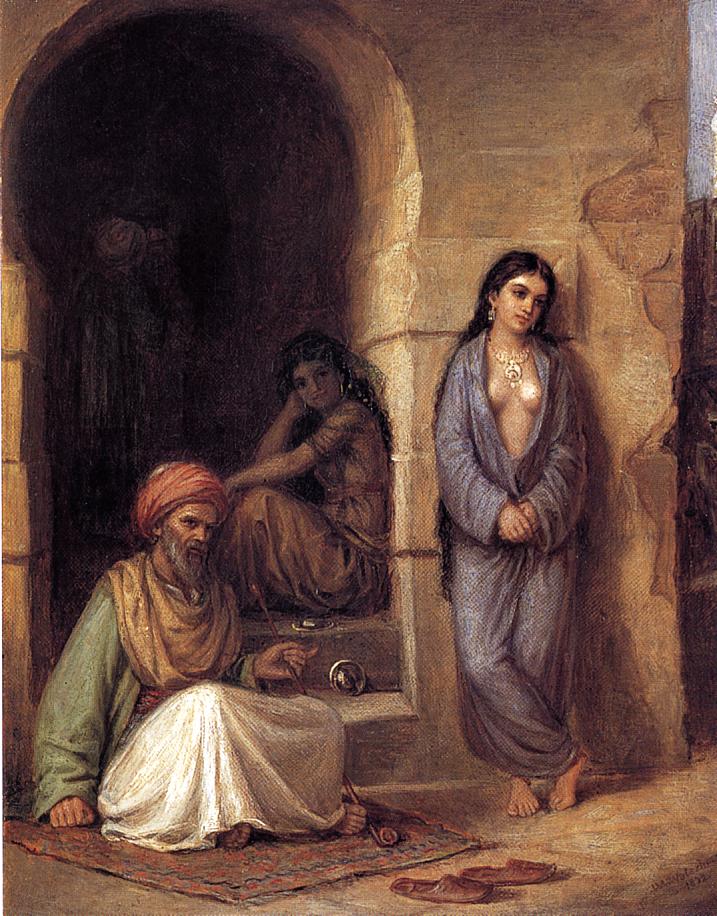
Image source: wikiart.org
Introduction
John William Waterhouse’s The Slave (1872) is a small drama staged in silence. At first glance, the painting seems to offer a straightforward scene from an imagined Eastern interior: stone walls, a deep archway, a seated man in a turban, and two women positioned like figures in a chamber of waiting. Yet the longer you look, the more the picture resists turning into a simple story. Nothing “happens” in the obvious sense. Instead, Waterhouse builds tension out of stillness. He lets posture, light, and distance do the work of narrative, and he invites the viewer to read the space the way one reads a room after a conversation has ended.
The title The Slave sets an expectation of power and possession, but the painting’s emotional tone is not loud or sensational. It is subdued, almost hushed, as if the scene has been drained of spectacle and reduced to atmosphere. That restraint is part of what makes the work memorable. Waterhouse is not yet the mature painter of mythic enchantresses and Pre-Raphaelite heroines that many people associate with his name. In this early period, he is already fascinated by storytelling, but he tells it through controlled composition and psychological cues rather than overt action. The result is a painting that feels like a pause in a larger narrative, a moment suspended between what has happened and what may happen next.
The setting and the architecture of confinement
The room is constructed like a stage set that also functions as a metaphor. A heavy stone arch dominates the left side, opening into a dark recess that reads as both depth and absence. The arch’s interior is nearly black, a visual void that swallows detail and seems to pull the air out of the space. Against it, the front area feels exposed. The architecture divides the scene into zones: shadowed interior, middle step, and the brighter wall to the right. This division is crucial, because it turns the room into a map of visibility and control.
Stone surfaces are rendered with warm, dusty tones, suggesting heat, age, and roughness. The wall at right has uneven texture and faint marks, which makes the environment feel real and worn rather than decorative. There is nothing lush or luxurious here. Instead of silk and gold, there is plaster, stone, and dimness. That choice shapes the mood: this is not a fantasy of comfort, but a place of waiting. Even the open space at the bottom foreground feels spare, defined by a rug, a pair of sandals, and scattered objects. The setting presses inward, not through crowding, but through emptiness and enclosure.
Composition and the choreography of distance
Waterhouse arranges the three figures in a quiet triangle, but he stretches that triangle across the room so that emotional distance becomes physical distance. The man sits in the left foreground on a patterned rug, grounded, heavy, and close to the viewer. A second woman sits farther back on a raised step, partially swallowed by shadow. The standing young woman occupies the right side near a brighter wall, separated from the man by open floor space and by the vertical edge of the architecture. She is present, visible, and yet not fully “within” the same zone of the room.
This spacing matters because it suggests relationships without spelling them out. The man is closest to us, which gives him immediate visual authority. The standing woman is the most illuminated figure, which gives her central emphasis even though she is physically farther from the viewer than the man’s seated position implies. The seated woman in the middle distance functions like a witness or a second register of feeling, a human presence that complicates the simple idea of a single subject. By placing her in shadow, Waterhouse makes her both real and withheld, as if her perspective exists but is not granted full clarity.
The composition also uses thresholds. The step behind the man is a literal level change, turning the middle ground into a boundary. The arch is another threshold, a portal to darkness. The standing woman is near a bright edge that hints at an opening or a different space beyond the frame. These structural boundaries echo the painting’s subject, because slavery is fundamentally about limits: limits on movement, choice, and selfhood. Waterhouse does not need chains to communicate restriction. The room itself becomes the language of constraint.
Light, color, and the painting’s emotional temperature
The palette is dominated by warm earth tones: ochres, browns, and dusty golds that suggest sunbaked stone. Into that warm field, Waterhouse introduces cooler notes, especially the blue drapery around the standing woman. That blue is not vivid in a decorative way; it is muted, soft, and weighty, like cloth that has absorbed the room’s dimness. The contrast between warm architecture and cool garment helps the viewer locate the figure immediately, but it also sets an emotional contrast: the room feels heated and stale, while the blue suggests calm that may be forced rather than natural.
Light falls unevenly. The standing woman is the clearest recipient of illumination, her face and torso catching a gentle glow. The man is lit enough to show his clothing and features, but the darkest values cluster around the arch and behind the seated woman on the step. That unevenness creates a hierarchy of attention. We are guided to the woman who stands, then drawn back to the man, then compelled to search the shadow for the second woman’s expression and posture. This is a slow kind of looking, and it aligns with the painting’s slow narrative rhythm.
The overall effect is a controlled melancholy. Nothing sparkles. Even the jewelry reads more as a sign of status or ownership than as celebratory ornament. The light is soft, not theatrical, and its softness makes the scene feel personal rather than public. It is as if the viewer has entered a private interior where power is expressed through routine rather than spectacle.
The standing figure and the language of vulnerability
The standing young woman is the painting’s emotional center. Her posture is reserved: her hands are clasped in front of her body, and her stance leans slightly, as if she is holding herself together in a place where composure is required. Her drapery is loose and open at the chest, and she wears jewelry that draws attention to her body. Yet her expression is not inviting. She looks outward with a calm that can be read as resignation, guardedness, or a practiced neutrality. Waterhouse paints her not as a triumphant beauty, but as someone carefully managing how she is seen.
Her vulnerability is communicated through small choices. Bare feet on stone can suggest both intimacy and exposure. The clasped hands suggest self-protection. The slight tilt of the head reads as weary rather than flirtatious. Even the way she stands near the wall implies a desire to be supported by something solid, as if the architecture is the only reliable presence in the room. The painting’s title pushes the viewer toward a specific identity for her, but Waterhouse leaves just enough ambiguity to make her feel like a person rather than a label.
At the same time, the painting undeniably participates in the tradition of presenting female bodies for viewing. The scene is built around visibility, and the standing woman is positioned to be seen. Waterhouse complicates this by giving her a face that refuses easy consumption. She is not painted as delighted by attention. She is painted as aware of it, and that awareness introduces discomfort into the act of looking.
The seated man and the portrait of possession
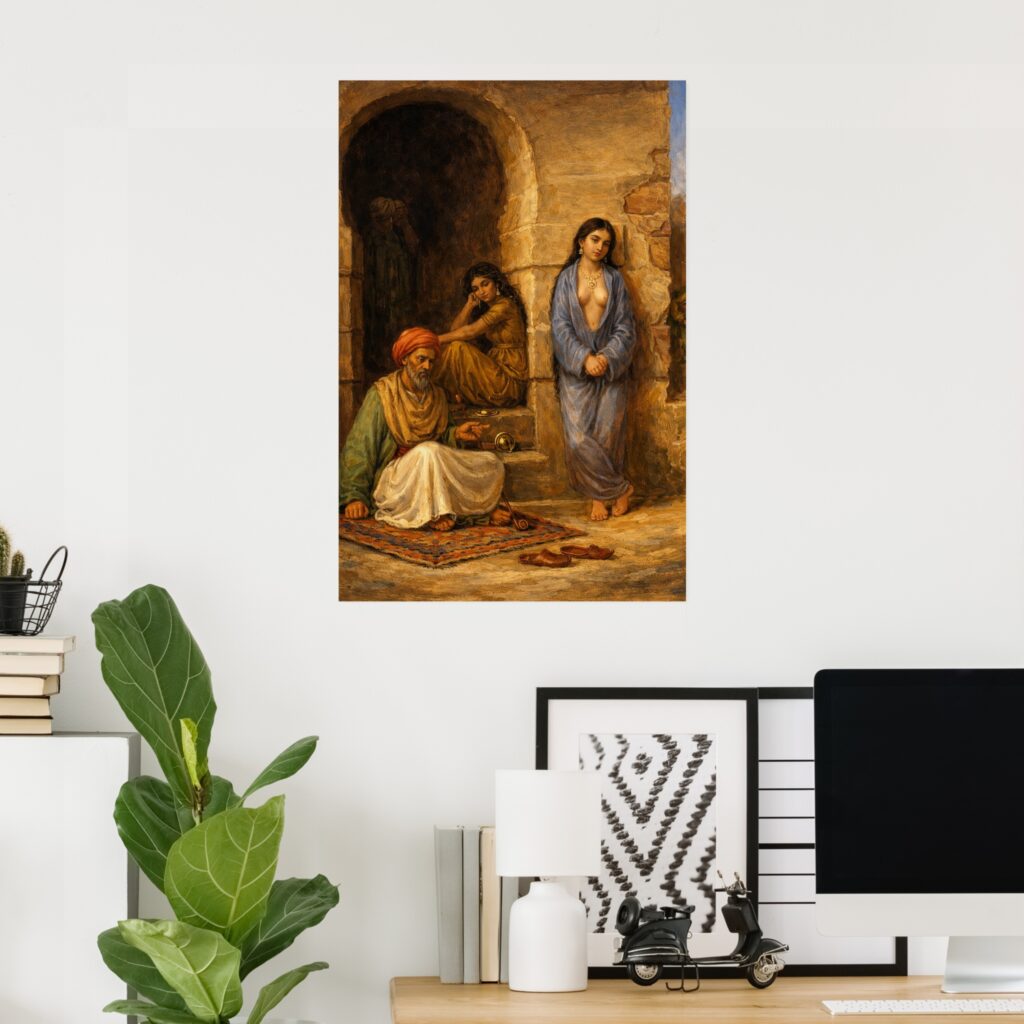
The man sits low but commands the foreground. His clothing and turban identify him as part of the painting’s imagined setting, and his placement makes him feel anchored, as if he belongs to the room in a way the women do not. He holds a long pipe or smoking implement, and nearby are objects that suggest leisure. The act of smoking reads as calm routine, a gesture of unhurried control. He does not need to move quickly. The room, the time, and the people within it appear arranged around him.
His gaze is angled downward, not sharply locked onto the standing woman, which is significant. Waterhouse avoids turning the image into a blunt scene of confrontation. Instead, the man’s posture suggests a habitual authority, the kind that does not require constant display. His calm becomes part of the painting’s tension. The viewer senses that the stillness is not peace, but a quiet form of dominance.
At the same time, Waterhouse paints him with enough individuality to avoid caricature. The face is lined and thoughtful, the body posture relaxed but not theatrical. This complexity matters because it shows how the painting’s unease arises not from melodrama but from normalcy. The unsettling feeling comes from how ordinary the situation appears within the picture’s world.
The shadowed woman and the echo of a second story
The woman seated on the step is the painting’s most haunting element because she is the least legible. She sits in shadow, her arm bent, her head leaning as if tired or bored. She appears present but emotionally distant, almost absorbed into the gloom behind her. Because she is not the title’s obvious focal point, she invites questions. Is she also enslaved? Is she a companion, an attendant, a captive, or simply someone who has learned to disappear into the room?
Her placement on the step suggests she is between the man and the standing woman, both spatially and narratively. She occupies a middle ground that feels like a corridor of implication. Her shadowed presence turns the scene from a single portrait into a system. It hints that the standing woman’s situation is not unique, and that the room contains layered roles and routines. In this way, the second woman amplifies the painting’s emotional gravity. She makes the scene feel institutional rather than personal, as if this is not a singular tragedy but a repeating pattern.
Waterhouse’s choice to obscure her also mirrors the broader historical pattern in which the lives of exploited people are partially recorded, partially erased, and often mediated through the eyes of those with power. The painting cannot escape that dynamic, but it does, at minimum, acknowledge complexity by including her at all.
Objects, clothing, and the symbolism of everyday control
The painting’s objects are few, but each one contributes to the sense of a controlled interior. The rug beneath the man implies comfort and status, but it is also a boundary marker, a small territory of ownership. The sandals in the foreground suggest arrival or removal, a small domestic detail that makes the scene feel lived in. The smoking apparatus and related items point to leisure, and leisure in a context of domination can be read as a privilege made possible by others’ lack of freedom.
Clothing is equally symbolic. The man’s garments are layered and substantial, emphasizing his protected position. The standing woman’s drapery is looser, less structured, exposing her to the gaze and to the room’s atmosphere. Jewelry functions in two directions: it beautifies, but it can also signify possession, like an adornment given by a master and worn as a sign of status within captivity. Waterhouse lets these details sit quietly. He does not underline their meaning, but he arranges them so the viewer senses that every soft textile and every small object participates in a system of power.
Even the architecture serves as an object. The arch’s darkness feels like a threat of disappearance. The wall’s solidity feels like permanence. These are not neutral backdrops. They are part of the painting’s emotional machinery.
Orientalism and Victorian imagination in Waterhouse’s early career
The Slave belongs to a long nineteenth-century tradition in which European artists painted imagined scenes of the Middle East and North Africa, often blending travel impressions, studio props, and inherited visual stereotypes. In Victorian Britain, such images could satisfy curiosity, provide moral or erotic frisson, and offer a safe distance from contemporary social questions by placing themes of power and exploitation in an “elsewhere” that viewers treated as exotic.
Waterhouse’s painting participates in that tradition through costume, setting, and the implied social structure of the room. The title itself is part of the framing. It tells the viewer how to interpret the standing woman’s presence, and it invites a narrative shaped by ownership. At the same time, Waterhouse’s approach is comparatively restrained. He does not crowd the canvas with ornament. He does not turn the scene into pageantry. Instead, he paints an interior that feels quiet, even weary. That restraint can be read as a psychological choice: rather than selling exotic excitement, he explores the emotional cost of a system built on objectification.
Still, it is important to recognize that the painting’s very premise depends on a Victorian fantasy of the “Orient” as a place where such arrangements are expected, visible, and narratively convenient. The work is powerful as an atmosphere, but it is also a product of its time, shaped by cultural assumptions about foreignness and the body. Looking at it today means holding both truths at once: the painting is visually sensitive, and it is also implicated in a tradition that reduced real societies and real suffering into aesthetic subjects.
Technique, surface, and Waterhouse’s developing voice
As an early work, The Slave shows Waterhouse building skills that he would later use in mythological and literary subjects. The handling of light is careful rather than flashy. Transitions are soft, especially in the stone textures and the shadows within the arch. The figures are modeled with smooth gradations, giving them a sculptural presence without harsh outlines. This contributes to the painting’s quietness. Nothing feels aggressively sharp. The world appears slightly veiled, as if seen through warm air.
The composition reveals an academic discipline. The geometry is stable, anchored by the arch and the vertical wall. The figures are arranged to guide the eye in a slow circuit rather than a quick hit. Waterhouse’s interest in narrative is evident in how he positions faces and hands. Even when detail is limited, gesture carries meaning. The clasped hands, the resting head, the relaxed seated posture all function as story beats.
There is also an early hint of Waterhouse’s later fascination with women as psychological protagonists. The standing figure is not a generic decoration. She is painted with a presence that suggests interior life. Her expression, poised and guarded, anticipates the later Waterhouse heroines who often appear caught between worlds, between desire and fate, between attention and isolation. In The Slave, that theme is grounded in a realist interior rather than a mythic landscape, but the emotional logic is related.
Interpreting the narrative: a moment that refuses closure
The painting’s great strength is that it refuses to give the viewer a satisfying conclusion. We do not know if the standing woman has just entered, is being presented, or is simply waiting. We do not know if the seated man is contemplating a decision, exerting authority, or merely passing time in a world where others must wait for him. We do not know what the shadowed woman has seen, endured, or accepted. The scene is a pause, and pauses are where the mind fills in what it fears.
That ambiguity also makes the viewer’s role uncomfortable. The painting is about looking, and the viewer becomes part of that structure. We stand where the man’s authority is closest to the picture plane, and our attention is drawn to the standing woman’s exposed vulnerability. Waterhouse uses traditional visual cues of emphasis and display, but he complicates them with mood and expression. The standing woman does not perform. She endures being seen. The difference matters, because it changes the painting from a fantasy of possession into a study of emotional pressure.
Ultimately, The Slave can be read as a meditation on constrained personhood. The room is still, but the stillness is heavy. The figures are quiet, but the silence is charged. Waterhouse achieves this without overt violence, without theatrical gestures, and without explicit action. He creates a painting where the true subject is not an event, but an atmosphere of power.