Image source: wikiart.org
Introduction
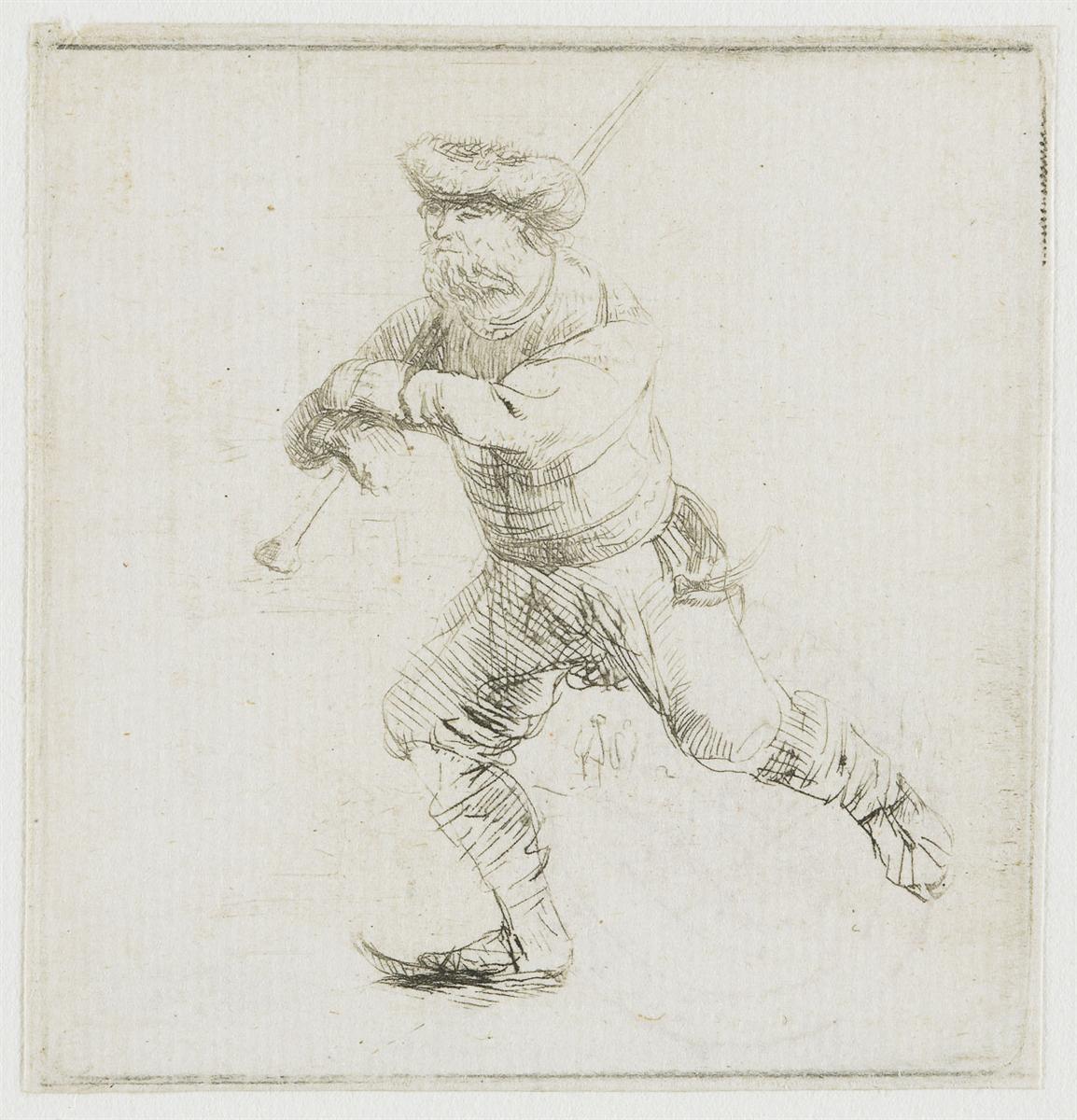
Rembrandt’s “The Skater” (1639) is a small etching with a big sense of motion. A burly man sweeps across the ice with arms folded and one leg thrust forward, his cap pulled low against the cold, his mouth clenched in concentration. The paper around him is almost empty, yet the sheet feels as lively as a winter pond. With a scant vocabulary of lines—few cross-hatches, sparing shadow, and no background to speak of—Rembrandt turns the act of skating into an essay on balance, rhythm, and character. The print is both comic and affectionate, and it proves how much animation the artist could coax from metal and ink.
The Subject and Its Dutch Context
Skating was a national pastime in the Dutch Republic. Frozen canals converted the landscape into communal boulevards where all ranks mingled: traders and milkmaids, children and soldiers, courtly pairs and clumsy beginners. Painters such as Hendrick Avercamp made bustling panoramas of this seasonal theater. Rembrandt, by contrast, isolates a single figure and enlarges the choreography of a step. His interest is not in the spectacle of the crowd but in the physics and psychology of one person negotiating slippery ground. In doing so he gives us a different slice of Dutch life: not topography or etiquette, but embodied experience.
Composition and the Dynamics of Motion
The skater dominates the sheet, planted diagonally from lower left to upper right like an arrow. Rembrandt places the head high and left, the extended leg low and right, creating a counter-swing that communicates thrust and follow-through. The figure’s center of gravity hovers just ahead of the planted foot; the trailing leg bends as if to store energy for the next glide. Nothing interrupts the path—no horizon, no tree line, no nearby figures. The white field of paper becomes the ice itself, a stage that seems to open endlessly around the skater’s path. Because the composition is asymmetrical and tilted, the viewer experiences a mild sensation of slide, an empathetic lean into the move.
Gesture, Balance, and the Body’s Mechanics
Arms are folded tightly across the chest, a common technique for keeping warm and for stabilizing the torso during a push. The head is thrust slightly forward, eyes narrowed against wind and glare. The hips twist in opposition to the shoulders, a classic contrapposto modified for motion. Rembrandt reads such mechanics with amused precision. The skater’s left foot turns outward to bite into the ice, while the right toes lift as the leg swings forward. Creases in the breeches follow the torque of thigh and knee, and the tunic’s hem flutters just enough to register speed. This is not anatomy shown for virtuosity; it is anatomy on the job.
Costume and Character
Clothing in “The Skater” does more than keep the figure warm; it builds personality. The thick cap wraps the skull like a fur-ringed helmet, and the rough collar hugs the neck. A long sweater or padded jerkin swells the torso, suggesting a workman’s build rather than a courtier’s silhouette. Strapped leggings wrinkle around the calves and disappear into sturdy shoes with metal runners indicated by a few terse strokes. The garments’ bulk amplifies the impression of effort—the man is pushing a lot of winter through the cold. Yet the costume stops short of caricature. The dignified set of the mouth and the alert brow keep the figure human and relatable.
Line Quality and the Language of Etching
Rembrandt’s line is quick, elastic, and descriptive. He uses a fine needle to etch the outer contour with small accelerations where the figure bends, so that the silhouette vibrates with life. Inside the form he lays short hatches along sleeves and thighs to model volume and to indicate the stress of movement. The face receives a few decisive strokes—thickened for mustache and beard, crisp for the bridge of the nose, lightly feathered for the brow. The effect is drawing transposed to copper without loss of spontaneity. Drypoint burr is sparing, reserved for accents that need softness, such as the cap’s edge and the trailing hem. The economy is audacious: the skating reads as convincingly as if it were described with dozens of additional lines.
Space and the Expressive Use of Negative Ground
The blank expanse around the figure is a major compositional device. Instead of filling the scene with anecdote, Rembrandt lets the untouched paper become cold air and ice. A tiny cluster of sketchy forms in the distance—scarcely more than a few dots and flicks—hints at other skaters without breaking the solitude of the moment. This negative space heightens the sense that we have caught a single action in a broad winter silence. It also throws every mark on the body into relief, making the skater’s motion the sheet’s true content.
Light Without Chiaroscuro
Unlike Rembrandt’s dramatic nocturnes, this print uses little chiaroscuro. Light is implied rather than staged. Because the paper is left largely white, the figure seems illuminated by a crisp winter day. Shadows are rendered as directional hatching along the underside of sleeves and breeches; there is no cast shadow on the ice, which keeps the image buoyant and forward-moving. The absence of heavy darks prevents the figure from feeling stuck; we sense glide rather than weight.
Humor and Humanity
The image carries a gentle humor. The man’s determined expression and bundled bulk play against the elegance we might expect from skating scenes. He looks like someone who works with his hands the rest of the year and refuses to surrender dignity even as he practices a winter pastime that can make anyone look foolish. Rembrandt’s sympathy is unmistakable. He does not mock; he recognizes the comedy built into human effort. The print is an ode to competence trying to happen on a slippery surface.
Sound, Cold, and Sensation
Good pictures summon more than sight. “The Skater” invites us to hear the scrape of the runner, the quick whisper of wool against wool, the distant shouts on the canal. We can feel the sting in the nose and the prickle of breath freezing at the moustache. Rembrandt achieves this sensory richness without describing weather or landscape. It arises from the specificity of posture and the suggestiveness of line—proof that the human body, correctly observed, is a complete weather report.
Relationship to Rembrandt’s Other Prints
Rembrandt often used small etchings to study daily life: beggars, street traders, walkers in wind, a man learning to dance. “The Skater” belongs to that family, but with a special emphasis on motion captured from a single vantage point. Compared to his portraits or sacred subjects from the same year, this sheet is remarkably informal. Yet it shares their essential values: acute observation, economical means, a refusal to flatten people into types. One can place this print beside his self-portraits of 1639 and see the same curiosity about how bodies occupy space and how faces hold purpose.
Dialogue with Dutch Winter Painting
Avercamp’s expansive winter landscapes transform the ice into a civic stage, filled with gossip and games. Rembrandt offers a counterpoint: the close-up of one participant, sovereign in his own effort. Where Avercamp lavishes color and detail on architecture and atmosphere, Rembrandt strips everything away to line and movement. The two approaches complement each other, giving us both the sociable breadth and the embodied depth of the Dutch winter.
The Print as Object for Collectors
Small etched figures were perfect for the seventeenth-century collector’s album. They could be held in the hand, compared with other impressions, and used as conversation pieces about technique and observation. “The Skater,” with its lively contour and open field, would have showcased beautifully in such a portfolio. Collectors prized Rembrandt’s capacity to suggest fullness of life with minimal means; this sheet is a prime example of that economy, and its subject would have resonated with anyone who had stepped onto a January canal.
States, Impressions, and the Pleasure of Difference
Rembrandt was known for altering plates and issuing different states. Even when the composition stayed constant, the inking of a copper plate and the wear of burr could change the feel of an impression. In a print this spare, such shifts become expressive. A slightly richer inking deepens the cap or sleeve; a cleaner wiping brightens the field and makes the skater appear lighter on the ice. Collectors would have delighted in these nuances, treating each impression as a subtly different weather.
The Drawing Mind in the Print
What most distinguishes “The Skater” is its drawing mind. One can sense the artist sketching the pose rapidly on the plate—mapping weight with a sweeping contour, testing volume with a few oblique hatches, then stopping before the vitality evaporates. The restraint is a kind of courage. Overworking would have converted momentum into stiffness. Rembrandt leaves the air inside his lines so that the figure can breathe and keep moving on the page.
Psychological Reading of the Expression
Look closely at the face: the brow knits as the man concentrates, the beard bristles, the mouth sets in a line that signals determination but not strain. This is not exhilaration; it is competence under construction. Perhaps he is a beginner or simply a careful skater on rough ice. The expression resists cliché and situates the motion within a thinking body—skating as a problem to be solved, not just a pleasure to be tasted. Such psychological nuance is typical of Rembrandt even in his most casual sheets.
The Poetics of Economy
Artists often aim to suggest the most with the least. Here Rembrandt achieves that ideal. Ten or twelve crucial moves—cap curve, shoulder thrust, ribbed leggings, splay of the forward foot—carry the full freight of narrative and sensation. The minimal background lets those moves sing. The print becomes an object lesson in how parsimony can produce abundance when lines are chosen with care.
Why The Image Still Feels Fresh
“The Skater” looks modern because it reads like a captured instant. Today we might take a quick photo to freeze such a moment; Rembrandt gives it to us with lines whose energy we can trace back to the artist’s hand. The absence of ornamental context keeps the figure timeless. Dress signals the seventeenth century, but the action belongs to any winter. The print’s friendliness makes it easy to live with; its intelligence keeps it interesting for a lifetime.
Afterlife and Influence
Rembrandt’s small, humane observations influenced generations of printmakers who understood paper as a stage for lived gestures rather than for academic demonstrations. Eighteenth-century amateurs, nineteenth-century realists, and modern artists of the pen all learned from the way he honored ordinary bodies at work and play. In Northern Europe in particular, the single figure in motion—walking against wind, carrying a load, gliding on ice—remains a vital subject, indebted to sheets like this one.
Conclusion
“The Skater” condenses a Dutch winter into a few dozen lines. It preserves the feel of cold air, the concentration of a step, and the comedy of self-serious effort without crowd or landscape. Rembrandt’s etching shows how negative space can be eloquent, how gesture can carry narrative, and how the human body, observed with sympathy, can turn a sheet of paper into a living scene. We see a man moving forward, steadying himself with folded arms, and we cannot help leaning with him. In that empathic tilt lies the print’s lasting charm.