Image source: wikiart.org
A Young Painter Turns Allegory Into Everyday Life
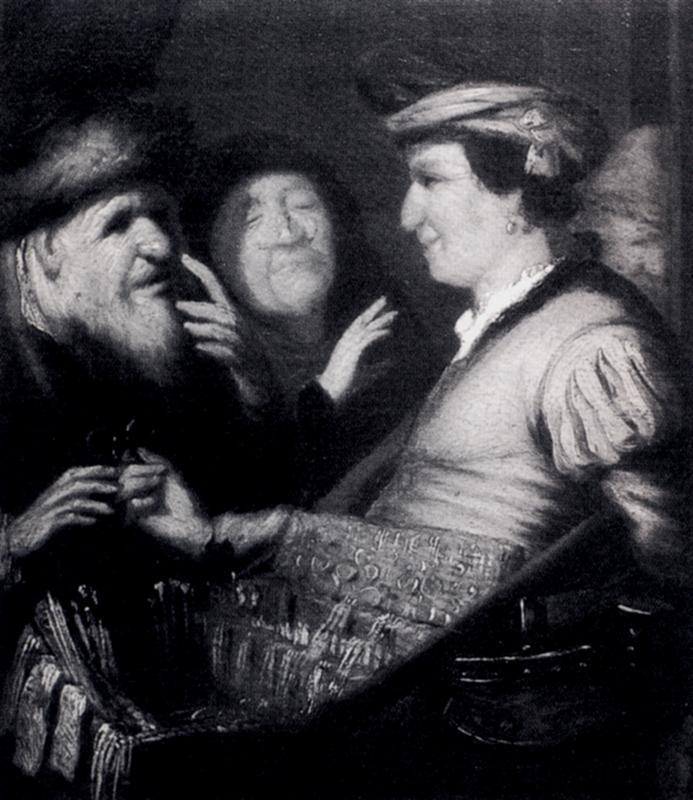
Rembrandt’s “The Sense of Sight” belongs to a youthful series of small panels that personify the human senses through scenes drawn from daily life. Painted in Leiden around 1625, the work exchanges classical personifications for a humble encounter that would have been familiar on Dutch streets: a spectacles seller calling attention to his wares while two potential customers press close to examine them. The result is a witty and intimate study of how people actually see—through squints, gestures, and borrowed lenses—rather than a symbolic figure holding an attribute. Already in his teens, Rembrandt shows a taste for psychological comedy, for the gently comic dignity of ordinary faces, and for the persuasive power of light to direct understanding.
Context In The Leiden Years And The “Senses” Series
In the mid-1620s Rembrandt had returned to Leiden after a short apprenticeship with Pieter Lastman in Amsterdam. From Lastman he learned how to stage a narrative clearly, how to dress figures in striking costumes, and how to use gesture as a legible language. Back in Leiden, he adapted those lessons to small-scale pictures intended for a domestic audience. The “Senses” panels—each about the size of a sheet of paper—playfully visualize sight, smell, hearing, touch, and taste. Instead of remote allegories, Rembrandt delivers recognizable social scenes: a barber-surgeon performing a “stone operation” for touch, a trio of singers for hearing, a fainting patient revived with smelling salts for smell, and, in the present panel, a spectacles vendor for sight. The series reveals a young artist trying out comic timing and close-up characterization while practicing the craft of making small figures read clearly in a shallow space.
The Everyday Theater Of The Spectacles Seller
Three figures crowd a tight foreground stage. At left, an elderly buyer leans in, his face furrowed by years of peering. His hand lies open to receive a pair of spectacles, while his other hand rises, ready to test, negotiate, or simply steady himself. In the middle, a second figure, perhaps a companion or wife, squints with theatrical exaggeration, eyes squeezed shut in a private rehearsal of seeing. At right, the vendor—in plumed cap and jaunty doublet—presents his tray of wares, his smile part salesman’s patter and part delight in the absurdity of the moment. The tray itself, angled toward the viewer, becomes a miniature display case filled with glints of metal and glass. The scene is at once comic and tender. No one is mocked; instead, the painter celebrates the human effort to overcome the body’s limits with tools and help from others.
Light As A Demonstration Of Vision
The light, coming from high at the right, performs the painting’s thesis. It kisses the rims of the spectacles, maps the wrinkles across the old man’s cheek, and slides along the vendor’s sleeve where the fabric puffs into pleats. The middle figure’s eyelids pick up a soft sheen that makes her squint legible from across the room. In a painting about sight, light becomes both subject and instrument. It reveals not only objects but the act of looking. The strongest highlights fall on the vendor’s tray and on the old man’s eager hands—the two instruments of vision in the scene—while the background remains a warm, breathable dusk. Even at this early date, Rembrandt uses light not as an even flood but as a deliberate hierarchy, granting clarity where meaning lies and letting less important zones dissolve into suggestion.
Composition That Pulls The Viewer Into The Joke
The composition is constructed like a triangular dialogue. The seller on the right forms the base with his angled tray; the two buyers, stacked left of center, close the triangle with their huddled heads. The tray’s diagonal thrust aims directly at the old man’s hands, and from there the eye hops to his face, then to the squinting companion, and finally back to the seller’s smile. This looping motion keeps the joke alive: offer, test, reaction, renewed offer. The proximity of bodies creates an intimacy that reads as trust rather than intrusion; they share the same air, leaning into common purpose. The shallow depth compresses the scene as if we have stepped within earshot of the vendor’s patter and the customer’s delighted exclamation. The frame crops tightly, a device that heightens immediacy and prevents distraction—this is vision in close-up.
Character As The True Subject
Rembrandt’s genius for faces is visible in embryo. The old man’s expression blends eagerness, suspicion, and hope; he looks the way someone looks when they might finally read a letter again. The companion’s shut-eyed grin captures the helpless hilarity of trying to see without seeing, a little pantomime of blindness enacted in good humor. The vendor’s slick confidence and slightly arched posture convey the confidence of a trader who knows that his wares solve a real problem. None of these are stock types; all feel observed, as if neighbors agreed to play roles in a studio skit. The warmth toward human foible—never cruel, always precise—will later become a hallmark of the artist’s etched beggars and his portraits of scholars and merchants.
Costume And Prop As Tools For Meaning
The seller’s feathered cap, the trim doublet, the open collar, and the broad belt do more than decorate the figure. They establish a rhythm of textures—soft felt, crisp linen, sturdy leather—against which the gleam of metal rims and glass can register. The tray, polished and patterned, turns into a stage within the stage; when the light hits its edge, it throws a bright wedge that cuts the foreground and draws the eye. The customers’ hats and shawls, by contrast, are simple and dark, their modesty aligning with their need. The difference in dress underscores the transaction: expertise and inventory on one side, desire and relief on the other. Yet the clothing never freezes into social caricature. Rembrandt keeps attention on faces and hands, the places where stories are legible.
Brushwork And Surface That Reward Close Viewing
Even in an image meant for a domestic interior, the paint handling is varied and intentional. Flesh is modeled with a buttery softness that rounds cheeks and noses without slickness. The beard at left breaks into quick, light-catching touches that vibrate against the dark. The vendor’s sleeve is a splendid sequence of broader strokes laid along the curve of the arm, each ridge catching light like a tiny pleat. The tray’s pattern is suggested rather than painstakingly drawn, a tremor of marks that reads as ornament when seen as a whole. This orchestration of thick and thin, sharp and soft, anticipates the juicier surfaces of the 1630s while showing a teenager’s discipline in making small forms read without fuss.
Humor As A Mode Of Empathy
Humor in this panel does not arise from mockery but from recognition. Anyone who has watched an elder attempt a new pair of glasses will recognize the choreography: the tentative pinch of the frame, the experimental squint, the sudden grin of success. The figures perform these actions with exaggerated clarity so that even in a small format they are legible, yet the exaggeration never tips into ridicule. The middle figure’s shut eyes are funny and moving at once; she wants to see so much that she rehearses seeing. Rembrandt’s humor opens a path to tenderness. He accepts the body’s frailties and finds in them occasions for community rather than shame.
Allegory Without the Pedestal
Traditional allegories of sight often feature a classically draped woman with an eagle, a mirror, or a single, elegantly held lens. Rembrandt chooses a scene where sight is a communal enterprise. It requires a vendor’s skill, a craftsman’s lenses, a buyer’s courage to admit need, and a companion’s support. By staging sight as a social action rather than a solitary attribute, the painter collapses the distance between abstract virtue and lived experience. The allegory becomes persuasive because it is plausible. You believe these people exist; therefore you believe the idea they enact.
The Market World Of Seventeenth-Century Leiden
The Dutch Republic’s commercial energy suffuses the panel. The vendor belongs to a class of itinerant specialists whose cries filled the streets and courtyards of cities like Leiden and Amsterdam. Innovations in lens grinding were underway; spectacles and magnifiers circulated not only among scholars but among craftsmen and elders. The painting thus nods to a culture in which knowledge and trade were tightly linked and where practical devices improved everyday life. In this context, the panel would have been both amusing and topical, a celebration of a technology that served piety, literacy, and commerce alike by returning the pleasures of reading, sewing, accounting, and worship to aging eyes.
A Laboratory For Chiaroscuro
Although the tonal range here is gentler than in later, darker works, the panel still operates as a test site for chiaroscuro. Against a warm, brownish field, the heads and hands emerge like low relief, modeled by a light that knows what it wants. Edges seen in profile—the old man’s beaklike nose, the vendor’s cheekbone—catch tight ridges of brightness, while recesses—the shadow under the tray, the pocket of space behind the central figure—collect soft gloom. This manipulation creates depth without elaborate architecture or landscape. Rembrandt proves that human faces, set close together under a single lamp, can generate an entire world of spatial cues.
The Triad Of Hands And The Mechanics Of Looking
Hands are the engine of the scene. The vendor’s right hand steadies the tray, his left retrieves a pair. The old man’s hands open to receive and to test, their fingers curling like question marks. The central figure’s fingertips rise toward her own face, an unconscious aid to concentration. This triad of hands traces the chain of seeing: making and offering, receiving and adjusting, focusing and verifying. In later paintings Rembrandt will rely on hands to carry a disproportionate share of meaning—think of the blessing in his biblical scenes or the open palms in his portraits. In “The Sense of Sight,” the hands are already eloquent, a silent chorus accompanying the eyes.
The Space Between The Figures As The Site Of Meaning
While the faces carry expression, the gaps between bodies carry relationship. The slender wedge between the seller’s elbow and the tray’s edge invites the viewer to step visually “into” the transaction. The slim pocket of shadow between the two buyers is not a void but a breathable area that lets their individual reactions coexist. These intervals keep the scene from collapsing into a single mass and preserve the individuality that makes the comedy humane. The painting therefore stages sight not only as a capacity of the eyes but as an exchange held in the invisible air between people.
The Panel’s Modest Scale And Intimate Address
The work’s small size is not an accident of youth or means. It suits the subject. A picture about peering and close inspection should reward closeness. When viewed at arm’s length, tiny effects come alive: the sparkle on a wire rim, the moist edge of a lower eyelid, the glimmer of a tooth in the seller’s grin. The modest panel invites a domestic ritual—lean closer, smile, recognize yourself—which is precisely the kind of attention that transforms a household picture into a companionable object rather than a distant spectacle.
Continuities With The Later Rembrandt
Looking forward from 1625, one can see several seeds that will define Rembrandt’s maturity. There is the ethical warmth that refuses to flatten people into types. There is the belief that light can carry narrative meaning independent of emblem or inscription. There is the love of textured surfaces that give the eye something to feel. There is, too, an interest in the cooperation between viewer and picture: the way a painting can cue us to complete a gesture or imagine a sound. In this sense the “Senses” panels are not juvenilia but blueprints. They declare that the highest art can come from the nearest life.
Seeing As A Moral And Social Act
Sight in this painting is not neutral perception. It is charged with care, trust, and commerce. The old man must admit need; the vendor must be honest; the companion must attend. The tiny world of the panel models a larger social insight: clarity often arrives through help. The painting gently corrects the fantasy of solitary vision by showing how we rely on others to sharpen what we see, whether through lenses, counsel, or shared laughter. This moral dimension lends the small comedy its lingering aftertaste; we leave the picture liking the figures and, by extension, liking a world in which such moments are possible.
Reading The Painting Today
For modern viewers accustomed to quick images, the panel offers a slower pleasure. It asks us to track micro-expressions, to notice how a crease in a sleeve reinforces a smile, how a tray’s angle directs attention as effectively as a pointing finger, how highlights gather on the rims of glasses like tiny moons. It also provides a historical echo: our own age is full of devices that promise sharper seeing—phones, screens, lenses—yet still depends on shared human attention. The painting thus feels contemporary not because of its props but because of its attitude toward need and help.
Why This Early Work Matters
“The Sense of Sight” matters because it demonstrates, at the threshold of a career, how to convert an abstract idea into a living scene without sacrificing clarity. It shows a young artist finding the scale and tone best suited to his gifts: close, humane, gently comic, and fiercely attentive to the expressive possibilities of faces and hands under a directed light. It also preserves a slice of social history—the spread of practical optics—while refusing to reduce people to examples. In its compact way, the panel is a masterpiece of measure: measured size, measured light, measured humor, and measured love for ordinary life.