Image Source: wikiart.org
Introduction: Claude Monet’s Captivating Vision of the Seine at Sunset
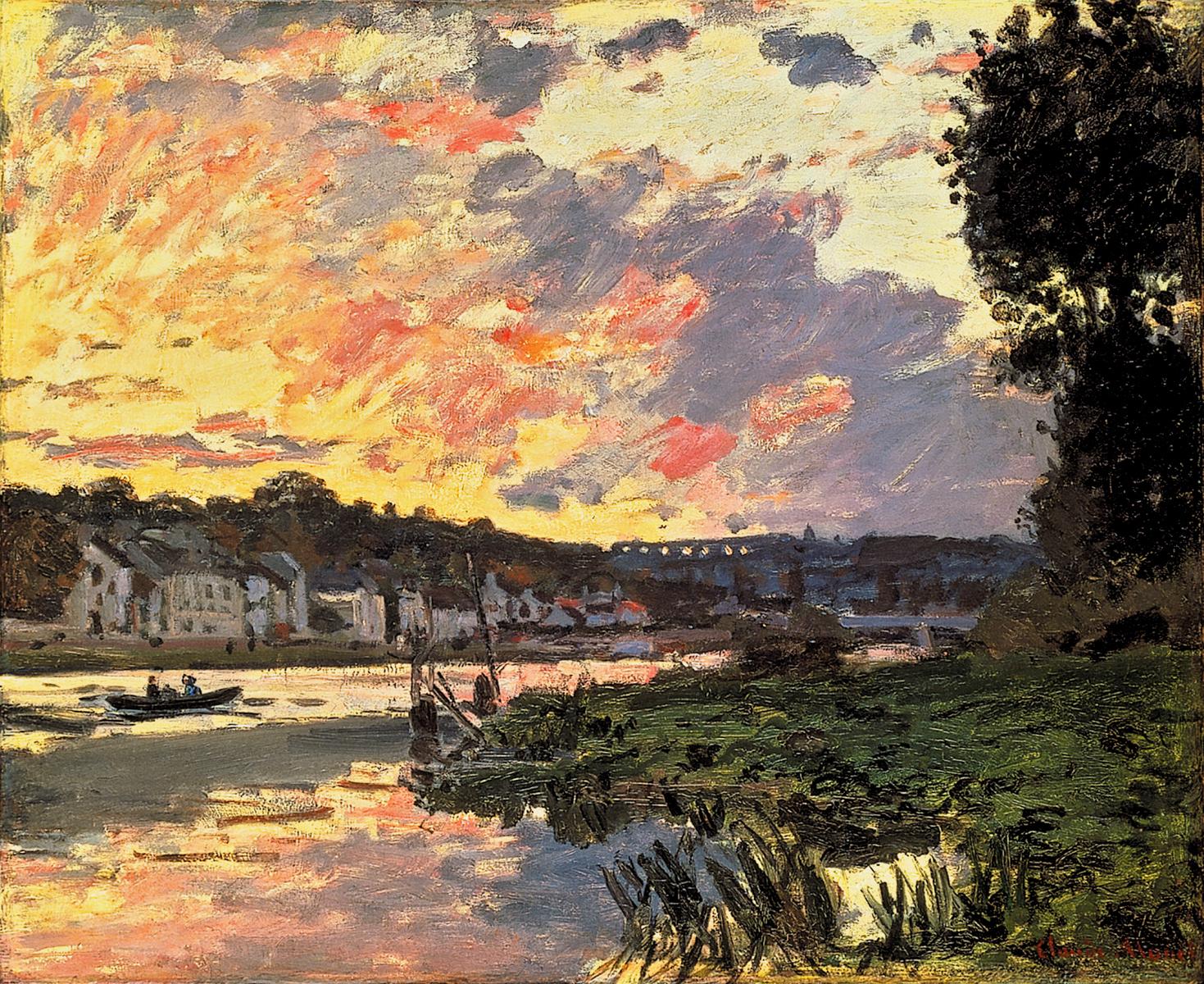
The Seine at Bougival in the Evening, painted by Claude Monet in 1869, is a remarkable landscape that captures the fleeting beauty of sunset along the River Seine. With its fiery sky, shimmering water, darkened vegetation, and quiet riverside settlement, the painting reveals Monet’s growing fascination with the changing effects of natural light, a central concern that would eventually define the Impressionist movement.
Created during an important transitional period in Monet’s artistic development, this atmospheric composition demonstrates his willingness to move beyond traditional landscape painting. Rather than presenting nature as a collection of carefully defined objects, Monet concentrates on the emotional and visual experience of a particular moment, when the final sunlight transforms an otherwise ordinary riverside scene into a spectacle of color.
The painting depicts Bougival, a picturesque town situated along the Seine west of Paris. During the nineteenth century, Bougival and its surrounding communities became increasingly popular destinations for Parisians seeking fresh air, boating excursions, and recreational activities away from the capital. The region also attracted artists who were fascinated by the relationship between modern leisure, natural scenery, and the rapidly changing French countryside.
What makes The Seine at Bougival in the Evening especially compelling is the extraordinary contrast between the luminous sky and the darkening landscape. Monet transforms the evening atmosphere into the dominant subject, creating a painting that feels both spontaneous and carefully organized. Every element, from the small boat gliding across the river to the vegetation silhouetted against the sunset, contributes to an evocative portrayal of a world suspended between daylight and darkness.
Historical Context: Claude Monet and the Birth of Impressionism in 1869
The year 1869 occupies an important position in Claude Monet’s artistic career. Although Impressionism would not receive its familiar name until the first independent exhibition of the Impressionists in 1874, many of its defining characteristics were already emerging in Monet’s work during the late 1860s.
At this time, Monet was experimenting with ways to represent natural light through increasingly direct brushwork and unconventional color relationships. His interest in painting outdoors encouraged him to observe atmospheric conditions as they unfolded, allowing the changing appearance of a landscape to influence his artistic decisions.
Traditional academic landscape painting generally emphasized controlled drawing, carefully blended colors, and balanced compositions. Monet increasingly challenged these conventions by treating visible brushstrokes, contrasting pigments, and transient lighting effects as essential components of the finished image.
During the summer of 1869, Monet worked alongside Pierre-Auguste Renoir at La Grenouillère, a popular bathing and boating establishment near Bougival. Their paintings of the same recreational setting became important experiments in the broken brushwork and vibrant reflections that would characterize Impressionist painting.
Although The Seine at Bougival in the Evening presents a quieter atmosphere than the lively scenes associated with La Grenouillère, it belongs to the same period of artistic exploration. Monet was discovering how water, sunlight, clouds, and vegetation could be represented through energetic applications of paint that preserved the immediacy of visual experience.
His personal circumstances during these years were frequently difficult, particularly because of financial insecurity and the challenges of establishing himself as an independent painter. Nevertheless, his commitment to developing a distinctive artistic language remained strong.
The landscape around Bougival offered an exceptionally rich environment for his experiments. Its combination of riverbanks, boats, houses, trees, bridges, and changing skies provided subjects that could be studied under an almost endless variety of atmospheric conditions.
In this painting, Monet demonstrates how an ordinary geographical location could become extraordinary through the effects of evening light. The result anticipates his later conviction that the appearance of a subject could change so dramatically with the time of day that light itself became the true subject of painting.
A Detailed Description of the Painting
The composition of The Seine at Bougival in the Evening is dominated by an expansive sunset sky occupying more than half of the canvas. Broad passages of golden yellow, orange, coral pink, violet, and gray spread across the atmosphere, suggesting clouds illuminated by the final rays of the descending sun.
Below this spectacular display, the Seine flows gently through the landscape. Its surface reflects the warm colors overhead, creating shimmering areas of yellow, peach, and pink that contrast with the darker blue-gray water.
On the left bank, a small settlement appears beneath a line of trees. Pale buildings with dark roofs stand close to the river, their architectural details simplified by the fading daylight and Monet’s energetic handling of paint.
A small boat carrying figures moves across the water near the left side of the composition. Although the occupants are rendered with minimal detail, their presence introduces a subtle human dimension and establishes the river as a place of everyday activity.
The opposite bank occupies much of the lower-right section of the painting. Dark green vegetation, rough grasses, and irregular patches of earth form a textured foreground that contrasts sharply with the luminous sky.
Near the center of the composition, a few slender vertical forms rise beside the water, suggesting posts, young trees, or riverside structures. These modest details provide important accents within the broader landscape and help connect the foreground to the distant settlement.
At the upper-right corner, a large mass of dark foliage extends inward from the edge of the canvas. Its nearly black silhouette creates a powerful contrast with the glowing sky and gives the composition a sense of enclosure.
In the middle distance, darker architectural forms and a long horizontal structure are visible beneath the horizon. Their subdued appearance suggests the growing influence of twilight as the landscape gradually loses its individual details.
The overall scene is peaceful, yet its colors are remarkably energetic. Monet captures the quietness of the riverside without diminishing the visual excitement of the sunset, achieving a striking balance between tranquility and movement.
The Dramatic Sunset Sky: Color, Light, and Atmosphere
The sky is undoubtedly the most visually commanding feature of The Seine at Bougival in the Evening. Rather than treating it as a passive background, Monet makes the atmosphere the principal source of color, movement, and emotional intensity.
A brilliant golden glow spreads across the left side of the painting, suggesting the sun has descended toward or below the horizon. This illumination transforms the clouds into vibrant formations of orange, salmon pink, and pale yellow.
The brightest passages are distributed unevenly, creating the impression of sunlight breaking through shifting layers of cloud. Their irregular placement gives the sky a natural complexity that would be difficult to achieve through a rigidly symmetrical arrangement.
Toward the center and right, heavier clouds introduce cooler shades of violet, lavender-gray, and muted blue. These cooler passages intensify the brilliance of the warm colors through direct visual contrast.
Monet avoids creating a uniform sunset in which every part of the sky is equally illuminated. Instead, he observes the uneven distribution of light, showing how some clouds absorb the final sunlight while others appear increasingly dark.
The contrast between warm and cool colors also suggests the changing temperature of the atmosphere. Golden light appears to radiate from the western horizon, while the larger gray-violet cloud formations evoke the approaching evening.
Especially striking is the painter’s treatment of the boundary between clouds and illuminated sky. Rather than defining every contour with precision, Monet allows strokes of contrasting color to overlap, merge, and interrupt one another.
This technique creates a sense of atmospheric instability, as though the clouds are slowly changing shape before the viewer’s eyes. The sky does not appear frozen into a permanent arrangement but seems to belong to a particular moment that cannot be repeated.
The luminous atmosphere also influences the emotional character of the entire painting. Its brilliant colors suggest warmth and vitality, while the gathering shadows introduce a quieter feeling of reflection and approaching night.
Through this combination of light and darkness, Monet presents sunset as a complex visual experience. It is simultaneously beautiful, dramatic, fleeting, and deeply connected to the passage of time.
The Seine River: Reflections and the Movement of Water
Water plays a fundamental role in Claude Monet’s artistic development, and The Seine at Bougival in the Evening provides an excellent example of his fascination with its reflective properties. The river becomes a second surface upon which the changing colors of the sky are displayed.
In the foreground, broad areas of warm pink and orange appear alongside cooler gray-blue passages. These colors echo the atmosphere above while adopting the irregular patterns produced by the gently moving water.
Monet does not create a perfect mirror image of the clouds. Instead, he translates their colors into horizontal and broken strokes, suggesting how reflections become fragmented as the water shifts.
This distinction is important because it demonstrates Monet’s increasing interest in visual perception. A reflection is not simply an inverted copy of an object but an unstable arrangement of light that changes according to movement, distance, and viewing angle.
Near the horizon, the water contains especially luminous passages of yellow and pale orange. These areas suggest the concentrated reflection of the brightest section of the evening sky.
Farther forward, the colors spread into broader and softer patterns. The effect gives the river a convincing sense of depth while maintaining the expressive character of the brushwork.
Small dark marks interrupt the illuminated surface, creating the impression of ripples, floating objects, and subtle movements. Their presence prevents the water from appearing completely motionless, even though the overall atmosphere remains calm.
The river also performs an important compositional function by guiding the viewer’s attention across the scene. Its horizontal movement connects the distant buildings, the small boat, and the grassy foreground into a unified landscape.
In symbolic terms, the Seine may also be understood as an image of continuity. While the sunset represents a fleeting moment, the river continues flowing, suggesting the coexistence of temporary beauty and the enduring rhythms of nature.
Composition and Perspective: Creating Depth Through Contrasts
The composition of The Seine at Bougival in the Evening reveals Monet’s ability to organize a complex landscape without sacrificing the appearance of spontaneity. Although the painting seems immediate and loosely executed, its major visual elements are carefully balanced.
The horizon lies relatively low in the picture, allowing the sky to occupy the dominant portion of the canvas. This arrangement emphasizes the atmospheric spectacle while reducing the architectural landscape to a supporting role.
The strong horizontal division between sky and land creates a sense of spaciousness. The viewer is encouraged to look beyond the immediate riverside toward the distant settlement and the enormous expanse of glowing clouds.
The foreground introduces a contrasting diagonal movement. The grassy bank extends from the lower-right area toward the center, directing attention inward and establishing a clear spatial relationship with the river.
The dark tree mass on the right acts as a natural frame. Its irregular outline contrasts with the open atmosphere and helps prevent the composition from feeling visually unbalanced toward the brightly illuminated left side.
Monet also uses differences in detail and color intensity to suggest distance. The foreground vegetation contains relatively dense, textured brushwork, while the distant buildings and hills are represented with softer, more generalized forms.
Atmospheric perspective is particularly visible in the treatment of the distant landscape. The far bank appears subdued beneath bluish and gray tones, suggesting that its details are gradually absorbed into the evening air.
The small boat provides another useful indication of scale. Its modest size, when compared with the broad river and enormous sky, emphasizes the expansive nature of the scene.
These compositional relationships create a subtle tension between intimacy and grandeur. The viewer stands close enough to observe the rough grasses along the bank but remains aware of the immense atmospheric drama unfolding overhead.
The result is a landscape that feels simultaneously grounded in a specific location and open to broader emotional interpretation. Monet transforms a familiar stretch of river into a composition of impressive visual and atmospheric depth.
Monet’s Brushwork and the Emerging Impressionist Technique
One of the most revealing aspects of The Seine at Bougival in the Evening is its energetic brushwork. Monet’s handling of paint demonstrates his movement away from the smooth, carefully finished surfaces traditionally favored by academic painting.
The clouds are constructed through visible strokes of varying length, direction, and thickness. Some marks sweep diagonally across the sky, while others form compact patches of color that suggest denser atmospheric formations.
These strokes remain distinguishable on the painted surface, allowing viewers to recognize the physical gestures involved in creating the image. Rather than concealing his technique, Monet makes the application of paint part of the painting’s expressive character.
The foreground vegetation is handled with even greater freedom. Short, dark marks suggest grasses and leaves, while broader passages of green and brown establish the general shape of the riverbank.
Individual plants are rarely described with botanical precision. Instead, Monet concentrates on the collective appearance of vegetation under fading daylight, when shapes begin to merge into larger masses of color.
This approach reflects a fundamental principle of Impressionist painting: the visual impression produced by a scene can be more important than the exact description of its separate objects. Monet seeks to communicate how the landscape appears at a particular moment rather than how every detail might look under neutral lighting.
The buildings along the opposite bank receive similarly economical treatment. Their pale walls and dark roofs remain identifiable, yet their forms are simplified into arrangements of light and shadow.
The water is painted with more horizontal strokes, distinguishing its surface from the irregular gestures used in the sky and vegetation. This variation in brushwork allows Monet to suggest different natural textures without relying on meticulous detail.
His technique creates a sense of unity between subject and execution. The restless marks of the sky evoke moving clouds, while the broken strokes on the river resemble reflections disturbed by gentle currents.
Viewed closely, the painting can appear almost abstract in certain passages. From a greater distance, however, the separate marks combine into a convincing landscape filled with light, atmosphere, and depth.
This relationship between visible paint and recognizable imagery would become one of the defining achievements of Impressionism. In this work from 1869, Monet was already exploring its remarkable expressive possibilities.
The Color Palette: Warm Sunset Tones Against Deepening Shadows
Color is essential to the emotional and visual impact of The Seine at Bougival in the Evening. Monet creates a striking relationship between the brilliant warmth of the sunset and the cool darkness gradually overtaking the landscape.
Golden yellow forms the foundation of the illuminated sky. Its brightness suggests the final intensity of sunlight, while its distribution across the clouds produces an atmosphere of exceptional warmth.
Orange and coral pink introduce greater complexity. These colors give the clouds a glowing appearance and prevent the sky from becoming a simple arrangement of yellow light and gray shadow.
Violet and lavender-gray provide a cooler counterbalance. Their presence is particularly important because they allow the warm pigments to appear even more luminous through contrast.
The darker portions of the landscape contain deep greens, browns, and near-black tones. These colors anchor the composition and communicate the reduced visibility associated with approaching night.
Monet’s handling of shadow is especially noteworthy. Rather than relying exclusively on black, he introduces subtle variations of green, blue, gray, and brown that preserve the richness of the landscape.
The foreground grasses appear predominantly dark green, but their texture is enlivened by lighter touches and earthy accents. These variations suggest that the vegetation continues to reflect small amounts of the remaining daylight.
The distant buildings contribute quieter tones of cream, gray, and muted blue. Their relatively restrained colors create a visual transition between the glowing atmosphere and the dark foreground.
The river unifies these contrasting palettes by incorporating both warm and cool colors. Its reflective surface allows the yellow, orange, pink, and violet of the sky to interact with the grays and blues of the water.
This sophisticated arrangement demonstrates Monet’s growing understanding of color as a means of representing light. Instead of assigning every object a fixed local color, he shows how environmental conditions transform the appearance of everything within the scene.
Bougival and the Changing Landscape of Nineteenth-Century France
The setting of The Seine at Bougival in the Evening is significant because Bougival was part of a region undergoing considerable social and cultural transformation during the nineteenth century. Situated along the Seine west of Paris, the town became closely associated with riverside leisure and the growing accessibility of suburban landscapes.
Improved transportation connections encouraged Parisians to travel outside the capital for relaxation and recreation. The Seine offered opportunities for boating, swimming, dining, and social gatherings, making communities such as Bougival increasingly attractive destinations.
Artists were drawn to these locations because they combined natural scenery with recognizable aspects of contemporary life. Rivers, wooded banks, villages, and recreational establishments provided subjects that differed from the historical narratives and idealized landscapes traditionally celebrated by academic institutions.
Monet’s painting reflects this changing cultural environment through its modest human details. The boat on the river and the buildings along the opposite bank suggest a landscape inhabited and used by ordinary people.
Yet the painting does not emphasize crowds, fashionable entertainment, or the excitement of modern recreation. Instead, Monet presents Bougival during a quieter moment, when the activities of the day seem to be giving way to evening stillness.
This choice distinguishes the work from more animated representations of riverside leisure. The presence of human activity remains subtle, allowing the overwhelming beauty of the natural atmosphere to dominate.
The painting can therefore be understood as a meeting point between modern life and timeless landscape traditions. Its subject belongs to the contemporary world of nineteenth-century France, but its emotional appeal emerges primarily from the universal experience of watching daylight fade.
Bougival’s importance in the history of Impressionism also gives the work additional interest. The region became associated with artists including Monet, Renoir, and later Berthe Morisot, each of whom explored the changing relationship between people, landscape, and modern visual experience.
For Monet, the Seine was more than a convenient geographical subject. It provided an environment in which reflections, clouds, vegetation, and changing light could be observed together, encouraging the artistic investigations that would shape his later career.
The Small Boat and the Human Presence in the Landscape
Although the sunset dominates the painting, the small boat near the left bank introduces an important human element. Its occupants are represented through a handful of dark and lightly colored strokes, making them recognizable without turning them into individual portraits.
The boat appears to move quietly across the illuminated water. Its horizontal form echoes the surrounding riverbank and reinforces the impression of a calm evening rather than a scene of dramatic activity.
Monet deliberately keeps the figures small in relation to the landscape. This difference in scale emphasizes the vastness of the sky and suggests that human life occupies only a modest place within the larger natural environment.
The figures also establish a connection between the viewer and the painted scene. Their presence invites the imagination to consider the experience of traveling along the Seine beneath such an extraordinary sunset.
One might imagine the quiet sounds of water moving against the boat, the cooling evening air, and the distant activity of the riverside settlement. These sensory associations arise naturally from the atmosphere Monet creates, even though the painting offers few explicit narrative details.
The boat provides a useful contrast between movement and stillness. While the river continues flowing and the clouds appear to shift overhead, the small craft introduces a more deliberate form of human movement within the scene.
It also gives the composition a sense of everyday authenticity. The landscape is not an untouched wilderness but a familiar environment in which people live, travel, and interact with nature.
This understated approach to human activity is characteristic of Monet’s growing artistic interests. Rather than constructing an elaborate story around the figures, he integrates them into the broader visual experience of light and landscape.
Their anonymity is therefore meaningful. The painting is less concerned with who these individuals are than with how their presence contributes to the atmosphere of a particular evening along the Seine.
The Emotional Atmosphere: Tranquility, Melancholy, and Wonder
The Seine at Bougival in the Evening communicates a complex emotional atmosphere through its combination of brilliant color and deepening shadow. The painting initially attracts attention through the spectacular sunset, but its quieter details introduce a mood of contemplation.
The warm colors suggest vitality and natural beauty. Their intensity creates a sense of wonder, as though the viewer has encountered an unusually memorable moment in the ordinary progression of the day.
At the same time, the dark foreground and heavily shadowed buildings introduce a subtle melancholy. They remind the viewer that the glowing light is temporary and that the landscape will soon disappear into darkness.
This contrast between illumination and obscurity gives the painting its emotional depth. Sunset becomes a moment of transition, balancing the warmth of the departing day against the uncertainty and stillness of approaching night.
The river contributes to the contemplative mood through its gentle reflections. Its surface appears calm enough to preserve the colors of the sky, yet its shifting strokes suggest that the scene remains constantly in motion.
The small boat enhances the feeling of quiet human presence within an immense natural setting. Rather than disturbing the tranquility, the figures seem absorbed into the rhythm of the evening landscape.
There is also a sense of intimacy in Monet’s viewpoint. The viewer appears positioned close to the riverbank, surrounded by vegetation and looking outward across the water toward the illuminated horizon.
This perspective encourages an almost personal experience of the scene. The painting feels less like a formal depiction of a celebrated landmark and more like a private observation of an unexpectedly beautiful evening.
Its emotional power ultimately depends on Monet’s ability to capture the relationship between beauty and impermanence. The sunset is radiant precisely because its extraordinary colors cannot last.
Comparing the Painting with Monet’s Other Works from 1869
The year 1869 produced several important works that illuminate Monet’s development toward Impressionism. Among the most significant are his paintings of La Grenouillère, where he explored the appearance of water, reflected light, and modern recreational life.
In the La Grenouillère compositions, Monet often emphasizes bright daylight, lively boating activity, and rapidly changing reflections. The water becomes a complex mosaic of small strokes that translate sunlight into vivid patterns of color.
The Seine at Bougival in the Evening explores similar technical problems under very different atmospheric conditions. Instead of concentrating on midday brightness and crowded leisure, Monet investigates the dramatic contrast between sunset illumination and the darkening landscape.
The evening setting encourages a broader and more expressive treatment of color. Large cloud formations become the principal visual attraction, while the buildings and figures appear increasingly subordinate to the surrounding atmosphere.
This contrast reveals the flexibility of Monet’s emerging technique. The same interest in direct observation could produce either a lively daytime scene or a deeply atmospheric evening landscape.
The painting also anticipates his later river landscapes at Argenteuil, where boats, bridges, and waterside buildings would become central subjects. In those works, Monet continued exploring how reflections and changing weather could transform familiar scenery.
An even broader connection can be made with his celebrated series of haystacks, poplars, and Rouen Cathedral paintings from the following decades. Although their subjects differ considerably, these later works share the conviction that light can alter the entire visual identity of a scene.
The evening atmosphere at Bougival therefore represents an early expression of a lifelong artistic concern. Monet was beginning to understand that a landscape could never be separated completely from the conditions under which it was observed.
Nature, Modernity, and the Passage of Time
One of the most interesting ways to interpret The Seine at Bougival in the Evening is through its relationship with time. Monet portrays a specific moment of transition, when the brilliant colors of sunset briefly dominate the landscape before disappearing.
The changing atmosphere is central to this experience. The sky contains simultaneous indications of lingering sunlight and approaching darkness, making the passage of time visible through color.
The river reinforces this theme because its reflections are inherently unstable. Even if the clouds remained unchanged, the movement of water would continuously alter their appearance on its surface.
The small boat introduces another temporal dimension through human movement. Its journey across the Seine suggests the ordinary rhythms of daily life continuing beneath the extraordinary spectacle of the evening sky.
The settlement along the opposite bank represents a more enduring human presence. Buildings and riverside structures remain relatively stable while the surrounding light changes from moment to moment.
This relationship between permanence and transformation is particularly compelling. Monet places the lasting forms of the landscape within an atmosphere that is visibly temporary.
The painting also reflects the modern nineteenth-century fascination with direct experience. Rather than presenting an idealized landscape detached from everyday reality, Monet focuses on the sensation of observing a recognizable place at a particular hour.
This approach helped redefine the purpose of landscape painting. Nature was no longer merely a suitable setting for historical, religious, or literary subjects but could become an independent source of artistic meaning.
Through the fleeting beauty of evening light, Monet demonstrates that ordinary experience contains moments worthy of sustained attention. The painting invites viewers to recognize the extraordinary visual possibilities hidden within familiar surroundings.
The Significance of the Painting in Monet’s Artistic Development
The Seine at Bougival in the Evening is valuable for understanding the artistic changes that shaped Claude Monet during the late 1860s. Its visible brushwork, dramatic color contrasts, and emphasis on transient lighting effects anticipate several essential characteristics of his mature style.
The painting demonstrates his increasing willingness to simplify solid forms in order to communicate atmospheric unity. Buildings, trees, and figures remain recognizable, but none is allowed to compete with the overall effect of evening light.
This shift represents an important departure from conventional landscape painting. Rather than emphasizing the permanence of physical objects, Monet explores how their appearance changes according to environmental conditions.
The sky’s expressive brushwork is especially revealing. Its layered passages of warm and cool pigment show Monet treating color as an active means of constructing atmosphere rather than merely filling predetermined outlines.
The water provides another indication of his developing artistic language. Its broken reflections foreshadow the increasingly sophisticated techniques he would use in later paintings of rivers, ponds, and gardens.
At the same time, the composition retains a strong sense of traditional landscape structure. The foreground bank, distant village, and expansive sky remain clearly organized, showing that Monet’s experiments with technique did not eliminate his concern for visual balance.
The painting is therefore best understood as part of a transitional artistic moment. It combines recognizable landscape conventions with a freer, more immediate approach to painting that would become increasingly influential during the following decade.
Its significance also lies in the confidence with which Monet handles a potentially difficult subject. Sunset requires the painter to represent extreme differences in brightness, delicate shifts in color, and forms that become less distinct as daylight disappears.
Monet approaches these challenges through bold contrasts and economical detail. The result demonstrates both his powers of observation and his growing trust in the expressive possibilities of visible paint.
Why The Seine at Bougival in the Evening Remains So Compelling
More than a century and a half after its creation, The Seine at Bougival in the Evening continues to captivate through the immediacy of its colors and the emotional resonance of its atmosphere. Its appeal does not depend on an elaborate narrative or a famous historical event but on the extraordinary beauty of an ordinary moment.
The composition captures something deeply familiar: the experience of watching the landscape change as the sun disappears. Nearly everyone can recognize the contrast between a luminous evening sky and the dark silhouettes of trees, buildings, and riverbanks.
Yet Monet transforms this familiar experience through his distinctive artistic vision. His energetic brushwork gives the clouds a sense of motion, while his unexpected combinations of pink, orange, violet, and gray intensify the drama of the atmosphere.
The painting also rewards close examination because its apparent simplicity conceals a sophisticated arrangement of visual relationships. The glowing river echoes the sky, the dark foliage strengthens the brightness of the sunset, and the small boat provides a human point of reference within the expansive setting.
Its quietness is equally important. Despite the intensity of its colors, the landscape conveys calm, allowing the viewer to linger over the subtle relationship between movement and stillness.
For admirers of Claude Monet, the painting offers a fascinating glimpse of an artist developing the techniques that would eventually transform modern painting. For viewers encountering his work for the first time, it provides an accessible demonstration of his extraordinary sensitivity to light.
Above all, the painting reminds us that natural beauty is inseparable from change. Monet preserves the appearance of a fleeting evening while allowing its colors, textures, and atmosphere to retain the vitality of the original observation.
Conclusion: A Radiant Evening on the Seine
Claude Monet’s The Seine at Bougival in the Evening (1869) is a beautiful example of his early exploration of light, color, and atmospheric transformation. Through its fiery sunset, shimmering reflections, darkened riverbanks, and understated human presence, the painting captures the distinctive character of a peaceful evening along the Seine.
Its greatest achievement lies in the way Monet transforms a familiar landscape into an immersive visual experience. The buildings, boat, trees, and water are important, but their individual identities ultimately contribute to something larger: the extraordinary effect of the fading sun upon the natural world.
The painting also occupies a meaningful place in Monet’s development toward Impressionism. Its loose brushwork, expressive color relationships, and emphasis on the fleeting appearance of nature reveal an artist increasingly committed to representing the immediate sensations of sight.
By allowing the sunset to dominate the composition, Monet creates a landscape that feels both intimate and expansive. The scene belongs to a particular place and historical moment, yet its emotional significance extends beyond the banks of the Seine.
The Seine at Bougival in the Evening ultimately celebrates the beauty of transition. It reminds viewers that even the most familiar landscape can become extraordinary when illuminated by the changing colors of the evening sky.