Image source: wikiart.org
Introduction
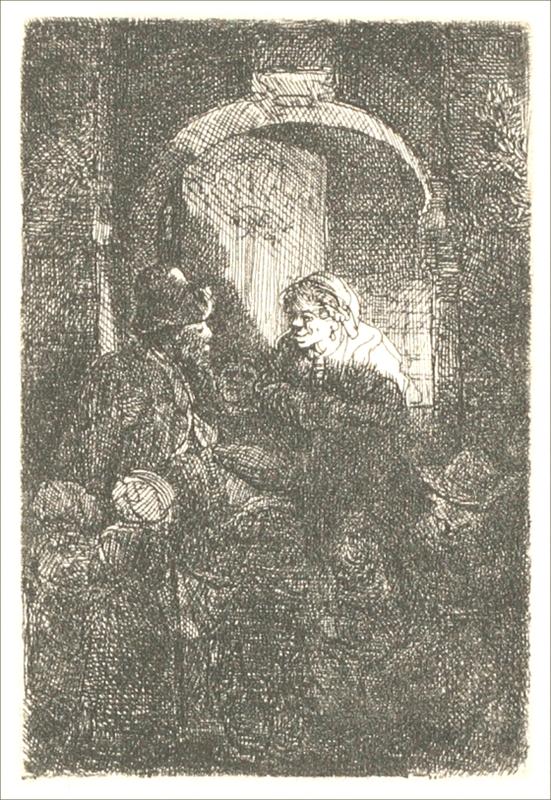
Rembrandt’s “The Schoolmaster” from 1641 is a small etching that feels startlingly large in atmosphere. Within a tight rectangle of ink and paper, he compresses an entire pedagogy of light and character. A teacher and pupil occupy a pool of illumination before a shallow arch, their faces leaning toward one another as if knowledge itself were being passed by whisper. Around them, the room dissolves into a soft, murmurous dark, textured with benches, books, hats, and the restless silhouettes of other students. The print belongs to Rembrandt’s cycle of intimate genre scenes from the early 1640s, works that explore daily life with the gravitas normally reserved for biblical stories. What distinguishes this image is the way instruction becomes drama. The teacher’s authority is neither pompous nor abstract; it is a human warmth the artist sculpts out of glint and shade, a luminosity that makes learning visible.
Subject and Narrative Moment
The title suggests a generic setting rather than a specific tale, yet the scene reads like a narrative frozen at the decisive instant. A schoolmaster sits or stoops in the left half-shadow, his face turned toward a child who leans forward on the right, cheek bright against the glow. Their hands appear to meet or nearly meet, perhaps guiding a slate, a page, or the child’s fingers. The arch behind them opens onto a luminous void that functions like a backdrop of concentrated attention. One senses that the teacher has just asked a question and the student has just found an answer. Rembrandt excels at choosing such moments of inward culmination—points in time where nothing spectacular happens and yet something essential changes. Learning is not thunderbolt revelation in this print; it is a patient exchange, the passing of a spark from an older mind to a younger one.
Composition and the Architecture of Attention
The composition orchestrates attention with extraordinary economy. A rounded arch centrally placed creates a shallow niche that acts as a reflector of light. The teacher sits in the arch’s left shadow, the student on its right edge, so that the negative space between them becomes a cone of concentration. The surrounding space is cradled in a dense lattice of crosshatching that both enwraps and muffles secondary forms. Hats and satchels appear as softly modeled ovals; benches and the floor become gradients of tone. This mass of darkness frames the central colloquy the way a theater darkens its house to focus the spectator on actors. It is not empty darkness, however; it has texture and livedness, like a buzzing room that falls away when revelation strikes. The arch keeps the event intimate. Instead of a vast schoolroom, we are given a niche that functions almost like a chapel, a sanctuary for words and numbers.
Line, Burr, and the Breath of Paper
Rembrandt’s etching line here is supple and aerated. He modulates pressure and spacing so that the paper’s untouched whiteness becomes an active participant in the image. The child’s face is partly drawn by omission: the light side is simply paper, the shadowed cheek stitched with lightly curved hatches. The schoolmaster’s features are built from short, descriptive strokes that stop and start, giving the sensation of living flesh rather than schematic features. The darkest zones—the lower foreground, the left wall, and layers of clothing—carry a dense web of crosshatching that sometimes catches slight drypoint burr, producing velvety depths. That burr softens edges, making darkness feel like air rather than a painted wall. In the arch, a screen of evenly spaced lines bends with its curvature; these not only carve space but create a silvery glimmer, a kind of acoustic shell for dialogue. The craft is never fussy. It breathes with confidence, as if the copper plate remembered the speed of the artist’s hand.
Light as Pedagogical Metaphor
The interplay of light and dark is not merely visual; it is thematic. The student’s face and upper shoulder receive the most concentrated illumination, suggesting receptivity and dawning comprehension. The teacher’s face, though half in shadow, glows along the cheek and nose, a candle-like source reflecting toward the pupil. The arch behind them gathers and returns the light, making the exchange feel communal rather than private. In the rest of the room, light scatters, catching random hats, book edges, and an elbow here and there, as if knowledge touches everyone sporadically but focuses intensely where teacher and student meet. The metaphor is classical, yet Rembrandt renders it with humility. There is no spotlight from heaven, only the practical radiance of a window or lamp translated into ink and paper. The effect is a moral: in ordinary spaces, attention transforms light into meaning.
Characterization Through Posture and Expression
The two central figures are defined by gesture more than by detail. The schoolmaster’s head tilts forward, his shoulders rounded not in defeat but in patience. His right hand likely lifts or guides, his left perhaps steadies a page, but the exact configuration refuses literalism; instead we read the coherence of the teacher’s body, bent into the shape of care. The student leans in with alert willingness, the mouth slightly open in speech or surprise. Rembrandt avoids sentimental cuteness. The child is lively and a little awkward, a real body at the threshold between confusion and clarity. Around them, other forms register as nods and hunched backs, the anonymous crowd of any classroom, half present, half adrift. The drama exists in how the master retrieves one mind from that drift and brings it into the arch of attention.
Interior Setting and the Dutch Schoolroom
While the print is not a documentary of a specific school, it resonates with Dutch seventeenth-century ideas about education. The Republic prized literacy for reading scripture, record-keeping, and civic participation. Schools often mixed ages and relied on the discipline and charisma of a single instructor. Rembrandt distills that environment into an archetypal corner: benches that blur into one another, forward-leaning backs, quiet accumulation of caps and satchels, a sense of controlled bustle. The arch could stand for a fireplace or an architectural passage; in either case it marks the seat of authority, a threshold that the student crosses temporarily when summoned. The compressed space evokes those urban interiors where learning was threaded into the practical day, joining the sacred dignity of knowledge with the homeliness of wood shavings and ink stains.
The Human Scale of Authority
Authority in this print is neither scolding nor aloof. The schoolmaster’s authority derives from proximity, from his willingness to stoop, listen, and gently direct. Rembrandt crafts this moral without recourse to symbolic props like rods or raised fingers. Even the teacher’s hat, barely legible in the murk, reads as soft rather than stiff. Authority is modeled as accompaniment. The child’s lighted face shows that the method works. The exchange’s closeness suggests a pedagogy of near speech, of guidance tailored to the pupil’s face. In an era when many images of schoolmasters revel in comic strictness, Rembrandt offers a counter-image of warmth and craft, a civic ideal disguised as a genre scene.
The Sound of the Scene
Though silent, the print suggests sound with extraordinary specificity. The dense, pebbled hatchings evoke a low hum of shuffling feet and whispered recitation. The arch, drawn with even, ringing lines, reads like an acoustic shell that gathers and clarifies the teacher’s voice. The white around the two faces has the quiet of a pause, the moment after a question when a child gropes for a word and finds it. This orchestration of imagined sound deepens the realism. Viewers do not simply see a school; they hear it in their heads. Rembrandt’s lines act like notation for a music of murmurs and sudden comprehension.
Humor and Tenderness in the Genre Mode
Rembrandt’s genre scenes often carry a gentle humor—a way of acknowledging human foibles without derision. In “The Schoolmaster,” humor appears in the awkward tilt of the student’s body and in the cluttered foreground, where oversized hats and bundles seem to develop lives of their own in the dark. The teacher’s face, turned with a slight smile, hints at the mixture of amusement and pride known to anyone who has coached a young mind through a knot. The humor never mocks learning; it celebrates the comic textures of real classrooms: the misfitting caps, the slumped shoulders, the eager child who leans too far into the light. Out of these homely particulars, tenderness grows.
Technique, States, and Printing Intelligence
Rembrandt’s prints from 1640–1641 often exist in multiple states as he re-entered plates to adjust tonality or sharpen emphases. In a subject like “The Schoolmaster,” he deploys a subtle balance of etched line and possible touches of drypoint to deepen local shadows. The density of crosshatching in the lower half likely evolved as he proofed impressions and noticed where the scene needed weight. Plate wear would soften those darkest meshes over time, which may explain the range of atmospheric effects across surviving impressions. Paper choice also matters. A slightly toned sheet can enrich the mid-tones and make the central light feel warmed; a whiter paper gives the arch an almost crystalline brilliance. Rembrandt is not simply drawing; he is building an instrument whose tone he can tune from impression to impression.
Comparisons with Other Intimate Prints
Placed alongside works such as “Christ Preaching (La Petite Tombe),” “The Artist’s Mother Seated,” or “The Reader,” this print demonstrates Rembrandt’s devotion to small dramas of attention. In those works, too, the action is a kind of listening or thinking. The difference here is the civic ordinariness of the theme. A schoolroom lacks the glamour of palaces or the doctrinal weight of altars, yet Rembrandt insists that grace and seriousness dwell here as well. Among his prints of 1641, the image also resonates with scenes like “The Blind Fiddler” and “Street Musicians,” where instruction and craft are passed by close example rather than decree. He is sketching a society that believes skills are shared in circles of light, one person at a time.
The Emotional Temperature of the Dark
A special virtue of this print is the emotional temperature of its darkness. Many artists use shadow as threat; Rembrandt uses it as embrace. The darkness here is warm, woven, hospitable. It hides messy details that would distract while preserving their weight. It becomes the collective of the class—the noise and patience necessary for any one lesson to take hold. In the seam between that darkness and the child’s illuminated cheek, the teacher’s work registers as a modest miracle. One can imagine the child stepping back into the room’s dusk with a new sentence under the tongue, the world a little larger for having been named.
The Child as Witness and Participant
The student’s expression is crucial. Rembrandt avoids making the child a passive recipient. The forward lean, the lighted cheek, the open mouth, and the hand poised to respond all suggest active participation. The child witnesses his own learning, feels it happening, and returns the teacher’s light with his own. The print therefore honors not only instruction but discovery. The arch behind them, nearly halo-like in its curve, crowns the event without sanctifying it beyond recognition. It affirms that to grasp a letter or rule is to cross a threshold, to become slightly other than one was a moment earlier.
A Civic Philosophy of Knowledge
The Dutch Republic’s prosperity rested on trade, law, and shared literacy. Rembrandt’s “The Schoolmaster” articulates a civic philosophy gently, without emblematic banners. The careful attention of a teacher to a single child becomes an emblem of the Republic’s belief that knowledge is communal property raised person by person. The surrounding students, though blurred, do not vanish; they constitute the social fabric from which this learner is momentarily singled. The arch reads like a doorway to participation. When the lesson ends, the child will rejoin the collective, better able to read a bill of lading, a psalm, or a contract—all the mundane documents through which the Republic’s life flowed.
The Viewer’s Position
Rembrandt places the viewer at the level of the benches, nearly shoulder to shoulder with the students. We look slightly upward toward the teacher and the lit child, as if we, too, await a question or check our own understanding. This point of view invites identification rather than mere spectatorship. We remember our own teachers, our own arches of attention. The intimacy of the scale helps: one must hold the print close, leaning in as the child leans in, making the act of viewing mimic the act of learning. Rembrandt often engineers such rhymes between subject and experience, asking the viewer to reenact the scene’s moral with their own body.
Why This Print Still Speaks
“The Schoolmaster” endures because it recognizes education as a human exchange conducted in ordinary light. Its compassion is unsentimental, rooted in the textures of rooms and the language of bodies. The etching shows that the smallest spaces can hold deep meanings, that authority can bend without breaking, and that understanding arrives not as thunder but as a lamp held close. Its lines remain fresh because they serve not just depiction but invitation. They invite us to value patience, to take pleasure in clarity arriving, and to remember that culture is transmitted in such humble circles everywhere.