Image source: wikiart.org
Introduction
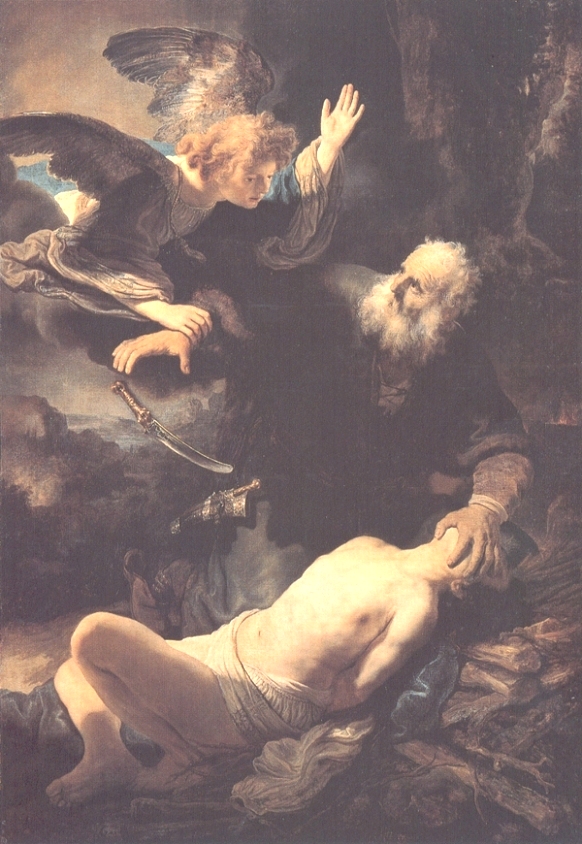
Rembrandt’s “The Sacrifice of Abraham” (1635) condenses one of the Hebrew Bible’s most unsettling episodes into a single, electrified breath—the instant when heaven interrupts the knife. The angel lunges into the scene with a forward thrust that is almost physical; Abraham, beard wild and eyes startled, whips his head toward the messenger while one heavy, calloused hand holds Isaac’s face against the altar. The blade, already in motion, drops away as if yanked by the command that just entered the air. Every element—gesture, light, palette, and composition—serves this pivot from obedience to reprieve. Rembrandt doesn’t merely illustrate Genesis; he dramatizes the microsecond in which fate reverses, and in doing so, he turns a theological test into a human event you can feel in your hands and ribs.
The Biblical Moment and a Painter’s Problem
Genesis 22 gives the story with spare intensity. Abraham is told to sacrifice his son Isaac; he obeys, builds the altar, binds the boy, and raises the knife—only to be stopped by an angel who announces that God has seen his faith. Painters across Europe approached the subject, but the challenge remains the same: which moment to show? Rembrandt chooses the hinge, the hairline seam between doom and deliverance. He also embraces the story’s contradictions: a father’s love tested by divine demand, a boy’s terror absorbed by trust, an angel who both arrests violence and validates the faith that made it possible. The painting holds those tensions without flattening them into a single moral.
Composition as Shockwave
The design reads like a blast of air entering a darkened room. From the upper left the angel plunges diagonally downward, wings tilted and curls lit, one hand clamping Abraham’s sword arm, the other lifted in an arresting sign. This diagonal collides with the counter-diagonal of Abraham’s body, which bends over Isaac and then twists back toward the messenger. The interlocking X of their gestures is the picture’s engine; it locks bodies into a single system of force and counterforce. Isaac’s bound, torsioned torso forms a third, lower diagonal that points toward the log-strewn altar, grounding the turbulence in physical matter. The entire composition is a machine designed to stage a stop.
Chiaroscuro and the Light of Intervention
Rembrandt’s light is not a neutral observer; it carries meaning. The angel’s face and uplifted hand radiate a clear, cool illumination that reads as unearthly; Abraham’s forehead and beard catch that light in a warmer key, as if mortal flesh reflects but does not originate it. Isaac’s body is modeled with a palpable, living glow, made more vulnerable by the soft whites and pinks that define young skin. Surrounding all this is a mass of darkness—rock, night, or cloud—that presses the drama forward like a velvet backdrop. The contrast is moral without being preachy: revelation arrives, and what it touches becomes visible, comprehensible, and rescued.
Gesture: The Grammar of a Command
The angel’s hands are the syntax of the scene: the left clamps, the right commands. Abraham’s hands answer in two languages—one lets go of the knife, the other still grips the boy’s face. That small delay between understanding and release is deeply human. Faith has arrested the arm, but the body needs a beat to catch up. Rembrandt courts precisely that beat. The blade is already slipping from Abraham’s fingers, its arc pointed toward the shadowed ground; yet the father’s other hand remains firm on Isaac’s head, an instinct as old as parenthood—control the child in danger. Gesture here is not decorative flourish; it is the thought made flesh.
The Knife and the Still Life of Danger
Rembrandt renders the knife with the factual care of a still life. Its belly-curved blade flashes, its hilt glints; you can feel its weight and the cool bite of sharpened steel. A second sword sheath hangs at Abraham’s side, an unnecessary accessory that nonetheless deepens the sense of preparedness. As the angel’s grip jerks Abraham’s wrist, the knife tumbles, pivoting on an axis that is both literal and symbolic: death turning toward the ground. The eye tracks the weapon’s descent, and with it the dispersal of dread.
Abraham’s Face: Obedience, Terror, Release
Abraham does not wear the serene mask of a saint. His brow knots, eyes widen, and mouth slackens in a second-by-second conversion from implacable obedience to stunned relief. The painter floods that face with a complicated light—part earthly, part borrowed from the angel—so that wrinkles and beard catch highlights like ripples on rough stone. The psychology is particular, not generalized. This is not “Faith” personified; this is an old man who has lived with promises, suffered delays, loves his son, and is hearing a voice that cancels the unbearable order he had determined to obey.
Isaac: The Body That Knows Before the Mind
Isaac’s head is wrenched backward, the throat exposed, the body bound with linen that bites into soft skin. He is not an idealized adolescent; he is a living son, and Rembrandt gives him the physiology of fear: arched back, curled toes, contracted abdomen. Yet there is also a hint of trust. The hands are tied but not clawing; the face is turned away, as if submitting to what the father has declared necessary. The boy’s form is the painting’s tender center—so luminous that it pulls the viewer’s empathy even as the angel’s command pulls the plot.
Angels That Feel the Air
Rembrandt’s angel is not a translucent idea but a body that displaces air. The wings are feathered with broad, loaded strokes; the curls of hair catch light like coiled wire; the robe billows with the physics of sudden arrival. In the downward thrust of the torso and the braced legs we feel momentum arrested. This is crucial to the painting’s credibility: the miracle does not merely appear; it exerts force on a world of gravity and muscle.
Landscape as Stage and Witness
The setting is a stark outcrop with a wedge of distant landscape opening at left—cool water or valley under a bruised sky. Rembrandt refuses picturesque scenery; his rocks are props with the dignity of necessity, their jagged edges catching a little light to show where the altar stands. The minimal landscape has two functions. It locates the story in the world rather than in abstraction, and it preserves the claustrophobic focus of the foreground encounter. Even the tiny figures below—often read as the servants left behind—contribute scale without stealing attention.
Color: Warm Flesh, Cool Revelation, Earth Underfoot
The palette is classic Rembrandt: warm earths in browns and umbers for Abraham’s garments and the rocky stage; honeyed ochres and pearly whites for Isaac’s body; a cooler, more silvery light for the angel’s skin and robe. Small accents—metal on the knife, a glint on the scabbard, bluish notes in shadow—keep the harmony from muddiness. Color here is not extraneous beauty; it is temperature. The human warmth of father and son heats the scene; the angel brings a cooler air; the earth absorbs both.
Brushwork: Urgency and Authority
Standing close, you see how Rembrandt’s paint shifts gears. He scumbles semi-transparent tones over dark ground to build the night; he lays down creamy, assertive strokes to model Isaac’s belly and knees; he pulls the brush to a furtive point to sharpen the blade’s edge and articulate fingers. The angel’s hair and wings are alive with bristling, loaded marks that feel like motion itself. Nothing in the execution is timid. The painter’s authority mirrors the narrative’s—command given, command obeyed.
Theological Stakes Without Pulpit
This story has troubled readers for centuries. What does it mean for God to command such a test? Rembrandt does not sermonize, but his choices imply convictions. The angel’s authority is gentle but firm; Abraham’s obedience is real but not robotic; Isaac’s vulnerability is unromantic and therefore precious. The ram, often included as the substitute victim, is absent or pushed out of frame, sharpening our focus on the moral fulcrum rather than the resolution. The painting refuses to explain God; it shows human fidelity meeting divine interruption and trusts the viewer to wrestle with the rest.
Comparisons and Rembrandt’s Signature Moment
Earlier artists—Titian, Caravaggio, Guido Reni—staged the sacrifice with different emphases: ideal beauty, violent drama, or polished grace. Rembrandt’s signature is the “interruption moment.” He loves the instant when a force from outside the frame changes every vector inside it: Belshazzar’s hand writing on the wall, the angel halting Abraham, the arresting glare of Christ in the Emmaus supper. In each, light and gesture crystalize the pivot. “The Sacrifice of Abraham” is perhaps the purest of these, because the pivot is absolute—life or death.
The Viewer’s Position and Emotional Arc
We stand at the altar’s edge, near Isaac’s feet, dangerously close to the action. From here the emotional arc is physical. Our eye moves from the boy’s white body to the fist on his face, jumps with alarm to the glinting knife, then slams into the angel’s downward rush and raised palm. That journey—terror, arrest, release—is the painting’s choreography of feeling. Rembrandt keeps us inside it by suppressing distractions: no elaborate costumes, no elaborate sky, no decorative onlookers.
Time Suspended, Time Resumed
The image holds time like a breath. Yet the painter also suggests what happens next: the knife will hit the ground; Abraham’s grip will loosen; father and son will collapse into embrace; the angel will withdraw; a ram (offstage) will be offered in Isaac’s stead. This double vision—suspension within motion—is Rembrandt’s gift to narrative painting. He captures the second that explains both the past (obedience) and the future (mercy).
Human Hands and the Problem of Violence
It matters that Abraham’s hand covers Isaac’s face. The gesture protects and controls, loves and terrifies; it is the same hand that would have killed the boy seconds later. By dwelling on hands—the hand that grips, the hand that commands, the hand that drops the knife—Rembrandt examines the moral ambiguity of human power. Faith can consecrate the hand, but it can also threaten to weaponize it; only the angel’s counter-hand redeems it. The painting thus becomes, among other things, a meditation on what it means to relinquish violence at heaven’s word.
Legacy and Influence
This canvas shaped later depictions of the theme and crystallized an approach to sacred drama that influenced painters from the Dutch Republic to the nineteenth century. Its psychological candor and kinetic composition anticipate modern cinematic “freeze-frames.” Its angel—bodily, urgent, humane—redefined celestial intervention as something that feels the air and touches the wrist. And its moral seriousness—refusing both sentimentality and cynicism—keeps the image alive for viewers far from its original theological milieu.
Why It Still Compels
In an age suspicious of obedience and traumatized by violence done in the name of faith, the picture might seem distant. Instead it feels immediate because it does not excuse or decorate; it simply witnesses a moment in which a command is countermanded, a life spared, and a father wrenched from the brink by grace. Its power comes from Rembrandt’s belief that paint can think—light can judge, gesture can speak, and flesh can carry meaning without a lecture. We don’t need to agree on doctrine to feel the relief captured here. We need only to recognize the sacredness of a reprieve.
Conclusion
“The Sacrifice of Abraham” is a masterclass in narrative compression and moral clarity. With a handful of bodies, a single blade, and a storm of light, Rembrandt stages the second when obedience meets mercy and death loses its claim. The picture is not content with telling us what happened; it makes us feel how it happened—through muscle and wrist, through glare and shadow, through a father’s breath catching in his throat. In that felt knowledge, myth becomes human, and human drama reaches toward the divine.