Image source: wikiart.org
Introduction to “The Rose Bower”
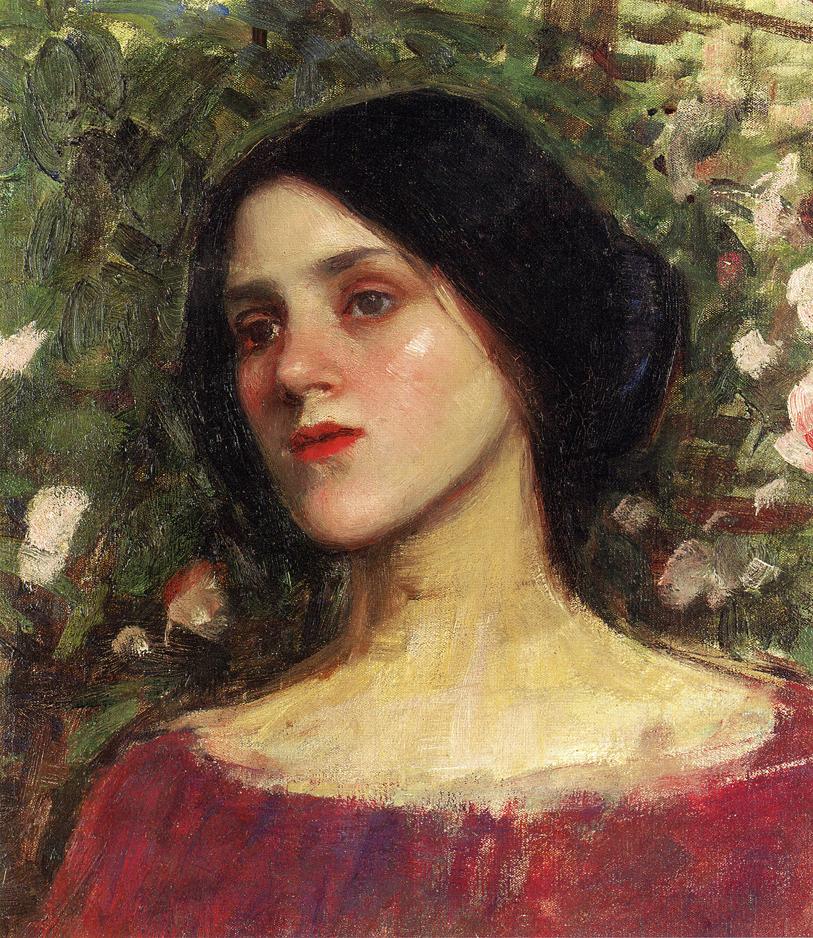
John William Waterhouse’s “The Rose Bower” offers a quiet kind of drama, the sort that happens in a glance held a fraction too long and in a room where nature seems to press up against the human world. Even at first sight, the painting feels like a threshold space. The sitter is close enough to meet us eye to eye, yet her gaze drifts past the viewer, as if listening to something beyond the frame. Around her, foliage and blossoms form a textured veil that reads as both setting and symbol. The effect is intimate, but not confessional. We are invited in, but not fully admitted.
Although the date is unknown, the work belongs comfortably to Waterhouse’s sustained fascination with the poetic portrait, where a single figure can carry the emotional weight of a narrative without overt action. “The Rose Bower” is not a scene of plot, but a mood made visible. Waterhouse turns a simple arrangement, head, shoulders, a suggestion of dress, and a surge of greenery, into an image about contemplation, desire, privacy, and the strange tenderness of being observed.
Waterhouse and the Poetics of the Female Image
Waterhouse is often associated with literary heroines, mythic women, and moments drawn from poetry. Yet even when his subject is not explicitly named, his women often feel like characters paused between chapters. In “The Rose Bower,” the figure seems to carry an inner monologue. She is not performing for an audience within the painting. She is simply present, and that presence becomes the subject.
What makes Waterhouse distinctive is how he balances idealization with specificity. The sitter’s features are softened into a lyrical unity, but the overall impression is not generic. Her parted lips, the slight flush in her cheeks, and the decisive shape of her dark hair give her a personal gravity. Waterhouse’s women are frequently poised between innocence and knowledge, and this painting continues that tension. The figure appears calm, yet there is heat in the color of the lips and in the forward glow of the skin against the cooler greens. The painting suggests a person experiencing feeling rather than demonstrating it.
Composition and the Power of the Close Crop
The composition is built on proximity. Waterhouse crops tightly around the head and shoulders, which creates the sensation that we are standing near the sitter, close enough to notice the sheen of paint on cheekbone and the nuanced shift from light to shadow along the jaw. This closeness does two things at once. It intensifies emotion, because small facial decisions become significant. It also heightens mystery, because the rest of the story is withheld.
The figure’s head is turned slightly, offering a three quarter view that emphasizes the line of the cheek and the arc of the neck. This pose is classical in portraiture, but Waterhouse uses it less to present status and more to present thought. The neck becomes a bridge between the face and the body, and the broad, pale plane of the upper chest acts like a quiet stage for light. The red garment sits low at the shoulders, framing the skin in a way that feels both elegant and deliberately vulnerable. The viewer’s eye is guided from the dark hair to the luminous face, then down the neck into the warm red of the dress, before returning to the surrounding foliage.
Light, Skin, and the Painted Breath of Life
Light in “The Rose Bower” is not theatrical. It behaves like daylight filtered through leaves, settling softly on the face and shoulder. Waterhouse uses light to model form, but also to convey atmosphere. The skin has a damp luster, a highlight at the cheek and the bridge of the nose that makes the sitter feel physically present. The luminosity is not merely “pretty.” It suggests warmth and circulation, the subtle evidence of a living body.
The tonal transitions are especially telling. The face moves from pale illumination to gentle shadow around the eye socket and under the cheekbone. The neck is treated with broad strokes that still capture anatomical truth, especially where the throat meets the collarbone. Waterhouse is attentive to the way light slides across the body, and this sliding light becomes a metaphor for thought itself, something shifting, something that cannot be pinned down.
The eyes are key to the painting’s emotional temperature. They are not wide in surprise or narrowed in suspicion. They are focused, but elsewhere. The slight redness around the eyes and the warm accents in the irises suggest feeling held in reserve. Waterhouse makes the gaze a private event that we witness from the outside.
Color: Red as Pulse, Green as Enclosure
The painting’s color structure is built on a powerful contrast: the deep red of the garment against the dense greens of the background. Red, in Waterhouse, often signals heightened emotion, erotic charge, or the proximity of danger and desire. Here, it reads as a pulse, a concentrated warmth that announces the sitter’s vitality. The lipstick like redness of the lips repeats this note, tying body and clothing into one expressive chord.
Green, by contrast, functions as enclosure. The background is not a neutral studio void. It is alive, textured, and active. The foliage seems to press forward, turning the space into a bower in the literal sense, an arbor of leaves and roses that offers shelter. At the same time, that shelter can feel like confinement. The figure emerges from nature, but also seems held by it. This ambiguity is central to the painting’s mood. The bower can be a sanctuary, a secret garden of the self. It can also be a place where emotion grows wild and unregulated.
Waterhouse’s greens are varied, layered with warm browns, muted yellows, and cool shadows. This variety prevents the background from flattening into pattern. Instead, it becomes a breathing environment, a surround of life that enhances the sitter’s stillness.
Brushwork and Surface: Between Finish and Flicker
One of the pleasures of “The Rose Bower” is the dialogue between refined modeling and visible brushwork. The face is more finished, with careful blending and controlled highlights. The background, by comparison, is built from energetic strokes that suggest leaves and blossoms without describing each one precisely. This difference is not merely technical. It creates a psychological distinction. The sitter feels solid, deliberate, and singular. The bower feels restless, abundant, and slightly unstable.
The painterly texture also carries time within the image. The background marks the speed of painting, the quick decisions that capture a sensation of foliage. The face marks slower attention, the investment in capturing an inner life. Together, these speeds create tension: a calm figure set against a world that seems in motion.
Waterhouse often used this kind of contrast to heighten presence. A face becomes more compelling when the world around it is less fixed. “The Rose Bower” uses the surface of paint to make that idea tangible.
The Rose Bower as Symbolic Space
A bower is not just a location. It is a cultural idea. It suggests secrecy, romance, and the cultivated wilderness of gardens. Roses bring their own long history: beauty entwined with thorns, desire paired with pain, fragrance and decay, bloom and passing. In many artistic traditions, roses mark the thresholds of love, especially love that is both exalted and complicated.
In this painting, the roses and foliage function less as botanical illustration and more as emotional architecture. The sitter is framed by the suggestion of blooms, as if her thoughts are growing around her. The garden becomes an extension of the psyche. This is where Waterhouse’s painting becomes quietly narrative. Something has happened, or is about to happen, but it is not shown. Instead, we see the aftermath in expression and the foreshadowing in symbol.
The red dress echoes the rose, binding the figure to the garden. That harmony can read as belonging, a woman at ease within a natural refuge. It can also read as absorption, a self becoming indistinguishable from the forces that surround it.
Expression and Ambiguity: The Drama of the Unsaid
The sitter’s expression is poised between softness and firmness. The lips are slightly parted, but not in speech. The head tilts with a gentle authority, as if she has decided not to explain herself. This refusal of explicitness is one reason the painting feels modern in its psychology. It does not instruct the viewer what to feel. It offers a state of being.
Waterhouse excels at this kind of ambiguity. He paints women who are neither purely passive nor overtly commanding. They occupy a middle realm where thought is power and silence is a kind of agency. In “The Rose Bower,” the woman is not displayed as an object of narrative action. She is the center of gravity. The painting asks the viewer to slow down and consider her interiority as the true subject.
The slight warmth in the cheeks and the intensity of the lips can suggest desire, but the direction of the gaze complicates that reading. She seems to be looking toward an absent presence, or toward memory. This ambiguity allows the painting to support many interpretations without collapsing into a single story.
Pre Raphaelite Echoes and Waterhouse’s Individual Voice
Waterhouse is often linked to the Pre Raphaelite circle in spirit, even though his career extends beyond the movement’s early period. In “The Rose Bower,” one can sense Pre Raphaelite interests: the emphasis on beauty, the lush natural world, the focus on a female figure as the emotional nucleus. Yet Waterhouse’s approach is not the same as the crisp, jewel like precision associated with some Pre Raphaelite painting. He favors a softer, more atmospheric handling.
Instead of sharply outlined detail, Waterhouse gives us sensation. Leaves are suggested rather than catalogued. The background feels like a lived environment rather than a decorative screen. This makes the sitter’s presence more immediate and less iconic. The result is a portrait that feels like it exists in real air, in real light.
The painting thus bridges two impulses: the romantic ideal and the modern psychological portrait. The sitter is beautiful in a stylized way, yet she also feels like a person with private thoughts. That blend is a hallmark of Waterhouse’s mature work.
The Relationship Between Viewer and Subject
Because the painting is so intimate in scale and crop, it creates a charged relationship between viewer and subject. We stand close, but we are not met directly. The sitter’s gaze is angled away, which subtly reverses power. We can look, but we cannot fully claim her attention. The painting grants access to her image while maintaining her autonomy.
This dynamic is part of the work’s emotional sophistication. Many portraits ask the subject to confront the viewer, establishing a social contract. Here, the contract is broken. The sitter looks beyond us, and that beyond becomes the painting’s most intriguing element. It suggests that the true focus is elsewhere, and we are positioned as witnesses rather than participants.
The sense of witnessing aligns with the bower motif. A bower is a place where one might hide, think, or wait. We are allowed to see into that private space, but only partially. The result is a painting that feels both inviting and guarded, a balance that keeps attention alive.
Timelessness and the Appeal of the Image Today
Part of why “The Rose Bower” remains compelling is its refusal to settle into a single era. The hairstyle and romantic setting evoke a generalized past, but the psychological restraint feels contemporary. The painting captures a recognizable human state: being lost in thought while still aware of being seen.
The work also resonates because it offers beauty without complacency. The sitter is not smiling. The garden is not simply decorative. There is sweetness, but also tension. The colors seduce, but the expression questions. That combination creates depth, and depth is what keeps an image from becoming merely pretty.
Waterhouse’s ability to merge sensual surface with inwardness gives the painting lasting power. The viewer returns not only for the lushness of greens and reds, but for the unanswered question in the eyes.
Conclusion: A Portrait as an Enchanted Interior
“The Rose Bower” can be read as a portrait, a mood piece, and a symbolic vignette all at once. Waterhouse uses close composition, luminous skin, and a richly textured garden setting to create an image where the outer world and inner feeling intertwine. The figure’s calm becomes dramatic because it is surrounded by abundance, and because her gaze points to a narrative we cannot see.
The painting’s enchantment lies in its restraint. It does not dramatize action. It dramatizes being. Within the bower of roses and leaves, Waterhouse places a woman who feels both timeless and intensely present, a human center in a living frame. The result is a work that lingers, not because it shouts meaning, but because it holds meaning quietly, like perfume in shaded air.