Image source: wikiart.org
Introduction
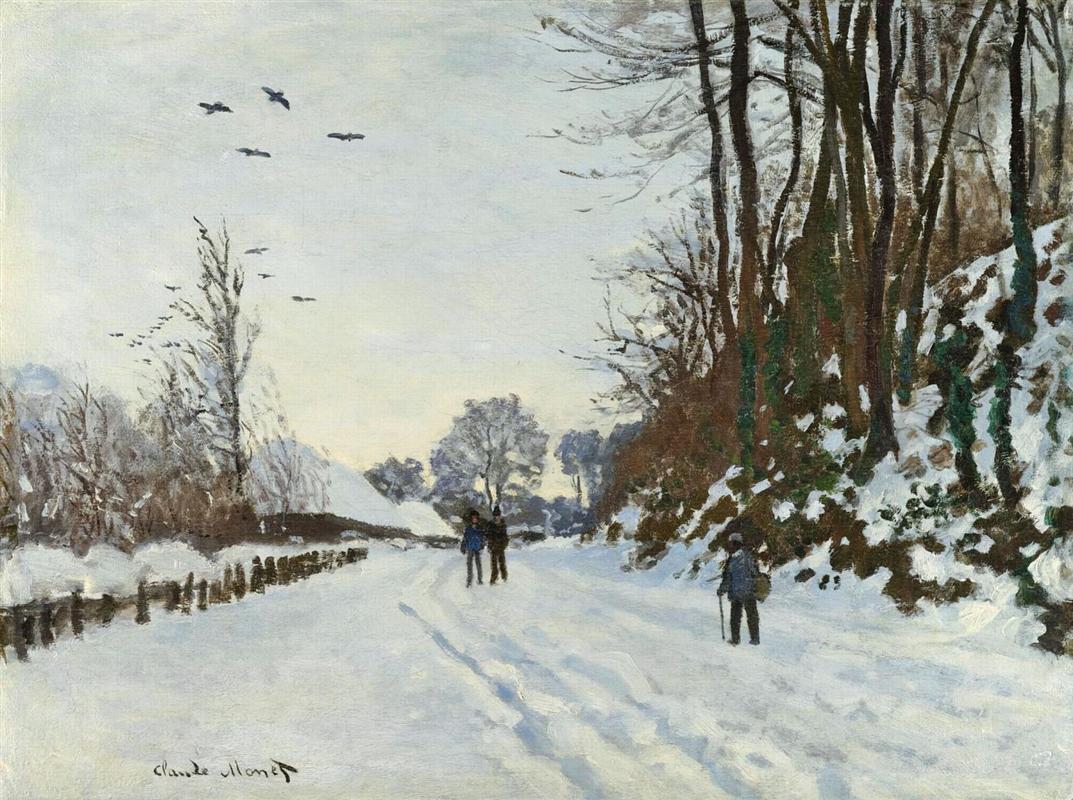
Claude Monet’s The Road to the Farm of Saint-Simeon in Winter from 1867 is a painting of remarkable restraint. At first glance, it seems almost simple. A snowy road stretches forward, a few figures move through the cold, bare trees rise at the right, and birds pass across a pale sky. Yet this apparent simplicity is exactly what gives the picture its force. Monet transforms an ordinary rural scene into a deeply felt study of season, atmosphere, and visual experience. The painting does not depend on drama, grand narrative, or elaborate symbolism. Instead, it draws its power from weather, light, space, and the quiet poetry of everyday life.
This work belongs to an important moment in Monet’s development. In the 1860s, he was still a young painter, but he was already turning decisively toward the qualities that would shape his mature art. He was less interested in polished academic finish than in the immediate sensation of a place. He wanted to paint what the eye actually encounters in nature: shifting light, subtle color changes, and the living character of air and season. In this winter landscape, that goal becomes especially clear. Snow is not treated as flat white covering. It becomes a surface of reflection, shadow, texture, and movement. The road is not merely a path. It becomes a device for organizing vision and carrying the viewer into the scene. The figures are not portraits. They are measures of scale and presences within climate.
What makes this painting memorable is the way Monet allows winter to speak in its own visual language. He does not overstate the cold. He does not fill the scene with picturesque anecdote. He lets the stillness, the muted colors, and the delicate tonal shifts create the mood. The result is a landscape that feels calm but never empty, natural but carefully constructed, direct but artistically sophisticated. It shows Monet discovering how much emotional and pictorial richness can exist in an ordinary road under snow.
The Setting and the Meaning of Place
The title points to a specific place, the road leading to the farm of Saint-Simeon. That specificity matters. Monet often worked from places he knew intimately, and this gives the painting a rootedness that separates it from the generalized landscapes favored in much earlier art. This is not an invented winter scene assembled from studio conventions. It is tied to a real environment, observed with attentiveness and familiarity. The title anchors the painting in the lived world, giving the viewer the sense that this was a place one could walk, a road one could travel, a winter day one could actually experience.
That sense of place is central to the painting’s effect. The road appears used and known rather than romanticized. The figures suggest routine movement through the countryside. The trees and embankment at the right are not decorative additions but essential features of the local terrain. Even the fence line at the left contributes to the sense of a working landscape. Everything implies rural life continuing through winter, not in spectacular hardship, but in quiet persistence.
There is also a subtle tension between openness and shelter in the composition. The left side opens outward into distance, sky, and low vegetation, while the right side rises more densely with trees and snow-covered ground. This creates a feeling of passage between exposed and enclosed space. The road becomes a corridor through the winter landscape, bordered by natural forms that shape the traveler’s experience. Monet does not dramatize the setting, but he makes it spatially and psychologically convincing.
The title’s reference to the farm also invites the viewer to think about destination. This is not merely a road in winter. It is a road leading somewhere. That gives the painting a quiet narrative structure. The viewer senses movement, however slow and subdued. The scene is not frozen into stillness. It is about travel through weather, about human presence within the season, and about the relationship between landscape and daily life.
Composition and Spatial Design
One of the most successful features of the painting is its compositional clarity. Monet builds the image around the broad white road that advances diagonally into the distance. This road functions as the central organizing element, guiding the eye inward while also distributing the visual weight of the composition. Because the snow-covered road occupies so much of the foreground, the viewer is immediately placed within the physical space of the painting. We do not simply look at the landscape from afar. We seem to stand on the road ourselves.
The right side of the composition is dominated by a stand of tall bare trees and a rising bank of snow and earth. These vertical forms create a structural counterweight to the open sweep of the road. They also frame the scene and establish a sense of depth through overlap and recession. The dark trunks, rising against the pale sky, provide a graphic firmness that keeps the painting from dissolving into soft atmosphere. Monet understands that winter light needs strong accents to remain visually alive. The trees fulfill that role without appearing heavy or artificial.
On the left, the lower fence line and sparse vegetation extend into space with great subtlety. These elements pull the eye toward the middle distance and reinforce the road’s recession. The distant tree forms near the center serve as a soft endpoint for the perspective, gently closing the space without fully sealing it. Beyond them, the light sky remains open, allowing the painting to breathe.
The placement of the figures is especially intelligent. A solitary figure stands closer to the right foreground, while two smaller figures appear farther back near the center. This distribution activates the road and gives the viewer several spatial markers. The figures help measure distance, but they also create a rhythm of human presence. They prevent the landscape from feeling deserted while preserving its quiet mood. Their small scale compared to the broad road and tall trees also reminds us of the modest place of the human body within nature.
The birds overhead contribute to the composition in a subtle but important way. They animate the upper part of the image and balance the grounded movement of the walkers below. Their scattered formation across the sky extends the sense of distance and suggests that the winter scene is not static but alive with passing motion.
Light, Snow, and the Complexity of White
Monet’s treatment of snow is the heart of this painting. Snow might appear to be the simplest thing in art, but it is in fact one of the hardest surfaces to paint convincingly. It changes constantly with light, weather, temperature, and the colors around it. In The Road to the Farm of Saint-Simeon in Winter, Monet shows an early mastery of this complexity. The snow is never merely white. It carries subtle blues, grays, creams, and faint violet tones that give it volume and atmosphere.
The road’s surface is shaped by delicate variations in shadow and reflected light. Tracks or compressed areas in the snow create directional markings that lead into depth. These traces also make the snow feel physical rather than decorative. It has weight, texture, and recent history. Someone has passed through it. The viewer senses the difference between packed snow and softer surrounding surfaces.
Monet is especially attentive to the way snow receives color from sky and environment. Cool tones appear in the shadows, while warmer notes emerge where the pale light touches the surface more directly. This interplay creates a luminous but subdued palette that feels true to a winter day. The brightness of the ground never becomes glaring because it is continually moderated by gray atmosphere and soft tonal transitions.
What is striking is the balance between immediacy and control. Monet wants the viewer to feel the freshness of direct observation, yet the painting is also carefully organized so that the many whites and near-whites remain distinct. The road, the banks, and the snowy patches among the trees each have slightly different tonal identities. This keeps the image visually rich and prevents monotony.
The painting also demonstrates Monet’s growing awareness that shadows are colored, not simply dark. The bluish and grayish passages in the snow help establish both form and time of day. They suggest weak winter sunlight filtered through cold air. In this sense, snow becomes a vehicle for studying the atmosphere itself. By painting snow well, Monet paints light well.
Color and Tonal Harmony
Although the painting seems almost monochromatic at first, its color relationships are delicate and sophisticated. Monet works with a restrained range, but within that range he creates extraordinary nuance. The dominant field of whites and pale grays is enriched by cool blue shadows, brown earth, dark trunks, and touches of muted blue in the clothing of the figures. These small contrasts matter enormously. They keep the painting from feeling bleached or empty.
The sky is a particularly important tonal element. It is pale, but not blank. Monet gives it a faint warmth near the horizon and cooler notes above, creating a gentle atmospheric gradient. This soft transition helps the landscape feel enveloped in winter air. The horizon does not cut sharply across the composition. Instead, it melts into the distance, allowing the forms of trees and snow to emerge gradually.
The brown and dark green accents on the right side are also essential. They bring visual density to the composition and remind the viewer that winter does not erase the underlying structure of the land. Snow partially covers the bank, but earth and vegetation still show through. This prevents the scene from becoming too abstractly decorative. Monet keeps the material reality of the place before us.
The figures introduce discreet chromatic emphasis. Their darker coats and hints of blue create focal points within the field of snow. These touches of stronger color do not dominate, but they help animate the picture and guide the eye. Monet uses them economically, which makes them more effective.
Overall, the painting’s color harmony is built on moderation. There are no loud contrasts, no theatrical sunsets, no sensational effects. Instead, Monet allows slight temperature shifts and tonal relationships to carry the visual experience. This restraint is part of the work’s beauty. It asks the viewer to slow down and notice small differences, much as one must do when looking at a snowy landscape in real life.
Brushwork and Surface
Monet’s brushwork in this painting reveals a young artist moving toward the freer handling that would later define Impressionism. The surface is not polished in the academic sense. Brushstrokes remain visible, especially in the snow, trees, and distant vegetation. Yet the painting is not rough for its own sake. The brushwork is responsive to the forms and conditions being represented.
In the road and snowy ground, Monet uses strokes that suggest both smoothness and disturbance. Some passages appear softly blended, while others retain more tactile directionality. This variation is important because snow itself is never visually uniform. It can look soft, crusted, trampled, reflective, or powdery depending on light and use. Monet’s handling captures that changing character without overdescribing it.
The trees at the right are painted with darker, more linear strokes that establish structure and rhythm. Their trunks and branches rise with a kind of calligraphic energy against the pale sky. These marks are not merely outlines. They are expressive elements that give the painting vertical tension and graphic definition.
In the distant forms, the brushwork becomes softer and more abbreviated. This creates atmospheric recession and helps the eye accept the depth of the scene. Monet does not insist on detail where detail would flatten the image. He knows when to let forms dissolve slightly into the surrounding air.
This sensitivity to surface is part of what makes the painting feel alive. The viewer can sense Monet responding directly to visual conditions rather than filling in forms according to formula. The painting records perception in action. It is not unfinished, but it does preserve the freshness of looking.
Human Presence and the Quiet Narrative of Winter
The figures in the painting are small, but they are far from incidental. They provide a human dimension that deepens the emotional character of the scene. Winter landscapes can easily become studies in emptiness, but Monet avoids that by including people moving along the road. Their presence makes the painting feel inhabited, and their smallness makes the season feel larger.
The solitary figure at the right foreground is especially effective. Slightly separated from the others, this person introduces a sense of individual experience within the landscape. The figure seems to pause or move slowly, perhaps negotiating the snow or simply continuing along the road in silence. The two figures in the middle distance suggest companionship and shared passage. Together, these human presences create a subtle narrative of travel without turning the painting into genre storytelling.
What matters most is that the figures are absorbed into the environment rather than dominating it. Monet does not ask us to read their faces or identities. They are participants in weather and space. Their dark forms against the snow make them visible, but their scale keeps the emphasis on the landscape itself. This is characteristic of Monet’s priorities. Human life exists within nature, not above it.
The painting therefore carries a quiet emotional tension. It is not lonely in an extreme sense, but it is undeniably solitary. The wide road, muted light, and cool air create a feeling of hush. The figures confirm that life continues, yet they do not dispel the stillness. Instead, they make it more poignant. Winter here is not empty death, but slowed existence.
An Early Monet and the Path Toward Impressionism
Seen within Monet’s development, this painting is deeply revealing. It shows him before the fully mature style of his later serial landscapes, yet many essential concerns are already in place. He is interested in transient conditions, outdoor observation, and the way atmosphere transforms the appearance of familiar forms. He does not paint landscape as a backdrop for historical or literary subjects. Landscape itself is the subject.
This is a crucial shift in nineteenth century art, and Monet was one of its great agents. In paintings like this one, he was learning how to trust direct visual sensation. Snow, sky, bare trees, and a road become enough. There is no need for mythological elevation or moralizing symbolism. The ordinary world, seen attentively, possesses its own richness.
At the same time, the painting still retains a certain structural solidity associated with Monet’s earlier years. The composition is carefully balanced, and the forms remain legible and stable. Later works would sometimes dissolve more radically into color and light. Here, one can still see the young artist negotiating between established pictorial structure and the new freedom of plein air perception. That tension gives the painting much of its interest.
The winter subject also offered Monet a natural laboratory for studying light. Snow simplifies certain aspects of landscape by covering surfaces, but it complicates others by intensifying reflection and tonal variation. For a painter committed to observation, winter was not a limitation but an opportunity. In this picture, Monet demonstrates how even a muted day can yield extraordinary visual subtlety.
Mood, Silence, and Emotional Resonance
The emotional power of The Road to the Farm of Saint-Simeon in Winter lies in its quietness. This is not a painting that tries to overwhelm the viewer. It invites a slower response. The more one looks, the more one feels its calm, its coldness, and its delicate sense of suspended time.
Part of this mood comes from the absence of excess. Monet avoids picturesque sentimentality. He does not crowd the scene with rustic anecdote, dramatic weather, or exaggerated hardship. The winter landscape remains plain, which is precisely why it feels convincing. Its beauty is inseparable from its modesty.
There is also a sense of temporal pause in the painting. The season has reduced the world to essentials. Trees stand bare. Color is muted. Movement is limited. Sound seems hushed by snow. Yet the scene is not lifeless. Birds cross the sky, people continue along the road, light rests on the ground. Life persists in a quieter register. Monet captures that condition with deep sensitivity.
For modern viewers, the painting can feel meditative. It offers an image of winter that is neither hostile nor sentimental, but contemplative. The road suggests continuity, the figures suggest endurance, and the pale sky suggests openness beyond immediate cold. It is a painting about being present in a season, not escaping it.
Conclusion
The Road to the Farm of Saint-Simeon in Winter is one of those Monet paintings that reveals its strength gradually. It does not rely on spectacle, but on attentiveness. Through a snowy road, a few figures, a stand of bare trees, and a pale winter sky, Monet creates a landscape of great visual intelligence and emotional subtlety. The composition is balanced but natural, the palette restrained but rich, and the brushwork fresh without losing coherence.
Most importantly, the painting shows Monet’s gift for discovering beauty in ordinary conditions. Winter here is not an excuse for theatrical effect. It is a real atmosphere, a real place, and a real experience of light on snow. The work stands as an early but powerful statement of Monet’s belief that modern painting could emerge from direct contact with the visible world.
In this quiet road leading toward Saint-Simeon, Monet finds far more than a rural motif. He finds a language of stillness, climate, and perception. He turns a simple winter passage into a lasting meditation on landscape itself.
