Image source: wikiart.org
Claude Monet and an Early Landscape Vision
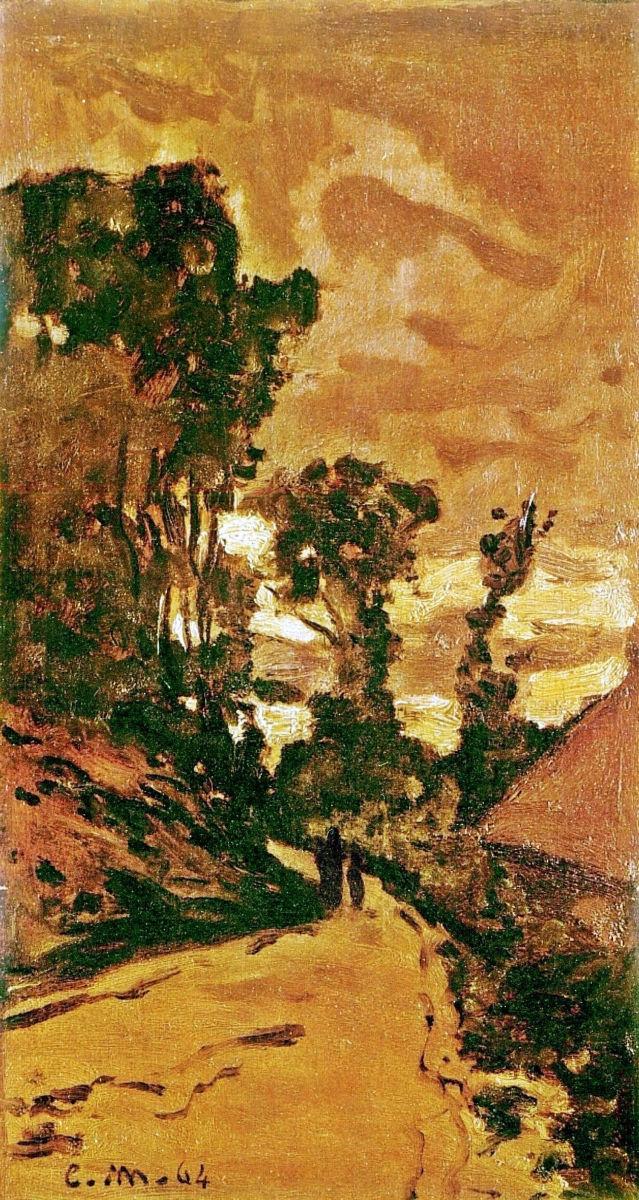
Claude Monet’s The Road to the Farm of Saint-Simeon from 1864 is a small but deeply revealing work from the early years of his career. At first glance, the painting may seem modest. It does not offer the dazzling color harmonies or broken light effects that many viewers immediately associate with Monet’s mature Impressionist paintings. Instead, it presents a rough path, dark trees, a low rise in the land, and a broad sky washed in warm gold and brown tones. Yet this apparent simplicity is exactly what makes the painting so compelling. It captures a moment when Monet was still forming his artistic language, testing how atmosphere, place, and perception could be translated into paint.
The painting has the directness of something quickly seen and quickly felt. It does not feel overworked or carefully staged. The scene appears to rise naturally out of the artist’s contact with the landscape. That sense of immediacy matters because it points toward the qualities that would later define Monet’s greatest work. Even here, before Impressionism was fully articulated, Monet is already less interested in topographical detail than in the emotional and visual truth of a fleeting outdoor experience.
The subject also matters. The Farm of Saint-Simeon near Honfleur was an important location for artists in the mid nineteenth century. Situated in Normandy, it became associated with painters interested in open air work and changing natural effects. For Monet, places like this were not merely picturesque stops. They were laboratories of vision. In The Road to the Farm of Saint-Simeon, the road is more than a route through the countryside. It becomes a compositional guide, a mood-bearing element, and a metaphor for artistic transition. The painting itself seems to stand on a threshold between tradition and innovation, between structure and sensation, between representation and atmosphere.
The Setting of Saint-Simeon
The title grounds the work in a specific place, and that specificity is important. Saint-Simeon was not an invented pastoral retreat. It was a real location tied to the artistic life of Normandy. Monet’s choice to paint the road leading to the farm suggests an interest not only in the destination but in the approach, in the experience of arrival. Roads in landscape painting often function symbolically, leading the eye inward and inviting the viewer into the scene. Here, the road feels slightly uneven and organic, as though shaped by repeated use and weather rather than formal design.
The setting is rural, but not idyllic in a polished or decorative sense. There is no attempt to smooth out the land or idealize the vegetation. The path is irregular. The trees appear rugged and asymmetrical. The forms are partially dissolved into the warm light of the atmosphere. This gives the painting a sense of lived reality. It feels like a place encountered in passing, perhaps during a walk uphill, when the eye catches the way trees, sky, and earth momentarily lock into a memorable arrangement.
That sense of locality is one of the strengths of the painting. Monet does not treat the countryside as a theatrical backdrop. He presents it as a place with weight, weather, and texture. Even the faint suggestion of architecture at the right edge, which may indicate a roof or sloping structure, contributes to this grounded feeling. Human presence is not dominant, but it is implied. The land has been traversed, inhabited, and observed. The result is a landscape that feels real without becoming descriptive in a dry or literal way.
Composition and the Viewer’s Movement Through the Scene
One of the most effective aspects of The Road to the Farm of Saint-Simeon is its composition. Monet organizes the picture around a path that enters from the lower foreground and rises into the middle distance. This road acts as a visual invitation. It draws the viewer inward, but it does not do so in a perfectly straight or orderly manner. Instead, the route bends and softens as it moves through the scene, echoing the irregularity of natural perception.
To the left, a cluster of tall, dark trees anchors the composition. These vertical forms give the painting weight and structure. They counterbalance the open sky and help establish a strong contrast between solidity and atmosphere. The trees are not finely outlined. Their edges blur into the light and surrounding foliage, making them feel alive rather than fixed. Beneath them, darker passages suggest brush, trunks, and shadow, but Monet never overdefines these elements. He allows them to remain somewhat ambiguous.
The middle of the composition opens outward, with smaller trees and patches of brightness creating depth. The eye is pulled between the road and the lighter horizon, where glowing passages of paint suggest distant light filtering through or beyond the vegetation. The right side introduces a slanted shape that helps frame the scene while also subtly disrupting it. That angled form prevents the composition from feeling too symmetrical or predictable.
What makes the composition especially interesting is its balance between construction and spontaneity. The picture is clearly organized, yet it does not feel rigid. Monet knows where the major masses belong, but he allows the painting to retain the freshness of a direct encounter. The viewer is guided, but not controlled. This freedom is central to the work’s charm.
Color and the Dominance of Warm Earth Tones
The color scheme of the painting is striking because it differs from the cooler, brighter palette many people associate with Monet’s later landscapes. Here, warm ochres, tawny browns, muted greens, and golden creams dominate the surface. The sky itself is infused with amber and honey-like tones, giving the entire scene a unified warmth. Rather than separating earth from sky through strong color contrast, Monet binds them together within a closely related tonal range.
This creates a mood of late afternoon or perhaps evening light, though the exact time is less important than the sensation of warmth spreading across the view. The road in the foreground glows with a sandy yellow, almost as if it has absorbed the light above. The sky, though broad and luminous, is not blue in any conventional sense. It feels suspended between weather and light, between cloud cover and illumination.
The dark greens and near-black passages of the trees become even more dramatic against this warm field. Monet uses contrast sparingly but effectively. He does not rely on sharp local color. Instead, he creates emotional intensity through tonal relationships. The dark masses seem to push forward, while the luminous areas recede and expand. The painting’s atmosphere comes not from many distinct colors but from the vibration within a limited palette.
This earthy coloration also aligns the painting with older landscape traditions, where browns and golds often conveyed depth, seriousness, and natural richness. At the same time, Monet’s handling of those tones is more fluid and responsive than academic convention would usually allow. He is not simply copying established formulas. He is using a relatively restrained palette to explore how light transforms everything it touches.
Brushwork and the Energy of Observation
The brushwork in The Road to the Farm of Saint-Simeon is one of its most revealing features. The painting does not hide the act of its making. Strokes remain visible across the surface, sometimes thin and sketch-like, sometimes thicker and more loaded. Trees are built from clustered marks rather than carefully modeled leaf forms. The road is laid out with broad, confident sweeps. The sky is brushed in with loose, cloudy motions that preserve a sense of movement.
This visible handling gives the work an immediacy that feels modern. Monet is not polishing away the traces of labor in order to create an illusion of seamless reality. He allows the paint itself to speak. In some passages, the image seems on the verge of abstraction, especially where foliage or clouds are suggested through loosely connected marks. Yet the scene never collapses into disorder. The brushwork remains responsive to what is being observed.
That tension between description and freedom is essential. Monet does not define every branch or contour because he seems more interested in how the eye experiences the whole than in how the mind categorizes individual parts. The painting records sensation as much as object. It gives us the feel of looking through shifting light, where some elements are grasped clearly and others are only partially caught.
This method also gives the picture rhythm. The marks are not static. They move across the surface in ways that echo wind, uneven ground, and changing light. Even the darker areas are alive with variation. The painting breathes because the brushwork never becomes mechanical.
Atmosphere and the Presence of Light
Although this is an early work, Monet’s fascination with atmosphere is already unmistakable. The scene is not merely arranged in space. It is immersed in air. Light does not simply fall on objects from outside. It circulates through the composition, altering the visibility of forms and softening their boundaries. Trees, sky, road, and distant vegetation are linked by the same atmospheric presence.
The warm sky is especially important in establishing this effect. Rather than serving as a neutral backdrop, it becomes an active participant in the scene. Broad passages of luminous paint suggest a sky filled with moisture, haze, or filtered sun. This light spills downward into the road and middle distance, creating moments where the land seems to glow from within. The result is not a sharp, crisp landscape but a suspended one, shaped by transient conditions.
This sensitivity to atmosphere would become central to Monet’s mature art. In later works, he would devote entire series to the changing appearances of a single motif under different conditions. Here, that impulse is still emerging, but it is already clear. The painting is not about the road in an abstract sense. It is about the road as it appears under a specific and passing veil of light.
That is why the work feels so intimate. It does not claim permanence. Instead, it preserves an encounter. The viewer senses that the whole scene might look different an hour later, in rain, or under cooler skies. Monet paints not just a place, but a momentary state of that place.
Nature Without Idealization
A major strength of this painting is its refusal to romanticize the landscape too heavily. The trees are not elegant ornaments. The road is not prettified. The scene does not present nature as an untouched paradise. Instead, Monet shows a rural environment shaped by weather, use, and irregular growth. This honesty gives the painting credibility.
Even though the image is beautiful, its beauty comes from authenticity rather than decoration. The trees lean and cluster in ways that feel natural. The path cuts through the land without becoming a formal avenue. The vegetation is dense in some areas and sparse in others. Nothing feels arranged solely for visual sweetness. This grounded realism helps explain why the painting still feels fresh.
At the same time, Monet is not producing a documentary record. He transforms the landscape through composition, tone, and painterly emphasis. What we see is nature interpreted through temperament. The warmth of the palette intensifies the mood. The looseness of the brushwork heightens immediacy. The glowing light turns a simple road into a place of quiet drama. So while the painting avoids sentimental idealization, it does not deny poetry. It finds poetry inside ordinary experience.
That balance between realism and feeling is one of Monet’s great gifts. He shows that a humble road bordered by trees can carry emotional resonance without needing narrative incident or grand symbolism. The land itself is enough.
The Painting as an Early Step Toward Impressionism
Viewed historically, The Road to the Farm of Saint-Simeon is fascinating because it reveals Monet in transition. The painting still retains elements connected to earlier landscape traditions, especially in its earthy palette and strong tonal masses. Yet it also points clearly toward the direction he would help define later in the decade and beyond.
The most forward-looking aspect is the priority given to sensation. Monet is not merely arranging a balanced landscape in the studio according to inherited formulas. He is trying to capture what the scene feels like under particular conditions. The visible brushwork, atmospheric emphasis, and partial dissolution of form all suggest an artist turning away from finish and toward perception.
There is also a freshness in the painting that seems tied to outdoor work. Even if some finishing touches may have been added later, the image carries the vitality of direct observation. That immediacy would become one of the hallmarks of Impressionism. Monet’s later achievements did not emerge suddenly. They were built through works like this one, where he tested how much a painting could depend on light, tone, and abbreviated form without losing coherence.
In that sense, this painting is valuable not only as an individual image but as evidence of artistic development. It shows Monet refining the instincts that would later transform modern painting. The work stands at the beginning of a journey, and that early position gives it special energy. It is searching, exploratory, and alive.
Emotional Tone and the Quiet Drama of the Scene
The emotional power of the painting lies in its restraint. There is no dramatic weather event, no striking human narrative, and no theatrical effect imposed on the land. Yet the scene has unmistakable mood. The dark trees rising against the glowing sky create a tension between shelter and openness, shadow and illumination. The road seems both inviting and slightly solitary. It suggests movement, but also pause.
This ambiguity is part of what makes the image memorable. The painting feels calm, but not empty. It feels warm, but not carefree. There is a quiet seriousness in the way the forms gather and in the way the sky presses down over them. If there are tiny figures on the road, they are so small that they deepen rather than interrupt the solitude of the landscape. Human life is present only as a fleeting note within a much larger natural order.
The emotional tone may also come from the way Monet compresses details and lets the broader masses dominate. We are not distracted by anecdotal incident. Instead, we are asked to experience the overall condition of the place. The result is contemplative. The viewer lingers not because there is a story to decode, but because the painting creates a sustained state of attention.
That quality of meditative stillness is easy to overlook in discussions of Monet, which often focus on brilliance and light. But works like this remind us that he could also create moods of depth, quiet, and inwardness. The road becomes not only a physical path but a space for reflection.
Why the Painting Still Matters
The Road to the Farm of Saint-Simeon remains important because it reveals how much can be achieved with modest means. Monet does not rely on spectacle here. He uses a limited palette, a simple subject, and relatively loose forms. Yet from those elements he creates a painting rich in atmosphere, structure, and feeling. The work shows that greatness in landscape art does not depend on grand scenery. It depends on the intensity of seeing.
The painting also matters because it broadens our understanding of Monet. It reminds us that he was not born fully formed as the painter of water lilies, haystacks, and radiant gardens. He developed through close engagement with the land, through experimentation, and through early works that still carry traces of older traditions while pushing toward something new. This painting captures that formative stage with unusual clarity.
For contemporary viewers, the work offers another kind of lesson as well. It demonstrates how ordinary places can become visually profound when attended to with patience and sensitivity. A road, some trees, a rise in the earth, and a warm sky are enough. Monet finds beauty not by embellishing reality but by noticing how light and atmosphere already transform it.
In the end, The Road to the Farm of Saint-Simeon is a painting about approach. It depicts a road leading somewhere, but it also records an artist approaching his own future. The picture stands at an early moment in Monet’s career, when the language of Impressionism had not yet fully emerged but its foundations were already being laid. That makes the work historically significant, but it also makes it deeply human. We are witnessing a painter learning how to trust his eye, how to let paint remain alive on the surface, and how to turn a passing landscape into an enduring image.
Final Thoughts
There is something deeply satisfying about the modesty of this painting. It does not announce itself loudly. It invites slow looking. The more time one spends with it, the more its strengths become apparent: the subtle organization of space, the warmth of the palette, the vigor of the brushwork, and the atmospheric unity that binds everything together. It is an early Monet, but it is already unmistakably the work of a painter who understood that nature is never static and that painting must respond to that living instability.
The road in the foreground remains the painting’s central metaphor and visual anchor. It leads us forward, but not in a straight line. It asks us to move through shadow toward light, through density toward openness. That movement mirrors the painting’s place in Monet’s development and perhaps even the act of viewing itself. We begin with a rough impression, then discover depth, variation, and coherence.
What makes The Road to the Farm of Saint-Simeon enduring is precisely this combination of immediacy and reflection. It captures a fleeting visual encounter, yet it continues to reward prolonged attention. It is rooted in a real place, yet it exceeds geography through mood and painterly intelligence. Above all, it shows Monet already committed to one of the great artistic ideas of modern painting: that the truth of a landscape lies not only in what is there, but in how it is seen.
