Image source: wikiart.org
Introduction
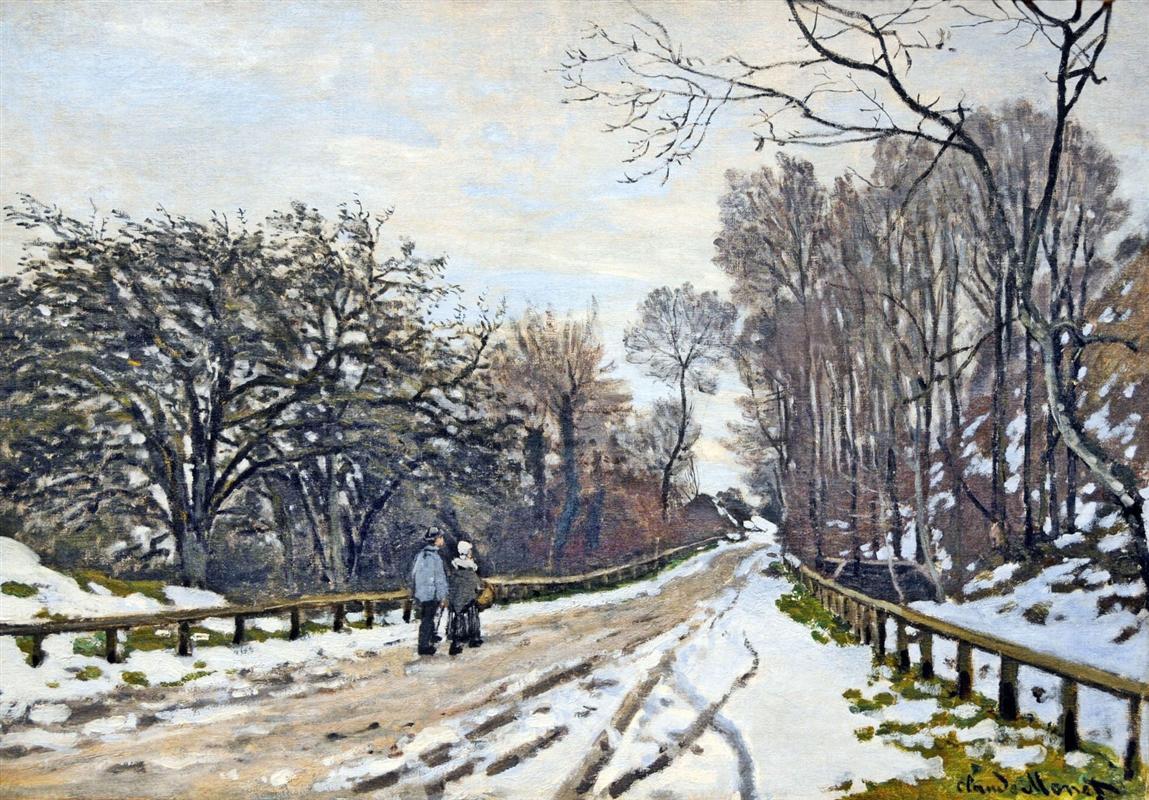
Claude Monet’s The Road to the Farm of Saint-Simeon from 1867 is a painting that reveals how much emotional force can be drawn from an apparently simple rural scene. At first glance, the subject seems modest. A road stretches into the distance. Snow lies in broken patches on the ground. Bare trees rise against a pale sky. Two small figures walk quietly along the path. Nothing dramatic happens, and yet the painting holds attention with remarkable power. Monet turns an ordinary winter road into a living atmosphere, a study of light, season, movement, and mood.
This work belongs to an important period in Monet’s early development, when he was refining the visual language that would later make him one of the central figures of Impressionism. In paintings like this one, he was already moving away from polished academic finish and toward a more direct, immediate response to nature. He was not simply recording a location. He was studying how a place feels at a specific moment, under a specific sky, in a specific season. That sensitivity to fleeting conditions is one of the reasons this painting remains so compelling.
The setting of Saint-Simeon also matters. The Farm of Saint-Simeon, near Honfleur in Normandy, was closely associated with artists in the mid nineteenth century. The area offered access to changing weather, coastal light, rural roads, orchards, and open horizons. For Monet, it provided both a real location and an artistic laboratory. In this painting, the road becomes more than a pathway through the countryside. It becomes a visual route into Monet’s emerging vision.
The Setting and Its Importance
The subject of the painting is rooted in the Normandy landscape, a region that played a major role in the development of modern French painting. Normandy offered changing skies, damp air, maritime light, and a mixture of agricultural and wooded terrain. These qualities made it especially appealing to painters who wanted to work directly from nature rather than construct idealized landscapes in the studio.
The road to the Farm of Saint-Simeon is not presented as a grand avenue or a romantic wilderness. It is a practical rural road bordered by wooden rails, flanked by winter trees, and partially covered with snow and slush. That ordinariness is essential to the painting’s achievement. Monet was interested in finding beauty not only in spectacular scenery but also in the everyday environment. This attention to the commonplace anticipates a major shift in modern art. Instead of elevating noble historical themes above all else, artists like Monet increasingly treated the visible world itself as worthy of close and loving attention.
The farm, though not prominently featured in the foreground, gives the road a destination. The title suggests a place toward which the viewer moves, even if the eye never fully arrives there. This gives the composition a sense of quiet narrative. The road leads both the walkers and the viewer into depth. It promises habitation, work, shelter, and continuity beyond the visible scene. That understated sense of human presence makes the landscape feel lived in rather than merely observed.
Composition and the Structure of the Scene
One of the most striking features of the painting is the way Monet organizes space through the road itself. The road begins broad in the foreground and narrows as it recedes, pulling the eye into the distance. This recession creates both depth and motion. The viewer is not meant to remain on the surface of the canvas. The composition invites entry.
The wooden fences on either side reinforce this movement. They act almost like guiding lines, subtly converging toward the center of the picture. The fences are irregular and humble, but compositionally they are highly effective. They help define the road while also framing the passage through the landscape. Their low horizontal rhythm contrasts with the vertical trunks of the trees, producing a stable but dynamic structure.
Monet balances the left and right sides of the painting with care. On the left, the trees are fuller and denser, with spreading branches that create a heavier visual mass. On the right, the trees are taller, thinner, and more upright, producing a somewhat more open yet still enclosing wall of woodland. This asymmetry keeps the composition from becoming mechanical. The scene feels natural because the balance is achieved through variation rather than exact symmetry.
The two figures near the center-left are small but crucial. Without them, the painting would still be beautiful, but it would feel more remote. Their presence gives the road scale and intimacy. They seem almost absorbed by the winter air, moving steadily forward without theatrical gesture. They are not portraits in any detailed sense. Instead, they function as signs of daily life and as a means of measuring the vastness of the surrounding environment. Their smallness makes the landscape feel larger, while their companionship adds a human warmth to the cold season.
Winter as Atmosphere Rather Than Spectacle
Many winter paintings depend on the visual brilliance of fresh snow, bright sunlight, or dramatic weather. Monet takes a subtler path here. The snow is not a dazzling blanket of white. It is patchy, disturbed, mixed with mud, and already shaped by traffic and thaw. This gives the scene a realism that feels immediate and unforced. Winter is shown not as decorative perfection but as lived weather.
This choice is important because it reflects Monet’s interest in transient conditions. The road is not frozen into stillness. It is wet, rutted, and unstable. Tracks cut through the snow, suggesting recent passage by carts or walkers. The season is therefore not represented as an abstract idea of winter, but as a very particular winter day. The ground records time and use. Snow has fallen, begun to soften, and been marked by movement. Nature and human activity are intertwined.
The sky adds to this atmospheric subtlety. It is pale and cool, with soft shifts of gray, white, and faint blue. There is no harsh contrast, no storm, and no dramatic sunset. Instead, the sky contributes to the painting’s quietness. It diffuses light gently across the scene, creating a muted harmony that suits the season. Monet shows how a restrained sky can be every bit as expressive as a spectacular one.
What makes the winter atmosphere so convincing is the absence of exaggeration. Monet understands that cold weather can transform a landscape through tone, texture, and silence rather than through visual drama alone. The result is a painting that feels deeply observed and emotionally credible.
Color and Tonal Harmony
The color palette of The Road to the Farm of Saint-Simeon is restrained, but it is far from dull. Monet works with a range of cool whites, grays, browns, muted greens, and soft blues, allowing delicate shifts in tone to carry the painting’s expressive force. This restraint is one of the work’s great strengths. Rather than relying on bright color contrasts, Monet builds a nuanced harmony that mirrors the subdued atmosphere of a winter day.
The snow itself is not simply white. It contains blue, gray, cream, and earth-tinted passages. This is a hallmark of serious observation. Snow reflects surrounding light and takes on the colors of sky, soil, shadow, and nearby vegetation. Monet captures these variations with sensitivity, making the surface of the ground feel alive and responsive.
The muddy road is equally important to the painting’s color structure. Its warm brown and beige tones break through the cooler whites, preventing the composition from becoming monochrome. These earthier notes give the road weight and physicality. They also create a visual bridge between the trees, the fences, and the ground. The road is not only a compositional device but also a tonal anchor.
The trees are painted in dark, complex tones, with blacks, deep browns, and cool grays that stand out against the lighter sky. Their branches create a web of linear energy across the canvas. Yet even here, Monet avoids flatness. The darks are varied and responsive to light, not inert outlines. The muted green patches along the roadside add another layer of subtle variation, suggesting grass or moss emerging beneath the snow. These touches prevent winter from feeling lifeless. Even in cold weather, the landscape retains latent vitality.
Brushwork and Surface
Monet’s brushwork in this painting is one of the clearest signs of his modernity. He does not smooth every form into polished finish. Instead, he allows the strokes themselves to remain visible, giving the surface an active, tactile quality. This is especially evident in the road, the snow, and the trees. The painting feels made in response to what was seen rather than meticulously disguised to hide the act of painting.
The road is built with loose, directional strokes that suggest slush, ruts, and uneven ground. These marks do not simply describe texture. They recreate the sensation of the road’s wet, unstable surface. The brushwork makes the viewer almost feel the softness of the thawing earth underfoot.
In the trees, Monet uses a more linear and broken handling. Branches are suggested with energetic, abbreviated marks. He does not render every twig in a dry, detailed manner. Instead, he captures the overall complexity of bare winter growth through a lively economy of touch. This approach keeps the trees from becoming static. They seem to vibrate slightly in the cold air.
The sky is handled more softly, with broader transitions and less aggressive texture. This contrast between the more active lower half and the calmer upper half of the composition helps establish the painting’s mood. The land is marked by movement and human passage, while the sky holds everything in a veil of quiet light.
This visible brushwork points toward Impressionism, but the painting also retains a certain structural firmness associated with earlier landscape traditions. That tension between solidity and immediacy is part of what makes the work so interesting. It stands at a moment of transition in Monet’s career, when observation was becoming freer without losing coherence.
The Human Presence in the Landscape
The two figures walking along the road are modest in scale, yet they carry great significance. They transform the painting from a pure landscape into a scene of lived experience. These are not heroic travelers or picturesque peasants posed for effect. They appear simply as people moving through the cold countryside, bundled against the weather and integrated into the rhythm of the place.
Because the figures are turned away and rendered with little detail, they remain anonymous. This anonymity actually increases their power. They become universal rather than individual. Viewers can imagine themselves in their place, walking the road, hearing the quiet crunch or slosh beneath their feet, and moving toward the distant farm under the pale sky.
The figures also contribute to the emotional tone of the painting. Their companionship softens the loneliness that might otherwise dominate a winter road. The scene is quiet, but not desolate. There is human life here, understated and ordinary. Monet understands that such small presences can make a landscape feel inhabited and emotionally accessible.
Their placement is carefully judged. Positioned slightly off center, they avoid stiffness while still becoming a focal point. They help mediate between foreground and distance, between the viewer’s space and the deeper reach of the road. In that sense, they are both subjects and guides.
Space, Distance, and the Experience of Looking
A major part of this painting’s appeal lies in its treatment of space. Monet creates depth not through theatrical tricks but through steady visual logic. The widening foreground, the narrowing road, the receding fences, and the thinning of forms into the distance all work together to draw the eye inward. The viewer experiences the scene as something traversable.
This sense of traversable space is important. The painting does not feel like a distant prospect viewed from above or from a detached vantage point. It feels close to human height, as though the viewer stands directly on the road. That placement creates physical empathy with the figures and with the landscape itself. We do not merely observe the road. We share its path.
The distant horizon is softened rather than sharply defined. Trees and atmosphere partly veil what lies ahead. This softness creates a subtle mystery. The destination exists, but it is not entirely disclosed. The farm of Saint-Simeon is present as an idea and a direction, not as a clear architectural endpoint. This keeps the painting open and suggestive. The journey matters as much as the arrival.
Monet’s handling of space here also reveals his growing interest in how atmosphere affects perception. Distance is not just smaller scale. It is lighter, softer, and less precise. The world dissolves gradually as it recedes, not because vision fails, but because air itself becomes part of the visual experience. This is a key principle in the development of modern landscape painting.
Monet in 1867
By 1867, Monet was still a relatively young artist, but he had already begun to challenge conventional approaches to painting. He was developing the habits of close outdoor observation that would become central to his mature work. Yet this painting also shows that he had not abandoned structure, drawing, or compositional planning. It is a strong early example of how he combined immediate sensation with formal intelligence.
This period in Monet’s career is often fascinating because it shows him on the threshold of major innovation. He was not yet the artist of the late water lilies, nor even fully the Monet of the classic Impressionist exhibitions. But the essential concerns are already visible. He is attentive to changing light, to the atmosphere of a specific hour, to weather as a shaping force, and to the value of contemporary, ordinary subject matter.
The painting also reflects a broader shift in French art. Landscape had long been important, but artists like Monet were beginning to make it central in a new way. Instead of using landscape primarily as a backdrop for mythological or historical scenes, they treated it as an independent subject worthy of direct, sustained exploration. A road in winter could carry as much visual and emotional meaning as a grand narrative theme.
In this sense, The Road to the Farm of Saint-Simeon is both personal and historical. It shows Monet refining his own vision while also participating in a larger transformation of painting.
Mood and Emotional Resonance
The emotional tone of the painting is one of quiet reflection. It is not bleak, but it is subdued. The muted colors, bare trees, and softened light create a contemplative atmosphere that invites slow looking. This is not a painting that overwhelms the viewer at once. Its effects gather gradually.
Part of its power comes from the balance between coldness and gentleness. The season is winter, the road is wet and difficult, and the trees are stripped bare. Yet the painting does not feel harsh. The sky is soft. The snow glows faintly. The figures walk together. The whole scene is held in a calm unity. Monet finds tenderness in an austere season.
There is also a sense of transition. The snow is not untouched, and the road is not frozen solid. The painting seems to capture a moment between states, perhaps after snowfall, perhaps during a thaw. This in-between quality gives it psychological richness. It suggests movement, change, and the passing of time. Winter is present, but so is the hint of eventual transformation.
Many viewers respond to paintings like this because they evoke the emotional texture of memory. The road, the trees, the pale sky, and the distant destination all feel familiar even if one has never visited Saint-Simeon. Monet turns a specific place into a scene of universal resonance. The painting becomes not only a record of Normandy in 1867 but also an image of passage, weather, and quiet endurance.
Why This Painting Still Matters
The Road to the Farm of Saint-Simeon remains important because it demonstrates how much can be achieved through close attention to ordinary reality. Monet does not rely on spectacle, literary symbolism, or dramatic incident. He gives us a road, a winter day, a pair of walkers, and a stand of trees. From these elements he creates a work of remarkable depth and sensitivity.
The painting matters historically because it belongs to the formative years of one of the most influential painters in modern art. It allows viewers to see Monet developing the methods that would later redefine landscape painting. It matters aesthetically because of its beautiful compositional balance, tonal subtlety, and expressive brushwork. And it matters emotionally because it captures a mood that remains immediately legible: the quiet, thoughtful stillness of moving through the countryside in winter.
This is also a painting about attention itself. Monet asks the viewer to notice the slight blue in the snow, the wet tracks in the road, the way dark branches lace across the sky, and the modest warmth of human company in a cold landscape. In doing so, he elevates perception. He shows that nothing in the visible world is truly simple once it is genuinely seen.
That may be the painting’s deepest lesson. A rural road can become a profound subject when approached with patience, sensitivity, and artistic intelligence. Monet’s achievement here lies not in transforming the world into something fantastical, but in revealing the quiet richness already present within it.
