Image source: wikiart.org
Introduction to “The Road to Calvary”
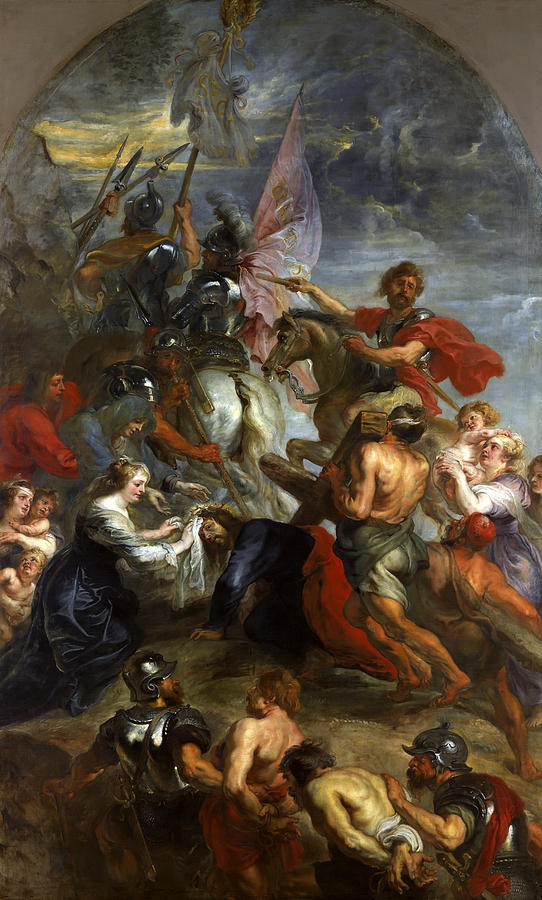
Peter Paul Rubens’ “The Road to Calvary,” painted in 1637, is a monumental Baroque meditation on suffering, compassion, and the clash between worldly power and divine humility. Filling a tall, arched format, the composition swirls with soldiers, horses, banners, and onlookers, all converging on the central figure of Christ as he stumbles beneath the weight of the cross. At the left, the compassionate Veronica leans forward to offer a veil, while the crowd presses in and Roman soldiers drive the procession onward toward Golgotha.
Rubens transforms the familiar biblical episode into a torrent of movement and emotion. Rather than isolating Jesus on a lonely path, he embeds him in a chaos of bodies and weapons, making viewers feel the crush of the crowd and the brutality of the journey. At the same time, the work highlights moments of tenderness and faith that shine against the backdrop of violence.
Historical and Spiritual Context
Painted in the late phase of Rubens’ career, “The Road to Calvary” reflects both his mature artistic style and the Catholic spirituality of seventeenth-century Flanders. The Counter-Reformation Church valued images that stirred the emotions and encouraged believers to meditate vividly on Christ’s Passion. Rubens, with his gift for expressive figures and dynamic compositions, was perfectly suited to this devotional agenda.
By 1637 Rubens was an internationally acclaimed painter and diplomat, but also a man who had experienced personal loss, political turmoil, and physical illness. His late religious works often carry an intensified sense of empathy and gravity. In this painting he invites worshippers not only to witness Christ’s suffering from a distance but to imaginatively place themselves within the tumultuous procession, sharing his exhaustion and emotional weight.
Composition: A Spiral of Movement and Tension
The composition is built around a powerful spiral that rises from the lower right, where a knot of soldiers and prisoners occupies the foreground, up toward the mounted figures and banners at the top. Christ, leaning under the cross at the center, is the tipping point of this spiral. The viewer’s eye moves from the muscular backs of the executioners, along the slanting beam of the cross, toward the mounted officer wrapped in a red cloak, and finally up to the fluttering standards against a stormy sky.
This spiral motion creates a sense of relentless forward drive. The procession is not static; it is surging uphill toward Calvary. The vertical format of the arched canvas intensifies this feeling of ascent and struggle. Figures appear stacked on different levels, as if climbing a steep, uneven road.
At the same time, Rubens uses diagonal lines to convey imbalance and instability. The cross tilts sharply; horses rear and twist; banners flap in the wind. Even the clouds seem to churn. These diagonals reinforce the sense that this is a moment of crisis and upheaval, not orderly ceremony.
The Central Figure of Christ
At the heart of the painting, slightly below center, Christ kneels under the cross. Unlike some depictions where he lies prone or is crushed completely, here he is on one knee, still trying to rise. His body bends forward, shoulders strained, hands gripping the ground for support. His blue robe, draped over a red garment, stands out amid the surrounding earth tones and armor, drawing the viewer’s attention.
Christ’s head bends low, yet his profile remains visible enough to show a quiet resignation. There is no dramatic cry, no exaggerated contortion; instead, Rubens presents a moment of deep interior suffering. The crown of thorns rests on his bowed head, and his long hair falls forward. Light touches his forehead and cheek, creating a subtle halo effect against the darker surroundings.
By placing Christ slightly off center and near the bottom of the frame, Rubens underscores his humiliation. He is physically beneath soldiers, horses, and banners, but his calm endurance sets him apart morally and spiritually. The viewer feels sympathy for his vulnerability in the midst of overwhelming force.
Veronica and the Gesture of Compassion
To the left of Christ appears one of the most poignant figures in the painting: Veronica. According to tradition, this woman stepped from the crowd to wipe Christ’s face with her veil, which miraculously retained his image. Rubens captures the instant she leans forward, arms outstretched, holding the cloth toward Christ’s bowed head.
Veronica is dressed in a dark blue gown with a white headscarf, colors that echo the traditional palette of the Virgin Mary and suggest purity and compassion. Her face shows both determination and sorrow. She moves against the flow of the procession, stepping downward as others push upward, making her act of kindness a quiet act of resistance.
The diagonal line from Veronica’s hands to Christ’s head becomes a visual axis of mercy within the swirling violence. Around them, soldiers prod prisoners and raise weapons, but between these two figures there is a moment of intimate human connection. Rubens invites viewers to identify with Veronica, to imagine themselves offering small acts of compassion in a brutal world.
Soldiers, Executioners, and the Machinery of Power
A large portion of the canvas is occupied by Roman soldiers, executioners, and attendants who drive the procession. Rubens paints them with powerful physiques and elaborate armor, emphasizing the sheer physical force arrayed against Christ. Some ride horses, others march on foot, carrying spears, halberds, and banners. Their metal helmets and breastplates catch glints of light, creating sharp highlights that contrast with the softer tones of Christ’s robes and the women’s garments.
In the immediate foreground, bare-backed executioners struggle with ropes and chains, their muscles straining. One man, his back to the viewer, bends forward in a knot of tension, representing the brutal labor of punishment. Another grips the cross to help hoist it forward, his stance wide and aggressive.
The officer on horseback draped in a red cloak serves as a focal point among the soldiers. His elevated position and vivid garment mark him as a figure of command. Yet his expression seems more anxious than triumphant; he glances backward, perhaps uncertain about controlling the crowd or anticipating the violence to come. Rubens thus complicates the soldiers’ roles, showing them as agents of power yet also part of the same tragic drama.
Women, Children, and the Suffering Crowd
On the right side of the painting, women and children cluster in emotional distress. One woman cradles a child, turning his face away from the scene as if trying to shield him from the horror. Another raises her arms in a gesture of lament. Their exposed shoulders and flowing hair emphasize vulnerability.
These figures represent the innocent victims of violence who, although not physically harmed in this episode, are deeply wounded emotionally. They also stand for the wider community affected by Christ’s Passion. Their reactions offer a spectrum of human responses: horror, grief, curiosity, helplessness.
By including these onlookers, Rubens broadens the narrative beyond Christ and his captors. The event is not merely between Jesus and the Roman authorities; it reverberates through families, children, and the entire society. Viewers are invited to see themselves in these witnesses, feeling the weight of collective responsibility.
Light, Color, and Atmosphere
Rubens orchestrates light and color to heighten drama and guide the eye. A cool, stormy sky looms overhead, painted with swirling grays and blues that seem to echo the turmoil below. Patches of brighter light break through the clouds, falling selectively on key figures: Christ, Veronica, the mounted officer, and some of the women and children. This selective illumination carries spiritual significance, suggesting divine attention amid darkness.
The color palette balances rich reds, blues, and metallic grays. Christ’s blue and red garments link him visually to both heaven and sacrifice; blue evokes the divine, while red suggests blood and martyrdom. Veronica’s deep blue robe harmonizes with Christ’s tunic, signifying solidarity. The officer’s red cloak connects him chromatically to Christ, subtly implying that even those complicit in the execution are not outside the sphere of redemption.
Earthy browns and flesh tones dominate the crowd, giving the painting a grounded, physical presence. Flesh is rendered with Rubens’ characteristic vigor: warm, rounded, and alive. The contrast between glowing skin and cold armor reinforces the tension between humanity and the instruments of conquest.
Baroque Emotion and Theatricality
“The Road to Calvary” exemplifies Baroque emotion and theatricality. Rubens choreographs his figures as if on a stage, each gesture contributing to the overall drama. There are outstretched arms, twisting torsos, turning heads, and expressive faces capturing surprise, anguish, anger, or indifference. Yet the composition avoids chaos; every movement leads the eye back toward the central drama of Christ and Veronica.
The painting also engages viewers physically. The low placement of some foreground figures and the way bodies appear to protrude into our space make us feel almost part of the crowd. The diagonal of the cross seems to threaten to tilt toward us, drawing us into the scene’s emotional gravity. This immersive quality was crucial for its original devotional function, encouraging believers to feel present at the Passion rather than contemplating it as distant history.
Theological Themes: Suffering, Compassion, and Imitation
Beyond its visual impact, the painting communicates profound theological themes. At its core is the mystery of redemptive suffering: Christ voluntarily carries the cross, accepting humiliation and pain for the salvation of humanity. His calm, resigned demeanor amid chaos suggests a deeper purpose behind the apparent defeat.
Veronica’s gesture highlights the role of compassion and imitation. Tradition holds that her veil miraculously bore the image of Christ’s face, a reward for her act of mercy. In Rubens’ scene, the moment just before this miracle invites viewers to emulate her courage—stepping out of the crowd, risking association with the condemned, and offering comfort however small.
The painting also confronts the problem of collective guilt. Many figures seem indifferent or absorbed in their tasks, complicit through participation or passivity. The bound prisoners in the foreground, the gawking children, and the hardened soldiers mirror timeless human patterns of going along with injustice. Rubens implicitly asks: where do we situate ourselves within this crowd?
Rubens’ Late Style and Personal Experience
In the 1630s Rubens’ style became more fluid and painterly, with looser brushwork and a heightened sense of atmosphere. “The Road to Calvary” shows this evolution. Clouds and draperies are rendered with sweeping strokes; edges blur slightly, creating a sense of movement and depth. At the same time, key faces and hands are carefully defined, ensuring clarity of expression.
Rubens’ own life likely informed the emotional weight of the scene. He had experienced the death of his first wife, Isabella Brant, and lived through the upheavals of the Eighty Years’ War that ravaged the Low Countries. His role as diplomat exposed him to the brutal realities of political power. These experiences may have deepened his empathy for suffering and his awareness of the cost of conflict, resonances that find visual expression in the grim determination of soldiers and the sorrow of onlookers.
Legacy and Contemporary Resonance
Today “The Road to Calvary” remains powerful not only as a religious image but also as a reflection on violence and human dignity. The painting speaks across centuries to audiences familiar with images of war, forced marches, and public humiliation. The crowded composition mirrors contemporary scenes of refugees, prisoners, and protestors surrounded by armed forces.
Modern viewers can also appreciate the nuances in Rubens’ portrayal of individuals within the crowd. There are no simple villains or saints; even the executioners show traces of strain and humanity. This complexity encourages a more nuanced understanding of responsibility and moral choice.
At the same time, the figure of Veronica continues to inspire. Her small act of kindness amid a sea of cruelty suggests that compassion, though seemingly insignificant, has enduring spiritual significance. In a world still marked by suffering, Rubens’ painting invites each viewer to consider what it means to step out of the crowd and respond with mercy.
Conclusion
“The Road to Calvary” is one of Peter Paul Rubens’ most compelling Passion scenes, a tour de force of Baroque composition, color, and emotional depth. Through swirling movement, expressive figures, and strategic lighting, he immerses viewers in the drama of Christ’s journey to Golgotha. At its heart, the painting balances terror with tenderness: the crushing weight of the cross and the machinery of power on one side, and the quiet courage of Veronica and the sorrowful witnesses on the other.
Rubens’ late style, with its fluid brushwork and atmospheric sky, enhances the sense of immediacy. The work remains a powerful piece of visual theology, exploring themes of suffering, compassion, and collective responsibility. Whether approached as a religious image or as a human drama, “The Road to Calvary” speaks with undiminished urgency, inviting us not only to observe but to choose our place within the crowd that surrounds the condemned Christ.