Image source: wikiart.org
Claude Monet and an Early Winter Vision
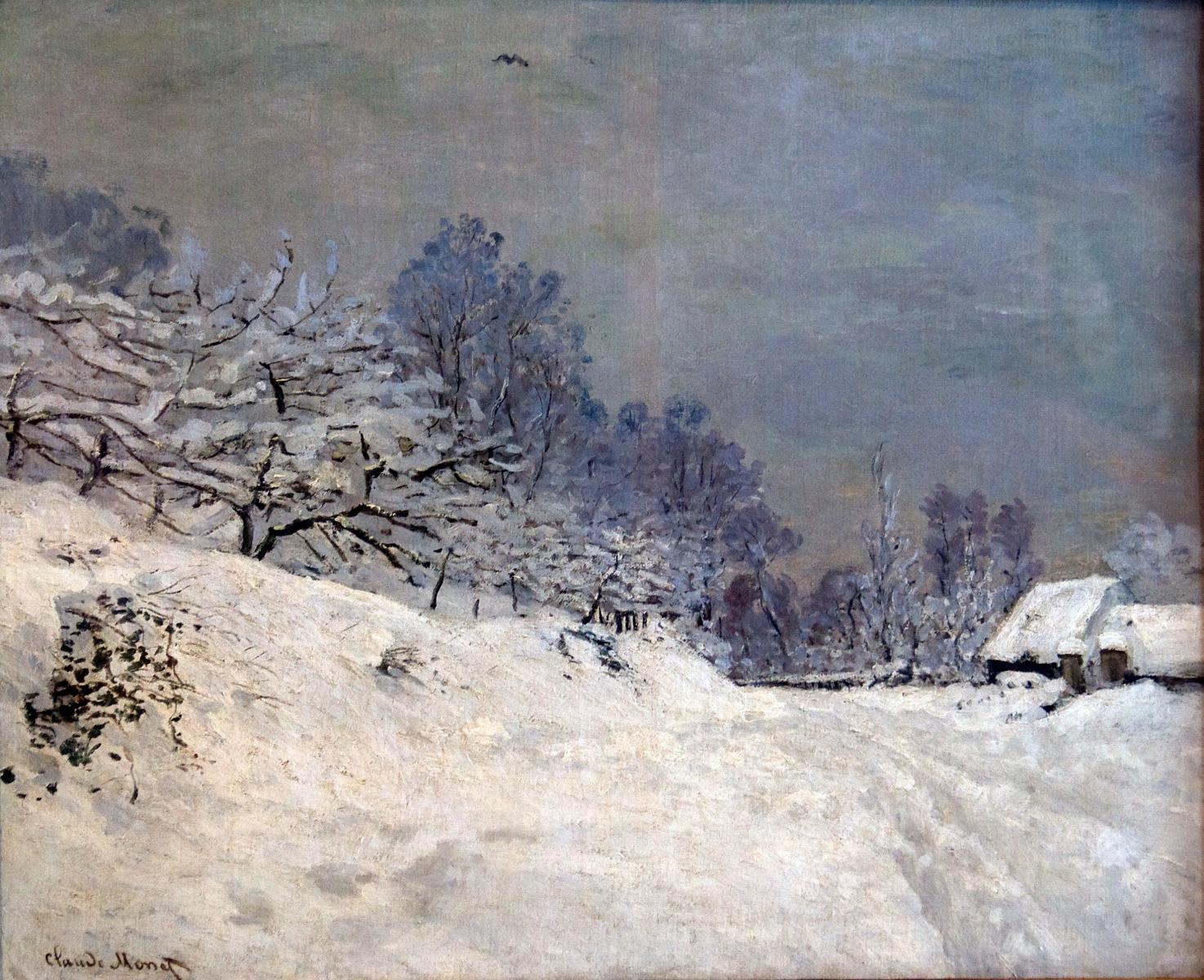
Claude Monet’s The Road in front of Saint-Simeon Farm in Winter from 1867 is a quiet, atmospheric landscape that reveals how much feeling can be carried by restraint. At first glance, the painting seems simple. A snow-covered road curves through a winter scene. Bare trees stretch across the slope on the left. A farmhouse sits to the right, half-buried in cold light and drifting white. The sky is broad, pale, and still. Yet the longer one looks, the more complex the painting becomes. This is not a decorative snow scene meant only to record a season. It is a work about climate, silence, distance, and the emotional weight of a place transformed by winter.
What makes the painting so compelling is the way Monet turns ordinary rural subject matter into a study of perception. The road, the orchard, the farmhouse, and the gray sky are all familiar things, but they do not appear in a hard, descriptive way. Instead, they are filtered through atmosphere. Snow softens outlines. Light dissolves detail. Trees become networks of dark lines against white masses. The sky hovers above everything like a sheet of muted color. In this sense, the painting already shows the artist moving toward the concerns that would define his mature work. Monet is less interested in telling a story than in recording what the eye experiences in a given moment.
This early date matters. In 1867, Monet was still a young painter, still developing the language that would later make him central to modern art. That makes this winter landscape especially interesting because it shows both discipline and experimentation. One can still feel the structure of traditional landscape painting in the arrangement of land, trees, road, and building. At the same time, one can see Monet pushing against strict finish and polished description. He wants the picture to breathe. He wants the surface to feel alive. He wants weather and light to shape the image as much as drawing does.
The result is a painting that feels suspended between observation and sensation. It is rooted in the visible world, but it also conveys something inward and meditative. The cold is not dramatic. The snow is not theatrical. There are no lively figures or picturesque incidents to animate the scene. Instead, Monet gives the viewer a winter day that feels deeply real because it is so understated. The beauty of the painting lies in its humility and its sensitivity.
Composition and the Quiet Movement of the Road
The composition is one of the painting’s greatest strengths. Monet organizes the scene through the gentle diagonal of the snowy road, which begins in the foreground and guides the eye toward the farmhouse and the distant trees. This path does more than provide structure. It becomes the emotional spine of the picture. Roads in landscape painting often symbolize movement, travel, or human presence, and here the road suggests all three, but in a hushed and almost withdrawn manner. It is a path made difficult by winter. It has not disappeared, but it has been subdued by snow.
The left side of the painting is dominated by the sloping bank and the orchard-like cluster of trees. Their branches spread outward in dark, angular forms, giving the composition a strong sense of rhythm. These black and brown lines cut through the surrounding white, establishing contrast and preventing the scene from becoming shapeless. On the right, the farmhouse anchors the image with a simple, solid form. Its roof, covered in snow, echoes the slope of the land and creates a visual balance with the hill opposite. Between these two sides, the road opens a space of passage and breath.
Monet is careful in the way he distributes visual weight. The dense network of branches on the left could have overwhelmed the painting, yet the openness of the sky and the broad snowfield keep the composition from feeling crowded. The farmhouse, though relatively small, becomes a focal point because it offers a recognizable human shelter within an otherwise expansive and silent environment. Its presence is understated rather than dominant, which is important. Human life exists here, but winter has temporarily taken control of the landscape.
There is also a notable sense of recession. The eye moves from the textured foreground snow into the middle distance and then upward into the vast, muted sky. The scene unfolds gradually rather than dramatically. Monet does not force perspective through sharp lines or rigid architectural elements. Instead, he relies on tonal shifts and soft transitions. This gives the painting a natural, lived-in quality. The viewer feels as if standing in the cold, looking across a rural road rather than looking at a staged composition.
The painting’s compositional calm is one reason it remains memorable. Nothing is exaggerated. Nothing feels arranged for spectacle. Monet creates an image whose power grows out of balance, patience, and subtle directional movement. The road is the central path through the picture, but it is also a path into mood.
Snow as Subject, Surface, and Sensation
Snow is the defining element of the painting, and Monet treats it with remarkable intelligence. Snow in art can easily become monotonous or overly sentimental. It can flatten space or turn into a generic symbol of winter. Here, Monet avoids both problems by recognizing that snow is never simply white. It absorbs and reflects the atmosphere around it. It gathers light. It reveals texture. It covers forms while also making them more visible through contrast.
In the foreground, the snow is broad and luminous, but it is far from empty. Monet works the surface with delicate tonal variations, hints of gray, cream, blue, and faint violet. These changes give the snow body and movement. One senses uneven ground beneath it, as well as footprints or the compressed traces of passage along the road. This is important because it keeps the scene grounded in experience. The snow is not an abstract field of color. It has weight, depth, and physical presence.
The trees on the left demonstrate another aspect of Monet’s understanding. Their snow-covered branches create a layered interplay between dark skeletal lines and thick white accumulations. In places, the snow seems to sit lightly on the branches; in others, it gathers into heavier masses. This variety prevents repetition. It also reminds the viewer that snow changes the appearance of everything it touches. Trees that might be ordinary in another season become intricate, sculptural presences in winter.
The farmhouse roof offers yet another variation. There the snow appears more settled, smoother, more compact. It turns the building into a geometric form softened by climate. The contrast between the rougher, broken textures of the orchard and the simpler snowy planes of the roof enriches the whole painting. Monet is attentive to how snow behaves differently on earth, wood, branches, and architecture.
More than anything, snow in this painting functions as a carrier of silence. It muffles the landscape. It reduces visual noise. It creates a world in which sound seems distant and motion slowed. Monet captures this without having to depict any event. The snow itself communicates the changed atmosphere of winter life. The viewer feels the stillness not because the painting says it directly, but because every surface has been transformed by cold and accumulation.
This sensitivity to snow as a shifting visual condition rather than a fixed object would become central to Monet’s development. He would later become famous for observing how the same subject looks under changing light and weather. In this early work, one already sees that instinct clearly. The snow is not background. It is the main event.
Color, Tonality, and the Poetry of Restraint
One of the most beautiful aspects of The Road in front of Saint-Simeon Farm in Winter is its restrained palette. Monet does not rely on bright winter sparkle or dramatic sunset effects. Instead, he builds the image through a harmony of cool grays, pale blues, soft violets, muted browns, and creamy whites. The result is both subtle and emotionally rich.
The sky sets the tonal key. It is a broad expanse of gray with delicate inflections of blue and lavender. This sky does not dominate through spectacle. It hovers quietly over the land, spreading its mood across the scene. Because it occupies so much of the canvas, it becomes essential to the painting’s emotional power. Its muted tone suggests overcast weather, but it is not dead or empty. Monet finds life within restraint. Small tonal shifts create depth and atmospheric vibration, allowing the sky to feel active even in stillness.
The land below responds to the sky. The snow is touched by its coolness, and the distant trees echo its bluish and violet notes. These harmonies connect the painting into a unified whole. Nothing feels isolated. Color moves gently from one part of the scene to another, creating a sense of air passing through the landscape. This is one of Monet’s great gifts. He understands that color is not merely applied to objects. It is shaped by the conditions around them.
The darker accents are especially effective because they are used sparingly. The black and brown branches, the shadowed openings of the farmhouse, and the occasional darker shrubs in the foreground provide punctuation within the pale field. They keep the image from dissolving entirely into atmosphere. At the same time, they never become harsh. Even the darkest forms are moderated by the surrounding light.
There is a quiet poetry in this limited range. The painting does not demand attention through brightness. Instead, it rewards close looking. The more one studies it, the more one notices the delicacy of the color relations. A faint violet in the trees answers a gray note in the sky. A creamy highlight in the snow near the foreground warms the image slightly and prevents it from becoming cold in a purely emotional sense. These shifts are minimal, but they matter deeply.
This tonal restraint gives the work seriousness. It suggests an artist more interested in truth than in easy prettiness. Monet is willing to paint a winter day as it is: muted, veiled, and quiet. Yet in doing so, he reveals how rich muted color can be. The painting becomes a lesson in how subtlety can produce emotional depth.
Brushwork and the Early Language of Impressionism
Although this work predates Monet’s most celebrated mature paintings, it already contains many signs of his evolving technique. The brushwork is varied, responsive, and visibly engaged with the act of seeing. Rather than smoothing every passage into academic finish, Monet allows strokes to remain active on the surface. This gives the painting energy even in its stillness.
In the snow, the brushwork is broad and soft, often laid in with enough looseness to suggest shifting texture rather than exact detail. This is a crucial choice because snow cannot be convincingly painted by line alone. It needs atmosphere, broken surface, and subtle tonal movement. Monet’s handling allows the viewer’s eye to complete the form. The painting does not explain everything. It invites participation.
The branches of the trees are treated differently. Here Monet uses darker, more calligraphic strokes that articulate structure without becoming fussy. The branches are descriptive enough to convey species and season, yet they are not overworked. They flicker across the white, helping the eye register the forms quickly and naturally. This kind of selective description is a major part of Monet’s achievement. He knows where precision matters and where suggestion is more powerful.
In the distant trees and the sky, the paint becomes softer and more vaporous. Edges blur. Forms merge gently into the surrounding air. This creates atmospheric depth, but it also reveals Monet’s growing interest in the instability of visual perception. Things far away are not sharply defined. Weather interferes. Light dissolves boundaries. Instead of correcting these effects in the name of clarity, Monet embraces them.
The farmhouse is painted with similar intelligence. It is recognizable, but it is not elaborated with unnecessary detail. The building exists as a solid presence within the climate of the picture, not as an architectural study. Even here, Monet seems more interested in how winter light falls across the roof and walls than in exact construction. This shift in emphasis marks a modern sensibility. The world is not presented as a catalogue of objects. It is presented as an experience of appearance.
Calling this painting fully Impressionist would oversimplify its place in Monet’s career, but it undeniably points in that direction. Its brushwork is more immediate than academic convention usually allowed. Its atmosphere matters as much as its subject. Its visible surface becomes part of its meaning. One can sense a young painter discovering that the truth of a landscape may lie not in polished finish, but in the freshness of perception.
Nature, Rural Life, and Human Presence
The painting is not purely about untouched nature. It is also about a worked rural environment shaped by human use. The road, the orchard, the fence line, and the farmhouse all speak of agricultural life. Yet what is striking is how winter changes the relationship between human presence and the land. The signs of habitation remain, but they are subdued, almost absorbed into the season.
The farmhouse on the right is crucial in this regard. It is the clearest sign that people belong to this place, that labor, routine, and domestic life continue despite the weather. But Monet does not include visible figures. No one walks the road. No smoke rises dramatically from a chimney. No animals interrupt the scene. This absence creates a feeling of pause. Rural life is implied rather than shown, and that makes the painting more contemplative.
The orchard on the left also matters. These trees are not wild forest growth. They appear cultivated, bent into forms shaped over time by pruning and seasonal care. Their winter state carries a particular resonance because orchards suggest cycles of productivity, blossom, fruit, and harvest. In winter they stand dormant, their usefulness postponed, their energy hidden. Monet captures this condition beautifully. The orchard is not dead, only waiting.
This tension between habitation and silence gives the work depth. The scene is humanized but not dominated by humanity. The road has been made by people, but snow has reasserted nature’s presence. The farmhouse provides shelter, but it looks small against the pale breadth of the sky and land. The painting therefore avoids both romantic wilderness and sentimental rural anecdote. It occupies a middle ground in which nature and human life coexist, though not as equals. In winter, nature sets the terms.
There is also something emotionally moving in the modest scale of the place. Monet does not depict a grand estate, a dramatic mountain range, or an iconic monument. He paints a farm road and a winter orchard. This choice reflects a modern artistic seriousness. Ordinary places are worthy of sustained attention. Beauty is not reserved for the spectacular. It can be found in the weathered and familiar.
That idea would become central to Impressionism and to modern art more broadly. Everyday life, fleeting conditions, and local environments could become major subjects. In this painting, Monet shows that even a quiet rural road can hold visual and emotional richness when truly observed.
Mood, Memory, and the Emotional Force of Stillness
Perhaps the deepest achievement of The Road in front of Saint-Simeon Farm in Winter lies in its mood. This is a painting of stillness, but not emptiness. It is calm, but not lifeless. It creates the emotional sensation of standing before a winter landscape where time seems temporarily slowed.
The absence of figures is important here. Without people to animate the scene, the viewer is drawn more directly into the environment itself. One becomes aware of the muted sky, the weight of snow, the distance between the trees, the hushed curve of the road. The painting invites not action but attention. It asks the viewer to dwell in the experience of winter rather than simply recognize it.
There is also an element of memory in the way the scene is painted. The softened edges, restrained palette, and broad quiet spaces give the landscape a slightly dreamlike quality. It feels observed, certainly, but also inwardly absorbed. One might imagine this as a place remembered after leaving it, or as a moment so still that it seems already to belong to recollection. Monet’s handling allows the painting to move beyond topographical record into emotional resonance.
The sky contributes enormously to this effect. It is expansive, subdued, and faintly melancholy. Yet the mood is not bleak. There is no sense of menace or despair. Instead, the atmosphere suggests introspection. Winter here is not a disaster or a symbol of death. It is a season of pause, reduction, and quiet concentration. The painting offers a kind of visual solitude.
This emotional register helps explain why Monet’s landscapes continue to matter. He was not simply recording pretty views. He was exploring how weather, light, and place affect the way one feels. In this painting, the feeling is one of subdued wonder. The landscape is ordinary, yet transformed. The road is familiar, yet strange under snow. The farmhouse is sheltering, yet distant. The scene is still, yet alive with tonal and atmospheric change.
The painting’s stillness also creates dignity. Nothing is rushed. Nothing is overstated. Monet trusts that attentive looking will reveal beauty. That trust is one of the most modern things about him. He does not need historical drama or allegorical content to give a painting significance. A winter road, honestly seen, is enough.
Why This Painting Still Matters
The Road in front of Saint-Simeon Farm in Winter remains significant because it shows Monet at a moment of formation, already demonstrating the sensitivity that would later transform landscape painting. It is an early work, but not a minor one in spirit. Within its quiet limits, it contains a sophisticated understanding of atmosphere, color, seasonal change, and visual experience.
The painting matters historically because it helps viewers see how Monet’s art developed. One can observe him moving away from rigid finish and toward a more immediate response to nature. One can see his fascination with transient conditions, especially the way light and weather alter appearances. These concerns would become foundational to Impressionism, and here they are already powerfully present.
It also matters aesthetically because it proves that understatement can be profound. The painting does not overwhelm the viewer with drama or technical display. Its power comes from balance, restraint, and close observation. It asks us to slow down. In a culture that often rewards instant spectacle, such a painting feels especially valuable.
The work also speaks to a universal human experience. Winter changes how people inhabit the world. Roads become quieter. Familiar places seem newly distant. Sound is softened. Color is reduced. Daily life continues, but under altered conditions. Monet captures that transformation with unusual tenderness. He understands that a season is not just a visual fact. It is a mood, a rhythm, a temporary way of being in the world.
Finally, the painting matters because it embodies one of the core truths of Monet’s art: reality is never static. Even in apparent stillness, everything is shifting. Snow reflects changing light. Trees dissolve into atmosphere. Buildings are altered by weather. The eye never sees a fixed world, only a momentary one. In this winter landscape, Monet turns that insight into something quiet and enduring.
