Image source: wikiart.org
Introduction
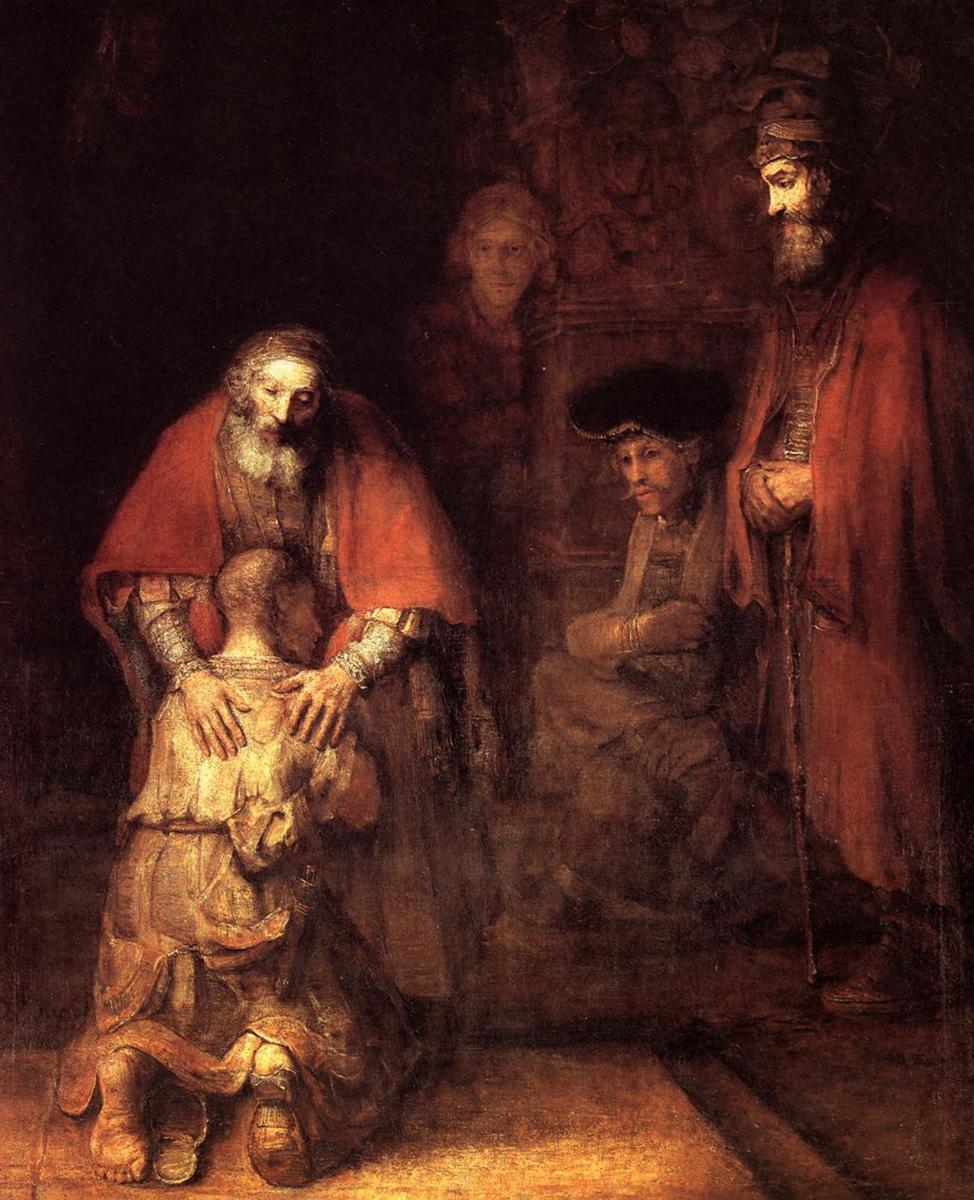
Rembrandt’s “The Return of the Prodigal Son” (1669) is a late, meditative masterpiece that distills a lifetime of seeing into a single, hushed moment. In a shallow, dark interior, a ragged young man kneels before an elderly father whose hands rest upon the son’s shoulders in a gesture of absolute welcome. A few witnesses hover at the right, their faces half in shadow, their attitudes registering curiosity, judgment, or reflective silence. Light gathers around the two central figures like a quiet revelation, spreading from the father’s face to the kneeling back and then dimming into the room’s brown dusk. Rather than narrate the entire parable, Rembrandt fixes the canvas at the instant of recognition and forgiveness. From that focus springs an immense range of meanings—ethical, spiritual, psychological, and painterly.
The Parable And Its Moral Gravity
The story comes from the Gospel of Luke. A younger son demands his inheritance, squanders it in a far country, and returns in shame hoping to be a hired servant. Before he can finish his apology, the father runs to meet him, embraces him, and calls for celebration. An elder brother, faithful yet resentful, questions the fairness of this mercy. Rembrandt’s choice is to depict not the feast or the journey but the still point when repentance meets compassion. The narrative energy contracts to touch: the father’s hands on the son’s shoulders, the son’s pressed head, knees pulled beneath him, shoes broken and mismatched. In this compression the entire parable becomes visible without a single spoken word.
Composition As Architecture Of Mercy
The painting’s structure is a pyramid whose apex is the father’s bowed head and whose base is the kneeling son. The father’s mantle builds a broad, stable mass that seems to shelter the younger figure. Their fusion at the center generates calm, while the witnesses at the right form a counterweight that prevents the composition from tipping into sentimentality. One onlooker sits low, chin in hand; another stands tall and rigid, wrapped in a red cloak; a third, in half-light, peers from behind a column. The space is shallow, almost theatrical, yet the bodies settle into it with the heaviness of real weight. The architecture is minimal—an implied wall, a plinth, faint carvings—but enough to frame the drama and keep the eye circling back to the embrace.
Light As Theological Speech
Rembrandt’s late light never shouts; it confers. It descends from the left, bathing the father’s face and hands, then opening like a benediction across the son’s shaven scalp and ragged shoulders. The light diminishes as it spreads to the right, allowing the onlookers to remain morally ambivalent in shadow. Darkness is not mere absence; it is the medium from which the vision emerges, the world into which compassion is introduced. The father becomes a lantern in that dusk, his face a soft conflagration of whites and warm ochers, his beard catching delicate highlights, his eyes nearly closed in concentration. Light is thus both optical and theological, a means of seeing and a metaphor for grace.
Color And Tonal Harmony
The palette is restrained yet resonant. Earthy browns and near-blacks define the interior and garments; embers of red and rust glow in the father’s cloak and the standing figure’s robe; quiet ochers, lead whites, and a few gentle greens circulate through the faces and hands. Because chroma is low, temperature carries emotion. Warmth pools around the father and the kneeling son, while cooler, grayer notes gather near the observers, subtly reinforcing the difference between compassion and calculation. The painting feels like a chord held for a long time—deep, steady, and humane.
Gesture And The Eloquence Of Hands
Few canvases demonstrate so clearly how hands can carry meaning. The father’s left hand, broader and heavier, rests on the son’s shoulder like an anchor; his right hand, narrower and more delicate, touches higher up, almost at the neck, with the gentleness of blessing. Together they proclaim both strength and tenderness. The son’s hands fold inward over his chest, fingers pressed, as if to contain the ache of return. The watching elder’s hands are hidden within his robe, a subtle sign of withdrawal; the seated onlooker’s hand props his head in analytic detachment. Every hand is a moral position.
The Faces And Their Psychologies
The father’s face is the picture’s soft engine. Wrinkled, downward-looking, and suffused with light, it registers not triumph but relief and compassion. The son’s head is shaven, penitential, almost monk-like; his face is all but invisible, not because it lacks value but because in this instant his identity is being received rather than displayed. The elder brother’s profile, cool and reserved, studies the reunion from a distance, suggesting a conscience confronted by mercy’s extravagance. The seated figure, sometimes read as a steward, sometimes as an onlooker who could be Rembrandt himself, squints into the glow, unsure whether to join or judge. Rembrandt arranges these psychologies in a single chamber, letting viewers locate themselves among them.
Costume, Poverty, And Dignity
The son’s clothing hangs in tatters—patched, belted with a cord, one shoe split at the toe, the other lost entirely. These details are not theatrical misery but concrete facts that make the body believable. The father’s robe is heavy and warm, edged with fur textures created by sticky, lifted paint; a faint pendant at his chest suggests status made modest by age. The standing figure’s cloak is crisp and ceremonial, its edges catching light with an authority that feels slightly cold. Rembrandt avoids lace-like virtuosity, turning instead to impasto and scumble to indicate fabric. Paint itself becomes cloth, and the cloth becomes a language of character.
Space, Setting, And The Poetics Of The Indeterminate
The setting is less a room than a softly articulated dusk. A column, perhaps a carved niche, and a few steps suggest a threshold between public and private worlds. The floor in front is a small rectangle of blond light that reads like a welcome mat for repentance—a path to kneel upon. The background’s vagueness is deliberate. It prevents the scene from becoming an anecdote tied to a time and place; it lets the image function as a perpetual present, a space in which acts of mercy are always possible.
Texture And The Intelligence Of Paint
Late Rembrandt lets pigment carry feeling. The father’s robe and beard are built from thick impastos that catch real light; the son’s rags are thinner, the underlayers showing through like worn cloth. In the faces, semi-opaque strokes preserve soft transitions; at the eyelids and lips, tiny ridges of paint glisten, giving moisture and life. The background is a haze of scumbles and veils, the brush’s sweep visible yet quiet. These material choices mirror the subject: places of abundance are physically richer in paint; places of lack are leaner, closer to the ground. The canvas is thus not only a picture of mercy but an embodiment of it in matter.
Theological Themes: Mercy, Justice, And Joy
The painting weighs mercy and justice without turning into argument. Justice, represented by the elder brother’s stance, demands proportionality; mercy, embodied by the father, gives more than is deserved. Rembrandt sides with mercy but does not caricature justice; the elder brother’s posture is understandable, human, wounded by comparison. The light’s distribution—fullest on the embrace, dimmer on the witnesses—suggests an order of love rather than a dismissal of law. Joy is present but quiet, as if the celebration begins in the father’s hands and will spread outward after the silence of recognition has had its due.
Biographical Resonances
Painted in the final year of Rembrandt’s life, the canvas inevitably collects biographical echoes. By 1669 he had suffered bankruptcy and the deaths of those dearest to him. The subject of a son restored to a father must have cut close, given the death of his own son Titus that same year. Yet the painting is not elegy; it is an act of hope. The gentleness with which the light rests on the figures suggests a vision gained through experience rather than despite it. The painter who once delighted in drama here chooses restraint, trusting that a slow, steady gaze can carry more truth than spectacle.
How To Look At The Painting In Person
Start from a distance and let the composition settle: the pyramid of the embrace, the flank of witnesses, the quiet floor. Move closer until you see bristle tracks in the father’s cloak and small peaks of paint on his beard. Notice the different weights of the two hands and how they create a chord of touch. Study the son’s clothing, where thin layers reveal ground and earlier decisions. Shift to the right and compare faces: the elder brother’s cool profile, the seated figure’s thoughtful squint, the half-seen head behind them, and the hidden watcher in the far dark. Step back again to let the light gather. The painting orchestrates this dance of distance so that matter and meaning alternate in your attention.
Influence And Legacy
This canvas has become a touchstone for artists, writers, theologians, and viewers seeking a non-sentimental image of forgiveness. It influenced painters who learned from its darkness, its orchestration of texture, and its refusal of spectacle—Goya, for example, in his late portraits, or modern artists who keep the figure close to the surface’s material reality. Beyond stylistic influence, the work altered how sacred narrative could be told: not as pageant, but as private encounter expanded to monumental scale.
The Elder Brother And The Viewer’s Position
One of the painting’s quiet achievements is the way it implicates the viewer. Do we stand with the father, ready to forgive; with the son, longing to be received; with the elder brother, carefully measuring fairness; or with the seated observer, suspended between critique and empathy? By distributing attitudes around the central act, Rembrandt invites us to locate ourselves and to move. The image offers not a verdict but a space in which the heart can change.
The Silence Of The Scene
Perhaps the most moving quality of the painting is its silence. No mouth is open. The father’s eyes close; the son’s face hides; the observers watch in reserve. This silence creates room for the viewer’s own words to form and then fall away. The painting trusts touch—and the light that dignifies it—to speak the necessary truth. In that wordless center the parable’s message becomes palpable: forgiveness is an event before it is a statement.
A Meditation On Time
Everywhere in the painting time is visible. The father’s hands, one broader and older than the other, suggest a lifetime of labor and blessing. The son’s shaven scalp hints at recent hardship and penitence. The elder brother’s posture records years of dutiful habit. The canvas itself carries time in its layers—thin passages where earlier strokes reappear, thick ridges where paint has been pressed and left to stand. The work is not a snapshot; it is a sediment of choices that mirrors the process by which human lives are formed.
Conclusion
“The Return of the Prodigal Son” endures because it refuses to force a miracle into noise. It pares the story down to touch, lets light do the moral work, and grants every figure a credible inner life. The father’s hands, the son’s kneeling back, the witnesses’ divided attention, the warm rectangle of floor—all collaborate to make compassion visible. In his last year, Rembrandt found a way to make paint itself hospitable to mercy. The canvas is less a lecture about forgiveness than an experience of it: a chamber where judgment softens, where dignity is restored by hand and light, and where viewers are invited to step closer, be still, and let the scene do its quiet work.