Image source: wikiart.org
Introduction to “The Return of the Farm Workers from the Fields”
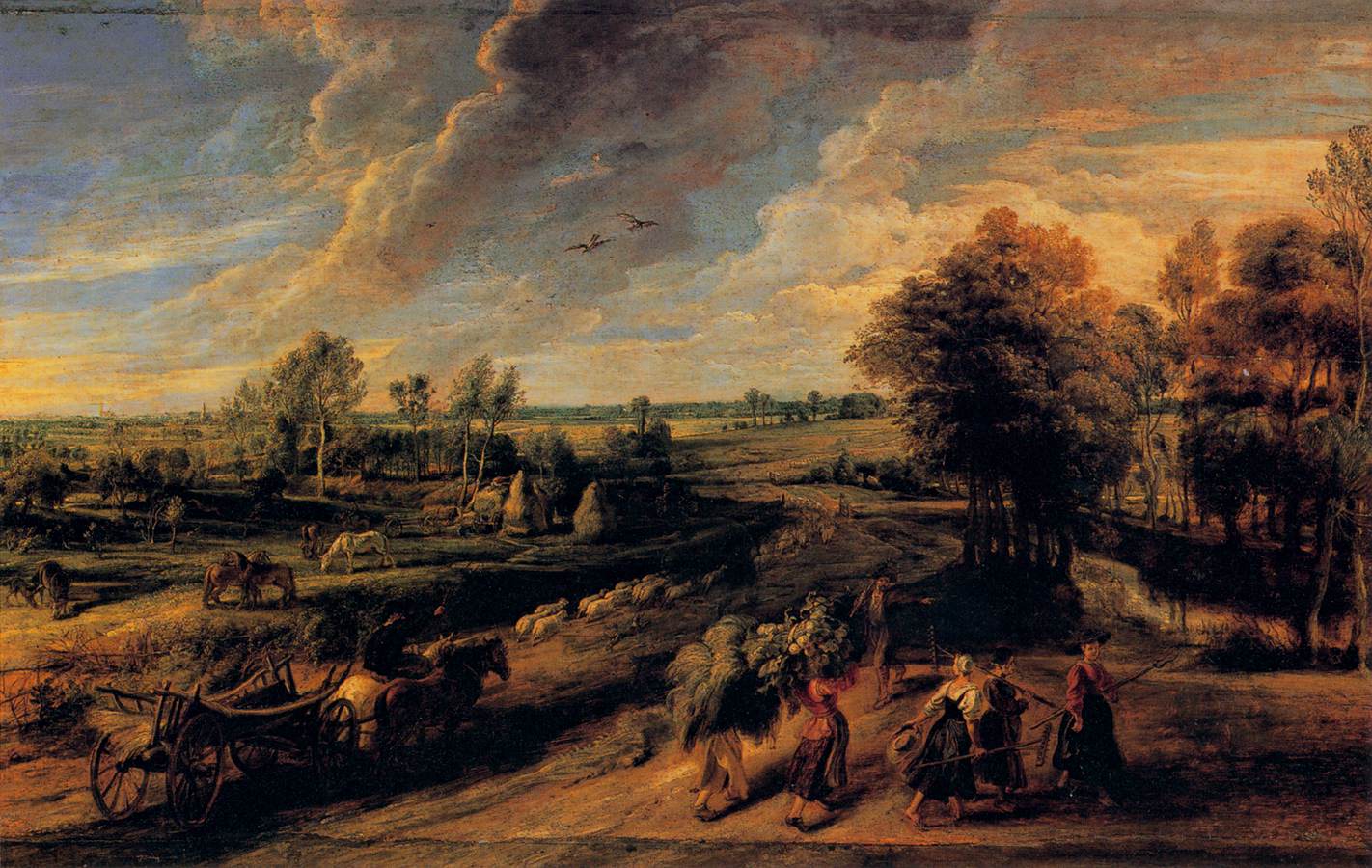
Peter Paul Rubens’ “The Return of the Farm Workers from the Fields,” painted around 1640, is one of the most lyrical and expansive landscapes of his late career. The canvas presents a broad Flemish countryside under a towering sky, animated by carts, riders, flocks of sheep, and a small procession of peasants carrying sheaves and flowers along a country road. Rather than focusing on mythological heroes or courtly patrons, Rubens turns his attention to ordinary rural life and to the land itself, which stretches toward a distant horizon bathed in evening light.
This painting belongs to the group of late pastoral landscapes that Rubens created at his country estate, Het Steen, after retreating from the intense diplomatic and courtly world of his earlier years. It is both a celebration of agricultural labor and a meditation on time, weather, and the rhythms of the seasons. The artist’s delight in the living landscape suffuses every part of the composition, from the glowing clouds in the sky to the meticulous rendering of horses, trees, and workers on the road.
Historical Context and Rubens’ Life at Het Steen
By 1640 Rubens was in his early sixties and suffering from chronic gout, which limited his mobility but did not diminish his creative vigor. After decades of commissions for kings, princes, and major churches, he purchased the estate of Het Steen near Antwerp and spent much of his remaining life there. The countryside around Het Steen became his favored subject. Instead of painting landscapes as background for mythological scenes, he now allowed the land to take center stage.
“The Return of the Farm Workers from the Fields” reflects this change in focus. It shows not a generalized ideal landscape but one rooted in the real topography and agriculture of the Low Countries. At the same time, Rubens infuses the scene with his own sense of harmony and abundance, shaped by classical ideas about the golden age and the dignity of rural labor. The painting thus stands at the intersection of observation and imagination, personal experience and art-historical tradition.
Overall Composition and Spatial Design
The composition is panoramic, stretching wide across the canvas and leading the viewer’s eye from the foreground road into the distant horizon. Rubens divides the scene into roughly three zones: the darkened foreground with figures and carts; the middle ground of fields, trees, and herds; and the luminous sky that occupies nearly half the painting.
In the lower right, a diagonal road runs from the front edge of the canvas toward the center, creating a strong perspective line. Along this road walks a small procession of farm workers returning from the fields. Their movement into the depth of the painting invites the viewer to follow them visually, almost as if joining them on their way home. On the left foreground, a cart drawn by horses moves in the same general direction, echoing the procession’s diagonal and reinforcing the sense of evening migration.
The middle ground opens into a broad valley where fields, hedgerows, and haystacks dot the land. Scattered across this area are grazing horses, more carts, and a large flock of sheep being guided across a shallow stream. Trees stand in clusters, some lit by the sun, others cast in shadow. The horizon line is low and distant, giving prominence to the sky and enhancing the impression of expansive space.
Rubens uses overlapping forms, shifts in color intensity, and diminishing scale to create depth. Figures and animals in the foreground are larger and darker; those in the middle ground are smaller, rendered with softer edges and lighter tones. The city or village at the far left horizon appears as a faint silhouette, barely visible beneath the vast sky, suggesting that human settlements are small components of a much larger natural world.
The Dominant Sky and Atmospheric Effects
One of the most striking features of the painting is its sky. Towering, billowing clouds sweep across the upper half of the canvas, bathed in warm evening light. The clouds are painted in a mixture of golds, pinks, and grays, with darker masses gathering toward the center and right. These cloud formations lend drama and grandeur to the otherwise humble subject matter.
The light source seems to come from the left, just beyond the edge of the canvas, where the sky glows most brightly. This light spills across the fields, catching the tops of trees and buildings and casting long shadows across the land. The right side of the painting, where the road and group of returning workers are located, lies partially in shadow, but streaks of warm color still touch the foliage and the backs of the figures.
The sky does more than provide a backdrop; it shapes the mood of the scene. The mixture of sunlit clouds and darker masses suggests a moment of atmospheric transition, perhaps just after a passing shower or as evening gathers. Two birds soaring high in the center of the sky emphasize the feeling of spaciousness and the continuity of life above the human bustle below.
Depiction of the Returning Farm Workers
The title draws attention to the small group of peasants in the lower right, who, despite their size, carry significant narrative weight. They walk along the road away from the fields, heading perhaps toward a distant village or farmhouse. The group includes men and women; some carry tools, others bear bundles of harvested crops and flowers.
One figure, slightly ahead of the others, appears to be a woman balancing a large sheaf or basket of grain and blossoms on her head. Her posture is strong and upright, her skirt glowing with warm color in the fading light. Beside her, another worker carries a similar load on his back, hunched slightly under the weight. A third figure holds a long staff or rake, gesturing toward the field they have left. Children or younger workers accompany them, one turning as if speaking to a companion.
Rubens depicts these figures with affection and dignity. Their faces are not individualized in detail, yet their gestures and positions convey a sense of camaraderie and shared purpose. They are not portrayed as downtrodden or pitiable; instead, they appear robust, integral to the life of the land. The inclusion of flowers in their bundles suggests a celebration of harvest and perhaps a symbolic link to fertility and abundance.
Animals, Carts, and Rural Industry
Throughout the painting, Rubens populates the landscape with animals engaged in everyday tasks. Horses graze or pull carts; cattle stand near haystacks; a large flock of sheep moves together along a sunlit stretch of land. These animals are not mere decorative motifs. They bear witness to the economic and ecological fabric of the countryside.
In the foreground left, a horse-drawn cart heads down the road, its driver seated high, reins in hand. The cart’s wooden wheels and structure are painted with sturdy realism, emphasizing its role as a practical vehicle for transporting harvests. Closer to the center, we see another cart near a haystack, perhaps being loaded or unloaded.
The sheep in the middle distance form a sinuous, pale band that leads the eye deeper into the scene, mirroring the path of the road. Their presence evokes ideas of shepherding, pastoral care, and collective movement. Rubens’ careful attention to the different postures and colors of the animals shows his keen observation of rural life at Het Steen.
Trees, Water, and the Structure of the Land
The trees in the painting are varied in species and age, some slender and upright, others full and rounded. On the right, a dense cluster of trees rises above a darkened pool or stream, casting reflections into the water. Their foliage is tinged with warm golds and browns, hinting at late summer or early autumn. On the left and center, more scattered trees stand along field boundaries, their trunks catching the low light.
Rubens uses these trees to organize space and create contrast. The heavy mass of foliage on the right balances the open, sunlit fields on the left. The darker tones of the wooded area frame the lighter sky, drawing the viewer’s attention toward the center where the workers and animals move.
Water features subtly in the landscape. A small stream or ford runs across the center, where the flock of sheep crosses, and its reflective surface adds a cool note to the warm earth tones. The presence of water reinforces the sense of a living ecosystem sustained by natural cycles.
Light, Color, and Seasonal Atmosphere
Color plays a key role in establishing the mood of “The Return of the Farm Workers from the Fields.” Rubens uses a rich palette of earthy browns, deep greens, golden yellows, and soft blues. The warm tones of the soil and foliage contrast with the cooler hues of the sky and distant horizon.
The time of day appears to be late afternoon or early evening, when the sun is low and the light skims across the land. This is suggested by the long shadows, the warm golden glow on the treetops, and the subtle pinks in the clouds. The atmosphere feels calm but not static; the sky and land reveal traces of recent activity—perhaps changing weather or the end of a long day’s work.
Seasonally, the abundance of crops being carried home and the lushness of the fields suggest late summer or early autumn at harvest time. This seasonal context adds symbolic richness, associating the painting with ideas of fruition, reward for labor, and the cyclical nature of rural life.
Human Labor and the Idea of Harmony with Nature
While the painting does not depict a single narrative event, it conveys a clear theme: the harmonious relationship between human labor and the land. The farm workers, carts, and animals are integrated seamlessly into the landscape. Paths worn into the ground, fields divided by hedgerows, and haystacks rising in the distance all show how human effort shapes and maintains the environment.
However, Rubens avoids any hint of exploitation or misery. The workers appear healthy and purposeful; the land is fertile and generous. This idyllic representation reflects both artistic tradition and the painter’s personal appreciation for his estate, where he himself took pleasure in overseeing agricultural activities.
There is also a moral undertone. In a period marked by wars and political turmoil, scenes of peaceful rural labor could serve as reminders of a more stable, virtuous order grounded in honest work and respect for nature. The painting offers viewers a vision of a world where human industry and natural beauty support one another rather than being in conflict.
Comparison with Other Late Landscapes by Rubens
“The Return of the Farm Workers from the Fields” shares affinities with other well-known landscapes from Rubens’ final years, such as “The Rainbow Landscape” and “Landscape with a Castle.” All of these works feature broad panoramic views, monumental skies, and carefully observed details of rural life.
What distinguishes this painting is its emphasis on the procession of workers and the explicit theme of returning home. In some of the other landscapes, mythological or aristocratic figures appear in the foreground, linking the land to heroic narratives or noble leisure. Here, by contrast, the protagonists are peasants, and the focus is on daily labor rather than mythic adventure.
This emphasis suggests that Rubens, in his later years, had come to value everyday rural experience as worthy of grand artistic treatment. The landscape is not simply the stage for higher stories; it is itself the story, and the workers are its heroes in their own modest way.
Rubens’ Late Style and Painterly Technique
Technically, the painting reveals many characteristics of Rubens’ late style. His brushwork is loose and energetic, particularly in the clouds, foliage, and foreground earth. Rather than carefully delineating every detail, he uses swift strokes and subtle color modulations to suggest forms, leaving parts of the surface vibrantly alive.
Figures and animals in the distance are rendered with economical touches that nonetheless convey movement and volume. The handling of light is confident and atmospheric, with transitions from shadow to highlight that feel natural and unforced. The overall impression is one of spontaneity, as if the artist painted directly from his impressions of the countryside rather than from rigid preparatory designs.
Despite this apparent freedom, the composition is carefully balanced, and the color harmonies are refined. This combination of structure and looseness gives the painting its distinctive vitality and makes it a touchstone for later landscape painters who sought to combine realistic observation with painterly expressiveness.
Conclusion: A Vision of Rural Fulfillment
“The Return of the Farm Workers from the Fields” stands as one of Peter Paul Rubens’ most heartfelt tributes to the land and to the people who work it. Painted at the end of his life, it distills his experience as artist, landowner, and observer of the natural world into a single, expansive vision.
The towering sky, golden fields, and bustling road coalesce into an image of rural fulfillment at the close of day. The returning workers, bearing sheaves and flowers, embody the rewards of labor and the continuity of community. Animals graze and move across the land, trees cast long shadows, and the distant horizon hints at settlements beyond.
In this painting Rubens offers not just a view of the Flemish countryside but a reflection on human life attuned to natural cycles. It is a work of gratitude and serenity, a final affirmation that beauty and meaning can be found in the ordinary paths of workers heading home from the fields under a glowing evening sky.