Image source: wikiart.org
Introduction to The Rest on the Flight into Egypt
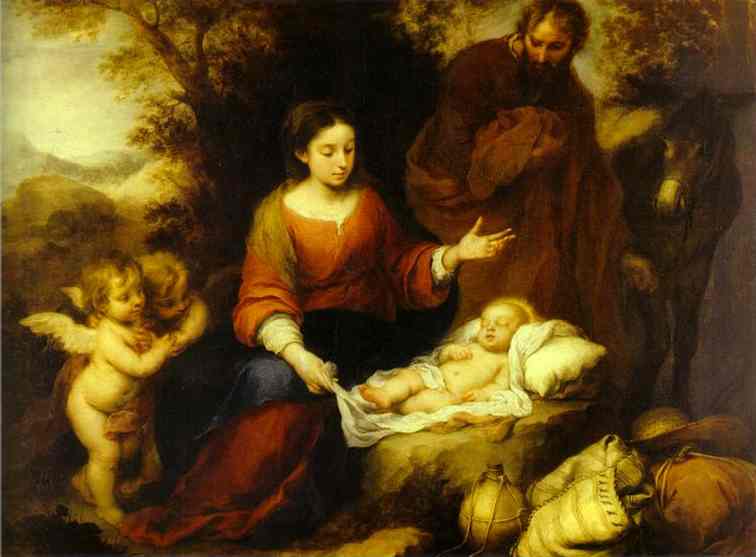
“The Rest on the Flight into Egypt” by Bartolome Esteban Murillo presents an intimate pause in one of the most dramatic episodes of the New Testament. Painted in 1665, the work captures the Holy Family as they briefly stop during their escape from King Herod’s persecution. Rather than focus on terror, urgency or hardship, Murillo chooses a moment of tenderness and quiet blessing. The painting is filled with warm light, soft colours and gentle gestures that transform a narrative of danger into an image of consolation.
Murillo was one of the leading artists of the Spanish Baroque and a central figure of Seville’s artistic life. His religious paintings were prized for their humanity, emotional immediacy and luminous atmospheres. In this work, all these qualities are clearly visible. The artist uses light, composition and expressive faces to draw the viewer into a story that feels both sacred and deeply human, as if we were witnesses to a real family resting along a dusty road.
Composition and General Layout
The composition unfolds across a horizontal format. On the left, two small angels embrace each other while gazing adoringly at the Christ Child. At the center, the Virgin Mary sits on the ground beside a rocky outcrop that serves as a makeshift cradle. She gently extends her hand over the sleeping baby, a protective and almost conversational gesture, as if presenting him to the world while also shielding him. On the right stands Joseph, half in shadow, hands folded in reverence and concern. Behind him, the head of the donkey is visible, reminding us that the journey is ongoing.
The scene is anchored by a diagonal that runs from the angels on the left, through Mary’s red and blue garments, to the reclining Christ Child on the rock and then up toward Joseph. This diagonal guides the viewer’s eye smoothly through the narrative. Despite the many elements, the composition is balanced and serene. The large mass of Mary’s body and her red dress dominates the center, while the angels and Joseph create smaller visual groups that echo the central theme of devotion.
Murillo frames the group with trees and soft foliage that form a natural canopy above the family. The landscape opens in the background to distant hills and a pale sky. This setting gives the story a sense of place, suggesting an ordinary countryside road, yet the soft haze and golden light hint at a supernatural atmosphere.
The Humanity of the Holy Family
One of Murillo’s strengths lies in his ability to humanise sacred figures without stripping them of their spiritual dignity. In this painting, Mary appears as a young woman dressed in simple but rich garments. Her head is slightly bowed, her gaze focused on her child with calm affection. There is no rigid solemnity in her posture. She seems relaxed, almost like any mother resting during a long journey, yet the gentle curve of her hand over the sleeping baby reveals her awareness of his significance.
The Christ Child is depicted as a plump, peaceful infant, asleep on a pillow laid atop the rock. His body is bathed in light, drawing attention to him as the central focus of the painting. The folds of the cloth beneath him echo the swaddling clothes of traditional Nativity scenes, linking this moment of travel to his earlier birth in Bethlehem. His vulnerability emphasizes the precariousness of the family’s situation, but his serenity also suggests divine protection.
Joseph stands behind them, slightly off to the side, yet his presence is crucial. Clad in earthy brown and wrapped in a cloak, he appears as a humble, hardworking man. His hands are joined near his chest, a mixture of prayer and anxious responsibility. Murillo conveys Joseph’s role as protector and provider, while allowing his face to show both fatigue and devotion. The donkey, partly visible behind Joseph, completes the everyday realism of the scene.
Angels as Companions and Witnesses
The pair of small angels on the left adds a charming note of playfulness and devotion. Unlike more formal angels who might hold symbolic objects or heraldic banners, these putti behave almost like children, embracing each other as they gaze at the sleeping Christ. Their presence creates a bridge between heaven and earth. They share the Holy Family’s rest, yet their glowing skin and feathered wings remind us that this is no ordinary family.
The angels also balance the composition. Their light bodies and gentle colours counterweight the heavier forms of Mary and Joseph on the right. The interaction between the cherubs and the child creates a silent chorus of adoration. Without playing instruments or speaking, they proclaim the mystery of the Incarnation simply by their attentive presence.
Light, Colour and Atmosphere
Murillo’s mastery of light is one of the most striking features of the painting. The scene seems bathed in a warm, golden glow that falls particularly on Mary and the child. This light does more than illuminate physical forms. It carries symbolic meaning, suggesting divine grace shining upon the Holy Family even in exile.
The artist uses a soft chiaroscuro that models faces and drapery with subtle transitions between light and shadow. There is no harsh contrast. Instead, forms melt into one another, creating a sense of softness and intimacy. The background trees and sky are painted in muted browns, greens and soft blues, which push them back spatially and focus attention on the figures in the foreground.
Colour plays an important role in identifying the characters and emphasizing their roles. Mary’s robe is a deep red, symbolising love and sacrifice, and her mantle is a rich blue associated with purity and heavenly grace. Joseph is dressed in earthy tones that underline his connection to manual labour and the everyday world. The Christ Child and the angels are rendered with pale, luminous flesh tones, reinforcing their innocence and divine nature.
The overall atmosphere is gentle and contemplative. Although the story behind the image is one of persecution and flight, Murillo chooses to depict a moment of calm. The soft light and warm colours invite viewers to rest alongside the Holy Family, to contemplate rather than fear.
Narrative Detail and Symbolism
Beyond its immediate beauty, “The Rest on the Flight into Egypt” is rich in narrative details and symbolic references. The bags, flasks and bundles at Mary’s feet remind us of the practical necessities of travel. Their worn appearance suggests that the journey has already been long and difficult. These humble objects ground the scene in reality and highlight the couple’s poverty and vulnerability.
The surrounding landscape may seem generic at first, but it contributes to the spiritual dimension of the painting. The path winding into the distance, the gentle hills and the soft clouds evoke a pilgrimage. The family is on the move, guided by God’s will, toward an unknown destination. The natural world appears calm and accepting, as if creation itself offers shelter.
The cherubs at the left can be read as symbols of divine protection. Their tender embrace echoes the protective gesture of Mary’s hand over the child. In visual terms, the painting suggests that Jesus is guarded by human love and heavenly guardians at the same time. The donkey has a long tradition as an emblem of humility and patience. Its quiet presence reinforces the theme of humble faithfulness in the face of adversity.
Finally, the resting moment itself carries symbolic weight. In Christian spirituality, rest during trial often represents trust in God. By showing the Holy Family not in panic but in repose, Murillo encourages viewers to see their own hardships through the lens of faith and divine care.
Murillo’s Devotional Style
This painting exemplifies Murillo’s characteristic devotional style that made him beloved in Spain and beyond. Unlike some Baroque artists who emphasised dramatic gestures or violent contrasts of light and dark, Murillo often preferred a softer, more tender approach. His religious works are filled with faces that are approachable, warm and emotionally engaging.
In “The Rest on the Flight into Egypt”, Murillo avoids theatrical gestures. Mary does not raise her hands or display overt sorrow. Instead, her quiet expression and simple pose invite the viewer to meditate gently. Joseph’s slightly bowed head and clasped hands communicate devotion without exaggeration. The angels’ simple embrace conveys affection more than celestial grandeur.
This moderation makes the painting particularly effective as an object of private devotion. Viewers can imagine themselves present in the scene, sharing the family’s rest and offering their own prayers. The humanity of the figures serves as a bridge to the divine rather than a barrier.
The Painting within Murillo’s Oeuvre
Murillo created several works depicting the Flight into Egypt and the Holy Family in domestic or rustic settings. These themes allowed him to combine his talent for religious narratives with his gift for genre painting and portrait like observation. “The Rest on the Flight into Egypt” belongs to this group and shows how he blended sacred subject matter with an almost everyday realism.
Compared to his earlier and later works, this painting reveals a mature mastery of colour harmony and atmosphere. The soft focus backgrounds and broad handling of light anticipate the Rococo sensibility that would appear in European painting in the following century. At the same time, the strong central grouping and clear narrative ties it firmly to the Baroque tradition.
Murillo’s images of the Holy Family also reflect the Counter Reformation emphasis on accessible, emotionally engaging religious art. The church encouraged painters to create works that would inspire devotion among ordinary people. Murillo’s gentle style, focused on mercy, tenderness and humble piety, perfectly answered this call.
Emotional Impact and Spiritual Message
Emotionally, the painting offers a complex mixture of tenderness, vulnerability and quiet trust. The viewer feels the fatigue of travel, senses the dangers that lie behind and ahead, yet ultimately experiences a profound calm. The mother’s affectionate gaze, the peaceful sleeping child and the watchful angels create an atmosphere of security that seems to defy the external circumstances.
Spiritually, the work invites reflection on themes of exile, migration and divine guidance. The Holy Family becomes a model for all who are forced to leave their homes. Murillo subtly suggests that even in marginal spaces and precarious journeys, grace can be found. The rock that serves as a cradle and altar reminds us that holy ground is not limited to temples or palaces. God’s presence accompanies the humble traveller.
For many viewers, the painting also speaks to the universal experience of family care. Mary’s gesture over the infant, Joseph’s protective stance and the playful angels evoke images of parents and guardians watching over children. In this way, Murillo bridges the gap between biblical history and everyday life.
Conclusion
“The Rest on the Flight into Egypt” is a quintessential Murillo painting, combining gentle religious sentiment with warm realism and luminous colour. Through a carefully balanced composition, humanised sacred figures and a glowing landscape, the artist transforms a story of escape and danger into an image of quiet trust and loving protection.
The painting invites viewers not only to admire the technical skill of its creator, but also to step into the narrative. By emphasising rest rather than flight, Murillo encourages contemplation, empathy and interior peace. The Holy Family appears as close and approachable, sharing the worries and hopes of every family on a difficult journey.
More than three centuries after its creation, this work continues to captivate audiences with its tender mood and subtle storytelling. It remains a powerful example of how Baroque art could combine drama with serenity, doctrine with emotion, and the grandeur of religious tradition with the intimate realities of human life.