Image source: wikiart.org
Entering Nero’s Private Aftermath
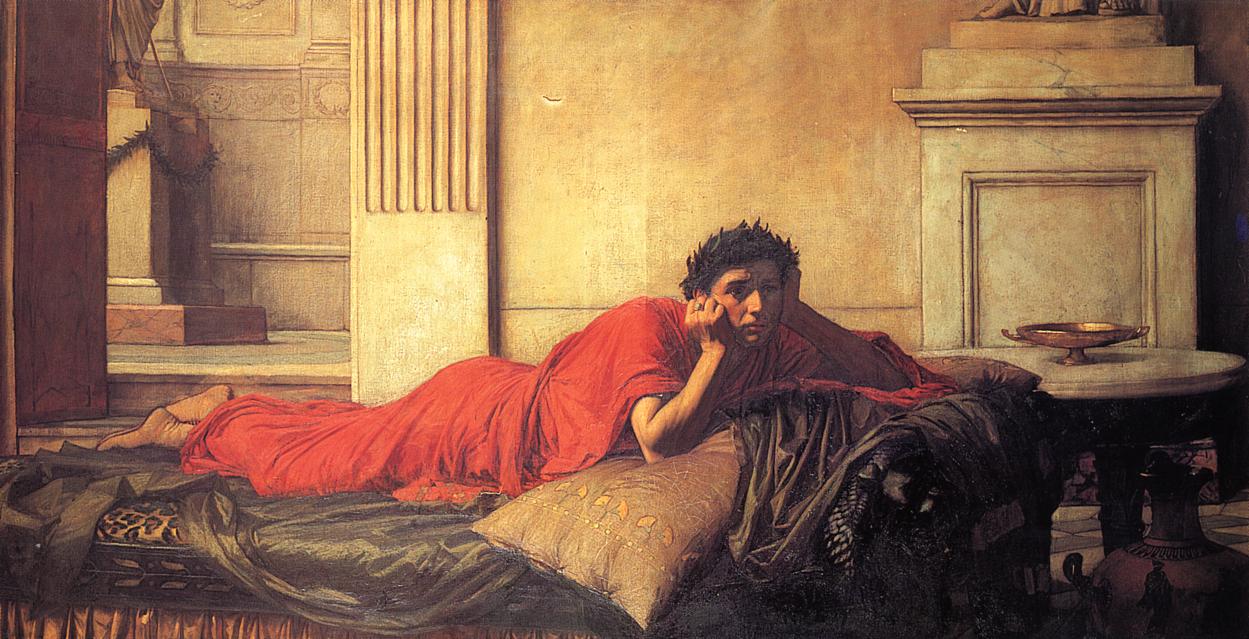
John William Waterhouse’s The Remorse of Nero After the Murder of His Mother (1878) stages a moment that is both intensely personal and brutally political. Instead of showing the murder itself or the public theater of Roman power, Waterhouse chooses the quiet afterward, when action has ended and thought begins to claw back. The result is a psychological history painting: a scene where the drama is not carried by crowds, weapons, or spectacle, but by posture, silence, and the oppressive weight of interior space.
At first glance, the composition feels almost too still. A single figure lies across a low couch, draped in a vivid red garment that dominates the foreground. Yet the longer you look, the more that stillness tightens into unease. The room is monumental but emptied of company, its marble surfaces cool and impassive. The emperor is physically at rest, but his face and hands suggest the opposite, a mind caught in a loop it cannot escape. Waterhouse paints remorse here not as a grand moral lesson delivered from above, but as something corrosive and human, a private sickness that persists even when no one is watching.
The Story Behind the Scene: Nero and Agrippina
The painting’s title points to one of the most infamous familial crimes in Roman history: the killing of Agrippina the Younger, mother of the emperor Nero. Agrippina was not simply a parent; she was a political force, deeply entangled in her son’s rise. Her influence, whether exaggerated or accurately reported by ancient writers, became part of the legend of Nero’s reign: a mother who helped shape an emperor and then became inconvenient to him.
By choosing the word “remorse,” Waterhouse frames Nero not only as a tyrant, but as a man forced to live with the consequences of an irreversible decision. This is crucial. Many depictions of Nero lean toward caricature: the decadent monster, the theatrical egotist, the embodiment of moral collapse. Waterhouse does not deny the darkness of the act, but he suspends the familiar stereotypes long enough to ask a different question: what does it look like when power fails to protect the mind from what it has done?
This focus aligns the painting with a long tradition of artists using antiquity as a mirror for modern concerns. Ancient Rome becomes a stage on which to examine guilt, conscience, and the fragility of self-control. The viewer does not need to be a specialist in Roman history to recognize the emotional premise. A person has crossed a line, and now the world, even in luxurious surroundings, feels narrowed to a single unbearable thought.
Composition as Confinement
Waterhouse builds the scene to feel both open and trapped. The setting is spacious, with large architectural planes and a sense of depth, yet the composition compresses the viewer’s attention toward the figure’s head and hands. Nero lies horizontally across the picture, stretching from left to center, but his face becomes the real focal point. The body is extended as if seeking comfort, while the upper torso props itself up, refusing to fully surrender.
This half-reclining pose is a masterstroke of contradiction. It evokes the traditional lounge of elite Roman leisure, but it is stripped of pleasure. Leisure becomes paralysis. The long line of the red garment reads like a spill across the couch, almost like a stain that cannot be contained. Waterhouse places Nero close to the ground, not elevated, not commanding. Despite the imperial context, the figure looks diminished, pinned by invisible pressure.
The surrounding objects and architecture do not offer narrative distraction. There are no courtiers to interpret his mood, no dramatic gestures to translate emotion into action. The emptiness is part of the meaning. It suggests isolation, but also something harsher: the idea that conscience is a private tribunal, and once it begins, no one else can interrupt it.
Color and Light: Red Against Stone
The painting’s emotional temperature is set by its color structure. The red drapery is the dominant note, saturated and heavy, immediately associated with imperial power, sensual excess, and blood. Against it, the room is composed of pale stone tones, warm-beige and off-white, with subtle shadows that keep the space from becoming theatrical. The contrast is simple but potent: flesh and fabric against marble, heat against cold, the living body against an environment that feels indifferent.
Light falls in a restrained way, illuminating the wall and catching the contours of Nero’s face and arms. There is no dramatic spotlighting. Instead, Waterhouse uses a steady, almost late-afternoon clarity that makes everything feel exposed. This is not the darkness of secret crime; it is the brightness of aftermath, when the mind replays what happened under the harshest internal illumination.
The red garment also does something compositional. It pulls the eye along the length of the couch, then funnels attention upward to Nero’s tense expression. The color becomes a visual path, guiding the viewer from the physical extension of the body toward the mental knot of the face. In that sense, color is not decoration. It is structure.
The Face of Remorse: Expression and Gesture
Nero’s expression is the painting’s psychological engine. Waterhouse paints him with a furrowed brow, heavy-lidded eyes, and a distant, unsettled gaze that does not quite meet the viewer. It feels like the look of someone listening for something that is not there, or fearing something that might arrive. His head is supported by his hand, a classic gesture of melancholy and brooding, but here it reads as fatigue mixed with dread.
The hands matter as much as the face. One hand props the head, the other supports the body, creating a sense of strain. The pose implies that rest is being attempted rather than achieved. Even the way Nero lies suggests that sleep, if it comes at all, will be shallow. The body is on a couch, but the mind is on a ledge.
Waterhouse avoids overstatement. There are no tears, no dramatic grimace. This restraint is what makes the emotion convincing. Remorse, especially after an act of calculated violence, is rarely clean or noble. It can be a grim, stubborn discomfort, a haunting that does not announce itself with theatrical gestures. The painting captures that grimness by showing guilt as something that sits in the muscles and refuses to leave.
Luxury as Accusation: Couch, Textiles, and Objects
The couch and its textiles carry an important secondary narrative. Nero lies on rich fabrics, including a patterned animal skin that signals extravagance and domination over nature. In many classical scenes, such objects reinforce status. Here they become accusatory. The softness beneath him contrasts with the hard reality he cannot soften: comfort exists, but it cannot do its job.
Nearby, a small round table holds a shallow dish, and beneath it sit vessels that suggest domestic routine or ceremonial function. These objects hint at ordinary acts, eating, drinking, offerings, all the small structures that keep life moving. Yet in the context of the scene, they feel strangely irrelevant. The presence of vessels and a dish suggests that life continues, but Nero does not participate. He is stalled.
Even the architectural details, crisp lines, carved panels, stepped platforms, amplify the impression of wealth and order. But order is exactly what remorse disrupts. Waterhouse uses the stable geometry of the room to make Nero’s inner instability more visible. Everything around him is built to last. His calm is not.
Architecture and the Weight of Space
The room is more than a backdrop. It behaves like a psychological pressure chamber. Marble walls and columns evoke imperial Rome, but they also create a setting where sound would echo and emptiness would feel louder. The architecture is rigid, composed, and impersonal, and that impersonality matters. It suggests a world where power is institutional, where the state is made of stone, and where individual feeling is incidental.
By placing Nero in such a space, Waterhouse emphasizes the mismatch between public identity and private experience. An emperor is supposed to be the center of the world, but in this room, Nero is small, almost swallowed by surfaces. The wall behind him is broad and bare, an expanse that reads like a blank sentence waiting to be filled. That blankness becomes a visual metaphor for moral void, or for the silence that follows a crime when applause is impossible.
The steps and thresholds in the background add another layer. They imply passageways, exits, routes to other rooms, perhaps to public spaces. Yet Nero remains where he is. The architecture offers escape, but remorse creates its own locked door.
Painting Remorse Without Showing Ghosts
The title invites the idea of haunting. Ancient accounts of tyrants often include visions, dreams, or supernatural punishment. Waterhouse does not need to paint a literal apparition to make the scene feel haunted. He achieves haunting through absence. The room looks as if it should contain attendants, guards, or servants, but it does not. The emptiness becomes the ghost.
This strategy keeps the painting grounded in human psychology. Remorse here is not delivered by divine intervention. It emerges from within, as if the mind itself has become a tribunal. The viewer is placed in an uneasy position: we become witnesses, almost intruders, looking at a ruler when his defenses are down.
The lack of overt narrative action also slows time. The painting feels like a suspended minute that could stretch into hours. This temporal suspension mirrors the experience of guilt, which can trap a person in repetitive thought. Waterhouse makes time feel sticky, and in doing so, turns a single pose into a full drama.
Waterhouse in 1878: Classical Subject, Modern Sensibility
Although Waterhouse is often associated with later images of mythic women and poetic reverie, this earlier work shows his engagement with classical history painting and academic craft. The handling of drapery, the convincing solidity of architecture, and the controlled light all reflect a painter trained to build believable worlds. Yet the emotional focus feels modern in its intimacy.
Rather than treating antiquity as distant pageantry, Waterhouse uses it as a container for psychological realism. The scene is not about Roman customs as such, but about what it means to live with power and consequence. In that sense, the painting bridges genres. It has the trappings of historical painting, but it behaves like a character study.
The choice to show Nero alone is especially telling. It refuses the usual moral simplicity of crowd scenes where virtue and vice are labeled by collective reaction. Here there is no chorus to tell you what to think. The painting asks you to read the human face and interpret the moral weather for yourself.
Themes of Power, Conscience, and Self-Destruction
The painting’s central irony is that Nero appears surrounded by the evidence of dominion, yet utterly conquered. This is a portrait of power’s limits. Political authority can command armies and rewrite laws, but it cannot undo an act once done. It cannot silence memory. It cannot guarantee sleep.
Remorse in this context is also a kind of self-destruction. The body is present, intact, alive, but the mind is eroding. Waterhouse suggests that the punishment for the crime is not only external, rebellion, scandal, historical infamy, but internal: the corrosion of inner stability. The emperor becomes his own captive.
The red garment can be read as both imperial and violent, a sign of status and a reminder of blood. Draped over a figure that looks tired and frightened, it becomes a costume that no longer fits. This mismatch suggests a deeper theme: tyranny is often performed, and guilt is what happens when performance collapses.
A Quiet Moral, Left Open
What makes the painting enduring is its refusal to close the story. Waterhouse does not show repentance leading to redemption, nor does he show remorse leading to justice. He shows a man stuck in the immediate aftermath. The moral question is left open: is this remorse a sign of humanity, or merely discomfort at consequences? Is it pity we feel, or satisfaction that guilt has arrived?
The painting allows multiple readings because it is emotionally precise but ethically ambiguous. That ambiguity is appropriate to the subject. History rarely offers clean moral arcs, and tyrants are not exempt from human feeling. Waterhouse paints Nero as culpable and troubled, powerful and afraid. The viewer must sit with that contradiction, just as Nero sits with his.
In the end, the room remains silent, the objects remain still, the marble remains indifferent. Only the mind moves, restlessly, inside a body that cannot find a position comfortable enough to escape what it knows.