Image source: wikiart.org
Introduction
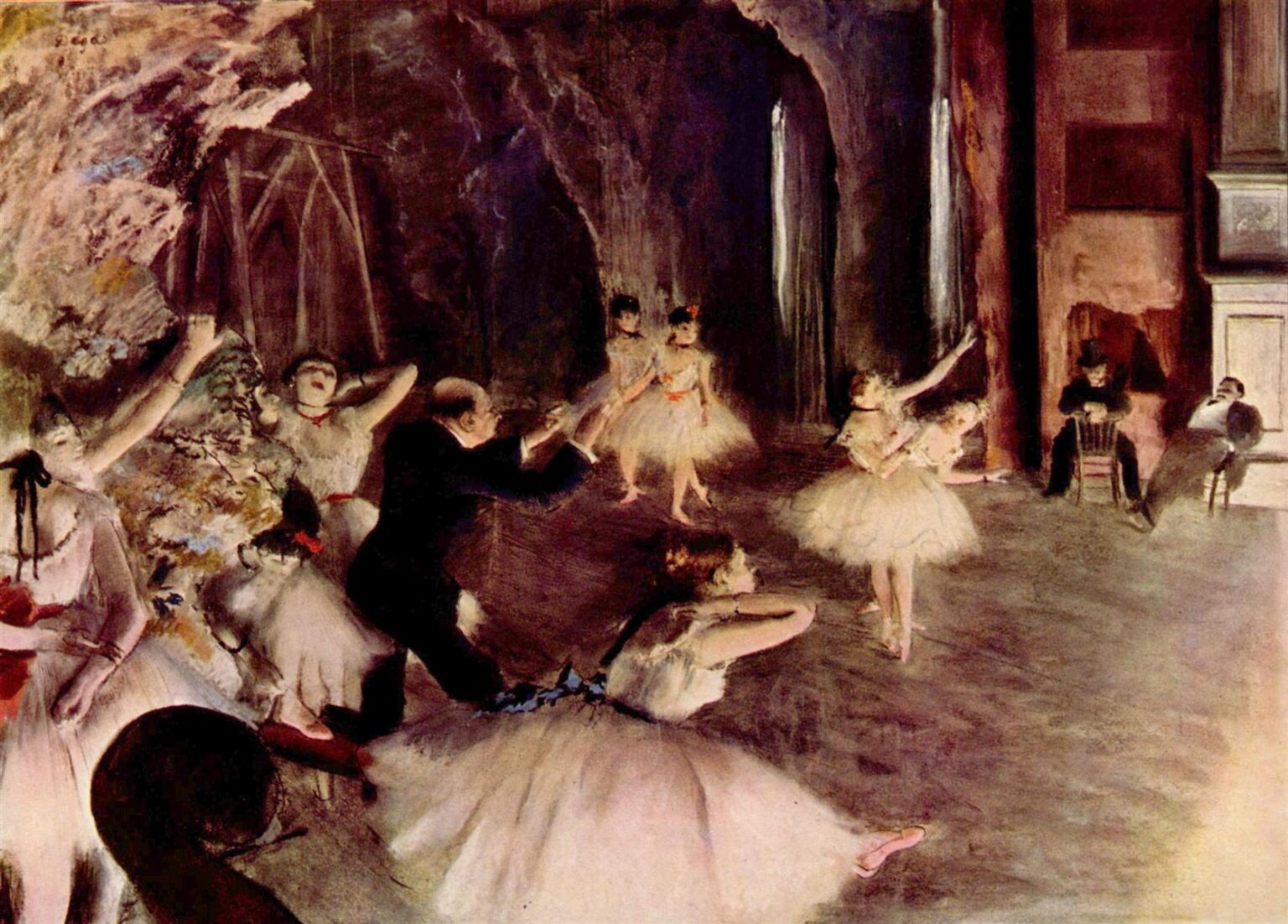
Edgar Degas’s The Rehearsal of the Ballet on Stage from 1874 is one of the clearest examples of how he transformed the subject of modern Parisian life into something psychologically rich, formally daring, and visually unforgettable. At first glance, the painting seems to offer a simple glimpse behind the scenes of the ballet. Young dancers in pale tutus gather on stage while a ballet master appears to direct or correct them. The space feels informal, unfinished, and full of motion. Yet the longer one looks, the more complex the picture becomes. This is not just an image of performance. It is an image of preparation, discipline, fatigue, observation, hierarchy, and fleeting beauty.
Degas was fascinated by the world of the Paris Opera and returned to it again and again. He painted dancers not simply because they were graceful, but because they allowed him to explore the body in motion, the effects of artificial light, and the tension between elegance and labor. In this painting, he avoids the polished glamour of a final staged production. Instead, he captures an in-between moment, when rehearsal exposes the hidden structure beneath spectacle. The dancers are not posed as idealized ornaments. They stretch, wait, turn, adjust, and listen. This makes the scene feel alive, even intimate, while still retaining a certain emotional distance.
What makes this painting especially compelling is its combination of looseness and control. Degas creates an atmosphere that seems spontaneous, yet every placement, every cropped figure, and every patch of light contributes to a sophisticated design. The result is a painting that feels both immediate and carefully composed, both airy and crowded, both beautiful and slightly uneasy.
Historical Context and Degas’s Interest in Ballet
By 1874, Degas was deeply engaged with themes drawn from contemporary urban life. Although he is often grouped with the Impressionists, his artistic concerns were somewhat different. He shared their interest in modern subjects and unconventional compositions, but he was less focused on landscape and changing outdoor light than on interiors, figures, and structured pictorial design. The ballet gave him an ideal subject because it brought together movement, modern entertainment, class structure, and the visual challenge of bodies caught in transitional states.
The Paris Opera in the nineteenth century was not merely a place of art. It was also a social institution shaped by money, status, desire, and display. The dancers occupied a complex position within this world. They were admired publicly for refinement and beauty, yet their training was physically demanding and their professional environment was governed by strict discipline. Degas understood this tension and built much of his ballet imagery around it. Rather than presenting dancers only as icons of grace, he showed them rehearsing, resting, waiting, and enduring the repetitive labor that made performance possible.
This perspective gives The Rehearsal of the Ballet on Stage much of its force. It belongs to a broader modern artistic interest in scenes of work, but Degas applies that interest to an arena that viewers often associated only with fantasy and pleasure. He strips away illusion without destroying beauty. In doing so, he creates a vision of modern life that is more truthful than theatrical.
Composition and Spatial Drama
One of the most striking features of the painting is its unusual composition. Degas does not organize the scene around a central, balanced focal point in the traditional academic manner. Instead, he scatters figures across the stage and arranges them in a way that feels fragmentary and open-ended. Some dancers are fully visible, others are partially cropped, and still others recede into the dim background. This creates the impression that the scene continues beyond the edges of the canvas.
The left side is crowded and active, filled with layered figures, tilted poses, and a sense of compression. Tutus overlap, arms extend, and bodies interrupt one another. In contrast, the right side opens into a broader sweep of stage floor, giving the composition breathing room while also directing attention toward the ballerina standing near the front. This asymmetry is essential to the painting’s energy. It prevents the image from becoming static and instead makes it feel as though the viewer has entered the scene in the middle of an unfolding rehearsal.
The perspective is equally important. Degas places us at a slightly oblique angle, not squarely in front of the stage but off to one side, as if we are witnessing the rehearsal from a privileged yet informal vantage point. This diagonal view emphasizes depth and lets the eye move across clusters of figures rather than settle immediately on a single protagonist. Even the background, with its shadowed stage architecture and vertical openings, contributes to a sense of layered space. The stage becomes less a flat platform than a lived environment filled with movement, interruption, and uneven attention.
This compositional approach shows Degas’s originality. He was influenced by photography and Japanese prints in the way he embraced cropping and off-center arrangements, but he transformed these influences into something entirely his own. The painting feels modern because it does not present the world as neatly ordered for the viewer’s convenience. It feels observed rather than staged.
Movement, Gesture, and the Body in Transition
The central subject of the painting is not performance itself but the body in rehearsal. Degas focuses on dancers in transitional moments, when movement is being practiced, corrected, or suspended. This is why the painting feels more revealing than a formal ballet scene. The dancers are not unified into one harmonious pattern. Each seems to exist within her own moment of effort or pause.
A figure near the front bends slightly and lifts an arm toward her neck. Another raises her arms above her head in a gesture that may be part stretch, part habitual adjustment. A dancer toward the right seems poised on her toes, while others in the middle distance wait for instruction or drift through the stage space. These varied gestures create a rhythm of tension and release. Some bodies are extended, others relaxed. Some are active, others nearly inert. Degas turns rehearsal into a study of physical intelligence.
The ballet master, dressed in darker tones, plays a crucial role in this structure. His presence introduces authority and direction. He is not merely another figure among many. He is the organizing force within the rehearsal, the one around whom correction and repetition revolve. His dark silhouette contrasts strongly with the pale dancers, making him stand out visually while also reinforcing the hierarchy of the scene. He embodies discipline in a world that spectators might otherwise see only as delicate and decorative.
What makes the painting especially subtle is that movement is never fully resolved. Degas captures the instability of transition. No gesture seems final. Nothing is frozen into a polished pose. The result is a vivid sense of life unfolding in real time. The dancers are becoming, not simply being.
Light, Color, and Atmosphere
Degas’s handling of light in this painting is remarkable for its atmospheric ambiguity. The stage is illuminated, but not evenly. Light appears to fall across the dancers and the floor in soft, shifting passages, leaving some areas glowing and others receding into shadow. This creates a theatrical environment that is luminous without becoming crisp or sharply defined.
The color palette is built around creamy whites, blush pinks, warm browns, muted reds, and smoky grays. These tones give the painting a warm, dusty, almost velvety quality. The tutus catch the light and form floating clouds of pale color, while the darker backdrop and surrounding architectural elements add weight and depth. Degas avoids strong, pure color contrasts. Instead, he relies on nuanced tonal relationships that make the painting feel unified and atmospheric.
The whites of the dancers’ costumes are especially important. They do not read as flat or simple white. Degas enriches them with pink, beige, lavender, and gray, allowing the tutus to shimmer subtly within the interior light. This sensitivity to color variation helps preserve the material presence of fabric while also enhancing the dreamlike quality of the scene.
At the same time, the darker sections of the painting are never merely empty. The shadowed background pulses with reddish and brownish tones, suggesting stage scenery, curtains, or architectural recesses without fully describing them. This uncertainty adds to the sense that the rehearsal takes place in a half magical, half practical world. It is a workplace, but it is also a theater, and Degas lets both realities coexist in the paint surface itself.
Brushwork and the Sense of the Unfinished
Part of the painting’s modern power comes from its brushwork. Degas does not smooth every form into polished finish. In many passages, the paint looks loose, sketch-like, and alive. This is particularly visible in the backdrop, where strokes seem to flicker and dissolve, and in some of the dancers, whose outlines remain soft or partially broken. Such handling gives the painting an improvisational quality that suits the subject of rehearsal.
This does not mean the work is careless. On the contrary, Degas controls this looseness with precision. He knows where to define and where to suggest. Certain faces are barely indicated, while a hand, a skirt edge, or a foot may receive just enough emphasis to anchor the figure. This selective focus mirrors the act of looking itself. In a busy rehearsal, one does not perceive everything equally. Degas paints attention as it moves, lands, and shifts.
The unfinished quality also has thematic meaning. Rehearsal is, by definition, incomplete. It is a process aimed toward a future performance. Degas’s brushwork reflects that state of incompletion. The painting feels in progress because the scene it depicts is in progress. This harmony between subject and technique is one of the reasons the work feels so convincing.
Moreover, the visible brushwork prevents the image from becoming sentimental. The dancers are lovely, but the paint keeps reminding us that this is an interpretation, a construction, a record of observation transformed by artistic intelligence. Degas gives us beauty, but never easy prettiness.
The Human Reality Behind the Spectacle
A major reason Degas’s ballet paintings continue to resonate is that they reveal the human reality behind public performance. In The Rehearsal of the Ballet on Stage, the dancers are not idealized into anonymous symbols of grace. They are working bodies. They wait, they repeat, they listen, they stretch, and perhaps they tire. Even when their faces are only lightly rendered, their physical presence is undeniable.
This honesty changes the emotional tone of the picture. There is beauty here, certainly, but there is also effort and structure. The stage is not only a place of enchantment. It is also a place of training and surveillance. The dancers occupy a disciplined environment shaped by instruction and expectation. Degas’s decision to paint a rehearsal rather than a formal performance brings these realities to the surface.
At the same time, he does not turn the scene into social protest or harsh critique. His vision is more nuanced. He is drawn to the visual poetry of rehearsal even as he acknowledges its labor. The result is a painting balanced between admiration and observation. He seems captivated by the dancers, yet he does not romanticize them completely. That tension is central to his art.
The painting also invites reflection on spectatorship. We are looking at dancers who are themselves being watched and directed. This layered structure of observation makes the viewer aware of the act of looking. We do not simply consume a performance. We witness the making of one. Degas thus shifts the viewer from passive spectator to active observer.
Why the Painting Still Feels Modern
More than a century after it was painted, The Rehearsal of the Ballet on Stage still feels strikingly modern. Part of this comes from its composition, which rejects rigid symmetry and embraces cropping, imbalance, and immediacy. Part comes from its psychological tone, which is subtle rather than theatrical. But perhaps most of all, its modernity lies in the way it values the transitional and the ordinary.
Traditional art often elevated finished moments, heroic actions, or idealized states. Degas, by contrast, finds meaning in the unfinished, the peripheral, and the unposed. He understands that modern life is often experienced not in climactic moments but in fragments, pauses, routines, and glimpses. Rehearsal, with its mixture of repetition and anticipation, becomes a perfect emblem of that condition.
The painting also feels modern because it resists simple interpretation. It is beautiful, but not conventionally glamorous. It is observational, but not detached. It is full of movement, yet its mood is oddly suspended. This complexity keeps the work alive for contemporary viewers. It does not flatten into a single message. Instead, it continues to open outward into questions about art, labor, femininity, performance, and perception.
Conclusion
The Rehearsal of the Ballet on Stage is one of Edgar Degas’s most compelling explorations of the ballet world because it captures far more than dancers in costume. It reveals a system of practice, discipline, and observation while preserving the fragile allure of theatrical light and movement. Degas turns rehearsal into a subject worthy of serious art, and in doing so, he redefines what beauty in modern painting can be.
The painting’s power lies in its balance of opposites. It is graceful yet unsentimental, atmospheric yet structured, spontaneous in appearance yet carefully composed. Its cropped figures, shifting light, and varied gestures create a world that feels both immediate and layered. We sense the beauty of the ballet, but we also sense the work behind it. We see performance not as a finished illusion, but as a fragile construction built through effort and repetition.
This is why the painting remains so memorable. Degas does not merely show dancers. He shows the unstable boundary between art and labor, spectacle and reality, elegance and exhaustion. He finds poetry in preparation itself. That achievement gives The Rehearsal of the Ballet on Stage its lasting significance and explains why it continues to stand as one of the most insightful images of modern artistic life.