Image source: wikiart.org
Introduction
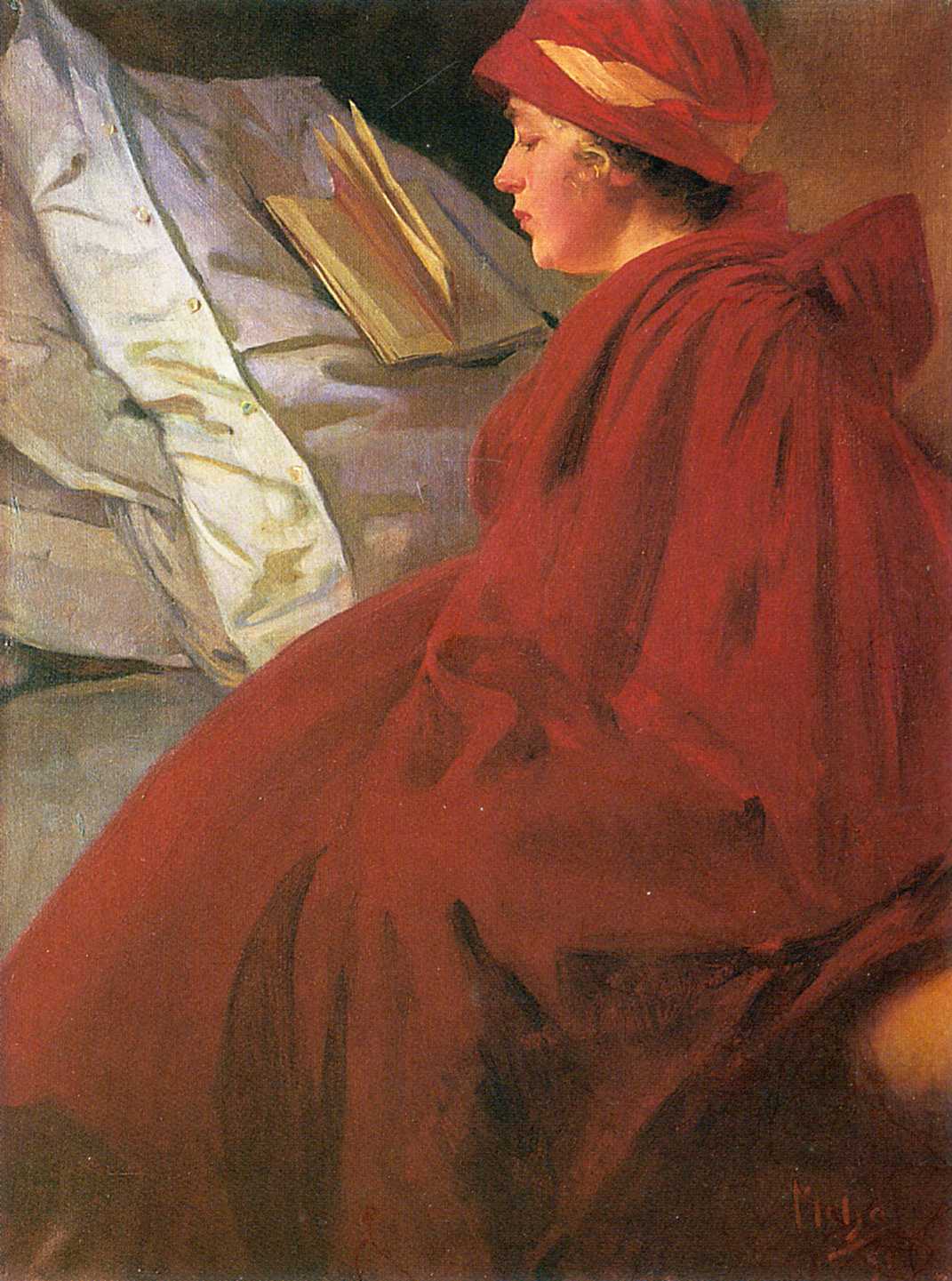
Alphonse Mucha’s “The Red Cape” from 1902 is an intimate painting that invites viewers into a quiet, domestic interval: a figure wrapped in a voluminous scarlet garment sits in profile beside a bed, her attention drifting toward an open book propped on the rumpled white sheets. The picture seems at first disarmingly simple—a seated woman, a book, a bed—yet the longer one looks, the more carefully orchestrated the experience becomes. The block of saturated red gathers the eye; the pale bedding and small wedge of pages provide a counterpoint; the profile’s calm sets the emotional temperature. Rather than the public theater of his famous posters, Mucha chooses a hushed room and a single moment of concentration. The result is a lyrical meditation on color, light, and the inwardness of reading at the height of the Belle Époque.
Historical Context and Position in Mucha’s Oeuvre
Painted in 1902, “The Red Cape” belongs to a period when Mucha, celebrated in Paris for his Art Nouveau posters and decorative cycles, increasingly explored subjects beyond commercial commissions. The work shows him experimenting with a painterly language adjacent to, but distinct from, the linear elegance of his lithographs. Instead of framing an emblematic heroine with arabesque borders, he locates a private sitter in an unadorned space. The red garment may recall the draperies of his allegorical figures, yet here the decorative impulse becomes volumetric paint. “The Red Cape” therefore expands the public persona of Mucha the poster master to include Mucha the observer of interiors, capable of translating the spirit of the age into quiet scenes of contemplation.
Composition and the Architecture of Calm
The picture’s structure is a triangle formed by the sitter’s body, the bedding, and the open book. Mucha places the figure to the right, cropped tightly so that the cape’s mass becomes a sweeping wedge from lower left to upper right. The bed descends diagonally across the left half of the painting, a cool plane punctuated by buttons that rhythmically step toward the book. That book, set near the compositional center, acts like a hinge between the red and the white. The sitter’s profile aligns with the book’s spine, creating an axis of attention. Cropping is crucial: the absence of floor, wall, or window narrows the world to the immediate—the warmth of fabric, the coolness of linen, the page’s promise. The viewer experiences proximity, as if seated on a chair just beyond the frame, watching time slow.
Color and the Emotional Temperature of Red
The painting’s most striking feature is the cape’s red, modulated from deep maroon in the shadows to an almost vermilion highlight along the upper folds. Mucha uses this chromatic field not merely to adorn the figure but to establish an atmosphere. Red in this context suggests heat, privacy, and the protective cocoon of clothing in a quiet room. It is not the theatrical red of a stage curtain but the lived red of a thick garment, dense with paint and weight. Against it, the bedding reads as cool silver-blue, and the pages as a warm ocher, creating a triad that keeps the composition vibrant without noise. The harmony rests on temperature rather than hue alone: warm flesh, warm paper, and warm red sit forward, while the cool white recedes, producing depth through chromatic conversation.
Light, Shadow, and the Quiet Drama
Light enters from the right, sliding gently across the sitter’s cheek and nose before catching the cape’s higher ridges. The shadows are tender rather than harsh, allowing the profile to merge softly with the surrounding red. On the bed, the light becomes cooler and more diffused, and Mucha uses brushstrokes to describe the creases and depressions left by a body. These broken strokes articulate the tactile sensation of linen and give the book a platform. The drama arises not from strong contrasts but from the way light organizes attention—first to the face, then to the book, then to the flowing garment. The illumination reads as natural, perhaps late afternoon or morning, when thoughts broaden and the world inside a room feels self-sufficient.
The Psychology of Reading
Although the sitter’s eyes are not depicted, the posture and proximity to the open book tell the story of absorption. Reading is more than an activity; it is a psychological state that the painting captures through stillness and orientation. The figure turns inward, chin lowered slightly, shoulders relaxed beneath the enveloping cape. The book’s angle suggests it was set down for a moment of reflection, or that a companion nearby was invited to read aloud. Mucha refrains from adding narrative props—no clock, window, or additional objects—to keep the mental act at the center. The picture thus celebrates the modern, private habit of reading as a form of autonomy and repose, consonant with the era’s burgeoning literacy and cultivated interiors.
Fabric, Texture, and the Painterly Turn
Mucha built his reputation on sinuous outlines and ornamental borders; here he lets paint carry the design. The cape’s surface is a study in brushwork, with broader, sweeping applications describing the garment’s mass and finer touches articulating folds near the bow at the back. The cloth feels substantial, its weight conveyed through the way it pools onto the lap and hides the body’s exact contours. In contrast, the bedding is constructed from quick, angular strokes, allowing creases to sparkle like facets. The difference in textures—dense red drapery, crisp white linen, papery book leaves—animates the canvas and demonstrates Mucha’s sensitivity to materials without resorting to decorative patterns. This painterly approach brings him into dialogue with contemporaries who sought to reinvigorate figuration through the sensuous handling of paint.
Edges, Contours, and the Discipline of Drawing
Even as the painting favors broad masses, Mucha’s draftsmanship remains firm. The sitter’s profile is locked with a sure contour that defines nose, lip, and chin in one continuous sweep. The silhouette of the cap and the oversized bow at the back of the cape provide counter-shapes that anchor the form. Many edges are softened, especially where shadow and garment meet, but at key junctures—nose against background, page edges against bedding—Mucha tightens the boundary to secure the composition. This alternation between soft and hard edges guides the viewer’s gaze without brute force. It also suggests the quiet breathing of the scene: where edges dissolve, time seems to loosen; where they sharpen, attention gathers.
Space, Scale, and the Intimacy of the Interior
By cropping the figure close and limiting visible furnishings, Mucha condenses spatial cues into a few essentials: the bed, the pillow, the book. There are no distant walls or architectural features to pull us away. Scale is inferred from the size of the book relative to the head and hand; it appears to be a modest volume, perhaps a novel, its smallness contributing to the sense of intimacy. The depth from viewer to sitter is shallow, fostering a personal closeness devoid of voyeurism. The painting thus becomes a chamber piece, a visual equivalent of a short musical work performed in a small room, relying on tone and phrasing rather than bombast.
Symbolic Meanings of the Cape
The cape functions on multiple levels. Practically, it is a garment for warmth. Visually, it is the compositional engine, gathering the picture into a single chromatic body. Symbolically, it suggests shelter and self-possession. Capes and shawls in turn-of-the-century imagery often signal the thresholds between public and private. Here the cape is emphatically private; it envelops rather than displays. Its sheer scale relative to the figure calls to mind the protective cocoon of thought that reading supplies. The bow at the back adds a note of ceremony, as if the domestic act were elevated to quiet ritual. While Mucha’s posters sometimes invested clothing with erotic glamour, the cape in this painting confers dignity and calm.
The Headscarf, Profile, and the Poise of Silence
The scarlet headscarf, tied simply and accented with a lighter band, frames the sitter’s face without ornament. Mucha’s choice of profile avoids the direct confrontation of a frontal portrait and the flirtatiousness of a three-quarter gaze. The profile is classical, typifying restraint and clarity. A few loose curls escape near the ear, softening the geometry. The lips are closed, the nostril delicately lit, the eyelid implied rather than carved. Everything in the head’s presentation contributes to a mood of thoughtful quiet, as if speech would be an interruption. The viewer is not addressed; one is allowed to witness someone else’s moment of interiority.
The Book as Modern Accessory
The book occupies a modest but pivotal role. Propped open on the bed, it tilts toward both light and reader, the pages catching a soft gleam. Books in paintings of this era often function as indicators of education, self-culture, and leisure. Here the book is unbranded, its title hidden, which prevents the scene from collapsing into illustration of a specific text. Instead, it stands for reading itself—the modern habit of making time for oneself. Its placement on the bed underscores the permeability between work, leisure, and rest at the turn of the century, when the bedroom was increasingly imagined as a private sanctuary for reflection as well as sleep.
Comparison with the Language of Mucha’s Posters
Viewers familiar with Mucha’s posters may expect flat, decorative fields and ornate borders. In “The Red Cape,” the border dissolves and the flatness gives way to subtle modeling. Yet the relationship between this canvas and the posters is intimate. The flowing contour of the cape echoes the whiplash curves of his decorative frames; the profile silhouette recalls the iconic profiles of actresses featured in his lithographs. What changes is the purpose: rather than projecting a brand or mythic role, the figure here inhabits a real moment. The painting demonstrates Mucha’s versatility—his ability to translate a signature linear poetry into fully realized flesh, cloth, and light.
European Currents and Artistic Kinship
The canvas participates in a broader European interest in interiors and intimate moments. Painters in France, the Netherlands, and Scandinavia had, in different registers, explored the psychology of quiet rooms and the play of light on domestic surfaces. Mucha’s approach aligns with this trend while retaining the decorative intelligence that made his art distinctive. The composed profile and monumental drapery suggest a memory of Renaissance portraiture, while the free brushwork over bedding edges toward Impressionist handling. The synthesis feels neither derivative nor programmatic; it is the work of an artist fluent in multiple languages who chooses, for this subject, a restrained blend.
Technique and the Craft of Atmosphere
The painting’s atmosphere arises from deliberate technical choices. A warm ground seems to underlie much of the surface, allowing reds to glow from within rather than sit chalky on top. Glazes deepen the shadows in the cape without turning them opaque, so the garment breathes. In the bedding, scumbled paint produces soft transitions that evoke cotton’s loft. The edges of the book’s pages are laid in with a few crisp strokes—efficient enough to persuade, simple enough to avoid fussy detail. Such economy is the privilege of mastery: the fewer marks needed to describe a thing, the more unified the whole. The technique supports the mood rather than competing with it.
Narrative Possibilities and Open Meanings
The painting resists a single story. Is the figure reading to another person in the bed, now stepped away? Is she visiting a convalescent? Is the book a private escape before sleep? Mucha gives just enough clues to keep interpretations alive—the impression of a body’s absence in the creased sheets, the informal placement of the book, the sitter’s composed attention. This openness allows viewers to project their own experiences with reading and rest. Rather than closing down meaning, the image invites participation, turning the viewer into a quiet co-author.
Gender, Leisure, and Domestic Modernity
At the fin de siècle, the domestic interior became a site where modern identities were negotiated. “The Red Cape” locates a woman within that space not as an object of display but as a subject absorbed in thought. Her leisure is not idle; it is purposeful concentration. The generous garment rejects the logic of tight corsetry and display, asserting comfort and autonomy. In this way the painting aligns with a subtle shift in representation: a move away from public spectacle toward private agency. Mucha, often associated with ornate femininity in advertising, here grants his sitter a presence defined by inwardness.
Material Culture and Sensory Memory
The painting operates as a catalogue of sensations familiar to early twentieth-century domestic life: the cool slide of buttons on linen, the rustle of pages, the warmth of a thick wrap against the skin. Viewers may recall similar experiences—curling into a garment on a chilly morning, leaving a book open to a passage that lingers in the mind, watching light ruffle the bed as day begins. Mucha’s achievement is to distill those sensations into a single, balanced image where color and form activate memory without sentimentality.
The Discipline of Restraint
Perhaps the most modern aspect of “The Red Cape” is its restraint. There is no ornamental border, no enticing patterned wallpaper, no vase of flowers or secondary scene through a window. The entire canvas depends on a few large relationships: red to white, curve to plane, profile to page. Such reduction requires confidence. It also represents a kind of ethical commitment to the subject’s dignity; nothing distracts from her quiet occupation. In this way the canvas reveals the depth of Mucha’s command. He can do more with less, and the result is a painting that feels timeless rather than merely fashionable.
Legacy and Contemporary Resonance
More than a century after it was painted, “The Red Cape” continues to resonate because it honors a universal human activity—reading—and the small sanctuaries where it occurs. Its color harmonies remain persuasive, its handling of fabric and light as pleasurable as ever, and its compositional discipline a lesson for painters and designers alike. For admirers of Mucha’s posters, the painting opens another door into his sensibility; for those new to his work, it offers a subtle introduction that foregrounds mood over spectacle. In an era saturated with images clamoring for attention, the canvas models a different tempo: attentive, generous, and unhurried.
Conclusion
“The Red Cape” shows Alphonse Mucha at his most reflective. The painting replaces the grand theater of Art Nouveau with the intimate theater of a single room. Through a bold red garment, a gently lit profile, and a humble book, Mucha composes a monument to inwardness. The canvas does not need overt symbolism or narrative twists to hold the gaze; its power lies in the coherence of its parts, the humanity of its subject, and the palpable pleasure the artist takes in the fall of light on cloth and paper. It is a picture to live with, the sort that deepens through repeated looking, each viewing another page in a book that never quite ends.