Image source: wikiart.org
History Erupts In A Kitchen
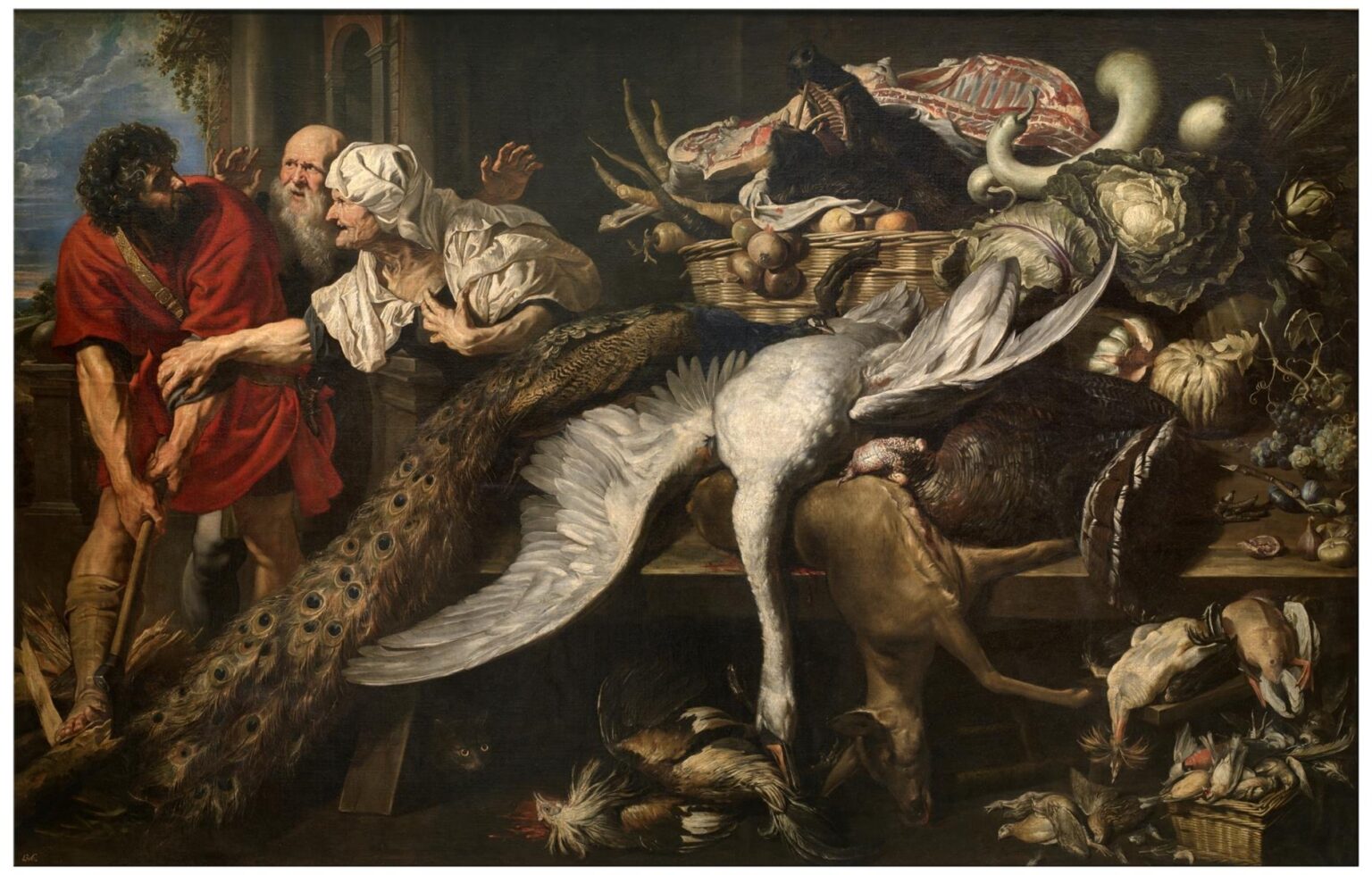
Peter Paul Rubens’s “The Recognition of Philopoemen” turns an ancient biography into a Baroque thriller staged in the most unexpected of theaters: a bustling kitchen overflowing with game, vegetables, and butchered meat. At the far left a weathered soldier in a red tunic is seized by the forearm; an elderly man peers past him in alarm; and a sharp-eyed housekeeper lunges forward, her mouth half-open as she recognizes the stranger. She has just intuited that the rugged diner is no ordinary traveler but Philopoemen, the celebrated Greek general, who—according to Plutarch—once entered a tavern incognito and was discovered by the quick wit of a woman among the staff. The setting lets Rubens fuse two genres he adored: the heroic history piece and the sumptuous still life. The result is a canvas where narrative urgency slices through a mountain of meticulously painted food, and where a single, electrifying gesture can be as gripping as the gleam on a swan’s wing.
A Narrative Compressed To The Split Second Of Discovery
Rubens selects the story’s most cinematic instant: the moment recognition happens. Nothing has yet been resolved—no banquet has commenced, no honors bestowed—yet everything is already decided. The woman’s thrusting torso and pointed chin shout the news before the words arrive; the startled elder raises his hands; the soldier in red resists slightly, unsure whether to accept the naming or retreat deeper into anonymity. That hesitation gives the scene its tensile strength. The viewer stands inside a suspended breath, watching a private identity become public against a clatter of kitchen life.
A Kitchen That Works Like A Stage
The tabletop groans under peacocks, swan, turkey, a deer carcass, baskets of grapes and squash, cabbages, and a saw-toothed jaw of butchered meat. These are not marginal props; they are protagonists in their own right. By laying this tidal wave of provisions between the viewer and the figures, Rubens turns the table into a proscenium. The crowding produces depth without linear scaffolding: objects pile forward and sideways, creating aisles of shadow that push our eye back to the human drama. The still life does not distract from the story; it conducts it, amplifying the sense of abundance from which recognition wrests our attention.
Collaboration In Spirit Between History And Still Life
The painting reads like a dialogue between grand narrative and virtuosic object painting. The feathering of the peacock’s tail—eye-spots picked out one by one, each ringed with metallic greens—converses with the leathery grain of the deer’s hide and the damp satin of the swan’s collapsed wing. Brassiness on poultry feet alternates with the dull nap of cabbages and the varnished sheen of gourds. Rubens’s ability to grant persuasive substance to every surface gives the story its credibility; if the food feels real to the hand, the moment of recognition feels real to the heart.
Baroque Composition Driven By Diagonals
The canvas is organized by surging diagonals that cross in the middle distance. From left to right runs the powerful line of the soldier’s forearm, the housekeeper’s thrusting shoulder, and the long spine of the peacock. Cutting it is the great diagonal of the swan, falling head-down off the table so that its neck becomes a curved pointer toward the corner where game birds tumble. These diagonals are not abstract scaffolding; they are emotional vectors. The living energy of the figures—reaching, grabbing, naming—skids across the inert weight of provisions that sluice toward the viewer. Motion meets mass, like a shout ringing through a storeroom.
Chiaroscuro That Carves Figures From Plenty
Light falls in sheets across the scene, breaking into pools on the white headwrap of the housekeeper, the red tunic of the soldier, and the pale plumage of the swan. Behind them a dim architecture and a wedge of sky keep the tonal spectrum broad enough to breathe. The contrasts are theatrical but never gratuitous. The brightest lights crown the agents of recognition—forehead, knuckles, cloth—while the darker tones cradle the mountain of food, allowing it to read as volume rather than chaos. The eye snaps first to the faces and hands because the light has decided they matter most.
Gesture As The Engine Of Plot
Rubens writes the story in hands. The housekeeper’s left hand hooks the soldier’s forearm, not in violence but in insistence, as if to arrest the flow of anonymity. Her right elbow wings outward, vaulting her torso toward the revelation. The old man behind raises both palms in an instinctive warding motion, his expression toggling between incredulity and delight. Most eloquent is the soldier’s wrist: flexed and corded, it holds a tool or cudgel loosely, suggesting the in-between state of one who has not yet decided whether to play along or pull away. In these wrists and fingers we read the entire arc of recognition—suspicion, assertion, and the slow consent of a humbled hero.
A Chorus Of Animals That Comment On The Drama
The still life “speaks” to the human action in sly ways. The peacock, emblem of worldly glory, lies gorgeous but lifeless, its closed eye a mute reminder that true honor is not in plumes. The swan with drooping neck acts like a white exclamation mark, punctuating the woman’s cry. The glistening turkey breast, the dangling hare, and the spilled basket of birds mutter about mortality and disguise: once creatures of motion, now “incognito” as food. A cat’s eyes glint from the shadow under the table, alert to opportunity, a familiar of kitchens and secrets. None of these signals devolves into heavy allegory; they are more like quiet asides, deepening the scene’s atmosphere.
Color As A Map Of Energy
Rubens organizes the palette as if conducting an orchestra. On the left he strikes a trumpet note of saturated red in the soldier’s garment, then surrounds it with quieter, earthier chords—brown beard, tanned forearm, gray masonry—to keep the red from blaring. Across the table the whites of linen and plumage call and respond to one another, while cool greens of cabbage and peacock eyes stabilize the warm cascade of meat and fruit. The color does narrative work: heat gathers where the revelation erupts; calm, nutritious greens and stone grays reassert order among provisions.
The Psychology Of Recognition
Recognition is more than naming; it is a moral act that reorganizes relationships in an instant. Rubens catches its psychology with tenderness. The woman is not contemptuous; she is bright with the delight of true perception. The old man’s lifted hands are not scolding; they are marveling, as if to say, “Can it be?” The soldier’s face is not fear but wary acceptance, a veteran aware that public identity brings obligations. In their interplay of expressions Rubens avoids caricature and instead proposes recognition as a form of charity—the accurate seeing of another person for who he is, even when concealed.
The Radical Choice Of Setting
Why put a Greek hero in a kitchen? Because kitchens condense the world’s realities: hunger, labor, abundance, waste, sharp tools, and urgent timing. They are social crossroads where gossip circulates and hierarchies tilt. In this space, the general’s greatness is measured not by a battlefield but by how he carries himself amid ordinary people. The housekeeper’s knowledge counts as much as a soldier’s scars. Rubens, ever attentive to the dignity of work, lets pots and produce surround the protagonists without shame. History here is not remote; it is as near as the next meal.
Space Built By Piling And Pushing
The depth of the composition arises from virtuosic overlapping. Feather rides on fur, skin on cloth, cabbage against wicker, until the eye falls into pockets of shadow beneath the table. There, small still-life vignettes—a basket of birds, a scatter of grapes—serve as stepping stones back into the picture. The figures at left push forward hard enough to almost exit the frame, a Baroque tactic that converts viewers into participants. The sense is of stepping aside to let the revelation pass.
Sound Implied By Surface
We hear the painting as well as see it. One can almost catch the rasp of the housekeeper’s headwrap against her ear, the bruised thud of a swan wing on wood, the whisper of the peacock tail sweeping the floor, the half-muttered exclamation of the old man, the scrape of the soldier’s staff. Rubens generates these acoustics through the descriptive richness of surfaces and the way edges collide. The kitchen is alive with minor noises, so that the spoken recognition lands like a bright chord atop an orchestral rumble.
The Moral Of Appetite And Fame
A mountain of food risks becoming a monument to appetite, yet the story keeps it from gluttony. The general is “recognized” in a place of consumption, and the peacock, ancient symbol of pride, is already destined for the spit. Rubens thus folds a gentle moral into the spectacle: worldly display ends up on the chopping block; true worth reveals itself in humility and service. Philopoemen’s incognito visit to a rough place becomes an emblem for leadership that can dwell among common things without losing dignity.
The Anatomy Of Work
The housekeeper’s body is one of the great achievements of the picture. Her back bends like a drawn bow; tendons string her neck; sleeves balloon with air, then crease down into bunched linen at the wrists. This is a body that has carried baskets and stirred kettles, now channeling its strength into an intellectual feat—recognition. The soldier’s calves knot beneath the red tunic; his feet, dirty and sturdy, plant on split logs. Rubens refuses to idealize these bodies into marble; he keeps them credible so their actions will matter.
Plutarch Through A Baroque Lens
Rubens does not illustrate antiquity archaeologically; he translates it. Architecture and costume mix classical hints with contemporary textures. The bearded elder could be a philosopher or a kitchen steward; the red tunic straddles Roman and rustic. Instead of pedantry, Rubens aims for psychological truth—the shock and joy of knowledge grounded in the senses. The Baroque swaps textbook accuracy for lived immediacy, and that exchange makes the old story new.
Pictorial Intelligence In The Smallest Details
Watch how the white of the headwrap finds cousins across the canvas—the swan, the gourd, the cabbage heart—so that the eye leaps like a stone across stepping-whites. Note how grape clusters echo the peacock eyes, round within round. Observe the cat’s eyes in the low dark, a tiny counter-recognition that mirrors the woman’s keen sight. Even the sliver of blue sky at far left is strategic; it keeps the tonal range open, preventing the room from turning claustrophobic and giving the drama a breath of air.
An Image Of Seeing That Sees Us Back
The painting ultimately meditates on perception itself. The housekeeper recognizes the hero; the animals seem to watch the humans; the cat watches everything; and we, who arrive as voyeurs of a still life, are ourselves recognized by the picture’s intelligence. It meets our desire for spectacle with abundance but then redirects it toward understanding. We come for the peacock; we stay for the moment a human name is rightly spoken.
Why This Picture Feels So Modern
Despite its antique subject, the scene feels contemporary because it honors local knowledge, quick wit, and the drama latent in everyday work. It understands that big events happen in small rooms and that truth often enters through the kitchen door. Rubens dignifies the labor that makes culture possible—the chopping, cleaning, carrying—and into that texture he drops a spark of history. The gesture that arrests the soldier’s arm lights the whole canvas like a struck match.
Conclusion: Recognition As Rubensian Art
“The Recognition of Philopoemen” is one of those Rubens inventions where everything the artist loved is present at once: thunderous human action, a carnival of textures, light that judges and delights, bodies that strain and speak, and a story where the moral is carried by a glance and a grip. The painting proves that the grand style can thrive amid cabbages and carcasses, that truth can be shouted over a laden table, and that the most sumptuous still life can serve a moment of piercing human clarity. We leave the picture not just impressed by painterly bravura but freshly sensitized to the instant when perception becomes knowledge.