Image source: wikiart.org
Introduction
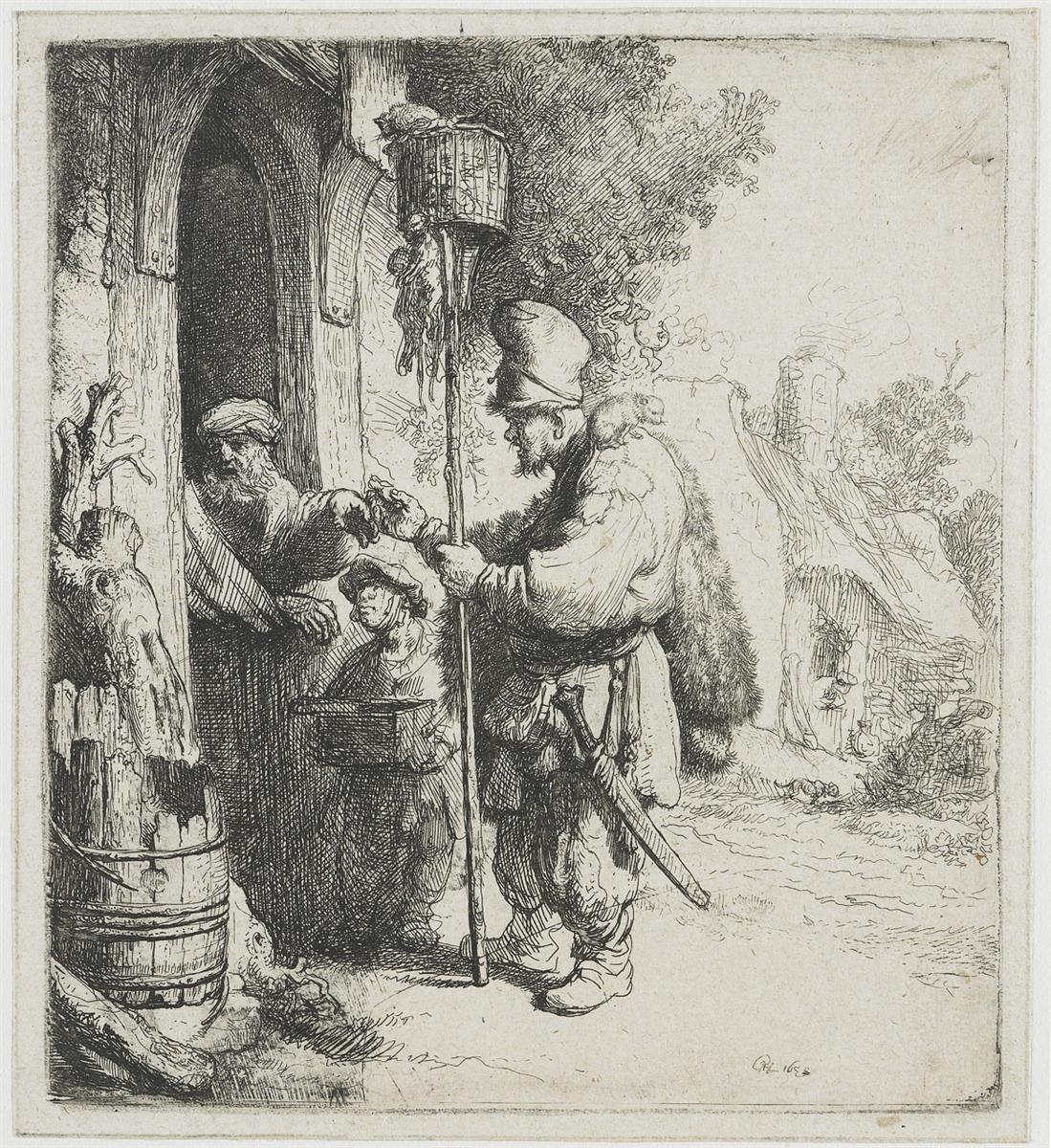
Rembrandt’s “The Rat Poison Peddler (The Rat Catcher)” of 1632 is a small etching that feels startlingly large in human insight. An itinerant vendor leans toward the threshold of a cottage, a long pole topped with a wicker trap balanced in his hand. A householder reaches from the doorway to exchange coins for a remedy, while a boy assistant cradles a box of wares and watches the bargain. The space is shallow, the gestures plain, and yet the entire scene breathes with social tension, curiosity, and wry humor. The print belongs to Rembrandt’s early Amsterdam years, when he was redefining what a genre subject could achieve. It converts everyday commerce into a theatre of character, and it does so with nothing more than bitten lines on a copper plate and the drama of light pulled from paper.
Historical Context
The year 1632 was a hinge in Rembrandt’s career. He had recently moved from Leiden to Amsterdam, a city flush with mercantile wealth and hungry for pictures that mirrored its life. Alongside grand commissions such as “The Anatomy Lesson of Dr. Nicolaes Tulp,” he produced etchings that explored street types, beggars, hucksters, scholars, and families. These sheets satisfied a thriving market for small collectible images while granting the artist freedom to improvise. In the Dutch Republic, where civic pragmatism and moral reflection often met, portrayals of itinerant tradesmen functioned as both documentary records and ethical prompts. The rat catcher or poison peddler was an especially resonant figure: a necessary servant of public health during a period when vermin were linked to filth, crop loss, and epidemic fear, but also a suspect outsider whose livelihood depended on infestation. Rembrandt taps that ambivalence and turns it into art.
Subject and Social Meaning
The rat catcher belongs to a family of European imagery that includes tooth pullers, quacks, and street vendors, figures who hovered at the edge of respectability. They offered real services yet carried a whiff of deception. Here the peddler’s long staff, heavy boots, and layered clothing mark him as a traveler. His basket-trap and dangling carcasses speak to gruesome expertise. The householder’s posture—reaching out with coins while remaining safely within the doorway—signals caution. The boy’s presence adds another layer: is he apprentice or exploited child, witness or accomplice? The etching records a transaction and simultaneously asks what kinds of exchange knit a community together and what kinds keep its members apart. Money crosses the threshold, but trust only partly does.
Composition and Staging
Rembrandt designs the image around the architectural frame of the doorway. A vertical stone jamb on the left and a barrel at the corner anchor the foreground; the dark interior behind the householder forms a shadowed stage into which the peddler leans. The tall pole thrusts upward to a basket where a small animal perches, extending the composition into the upper register and puncturing the canopy of leaves. The line of sight moves in a shallow zigzag: from the money in the two men’s hands up the staff to the trap, then back down to the boy’s box and across to the low cottage and chimney that recede into the distance at right. This zigzag enlivens an otherwise static exchange, making the viewer’s eye mimic the wary, scanning attention of the figures themselves.
The Threshold as Moral Theatre
Doorways in Rembrandt are not merely architectural conveniences; they are conceptual devices. The threshold separates private interior from public exterior, household order from itinerant risk, known from unknown. In this print, the householder extends his hand across that line but keeps his body planted inside, a choreography that dramatizes negotiation. The peddler, by contrast, stands fully in the open. He brings the problem—the reality of rats and the promise of their removal—right up to the limit of domestic safety. The tension between interior and exterior creates the scene’s moral electricity. It is a lesson in boundary management as much as in pest control.
Characterization Through Gesture
The sheet is small, yet each figure is individualized through posture and handwork. The peddler’s back bends forward with practiced insistence; his right hand, large and calloused in line, cups to receive or present. The householder’s hand reaches with hesitating exactness, thumb and forefinger pinching coin. The boy tilts his head upward, his body concealed behind the open box he supports, half eager and half intimidated. Rembrandt does not caricature. He registers differences in age and station through subtle economies of line: a peaked cap here, a baggy sleeve there, the different weights of cloth. The result is a quiet psychological triangle in which intention, suspicion, and curiosity intersect.
The Peddler’s Tools and the Iconography of Vermin
The long staff crowned with a wicker basket is both prop and emblem. It is practical—a portable cage or container for traps—and theatrical, a sign that announces trade before the salesman speaks. Rembrandt has fun with it, letting a small animal sit atop the container and another limp from a string. The motif sets a rhythm of verticals along the staff and horizontal interruptions along the basket rim, a grid of survival strategies made visible. The sword or long knife at the peddler’s side complicates the character further, perhaps a standard traveler’s defense, perhaps a hint at roughness. The barrel lashed to a dead tree in the left foreground and the distant tumbled cottage at right expand the world beyond the transaction: this is a landscape where wood rots and chimneys smoke, where pests flourish and livelihoods depend on keeping them at bay.
Light, Line, and Tonal Design
As in his finest etchings, Rembrandt organizes light by controlling the density and direction of hatch. The darkest passages collect in the doorway and under the peddler’s cap, creating a pocket of shadow from which hands and faces emerge. The middle tones of clothing and foliage are woven from crisscrossing strokes that turn with form, while the ground and distant house are left lighter, their paleness functioning as the air of the scene. Where the paper remains nearly untouched—upper right sky, the sweep of the path—light floods in, allowing the figures to pop without harsh contrast. The viewer experiences a truthful daylight and, more importantly, a truthful moral daylight in which nothing is wholly concealed.
Texture and the Pleasures of Observation
Rembrandt’s line distinguishes wood from cloth, leather from foliage, stone from flesh. The barrel’s staves show firm verticals; the boy’s cap is a soft tangle; the peddler’s heavy coat hangs with weight and weather. The tree stump at left is a virtuoso knot of bark and decay, a reminder that the artist loved drawing the life of materials as much as the life of people. The tactile feast is not gratuitous. It grounds the ethical tension in a convincing world. We believe in the pressure of the coin and the scratch of the rats because we believe in the texture of everything else.
Humor, Suspicion, and the Edge of Satire
There is a smile in this print, though it is a cautious one. The peddler’s elaborate staff and fur-lined attire border on the ridiculous, turning him momentarily into a self-made herald bearing the coat of arms of pest control. The householder, craning from his fortress of a doorway, appears both shrewd and a little gullible. The boy, hidden behind his box like a clerk behind a counter, is comically earnest. Rembrandt’s humor never becomes cruelty. He lets the scene remain ambiguous. Perhaps the poison works. Perhaps the peddler is an honest craftsman. Perhaps the householder is overpaying for false promises. The ambiguity is the point: human transactions are fragile and often negotiated under unequal knowledge.
The Boy Assistant and the Education of Looking
The child’s role deserves emphasis. He stands at the center, physically lower yet morally elevated as witness. His face is sketched with minimal lines, his eyes angled upward. He learns from what he sees: how to hold goods, how to watch hands, how to measure tone. The print thus doubles as an allegory of apprenticeship, not only for trades but for vision itself. Viewers, like the boy, are asked to notice—how coins pass, how authority postures, how evidence and promise are displayed. In that sense the sheet is also about Rembrandt’s own craft, which trains its audience to see the ethics in ordinary posture.
The Householder and the Politics of Home
The figure within the doorway embodies the politics of home in a market society. He must decide what to admit and what to exclude, when to spend and when to doubt. His head bends, his shoulder pushes forward, yet his feet are safe behind the sill. The attitude captures a common civic dilemma in the Dutch Republic: openness to trade coupled with vigilance against contagion, whether physical or moral. The rat catcher is a liminal helper who keeps the interior safe by confronting the exterior’s dangers. The householder buys security while refusing closeness. Rembrandt encodes this psychology in the simple geometry of the pose.
Landscape, Community, and the Wider World
Beyond the exchange, a path leads to another cottage, smoke curling from its chimney. Trees cluster around roofs, and a low wall or hedge breaks the ground. The background is brief yet eloquent. It tells us that this transaction is not unique. Neighbors elsewhere fight the same vermin and face the same choice about whom to trust. The world of the print is thus a network of doorways, each with its own negotiations. The rat catcher’s staff doubles as a signpost pointing from house to house; he is a moving axis along which the village calibrates its boundaries.
Comparisons with Related Images
Rembrandt’s fascination with humble figures appears across his early prints—beggars leaning on crutches, street musicians, peddlers of ribbons or remedies. Compared with more overtly satirical depictions by contemporaries, his treatment is gentler and more observational. He does not sermonize. Instead he composes a precise visual sentence and asks the viewer to finish it. The strategy anticipates his later group portraits in which action binds individuals into a social narrative. Here the action is small, but the social weave is tight.
Etching Practice, States, and the Life of the Plate
Technically, the plate shows a full range of etched vocabulary: fine parallel strokes to build mid-tones, cross-hatching deepened in subsequent bites for darkness, and open paper for highlights. The long vertical of the staff may have required careful stopping-out to keep its silhouette crisp while surrounding areas were bitten further. Impressions printed with more plate tone would deepen the doorway’s gloom and lend the foliage a smoky presence; cleaner wipings would shift the key toward brightness and sharpen the coin-passing hands. The variability inherent to etching suits a subject about uncertainty. Each impression presents the exchange under slightly different atmospheric conditions, as if the moral weather of the scene changes with the printer’s cloth.
The Print Market and Viewers’ Hands
Small etchings circulated widely in albums and portfolios. They were handled, shown to friends, compared with other impressions, and sometimes annotated. Collectors in Amsterdam, Leiden, and beyond would have recognized the rat catcher as a local type and debated the character of the trade. The sheet invites such talk. It is an image designed for conversation—about risk, trust, craft, and the value of practical knowledge. Its portability means that the ethical theatre of the threshold could unfold at dining tables and shop counters across the Republic, multiplying the scene’s life beyond the single cottage depicted.
Modern Resonance
Although rats no longer menace European households as they once did, the print feels contemporary. We still negotiate with specialists who promise to solve problems we barely understand. We still weigh expertise against suspicion, cost against hope. The staff with its trophy-trap becomes a metaphor for persuasive display, the boy a stand-in for consumers learning how to read a pitch, the doorway a symbol for our guardrails against risk. Rembrandt’s etching endures because it treats commerce as a human drama rather than a neutral transaction.
Conclusion
“The Rat Poison Peddler (The Rat Catcher)” demonstrates how Rembrandt used modest means to render the intricacies of social life. Composition turns a cottage doorway into a stage; line and light sculpt character; textures build a world we can smell and touch. Ambiguity, rather than moralizing, powers the image. We do not know whether the poison will work or whether the price is fair, but we feel the stakes in the press of palms and the tilt of heads. At once humorous and grave, the etching honors the everyday negotiations that keep communities functioning, even as it reminds us to look closely at who benefits from fear and who bears the cost. In a century that prized pragmatism and clarity, Rembrandt found a way to be clear about complexity. A peddler pauses at a door; a coin changes hands; a child watches; and in that small exchange an entire society comes briefly into focus.