Image source: wikiart.org
Mythological Background and Narrative Focus
“The Rape of Proserpina” by Peter Paul Rubens plunges directly into the climactic moment of one of antiquity’s most dramatic myths. In Roman mythology, Proserpina (the Greek Persephone), daughter of the grain goddess Ceres, is abducted by Pluto, lord of the underworld. While she gathers flowers with her companions, the ground splits open, Pluto appears in his chariot, and carries her away to be his queen in the realm of the dead.
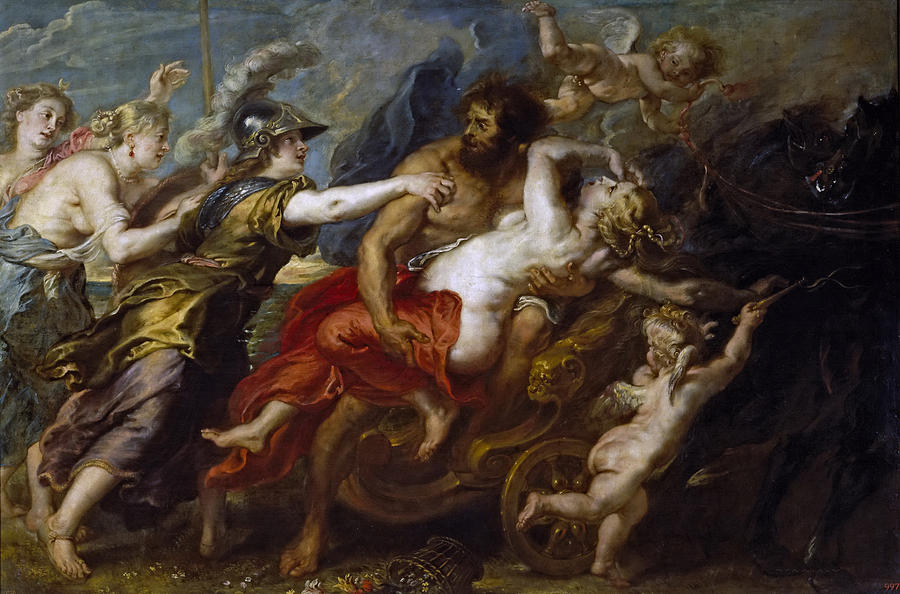
Rubens chooses the instant when the abduction is already underway. Pluto, powerful and darkly bearded, has lifted Proserpina into his chariot. Her body arches violently backward, arms flung out in resistance, while terrified companions race after them, grasping at her and at the god. Putti hover above and below, and black horses strain at the right edge, about to plunge into a swirling region of smoke and shadow that represents the mouth of the underworld.
This is not a quiet narrative but an image of sudden catastrophe. Rubens uses every device of Baroque painting—twisting forms, sweeping diagonals, crashing color contrasts—to convey the shock, chaos, and terror of the moment when a young woman’s peaceful world is shattered by divine force.
Central Figures: Pluto and Proserpina
At the visual center sits Pluto, the abductor. His muscular torso is turned three-quarters toward the viewer, legs braced as he hauls Proserpina into the chariot. Rubens paints him as a massive, elemental presence: dark hair and beard, tanned skin, red drapery swirling around his hips. He is not an elegant god but a rugged, almost brutal figure, emphasizing the raw power that drives the abduction.
Proserpina, by contrast, is pale and luminous. Her body forms a sinuous curve, from the tilt of her head to the extended legs trailing off the back of the chariot. Rubens’s handling of her flesh is extraordinarily delicate—the soft modeling of shoulders and back, the subtle blush in her cheeks, the golden highlights in her hair. This sensual beauty heightens the emotional charge of the scene: the goddess of spring, symbol of life and renewal, is being dragged toward darkness.
Her expression is a mixture of fear and pleading. One arm reaches out toward her companions, fingers spread in desperate appeal; the other strains against Pluto’s grip. The twist of her torso and the tension in her limbs communicate resistance, underscoring that this is an act of violence and not consent. Rubens does not romanticize the abduction; he shows its physical and emotional brutality in full force.
Companions and the Struggle to Intervene
On the left, three female figures rush toward the chariot, their bodies pressed forward in alarm. The central one wears armor and helmet, with a short tunic, shield, and spear—attributes traditionally associated with Minerva (Athena). Whether Rubens intends her literally as the war goddess or as a personification of protective force, her presence adds an allegorical dimension. She grabs Pluto’s arm with fierce determination, muscles tensed, attempting to wrench Proserpina free.
Behind her, two more women reach out. One clings to Minerva’s shoulder, urging her on; the other stretches her arms toward Proserpina. Their faces show shock and sorrow, hair loose and garments blown by the wind. These companions embody the helpless outrage of witnesses confronted with an overwhelming act of power.
Their movement forms a strong diagonal cutting across Pluto’s roughly opposite thrust. The resulting X-shaped pattern visually enacts the struggle between rescue and abduction, between solidarity and domination.
Horses, Chariot, and the Shadow of the Underworld
At the right edge, almost swallowed by darkness, we glimpse the rearing black horses that draw Pluto’s chariot. Rubens only partially reveals them: flaring nostrils, tense necks, wild eyes glinting from the gloom. The animals seem panicked, as if responding to the god’s violent urgency and the chaos around them. Their energy pulls the composition toward the right, toward the opening of the underworld.
The chariot itself is richly ornamented, with gilded wheels and curving metalwork. Its circular forms contrast with the flailing limbs of the figures, anchoring the scene even as it hurtles forward. Below, near the ground, a small basket of flowers has spilled, petals scattering—an eloquent symbol of Proserpina’s lost innocence and the abrupt interruption of her springtime activity.
Behind the horses looms a swirling mass of smoke and rock, pierced by a red glow. Within this darkness, Rubens hints at monstrous forms—a dog-like head, perhaps a suggestion of Cerberus, guardian of Hades. This indistinct, threatening zone represents the frontier between the sunlit world and the subterranean realm to which Proserpina is being dragged.
Putti and Ambiguous Divine Spectators
Two winged putti hover overhead, and another tiny figure clings to the harness near the horses. These infant spirits—part angelic, part cupid-like—are characteristic of Rubens’s mythological scenes. One above appears to hold the reins or whip, as if assisting Pluto in driving the chariot; another reaches out, perhaps in futile attempt to slow the descent.
Their presence complicates the mood. On one hand, they soften the horror with a touch of decorative playfulness, in keeping with the tastes of Baroque patrons for mythological subjects treated in a painterly, theatrical manner. On the other, their ambiguous allegiances suggest that many forces—desire, fate, divine will—collude in this tragic event. The smallest putto near the horses, trying to restrain them, seems overwhelmed, underscoring the idea that even benign spirits are powerless against the momentum of destiny.
Composition, Diagonals, and Baroque Dynamism
Rubens structures the entire painting around powerful diagonal lines. Pluto’s body leans from left to right, following the thrust of the chariot. Proserpina’s elongated form echoes this direction, while the armored rescuer and her companions push in the opposite diagonal, from right to left. These crossing vectors generate intense visual tension—the eye is pulled back and forth, mirroring the physical struggle.
The ground plane slopes downward toward the right, leading the chariot toward the underworld. Clouds race overhead, their forms sweeping in the same direction. Even the flowing draperies trace arcs that reinforce the sense of wind and speed.
This dynamic composition is quintessentially Baroque: no stable central axis, no calm symmetry, but a turbulent field of forces. The viewer feels drawn into the vortex of action, almost as if standing in the path of the onrushing chariot. Rubens’s mastery lies in controlling this complexity so that the narrative remains legible; despite the chaos, we can clearly read who is doing what and why.
Color, Light, and Emotional Temperature
The painting’s color palette intensifies its emotional tone. Proserpina’s skin is a luminous white tinged with rosy hues, set against the deep red of Pluto’s cloak and the dark, almost smoky background. This high contrast makes her the focal point: she appears as the brightest, most vulnerable element amid darker forces.
The armored companion’s garments shimmer with metallic greens and golds, catching cool highlights that distinguish her from the warmer flesh tones of Pluto and Proserpina. The sea and sky at the far left introduce cooler blues and greys, suggesting the normal world receding behind the figures. As the eye moves toward the right, colors become deeper and more muted, merging into browns, blacks, and smoky purples at the edge of the underworld.
Light plays across the scene in flashes rather than broad, even illumination. It picks out key elements—the gleam of armor, the curve of Proserpina’s back, the muscles of Pluto’s arms, the glossy coats of the horses—while leaving other areas in semi-shadow. This patchy lighting heightens the drama, as if the action were lit by a stormy, fitful sun.
Anatomy, Sensuality, and the Ethics of Representation
Rubens is famous for his robust, voluptuous bodies, and “The Rape of Proserpina” is no exception. The painter’s virtuosity with anatomy is evident in the modeling of muscles, the twisting of torsos, and the articulation of limbs in extreme poses. Proserpina’s body, in particular, is rendered with sculptural clarity: every curve of hip and shoulder, the tension in her neck, the arch of her back.
This sensual depiction is aesthetically powerful but also ethically complex. The myth itself concerns a non-consensual abduction, and the painting does not shy away from its physicality. Rubens presents an image that is simultaneously beautiful as art and disturbing in content. The viewer is confronted with the tensions inherent in much classical mythology, where stories of divine power often involve the suffering of mortals.
Rubens seems aware of this tension. Proserpina’s face is not eroticized but anguished; her grasping hand and twisting body express resistance rather than passive surrender. The companions’ frantic efforts further emphasize that what we witness is an attack, not a seduction. The sensual beauty of the figures becomes a way to make the violence felt more intensely, not to gloss it over.
Landscape, Sea, and the World Left Behind
In the far left background, Rubens includes a glimpse of the sea and shore where Proserpina and her companions were gathering flowers. The water is choppy, reflecting the storm of events, but the scene still reads as part of the familiar, sunlit upper world. A small ship’s mast or pole rises against the sky, a reminder of human civilization and the ordinary rhythms of life.
This background is quickly overshadowed by the rocky outcroppings and smoky clouds that fill the middle and right portions of the canvas. The transition from open sea and sky to cramped, shadowed terrain mirrors Proserpina’s shift from freedom to confinement. The landscape itself participates in the drama: nature becomes an agent of separation, closing behind the chariot as it plunges into the depths.
Allegorical Readings and Baroque Sensibilities
Beyond the literal myth, Rubens’s contemporaries likely understood “The Rape of Proserpina” in symbolic terms. The story had long been read as an allegory of the changing seasons: Proserpina’s descent into the underworld explains winter’s barrenness, and her eventual return brings spring’s renewal. In this reading, the violence of the abduction stands for the harsh necessity of cyclical change, the way life and death intertwine in nature.
For a Baroque audience, the painting might also evoke themes of fate, power, and the vulnerability of earthly happiness. Proserpina, carefree amid flowers one moment, is torn away the next—a reminder of how quickly circumstances can change. Pluto personifies forces beyond human control: death, time, political power, or overwhelming passion. The armored woman’s intervention shows that courage and resistance are noble even when they cannot fully prevent tragedy.
Rubens’s treatment of the myth reflects Baroque fascination with extremes: ecstasy and terror, beauty and horror, movement and stillness. The painting is not a moral lesson in the simple sense but an invitation to meditate on the complexity of human experience under the sway of larger cosmic powers.
Rubens’s Artistic Achievement
“The Rape of Proserpina” showcases Rubens at the height of his ability to orchestrate complex, emotionally charged scenes. He combines classical subject matter with a distinctly seventeenth-century sense of immediacy and drama. The figures have the monumentality of ancient sculpture yet pulse with contemporary energy.
His painterly technique is vigorous and assured. Brushstrokes are visible in clouds and drapery, giving surfaces a lively texture. Flesh is built up with subtle layers of color, from cool underpainting to warm highlights, creating a sense of palpable, living bodies. The composition, though crowded, is carefully balanced: our eye always returns to the central interaction between Pluto and Proserpina, even as we explore secondary details.
In this work, Rubens demonstrates how mythological subjects can address enduring human concerns while also serving as vehicles for artistic virtuosity. “The Rape of Proserpina” remains compelling not only because of its historical or literary associations, but because it captures—through paint alone—the terrifying swiftness with which a life can be upended, the clash between resistance and overpowering force, and the haunting beauty that can exist even in moments of profound violence.